TEL:+86 132 6656 7067




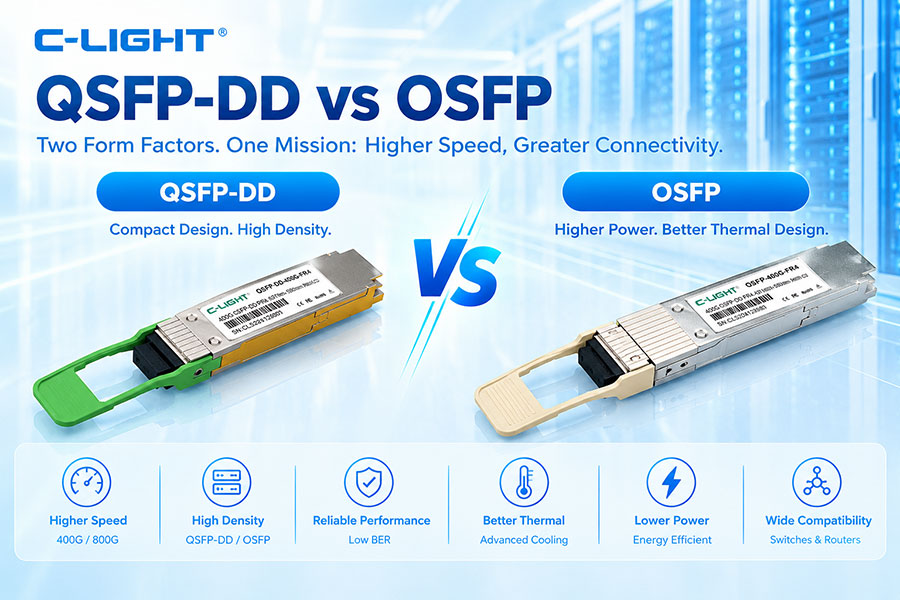
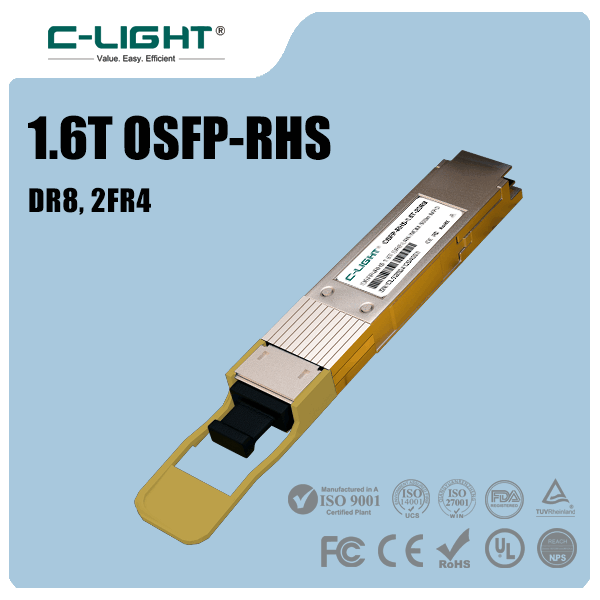
1.6T OSFP and 800G OSFP are two generations of high-speed pluggable optical interfaces designed for data center and AI networking. Both use the OSFP form factor and an eight-lane host electrical interface, but they differ significantly in electrical signaling speed, total bandwidth, thermal requirements, and optical implementation.
The most important distinction is the per-lane electrical rate. 800G OSFP uses eight 100G electrical lanes based on 112G-class PAM4 signaling, while 1.6T OSFP uses eight 200G electrical lanes based on 224G-class PAM4 signaling. This doubles the host-side bandwidth without doubling the number of electrical lanes.
1. What Is 800G OSFP?
800G OSFP is an OSFP-based pluggable interface designed to support an aggregate 800Gb/s host connection.
The OSFP MSA specifies an 800GAUI-8 mode using eight 112G-class electrical lanes, with each lane carrying approximately 100Gb/s. This provides an aggregate host interface of 800Gb/s.
2. What Is 1.6T OSFP?
1.6T OSFP, also referred to as OSFP1600, extends the same general OSFP platform to a 1.6Tb/s aggregate host interface.
It uses eight 224G-class electrical lanes, with each lane carrying approximately 200Gb/s. The higher lane rate is the key enabling technology for doubling the aggregate bandwidth.
3. 800G OSFP vs 1.6T OSFP at a Glance
| Feature | 800G OSFP | 1.6T OSFP |
|---|---|---|
| Aggregate host bandwidth | 800Gb/s | 1.6Tb/s |
| Electrical lanes | 8 | 8 |
| Electrical signaling | 112G-class PAM4 | 224G-class PAM4 |
| Approximate data per lane | 100Gb/s | 200Gb/s |
| Host interface | 800GAUI-8 | 1.6TAUI-8 |
| OSFP form factor | OSFP | OSFP |
| Thermal requirements | High | Higher |
| Typical generation | 800G data center networking | Next-generation 1.6T AI and data center networking |
4. The Most Important Difference: Lane Rate
The easiest way to understand the difference is to look at the electrical lanes.
800G OSFP uses eight lanes at approximately 100Gb/s per lane, while 1.6T OSFP uses eight lanes at approximately 200Gb/s per lane.
Therefore, 1.6T achieves twice the aggregate bandwidth without increasing the number of high-speed electrical lanes from eight to sixteen.
5. 800G Uses 112G-Class PAM4
800G OSFP uses 112G-class PAM4 electrical signaling. The corresponding signaling rate is approximately 53.125 GBd, with PAM4 carrying two bits per symbol.
This architecture represents a major increase in signaling density compared with earlier 50G-class and 100G-class electrical interfaces.
6. 1.6T Uses 224G-Class PAM4
1.6T OSFP moves to 224G-class PAM4 signaling. The OSFP specification identifies an electrical signaling rate of approximately 106.25 GBd.
This effectively doubles the lane bandwidth compared with the 112G-class interface while maintaining the eight-lane OSFP architecture.
7. Why Eight Lanes Remain Important
Maintaining an eight-lane architecture helps preserve the basic electrical architecture of the OSFP platform.
Instead of doubling the number of connector lanes, the industry increases the signaling rate of each lane. This allows higher total bandwidth while retaining the familiar eight-lane OSFP electrical structure.
8. OSFP Form Factor Remains the Same Family
One of the important characteristics of the OSFP roadmap is that the same general form factor can support multiple generations.
The OSFP MSA defines electrical and mechanical specifications for the platform and supports 400G, 800G, and 1.6T generations through different electrical signaling modes.
9. OSFP Does Not Mean a Specific Optical Standard
OSFP is a form factor and interface specification, not a single optical transmission standard.
Different OSFP modules can use different optical architectures, wavelengths, fiber types, modulation or detection technologies, and transmission distances.
Therefore, 800G OSFP and 1.6T OSFP describe the host interface generation, while the optical PMD determines how the actual optical link operates.
10. 800G OSFP Optical Architectures
800G OSFP can support several optical architectures.
Examples include parallel single-mode solutions such as 800G DR8, multimode 800G SR8, and WDM-based solutions such as 800G FR4 and FR8/LR8. The OSFP MSA also defines other optical implementations.
11. 1.6T OSFP Optical Architectures
1.6T OSFP expands the range of possible optical implementations further.
The OSFP specification includes examples such as 1.6T DR8, 1.6T DR4.2, 1.6T SR16, FR4/LR8 architectures, and coherent optical solutions.
This means that 1.6T does not require one single optical architecture.
12. 800G DR8
800G DR8 is an example of a parallel single-mode optical architecture in an OSFP module.
The optical interface uses multiple parallel fibers, with individual optical lanes carrying portions of the aggregate 800G traffic.
13. 1.6T DR8
1.6T DR8 follows a similar parallel-fiber concept but scales the electrical and optical lane bandwidth to support an aggregate 1.6Tb/s connection.
The transition from 800G DR8 to 1.6T DR8 therefore involves much higher electrical and optical signaling requirements even though the lane count remains eight on the host side.
14. 800G SR8
800G SR8 is a short-reach multimode architecture using parallel optical transmission.
It is designed for high-density data center environments where the required link distance is short and multimode fiber can be used.
15. 1.6T SR16
The 1.6T OSFP specification includes a 1.6T SR16 optical architecture.
The use of sixteen optical lanes is an example of how the optical side does not necessarily need to maintain the same lane count as the host electrical interface. The host may use eight 200G electrical lanes while the optical engine distributes the traffic across a larger number of optical lanes.
16. WDM Architectures Remain Important
Both 800G and 1.6T optical modules can use wavelength multiplexing.
WDM allows multiple optical channels to share fewer fibers by assigning different wavelengths to different channels. This can reduce the number of physical fibers required at the network interface.
17. Duplex LC Is Still Possible
High-speed optical modules do not automatically require MPO or another multi-fiber connector.
Depending on the optical architecture, an OSFP module can use duplex LC, dual LC, Mini-LC, MPO-family interfaces, or other supported optical connectors.
This is an important distinction when designing cabling for 800G and 1.6T networks.
18. Electrical Complexity
Moving from 112G-class to 224G-class signaling significantly increases the electrical design challenge.
PCB loss, connector bandwidth, insertion loss, return loss, crosstalk, equalization, package parasitics, and signal integrity become increasingly difficult to manage at higher symbol rates.
19. PCB Design for 800G OSFP
800G already requires careful high-speed PCB design because each electrical lane operates at a very high signaling rate.
The switch ASIC, PCB traces, OSFP cage, connector, module, and associated retimers or signal-conditioning components must work together within the channel loss budget.
20. PCB Design for 1.6T OSFP
1.6T increases these requirements substantially.
At 224G-class signaling, electrical channel design becomes one of the major constraints in the system. Connector performance, PCB materials, package design, channel length, and signal equalization all become more critical.
21. Thermal Requirements
Thermal management becomes increasingly important as module bandwidth increases.
800G modules already require substantial thermal management. 1.6T modules place an even greater emphasis on heat removal because the optical and electrical components must operate at substantially higher speeds.
22. OSFP Integrated Heatsink
The standard OSFP form factor uses an integrated heatsink designed to provide significant thermal capability.
The OSFP MSA documentation identifies the integrated heatsink as a key element of the form factor and specifies thermal performance suitable for high-power optical modules.
23. 1.6T Thermal Challenge
For 1.6T, the thermal design becomes a system-level consideration rather than just a module-level issue.
The switch ASIC, OSFP cage, connector, heatsink, module electronics, optical engine, airflow path, and rack cooling system all need to be considered together.
24. Module Power Consumption
1.6T modules generally require more power than 800G modules because the electrical and optical components operate at higher aggregate bandwidth and more demanding signaling rates.
However, power consumption is strongly dependent on the optical architecture, internal DSP or CDR implementation, laser technology, cooling conditions, and module design.
25. Do Not Compare Power Only by Data Rate
It is not accurate to assume that every 1.6T module consumes exactly twice the power of an 800G module.
Advances in process technology, SerDes design, optical engines, DSP architecture, packaging, and thermal engineering can reduce the power increase associated with higher bandwidth.
26. 800G OSFP and AI Networking
800G has become an important interface generation for high-bandwidth AI and data center networks.
It provides enough bandwidth for high-density switch fabrics while maintaining a practical pluggable architecture.
27. 1.6T OSFP and AI Networking
1.6T OSFP is intended to further increase switch and network port bandwidth as AI clusters require higher aggregate communication capacity.
A single 1.6T port can provide twice the nominal host bandwidth of an 800G port, allowing network designers to increase bandwidth density without proportionally doubling the number of front-panel ports.
28. Front-Panel Bandwidth Density
One of the main reasons for moving from 800G to 1.6T is bandwidth density.
For example, a switch with 32 OSFP ports can theoretically provide 25.6Tb/s of aggregate port bandwidth at 800G per port, while the same number of 1.6T ports can provide 51.2Tb/s.
29. Port Count and Switch Scale
Higher port bandwidth can reduce the number of physical ports needed to achieve a given aggregate switching capacity.
This can influence switch architecture, front-panel density, rack-level cabling, network topology, and overall data center footprint.
30. Breakout Capability
Both 800G and 1.6T OSFP can support breakout architectures when the relevant electrical and optical configurations are supported.
The OSFP MSA defines lane configurations that can divide a high-speed port into lower-speed logical ports.
31. 800G OSFP Breakout
An 800G OSFP host interface can support configurations such as two 400G connections, four 200G connections, or eight 100G connections, depending on the host and optical implementation.
This flexibility is useful during network migration and for connecting equipment with different port speeds.
32. 1.6T OSFP Breakout
A 1.6T OSFP host interface can support configurations such as two 800G connections, four 400G connections, or eight 200G connections.
This creates a straightforward migration path from one high-speed port to multiple lower-speed connections when supported by the equipment and optical architecture.
33. 800G OSFP and 1.6T OSFP Backward Compatibility
The OSFP platform was designed to support multiple generations of high-speed electrical interfaces within the same general form factor.
However, form-factor compatibility should not be confused with automatic operational compatibility. A module and host port must support compatible electrical signaling, management functions, thermal conditions, and optical configurations.
34. Can an 800G Module Be Used in a 1.6T OSFP Port?
Physical insertion capability does not necessarily mean that any 800G module can operate in any 1.6T host port.
The switch hardware and software must support the required electrical mode and module type. Host configuration and platform-specific compatibility also need to be verified.
35. Can a 1.6T Module Run at 800G?
The OSFP electrical architecture supports multiple operating configurations, but whether a particular 1.6T module can operate at 800G depends on its design and the host platform.
Module-level backward compatibility should therefore be confirmed from the manufacturer's specification rather than assumed from the mechanical form factor alone.
36. 800G vs 1.6T Fiber Requirements
The fiber requirements depend on the optical PMD rather than the host speed alone.
An 800G module can use parallel multimode fiber, parallel single-mode fiber, or WDM single-mode fiber. 1.6T modules can use similarly diverse architectures, including higher-count parallel optical interfaces and WDM solutions.
37. Connector Choice
| Architecture | Possible Optical Interface |
|---|---|
| 800G parallel optics | MPO-family, SN/MDC or other high-density interfaces |
| 800G WDM | Duplex LC or related interfaces |
| 1.6T parallel optics | MPO-family or other high-density interfaces |
| 1.6T WDM | Duplex LC or related interfaces |
The exact connector should be selected according to the optical PMD and cabling architecture.
38. 800G OSFP vs 1.6T OSFP for Cabling
At 800G, cabling density is already a major engineering issue. At 1.6T, higher aggregate port bandwidth can make cable routing and connector density even more important.
Designers need to consider fiber count, connector density, bend radius, cable routing, airflow, breakout architecture, and maintenance access.
39. Optical Module Architecture
The internal architecture can vary substantially between different 800G and 1.6T OSFP products.
Some modules may use conventional DSP-based signal processing, while others can use alternative architectures depending on the electrical interface and system requirements. Therefore, OSFP speed alone does not define the internal optical design.
40. 800G OSFP vs 1.6T OSFP Applications
| Application | 800G OSFP | 1.6T OSFP |
|---|---|---|
| AI data center | Widely applicable | Designed for next-generation high-bandwidth networks |
| High-performance computing | Suitable | Suitable for higher-capacity fabrics |
| Switch-to-switch | Yes | Yes |
| Rack-to-rack | Yes | Yes |
| Short-reach parallel optics | Yes | Yes |
| WDM optical links | Yes | Yes |
| Breakout networking | Yes | Yes |
41. 800G OSFP Product Selection
When selecting an 800G OSFP module, check the host interface, optical PMD, transmission distance, fiber type, connector, power consumption, operating temperature, FEC requirements, and host-device compatibility.
For AI and data center applications, cable density and module thermal performance should also be considered.
42. 1.6T OSFP Product Selection
For 1.6T OSFP, electrical compatibility becomes even more important.
In addition to optical parameters, verify 224G-class electrical support, host SerDes capability, connector and cage design, thermal capacity, module power, lane configuration, management interface, and supported breakout modes.
43. 800G vs 1.6T: Core Comparison
| Parameter | 800G OSFP | 1.6T OSFP |
|---|---|---|
| Aggregate bandwidth | 800Gb/s | 1.6Tb/s |
| Host lane count | 8 | 8 |
| Lane bandwidth | 100Gb/s class | 200Gb/s class |
| PAM4 signaling | 112G-class | 224G-class |
| Signaling rate | 53.125 GBd class | 106.25 GBd class |
| Optical architectures | Parallel and WDM | Parallel, WDM and coherent examples |
| Thermal challenge | High | Very high |
| Port bandwidth density | 800Gb/s per port | 1.6Tb/s per port |
44. Conclusion
800G OSFP and 1.6T OSFP belong to the same OSFP family but represent different levels of electrical and optical performance. 800G uses eight 112G-class electrical lanes to provide 800Gb/s, while 1.6T uses eight 224G-class lanes to reach 1.6Tb/s.
The transition to 1.6T is therefore not simply a matter of doubling the optical bandwidth. Higher SerDes rates, tighter electrical channel requirements, increased thermal demands, more advanced optical engines, and new optical lane architectures all become important.
For high-density AI and data center networks, 800G OSFP provides an established high-bandwidth pluggable platform, while 1.6T OSFP extends the same general form-factor concept toward substantially higher port bandwidth density. The correct choice depends on switch ASIC capability, link architecture, transmission distance, optical interface, power budget, thermal design, and deployment requirements.
 >
>

 >
>
 >
>
 >
>
 >
>
 >
>
 >
>
 >
>