C-LIGHT telephone TEL:+86 132 6656 7067    

Language
C-LIGHT search
TOSA vs BOSA>
By C-LIGHT Marketing 丨
TOSA and BOSA serve different roles inside optical communication equipment: TOSA handles optical transmission, while BOSA combines transmitting and receiving functions for bidirectional communication over a shared fiber.
ROSA vs BOSA>
By C-LIGHT Marketing 丨
ROSA focuses on optical reception, while BOSA integrates transmission and reception in one assembly, making the two components suited to different transceiver, BiDi and PON architectures.
TOSA vs TO-CAN>
By C-LIGHT Marketing 丨
TOSA defines an optical transmitter sub-assembly, while TO-CAN describes a compact hermetic package used to house optical devices such as lasers and photodiodes, making them different concepts within transceiver design
TO-CAN vs COB>
By C-LIGHT Marketing 丨
TO-CAN and COB represent different approaches to optoelectronic integration, with TO-CAN emphasizing enclosed device packaging and COB mounting bare optical dies directly on a substrate for compact optical assemblies.
COB vs COC vs COSA>
By C-LIGHT Marketing 丨
COB, COC and COSA describe different levels of optical integration: COB mounts dies directly on a board, COC uses a dedicated carrier, while COSA integrates key coherent optical and electronic functions into a compact sub-assembly.
PIN vs APD>
By C-LIGHT Marketing 丨
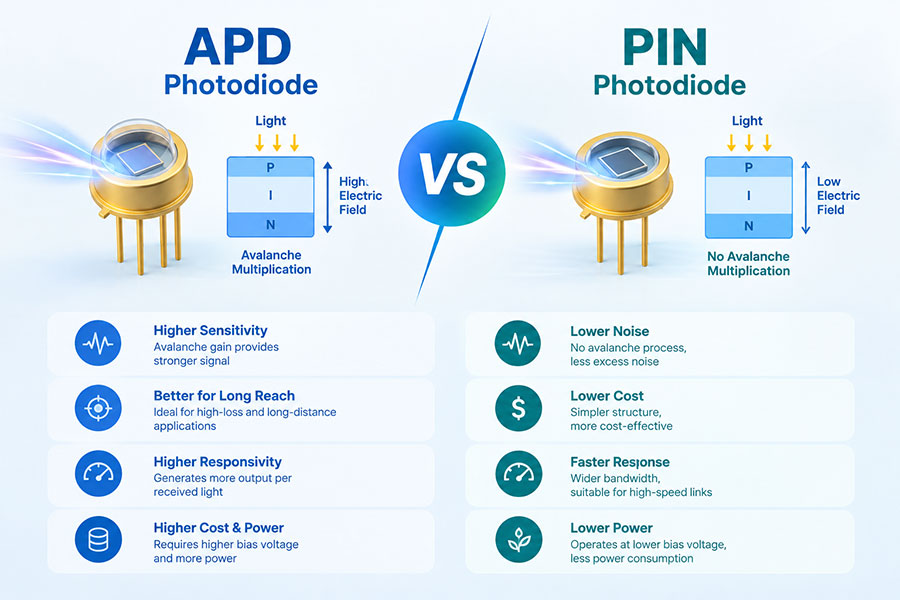
PIN and APD photodiodes both convert optical signals into electrical signals, but APD adds internal avalanche gain for higher receiver sensitivity while requiring higher bias and tighter noise, power and control considerations.
APD vs PIN Photodiode>
By C-LIGHT Marketing 丨
APD and PIN photodiodes use different detection mechanisms, with APD providing internal avalanche gain for weak optical signals while PIN offers simpler biasing, lower noise and easier integration in many optical receivers.
PIN vs APD Receiver>
By C-LIGHT Marketing 丨
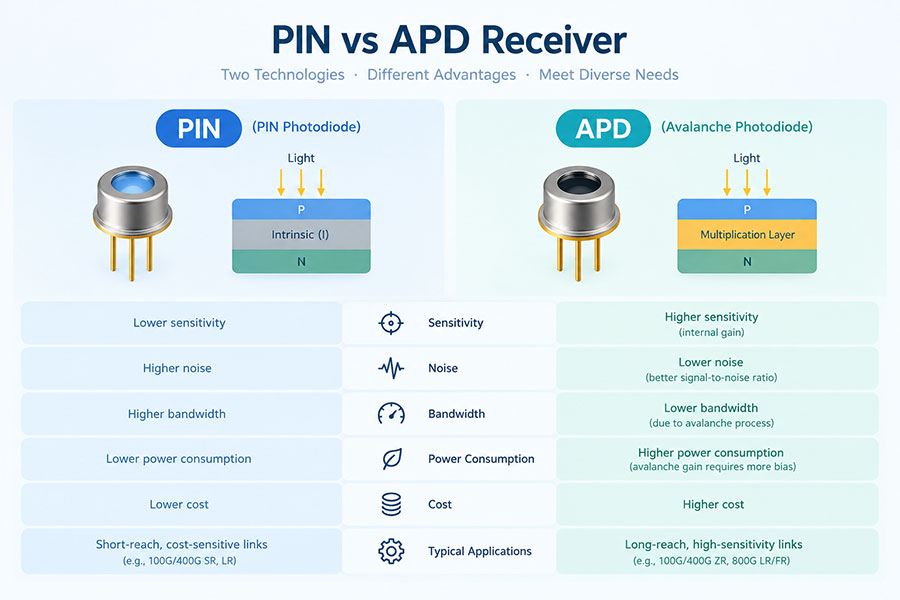
PIN and APD receivers use different photodetection approaches, with PIN offering simpler low-bias operation and APD adding avalanche gain for weak optical signals, affecting sensitivity, noise, power and receiver design.

Call
Top