AI workloads are transforming data center networks through massive east-west traffic, higher bandwidth, RDMA fabrics, multi-plane topologies, 800G and 1.6T interconnects, advanced congestion control, and tighter integration between networking and compute.
1.6T optical transceivers are emerging as AI data centers demand higher bandwidth density, lower power per bit, and scalable optical connectivity for next-generation GPU networks, with 400G-per-lane PAM4, advanced DSP, and silicon photonics accelerating the transition.
400G per lane is a key step for 1.6T optical modules, reducing lane count while improving bandwidth density, power efficiency, signal integration, and scalability for next-generation AI data center networks.
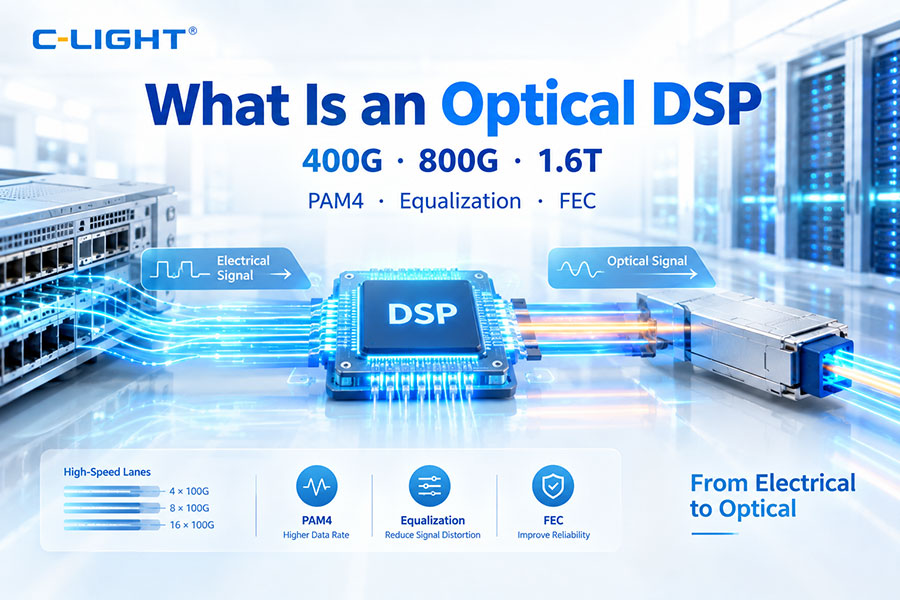
An optical DSP processes high-speed electrical and optical signals in modern optical transceivers. This article explains what an optical DSP is, how it works, its functions, power consumption, latency, FEC, PAM4, 400G, 800G and 1.6T applications.
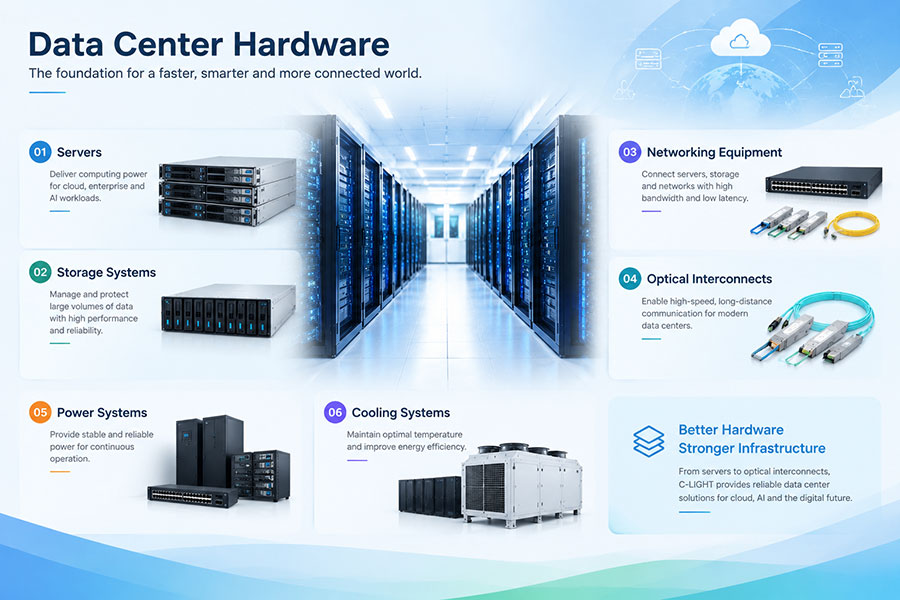
Data center hardware includes servers, storage systems, networking equipment, optical transceivers, power systems, and cooling solutions that build modern digital infrastructure for cloud computing, AI workloads, and high-speed data networks.