TEL:+86 132 6656 7067




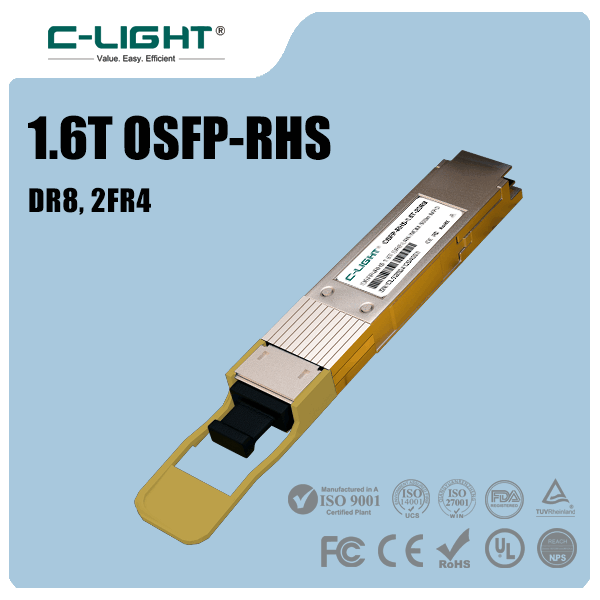
The evolution of optical modules is no longer driven only by increasing the total data rate of a module. The lane rate has become equally important. For 1.6T optical modules, moving from 200G-class lanes toward 400G-per-lane optical signaling changes the internal architecture, lane count, electrical interface, power efficiency, optical density, and long-term scalability of the module.
A 1.6T module can theoretically deliver the same aggregate bandwidth through different combinations of lane speeds. For example, four 400G optical lanes provide 1.6T of line-side bandwidth, while eight 200G-class lanes can also reach the same total bandwidth. The difference is that the 400G-per-lane architecture reduces the number of optical lanes required for the same aggregate capacity.
1. What Does 400G per Lane Mean?
400G per lane refers to an optical lane operating at approximately 400G-class signaling speed. It describes the data rate of an individual optical channel rather than the total capacity of the transceiver.
For a 1.6T module, four 400G optical lanes can provide:
4 × 400G = 1.6T
The actual electrical signaling rate can be higher than the nominal payload rate because implementation overhead, modulation, FEC, and internal gearbox functions must also be considered.
| Architecture | Approximate Lane Structure | Aggregate Optical Capacity |
|---|---|---|
| 800G | 4 × 200G-class | 800G |
| 1.6T | 8 × 200G-class | 1.6T |
| 1.6T | 4 × 400G-class | 1.6T |
| 3.2T | 8 × 400G-class | 3.2T |
This lane-count reduction is one of the primary reasons 400G-per-lane technology matters.
2. Why 1.6T Needs a Higher Lane Rate
Simply increasing the number of lanes is an effective way to increase bandwidth, but it becomes increasingly difficult as optical module density rises.
If a 1.6T module uses eight 200G-class optical lanes, the transceiver needs eight optical transmit paths and eight optical receive paths. Moving to four 400G-class lanes reduces the number of optical channels by half while maintaining the same aggregate bandwidth.
Fewer lanes can simplify the optical architecture and create more room for higher-density integration of lasers, modulators, photodiodes, drivers, DSP functions, and fiber connections.
3. 200G per Lane vs 400G per Lane
| Factor | 200G-Class Lane | 400G-Class Lane |
|---|---|---|
| Lane Rate | About 200G | About 400G |
| Lanes for 1.6T | 8 | 4 |
| Optical Channel Count | Higher | Lower |
| Bandwidth Density | Lower | Higher |
| Integration Requirement | High | Very High |
| Technology Difficulty | More mature | More demanding |
| Future Scalability | Suitable for 1.6T-class systems | Provides a path toward 3.2T and beyond |
The main tradeoff is that a 400G optical lane is substantially more difficult to implement. Higher-speed electrical and optical components must maintain adequate signal quality while operating within practical power and thermal limits.
4. PAM4 Makes 400G per Lane Possible
400G-per-lane architectures rely on advanced high-speed signaling technologies, with PAM4 being a key approach for increasing the amount of data carried by each symbol.
NRZ uses two signal levels and carries one bit per symbol. PAM4 uses four signal levels and can carry two bits per symbol.
This higher symbol efficiency allows data rates to increase without requiring the symbol rate to rise by the same factor as the aggregate bit rate.
However, PAM4 also produces smaller vertical eye openings than NRZ. As lane speed increases, the system becomes more sensitive to loss, noise, distortion, crosstalk, and other electrical and optical impairments.
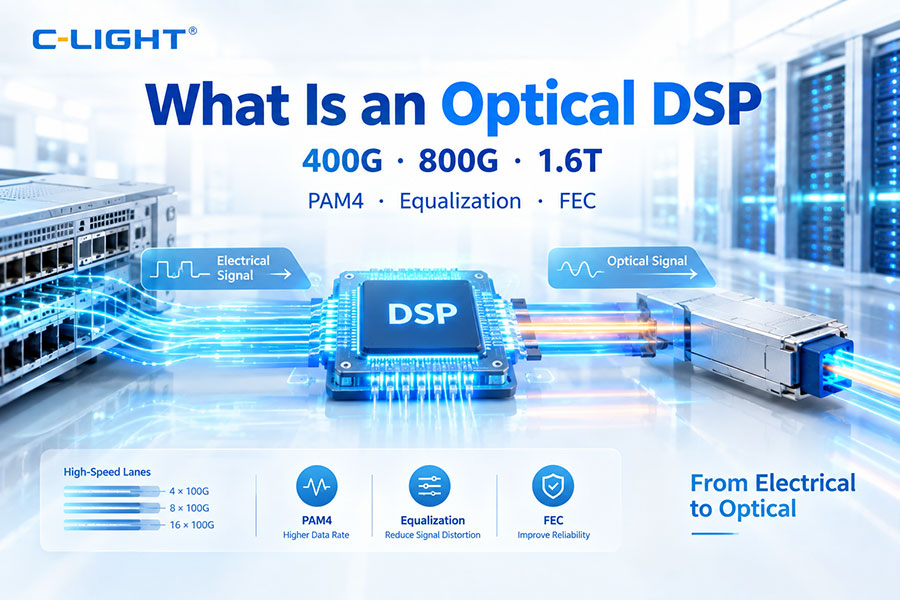
5. The Role of 400G PAM4 Optical DSP
At 400G-per-lane speeds, digital signal processing becomes increasingly important. The DSP must manage a substantially more demanding electrical and optical channel than earlier generations.
Depending on the implementation, the DSP can provide functions such as equalization, signal recovery, FEC processing, gearbox conversion, lane management, diagnostics, and optical-driver control.
A high-speed DSP therefore becomes one of the central components that makes a practical 1.6T module possible.
Modern 400G-per-lane PAM4 DSP architectures can also bridge different client-side and optical line-side lane configurations. This provides flexibility when a switch ASIC exposes multiple lower-rate electrical lanes while the optical interface uses fewer higher-rate optical lanes.
6. 8 × 200G vs 4 × 400G for 1.6T
| Architecture | Electrical/Optical Lane Concept | Main Characteristic |
|---|---|---|
| 8 × 200G | Eight 200G-class lanes | More parallel lanes |
| 4 × 400G | Four 400G-class lanes | Higher bandwidth per lane |
Both approaches can reach approximately 1.6T aggregate capacity, but the four-lane architecture provides a more compact line-side optical structure.
For high-density AI systems, reducing the number of independent optical channels can simplify optical integration and help reduce the physical resources needed to reach a given module bandwidth.
7. 400G per Lane and 1.6T DR4
DR4 is one of the important short-reach architectures associated with 1.6T optical modules. The "4" indicates four parallel optical lanes, while the DR architecture is intended for short-reach single-mode fiber connectivity.
A 1.6T DR4 implementation based on four 400G-class lanes therefore matches the basic relationship:
4 optical lanes × 400G-class signaling = 1.6T aggregate optical bandwidth
This architecture is particularly relevant to high-density AI and Ethernet data center networks where numerous short-reach optical links are required.
8. 400G per Lane and 1.6T FR4
FR4 follows the same fundamental lane-rate concept but is optimized for a different reach and wavelength architecture from DR4.
In a 400G-per-lane 1.6T implementation, four high-speed optical lanes can be combined with the required wavelength and fiber architecture to achieve the targeted reach.
The use of four lanes helps maintain high module bandwidth while limiting the number of physical optical channels that must be integrated into the package.
9. Why Fewer Optical Lanes Matter
Reducing lane count can have several system-level benefits.
Each optical lane requires a complete signal path involving electrical interfaces, drivers, optical components, coupling structures, and monitoring functions. Doubling the lane rate can therefore reduce the number of parallel optical paths that must be replicated inside the module.
This does not automatically mean that the module consumes half the power. A 400G lane is significantly more challenging than a 200G lane, and the required DSP and optical components can consume more power per lane.
The objective is instead to achieve a better balance between aggregate bandwidth, power per bit, optical density, and system complexity.
10. Power Efficiency and Power per Bit
Power consumption is becoming one of the most important constraints in AI data centers. A small difference in optical module power can become substantial when multiplied across thousands of ports.
Higher lane rates can improve bandwidth density and potentially reduce the number of optical components required for a given aggregate bandwidth. With advanced process nodes, integrated DSPs, and optimized optical components, this can contribute to lower energy consumption per transmitted bit.
However, power efficiency depends on the entire module architecture. DSP process technology, laser efficiency, modulator technology, thermal management, FEC implementation, and host electrical interfaces all contribute to the final result.
11. Bandwidth Density in 1.6T Optical Modules
Bandwidth density describes how much network capacity can be delivered within a given physical and thermal envelope.
For high-radix AI switches, the number of front-panel ports is limited by mechanical space, connector density, power consumption, and cooling capacity. A 1.6T module using four 400G-class optical lanes can provide a high aggregate bandwidth while reducing the number of parallel optical paths inside the module.
| Design Goal | Effect of 400G per Lane |
|---|---|
| Higher module bandwidth | Enables 1.6T using four optical lanes |
| Lower lane count | Reduces the number of parallel optical channels |
| Higher optical density | More bandwidth can fit within a compact package |
| Future scaling | Creates a path toward 3.2T-class modules |
12. Electrical Interface Challenges at 400G per Lane
The optical side is only one part of the problem. The host electrical interface must also support the much higher signaling rate.
At 400G-per-lane architectures, insertion loss, package parasitics, connector quality, PCB trace performance, crosstalk, equalization, and thermal effects become increasingly important.
This is one reason why high-speed optical development increasingly involves close co-design between the switch ASIC, DSP, connector, package, optical engine, and module manufacturer.
13. 400G per Lane and OSFP Form Factors
OSFP is an important form factor for high-bandwidth optical networking because it provides a mechanical platform capable of supporting high-power and high-density optical modules.
As optical lane rates rise, the form factor becomes part of the overall thermal and mechanical design. The module must accommodate the optical engine, DSP, drivers, thermal interface, electrical contacts, and fiber connections while remaining compatible with the host system.
For this reason, the transition to 400G-per-lane optics is not simply an upgrade of the laser data rate. It is a coordinated change across the complete module architecture.
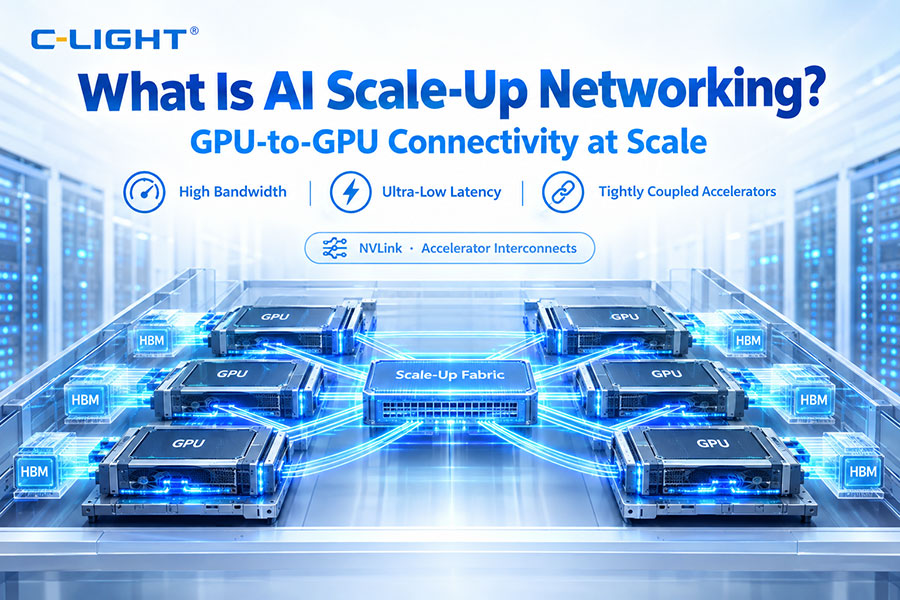
14. 400G per Lane for AI Training Networks
AI training clusters place particularly strong pressure on network bandwidth because large numbers of accelerators communicate simultaneously during distributed workloads.
As accelerator counts increase, the network must support higher aggregate throughput without expanding the physical and power footprint at the same rate.
1.6T modules using four 400G-class optical lanes provide a high-density interconnect option for AI scale-out and high-performance Ethernet or InfiniBand environments.
Higher lane rates are therefore closely connected to the broader evolution of AI networking, where bandwidth, latency, power, thermal management, and port density must all be considered together.
15. 400G per Lane and Silicon Photonics
Silicon photonics is particularly relevant to the move toward higher optical lane rates because photonic functions can be integrated into compact photonic integrated circuits.
At 400G per lane, integration becomes increasingly valuable because the optical subsystem must handle higher-speed modulation and detection within a limited physical area.
Silicon photonics can support highly integrated optical engines and may also be used in future NPO and CPO architectures where optical conversion is moved closer to the switching silicon.
16. 400G per Lane and CPO/NPO Architectures
The higher the switch bandwidth, the harder it becomes to maintain efficient electrical connections between the switch ASIC and front-panel pluggable optics.
400G-per-lane technology can therefore support a broader architectural shift toward optical engines located closer to the switching ASIC.
| Architecture | Optical Location | Primary Design Focus |
|---|---|---|
| Pluggable | Front panel | Serviceability and modularity |
| NPO | Near the switch ASIC | Short electrical paths and optical density |
| CPO | Integrated with the switch package | Maximum electrical integration and bandwidth scaling |
400G-per-lane optics do not require CPO, but higher lane speeds make closer optical integration increasingly attractive for some future system architectures.
17. 400G per Lane Is Also a Bridge to 3.2T
One of the most important reasons to develop 400G-per-lane technology is that it creates a scalable optical foundation beyond 1.6T.
A simplified lane relationship is:
4 × 400G = 1.6T
8 × 400G = 3.2T
Once the optical ecosystem supports 400G-class lanes, future modules can increase total bandwidth primarily by adding lanes or adopting new packaging architectures rather than immediately requiring another fundamental doubling of the per-lane rate.
This makes 400G-per-lane technology an important building block for the next generation of AI and hyperscale networking.
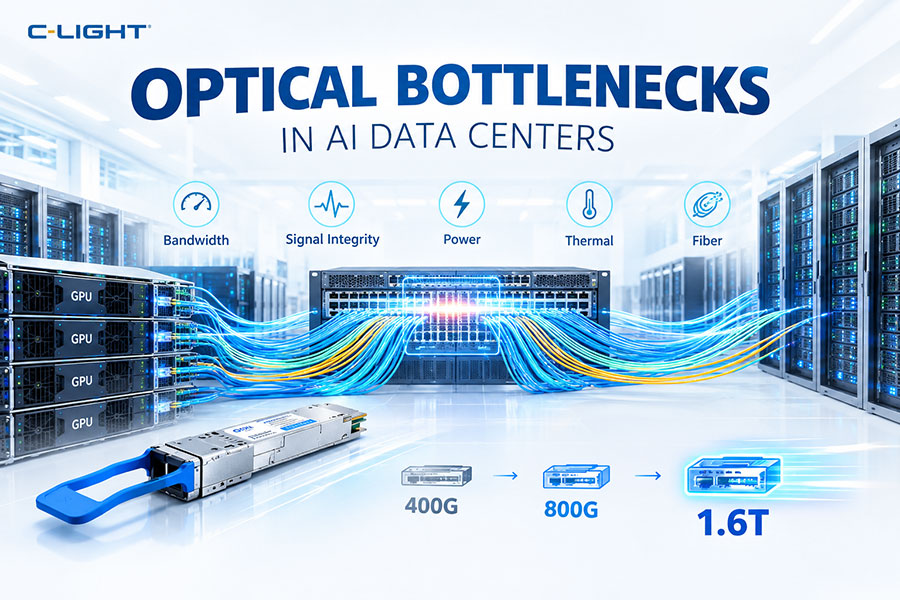
18. What Makes 400G per Lane Difficult?
The move from 200G-class to 400G-class lanes introduces several technical challenges:
| Challenge | Why It Matters |
|---|---|
| Signal Integrity | Higher data rates reduce electrical and optical margins |
| PAM4 Eye Opening | Higher-level signaling increases sensitivity to noise and distortion |
| DSP Complexity | More advanced equalization and signal processing are required |
| Optical Components | Lasers, modulators, and receivers must support higher-speed operation |
| Thermal Management | High-speed electronics generate significant heat in compact packages |
| Manufacturing | Tighter optical and electrical tolerances can affect yield and reliability |
| Interoperability | High-speed host and optical interfaces require careful validation |
These factors explain why 400G per lane is a major technology transition rather than simply a faster version of an existing optical lane.
19. How 400G per Lane Changes 1.6T Module Design
400G-per-lane signaling changes the design priorities of a 1.6T module from simply adding more parallel channels toward improving integration and efficiency per channel.
The major architectural effects can be summarized as follows:
Higher lane rate → fewer optical lanes → higher optical density → greater integration requirements → improved scalability for future bandwidth generations.
This approach is particularly relevant as AI switch capacities and accelerator network bandwidth continue to grow.
20. Why 400G per Lane Matters for the Future of Optical Networking
400G-per-lane optical technology represents a critical step in the scaling path from 800G and 1.6T toward future 3.2T and higher-capacity interconnects.
For 1.6T modules, it allows the same aggregate bandwidth to be delivered through fewer optical channels. That can improve bandwidth density and simplify the optical architecture, while creating new challenges in signal integrity, power consumption, thermal management, and component integration.
For AI data centers, the significance of 400G per lane extends beyond a single transceiver generation. It is part of a broader movement toward higher-speed PAM4, advanced DSPs, silicon photonics, optical engines, NPO, CPO, and increasingly integrated AI networking platforms.
 >
>

 >
>
 >
>
 >
>
 >
>
 >
>
 >
>
 >
>