TEL:+86 132 6656 7067





AI data center networks are placing increasing pressure on optical connectivity, particularly as switch capacity, accelerator bandwidth, and front-panel port density continue to grow. Conventional pluggable transceivers offer flexibility and field replaceability, but their physical dimensions, electrical interfaces, and thermal requirements create challenges when systems move toward extremely high aggregate bandwidth.
Two developments address different parts of this challenge: Silicon Photonics (SiPh) and eXtra-dense Pluggable Optics (XPO). Silicon Photonics integrates optical functions into photonic integrated circuits, while XPO introduces a high-density pluggable module architecture designed for large AI fabrics. The technologies are not direct alternatives. Silicon photonics can provide the optical engine inside an XPO module.
The distinction is becoming especially relevant as the industry develops 12.8T optical modules, 200G-per-lane interfaces, and advanced liquid-cooling systems. Understanding the relationship between photonic integration and module architecture helps network designers evaluate bandwidth density, power, cooling, serviceability, and future upgrade paths.
1. What Is Silicon Photonics?
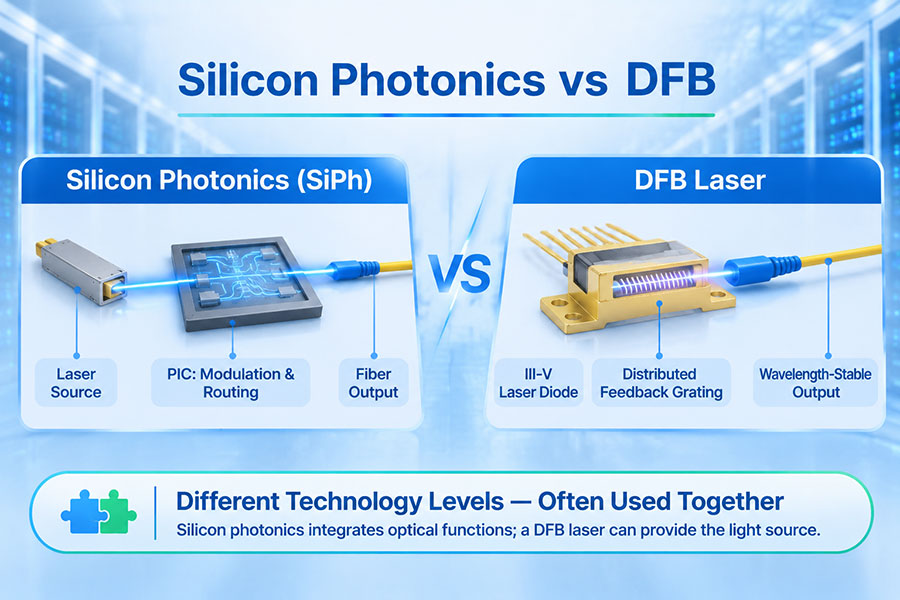
Silicon Photonics is an optical integration technology that uses silicon-based photonic integrated circuits (PICs) to implement multiple optical functions on a compact semiconductor platform.
Instead of assembling every optical function from separate discrete components, a silicon photonic chip can integrate several functions into a single circuit. Depending on the design, these functions may include:
Optical waveguides: Guide light through the photonic circuit.
Modulators: Encode electrical data onto an optical carrier.
Optical couplers: Transfer light between waveguides, fibers, and other optical components.
Wavelength multiplexers and demultiplexers: Combine or separate multiple optical wavelengths.
Photodetectors: Convert incoming optical signals into electrical signals.
The laser source does not necessarily need to be fabricated directly on the silicon photonic chip. Many implementations use external continuous-wave lasers, while others adopt hybrid or heterogeneous integration methods.
Silicon Photonics can be used in conventional pluggable transceivers, high-density XPO modules, NPO systems, and CPO optical engines. It describes how optical functions are implemented rather than defining the physical form factor of the complete module.
2. What Is XPO (eXtra-dense Pluggable Optics)?
XPO stands for eXtra-dense Pluggable Optics. It is a high-density pluggable optical architecture developed to address the bandwidth, front-panel density, and thermal requirements of large-scale AI data centers.
Unlike CPO, which places optical engines within or very close to the host ASIC package, XPO retains a pluggable module approach. Its design focuses on increasing the aggregate bandwidth available through each module while accommodating higher power and cooling requirements.
The XPO architecture announced by Arista in March 2026 introduced several major design targets:
12.8 Tbps module capacity: A configuration using 64 channels operating at 200 Gbps per channel.
High front-panel density: A stated target of 204.8 Tbps per Open Compute Project rack unit, approximately four times the density cited for 1.6T OSFP-based configurations.
Integrated liquid cooling: A cold-plate design intended to support cooling loads of up to 400W per module.
Multiple optical reach options: Support for optical categories including SR, DR, FR, LR, ZR, and ZR+.
Flexible electrical architectures: Support for linear, half-retimed, and fully retimed implementations.
The 400W figure refers to the stated cooling capability of the integrated cold-plate approach, not the module's electrical power consumption. Actual power consumption depends on the optical engine, laser arrangement, electronic components, and operating configuration.
XPO is being developed through a multi-source agreement (MSA) to establish a broader ecosystem for high-density pluggable optics. Its implementation involves more than increasing the size of a conventional transceiver: the connector system, electrical interface, module arrangement, cooling structure, and host platform all require coordinated design.
3. Silicon Photonics vs XPO: Core Differences
The fundamental difference is the level at which each technology operates. Silicon Photonics is a chip-level optical integration platform, while XPO is a module-level architecture that defines how high-density optical connectivity is packaged and deployed.
| Technical Factor | Silicon Photonics | XPO |
|---|---|---|
| Technology category | Photonic integration platform | High-density pluggable optical architecture |
| Primary objective | Integrate optical functions into compact PICs | Increase pluggable bandwidth density and support advanced cooling |
| Main design focus | Waveguides, modulators, couplers, and photodetectors | Module layout, connector density, electrical interfaces, and thermal design |
| Implementation level | Optical chip or photonic engine | Complete pluggable module and host interface |
| Form factor | Does not define a specific module form factor | Defines a high-density pluggable architecture |
| Cooling requirements | Depend on the PIC, laser, and surrounding electronics | Designed to accommodate advanced module-level cooling, including liquid cooling |
| Serviceability | Depends on the assembly in which the PIC is installed | Retains a pluggable service model |
| Potential combination | Can serve as the optical engine inside XPO | Can integrate silicon photonic or other suitable optical technologies |
4. How Silicon Photonics Can Be Used in XPO
A silicon photonic PIC can serve as the optical core of an XPO module. In this arrangement, the PIC provides optical modulation, wavelength routing, and photodetection, while the XPO mechanical and electrical architecture supports high-density connectivity and thermal management.
A simplified silicon-photonics-based XPO signal path includes the following stages:
Electrical data input: The host switch ASIC sends high-speed electrical signals through the XPO electrical interface.
Electrical signal conditioning: Driver circuitry prepares the signals for the optical transmitter.
Optical modulation: The silicon photonic modulator encodes the electrical data onto an optical carrier.
Optical routing: Integrated waveguides and other PIC components direct the optical signals toward the fiber interface.
Fiber transmission: Optical fibers carry the signals to another switch, server, or network device.
Optical reception: Photodetectors convert incoming optical signals into electrical signals for the receiving system.
The laser source may be external to the PIC. This arrangement can separate the light source from some of the heat generated by the optical engine and host electronics, although it introduces additional optical distribution and coupling requirements.
The XPO form factor does not require every implementation to use Silicon Photonics. Other optical technologies may be suitable depending on the required reach, wavelength, modulation format, power budget, and manufacturing strategy.
Importantly, the use of Silicon Photonics does not automatically determine whether an XPO module is linear or DSP-based. XPO supports different electrical signal-processing arrangements, including linear, partially retimed, and fully retimed implementations.
5. XPO Bandwidth Density and 12.8T Architecture
One of the most significant XPO design goals is increasing aggregate bandwidth without relying on a proportional increase in the number of conventional front-panel modules.
The announced 12.8T configuration uses 64 high-speed channels at 200 Gbps per channel:
64 × 200 Gbps = 12,800 Gbps = 12.8 Tbps
This channel arrangement provides a much higher aggregate module capacity than conventional 400G, 800G, or 1.6T pluggable modules. The benefit becomes particularly important in large AI fabrics, where many high-bandwidth connections must fit within limited switch-panel and rack space.
Arista's announced XPO architecture targets up to 204.8 Tbps of front-panel bandwidth per Open Compute Project rack unit. This is presented as approximately four times the density of 1.6T OSFP-based configurations.
| Architecture | Example Aggregate Capacity | Primary Design Focus |
|---|---|---|
| 400G Pluggable | 400 Gbps per module | Established data center connectivity |
| 800G Pluggable | 800 Gbps per module | Higher bandwidth per port |
| 1.6T Pluggable | 1.6 Tbps per module | Next-generation high-speed switch interfaces |
| XPO | Up to 12.8 Tbps in the announced 64-channel configuration | Extreme front-panel density and liquid-cooled pluggable connectivity |
These capacities describe different module architectures and should not be treated as directly interchangeable port configurations. Actual switch bandwidth also depends on the ASIC, electrical interface, number of supported modules, and system design.
6. Liquid Cooling and Thermal Management
As optical modules integrate more channels and higher-speed electronics, thermal management becomes a major system-level constraint. A high-density module must accommodate optical components, drivers, receivers, power delivery, and other electronics within a limited physical space.
XPO addresses this challenge through an integrated liquid-cooling approach. Its announced design includes a cold plate intended to support cooling loads of up to 400W per module.
Liquid cooling can provide a more direct heat-removal path than relying exclusively on conventional airflow. This is particularly relevant when multiple high-power optical modules are installed in a densely populated switch chassis.
However, the complete cooling solution requires more than a cold plate. Important engineering considerations include:
Cold-plate design: The thermal interface must transfer heat efficiently from the module to the cooling system.
Coolant distribution: Flow rate, pressure drop, and temperature must remain within the system's operating requirements.
Leak prevention: Fluid connections and mechanical interfaces require appropriate reliability controls.
Thermal uniformity: Optical components must remain within their specified temperature ranges.
System integration: The switch chassis, rack infrastructure, and facility cooling system must support the module design.
Silicon Photonics and liquid cooling address different parts of the thermal problem. PIC integration can reduce optical component footprint, while the XPO cooling architecture addresses heat removal at the module level. Neither technology eliminates the need for careful thermal qualification.
7. Electrical Interfaces and Signal Processing
High-density optical modules require high-speed electrical connections between the host ASIC and the optical engine. As the number of channels and per-lane data rates increase, electrical signal integrity becomes more demanding.
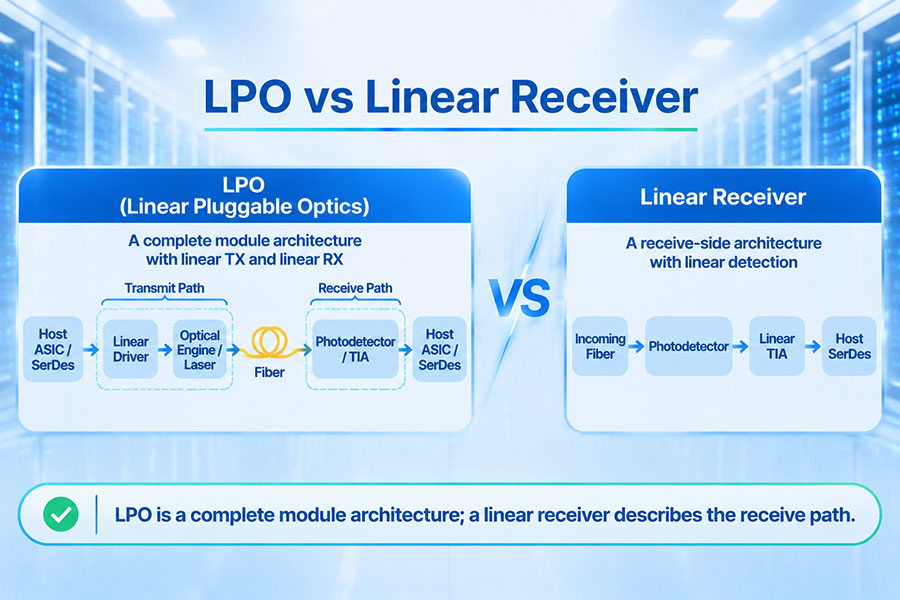
XPO supports different electrical interface architectures, including linear, half-retimed, and fully retimed approaches. This flexibility allows system designers to balance power consumption, latency, signal conditioning, and electrical channel requirements.
| Interface Architecture | Signal Processing | Main Consideration |
|---|---|---|
| Linear | Relies more heavily on the host SerDes and linear analog circuitry | Lower module processing overhead, with stricter host-channel requirements |
| Half-retimed | Retiming is applied to selected signal paths | Balances signal conditioning and power consumption |
| Fully retimed | Module-side DSP provides more extensive signal processing and retiming | Greater signal-conditioning capability, with additional power and latency considerations |
The choice of electrical architecture is independent of whether the optical engine uses Silicon Photonics. A silicon photonic PIC can be used with different electrical interface designs as long as the complete module meets the required electrical and optical specifications.
At very high lane rates, qualification must cover insertion loss, return loss, crosstalk, jitter, equalization capability, and host-module interoperability. A high-density connector alone cannot guarantee reliable operation without a validated electrical channel.
8. XPO vs Conventional Pluggable Optics
XPO retains the central advantage of pluggable optics: the optical module remains a separate unit that can be installed and replaced independently of the host ASIC. Its major difference is the emphasis on much higher aggregate bandwidth density and advanced thermal management.
| Design Factor | Conventional Pluggable Optics | XPO |
|---|---|---|
| Bandwidth per module | Common examples include 400G, 800G, and 1.6T | Announced 12.8T configuration |
| Front-panel density | Limited by conventional module and port dimensions | Designed for substantially higher aggregate density |
| Cooling | Typically uses chassis airflow or platform-specific cooling | Designed to support integrated liquid cooling |
| Electrical interface | Depends on the module form factor and host platform | Designed for 64 high-speed channels in the announced configuration |
| Serviceability | Individual modules are generally replaceable | Retains a pluggable architecture and service model |
| Target environment | General data center, enterprise, and telecom networks | High-density AI and hyperscale networking |
XPO does not eliminate conventional optical modules. Existing 400G, 800G, and 1.6T pluggables remain useful for networks that prioritize established interfaces, broad equipment compatibility, and flexible replacement procedures.
XPO is intended for systems where the bandwidth density and cooling advantages justify the additional requirements of a new connector, module, and chassis ecosystem.
9. XPO vs NPO and CPO
XPO, Near-Packaged Optics (NPO), and Co-Packaged Optics (CPO) all address the increasing bandwidth and power requirements of AI infrastructure, but they use different physical integration approaches.
XPO retains a high-density pluggable optical module. NPO places optical engines near the host ASIC while keeping them physically separate from its main package. CPO integrates optical engines much more closely with the ASIC package.
| Architecture | Optical Engine Position | Integration Level | Serviceability |
|---|---|---|---|
| Conventional Pluggable | Front-panel module | Separate from host ASIC | High; module-level replacement |
| XPO | High-density pluggable module | Separate pluggable assembly with advanced electrical and cooling interfaces | Retains a pluggable replacement model |
| NPO | Near the host ASIC | Closely positioned but physically separate from the main ASIC package | Depends on optical-engine mounting and system design |
| CPO | Within or closely integrated with the ASIC package | High package-level integration | More challenging when optical engines are tightly integrated |
These architectures represent different trade-offs rather than a simple progression in which one must replace all the others. XPO emphasizes extreme pluggable density and cooling, NPO shortens electrical paths through near-package placement, and CPO pushes optical integration closer to the switching silicon.
10. Applications in AI Data Centers and High-Performance Networks
XPO is designed for the bandwidth and density requirements of large AI networking systems. As accelerator clusters expand, their communication fabrics must support increasing traffic between GPUs, switches, and other compute resources.
Potential application areas include:
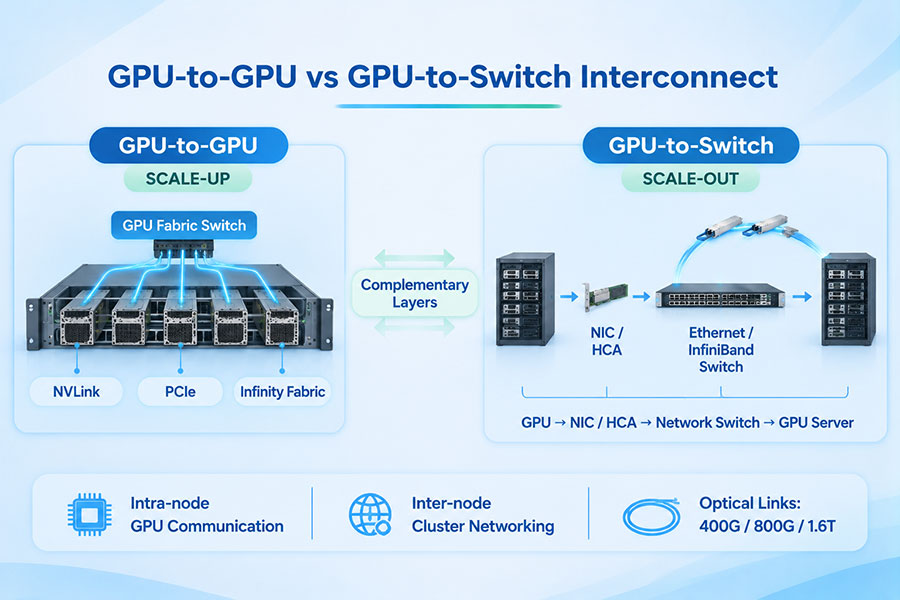
AI scale-up networks: High-bandwidth connectivity between processors and accelerators within tightly coupled systems.
AI scale-out networks: High-capacity connections between servers, racks, and network switches.
AI scale-across networks: Connectivity across larger infrastructure deployments and distributed computing resources.
High-radix Ethernet switching: Switch platforms requiring very high aggregate front-panel bandwidth.
Data center interconnect: Optical links supporting appropriate long-reach and coherent applications where the module implementation is qualified.
The announced XPO architecture supports multiple optical reach categories, including SR, DR, FR, LR, ZR, and ZR+. It also provides flexibility for other connectivity technologies and electrical processing approaches. Actual support depends on the specific module design and implementation.
Silicon Photonics can contribute to these applications by providing compact optical engines with integrated modulation, routing, and detection functions. The XPO architecture then provides the physical platform for deploying those engines at high density.
11. How to Evaluate Silicon Photonics and XPO for Network Design
Because Silicon Photonics and XPO are not competing technologies, network designers should evaluate their requirements separately before selecting a combined implementation.
| Engineering Requirement | Evaluation Focus |
|---|---|
| Optical integration | Check PIC architecture, modulation format, wavelength plan, and photodetector performance. |
| Aggregate bandwidth | Validate the number of channels, per-lane rate, and supported host interface. |
| Front-panel density | Evaluate module dimensions, connector arrangement, rack-unit capacity, and chassis layout. |
| Power consumption | Measure the complete optical module, laser source, driver, receiver, and supporting electronics. |
| Thermal performance | Verify cold-plate capability, coolant conditions, thermal interfaces, and optical operating limits. |
| Electrical signal integrity | Validate channel loss, crosstalk, return loss, jitter, and host-module compatibility. |
| Maintenance | Confirm module replacement procedures, connector accessibility, and cooling-system service requirements. |
| Deployment maturity | Check MSA specifications, ecosystem availability, host-platform support, and interoperability testing. |
For an AI data center deployment, the module's headline bandwidth is only one part of the evaluation. The switch ASIC, electrical interface, optical reach, cooling infrastructure, fiber routing, and operational maintenance model must all be considered together.
12. C-LIGHT Optical Connectivity for High-Speed Data Centers
The development of Silicon Photonics and XPO is expanding the range of optical architectures available for high-bandwidth networks. However, conventional pluggable transceivers, DACs, AECs, and fiber assemblies remain important throughout data center infrastructure.
C-LIGHT's optical transceiver portfolio covers multiple data rates and form factors, including 400G, 800G, and 1.6T product categories. These options support different network distances, host interfaces, and data center connectivity requirements.
When planning an upgrade toward higher-density optical connectivity, network designers should assess the required bandwidth, optical reach, host compatibility, electrical channel, power budget, thermal conditions, and fiber infrastructure. The selection of a particular optical architecture should be based on verified product specifications and platform-level qualification.
It is also important to distinguish product form factor from internal optical technology. A high-density pluggable module is not automatically a silicon photonic product, and a module's data rate alone does not establish its laser, PIC, or DSP architecture.
For optical connectivity requirements and product selection, visit the C-LIGHT optical transceiver portfolio or Contact C-LIGHT.
13. Conclusion
Silicon Photonics and XPO address different layers of next-generation optical connectivity. Silicon Photonics integrates optical functions into compact PICs, while XPO provides a high-density pluggable architecture designed to increase aggregate bandwidth and accommodate advanced liquid cooling.
The technologies can be combined. A silicon photonic PIC can serve as the optical engine inside an XPO module, while the XPO architecture provides the connector system, electrical interface, mechanical structure, and cooling capability needed for high-density deployment.
As AI data centers move toward 800G, 1.6T, and multi-terabit optical modules, both photonic integration and advanced pluggable packaging will remain important. The most suitable design depends on bandwidth density, optical performance, power, cooling, serviceability, and the maturity of the supporting ecosystem.
 >

 >
 >
 >
 >
 >
 >
 >