TEL:+86 132 6656 7067





As AI clusters and high-capacity data center switches move toward 800G and 1.6T connectivity, the physical location of optical conversion is becoming an important system-design decision. Traditional pluggable transceivers place optical engines at the equipment front panel, requiring high-speed electrical signals to travel across the host board. At increasingly high lane rates, this electrical path can create significant challenges for signal integrity, power consumption, and routing density.
Silicon Photonics (SiPh) and Near-Packaged Optics (NPO) are two technologies relevant to this transition, but they address different engineering layers. Silicon Photonics integrates optical functions into a photonic integrated circuit (PIC), while NPO moves optical engines closer to the host ASIC without necessarily integrating them into the same package.
These technologies can work together. A silicon photonic PIC can serve as the optical core of an NPO engine, combining integrated optical functions with a shorter electrical connection to the switching or computing chip. Understanding this relationship is important when evaluating optical connectivity for next-generation AI and data center networks.
1. What Is Silicon Photonics?
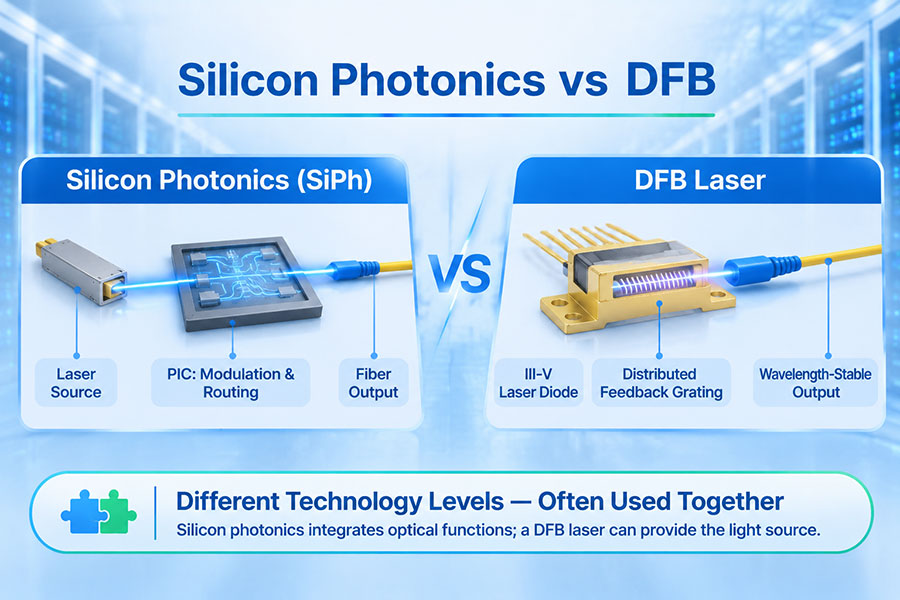
Silicon Photonics is a photonic integration technology that uses silicon-based semiconductor processes to implement optical functions on a photonic integrated circuit. Instead of relying entirely on separate optical components, a PIC can integrate multiple functions into a compact structure.
Depending on the design, a silicon photonic circuit may include:
Optical waveguides: Guide light through the photonic circuit.
Modulators: Convert electrical data signals into optical modulation.
Optical couplers: Transfer light between waveguides, fibers, and other optical components.
Wavelength multiplexers and demultiplexers: Combine or separate multiple optical wavelengths.
Photodetectors: Convert incoming optical signals into electrical signals.
The laser source does not necessarily need to be fabricated directly on the silicon photonic chip. Many designs use external continuous-wave lasers, while other implementations use hybrid or heterogeneous integration to combine light sources with the photonic platform.
Silicon Photonics can be deployed in several optical architectures, including conventional pluggable transceivers, on-board optical engines, NPO, and CPO. It describes the implementation of optical functions rather than the physical position of the complete optical engine.
2. What Is Near-Packaged Optics (NPO)?
Near-Packaged Optics is an optical interconnect architecture that places optical engines close to a host ASIC, such as a high-speed Ethernet switch chip or computing processor. Unlike conventional front-panel pluggable optics, NPO reduces the distance between the electrical interface of the ASIC and the optical conversion point.
In a typical NPO arrangement, the optical engine is positioned on the host board or within a nearby package structure, but remains physically separate from the main ASIC package. Optical fibers then connect the engine to the external network interface.
A typical NPO implementation may contain:
A switching ASIC or computing processor.
One or more optical engines positioned near the host package.
Photonic integrated circuits or other optical components.
Electrical driver and receiver circuitry.
Laser sources, either external or integrated according to the design.
Fiber-array interfaces and optical routing assemblies.
Power delivery and thermal-management structures.
By moving the optical engine closer to the ASIC, NPO can shorten the high-speed electrical channel compared with front-panel pluggable modules. This can reduce channel loss and ease some signal-integrity constraints without requiring the same degree of package integration as CPO.
NPO is not a single universally fixed mechanical implementation. The exact placement, electrical interface, optical-engine packaging, and service model can vary between system designs. The defining concept is the closer positioning of optical conversion relative to the host ASIC while retaining a degree of physical separation.
3. Silicon Photonics vs NPO: Core Differences
The main difference is that Silicon Photonics focuses on optical integration, while NPO focuses on system-level placement. One describes how optical functions are implemented; the other describes where the optical engine is positioned in relation to the host processor.
| Technical Factor | Silicon Photonics | Near-Packaged Optics |
|---|---|---|
| Technology category | Photonic integration platform | Optical interconnect and packaging architecture |
| Primary objective | Integrate optical functions into compact PICs | Position optical engines close to the host ASIC |
| Main focus | Waveguides, modulators, couplers, and photodetectors | Electrical reach, optical-engine placement, and system integration |
| Physical location | Can be used in pluggable modules, NPO, CPO, or other optical assemblies | Near the host ASIC, but generally separate from its main package |
| Optical components | Integrated photonic functions on a silicon-based chip | Optical engine containing PICs or other optical components |
| Electrical connection | Depends on the package and host interface | Shorter electrical connection between ASIC and optical engine |
| Laser arrangement | External, hybrid-integrated, or otherwise integrated light source | External or integrated laser architecture, depending on the design |
| Main engineering challenge | Photonic integration, coupling, laser integration, and thermal stability | Board or package integration, fiber routing, thermal design, and serviceability |
4. How Silicon Photonics and NPO Work Together
Silicon Photonics can provide the optical conversion functions inside an NPO engine. NPO then places that engine near the host ASIC to reduce the length of the high-speed electrical connection.
A silicon-photonics-based NPO system generally follows this signal path:
Electrical data generation: The host ASIC processes network or computing data and sends electrical signals toward the nearby optical engine.
Electrical interface: Driver electronics receive and condition the high-speed electrical signals.
Optical modulation: A silicon photonic modulator encodes the data onto an optical carrier.
Optical routing: Integrated waveguides and other PIC components route the optical signals toward the fiber interface.
Fiber transmission: Optical fibers carry the signals to another switch, server, or network device.
Optical reception: At the receiving end, photodetectors convert incoming light into electrical signals for processing.
The laser source may be located separately from the photonic engine. An external laser architecture can help separate the light source from some of the thermal conditions near the host ASIC, although it introduces additional optical distribution and coupling requirements.
The exact design depends on the optical engine, electrical interface, number of channels, modulation format, and system packaging. Silicon Photonics supplies the integrated optical functions, while NPO determines the engine's position and its connection to the host.
5. Electrical Reach and Signal Integrity
One of the main motivations for NPO is the electrical channel between the host ASIC and the optical transceiver. In a conventional front-panel pluggable architecture, high-speed electrical signals travel from the ASIC through package connections, PCB traces, connectors, and the module interface before reaching the optical engine.
As lane rates increase, the electrical channel becomes more sensitive to insertion loss, reflections, crosstalk, and impedance discontinuities. The host SerDes may require more advanced equalization and signal conditioning to maintain adequate operating margin.
NPO places the optical engine closer to the ASIC, shortening this electrical path. The reduced channel length can improve signal integrity and potentially lower the power required for electrical compensation.
Silicon Photonics itself does not determine electrical reach. A silicon photonic PIC inside a front-panel module still has to receive electrical signals through the module's host interface. The same PIC placed in an NPO engine can benefit from the shorter electrical path provided by the NPO architecture.
| Design Factor | Pluggable Silicon Photonics | Silicon Photonics in NPO |
|---|---|---|
| Optical engine location | Inside a removable front-panel module | Near the host ASIC on the board or in a nearby package |
| Electrical path | Extends across the host board to the front-panel module | Shorter connection between ASIC and optical engine |
| Signal-integrity requirements | Must support the complete board-to-module electrical channel | Must support a shorter, closely integrated electrical channel |
| System integration | Uses established pluggable interfaces | Requires coordinated ASIC, board, optical-engine, and fiber design |
| Service model | Generally supports independent module replacement | Depends on whether the optical engine is separately replaceable |
Shorter electrical reach does not automatically guarantee a particular power reduction or error rate. The complete channel must still be validated for insertion loss, return loss, crosstalk, jitter, and receiver margin under the intended operating conditions.
6. Power Consumption and Thermal Management
Power efficiency is an important consideration in both Silicon Photonics and NPO, but their contributions are different.
Silicon Photonics can integrate multiple optical functions into a compact PIC. This can support higher optical integration density and reduce the need for some discrete optical assemblies. However, the complete optical engine still consumes power through its laser source, modulator drivers, receiver electronics, and control circuitry.
NPO targets the electrical connection between the host ASIC and optical engine. By shortening this path, the architecture can reduce electrical channel loss and potentially lower the equalization effort required from the host interface.
Thermal management remains a major design consideration. Although NPO does not place the optical engine directly inside the ASIC package in the typical implementation, it still operates close to a high-power processor. The board, optical engine, laser source, and cooling system must be designed as a coordinated thermal environment.
| Power and Thermal Factor | Silicon Photonics | NPO |
|---|---|---|
| Potential efficiency benefit | Compact integration of optical functions | Shorter electrical paths and reduced channel compensation requirements |
| Power contributors | Laser, drivers, photodetectors, receiver electronics, and DSP if present | Optical engine, host SerDes, laser distribution, and supporting electronics |
| Thermal concern | Optical-component temperature stability and laser integration | Heat from nearby ASICs and optical-engine electronics |
| System-level requirement | Stable optical performance across operating conditions | Thermal separation, airflow or liquid-cooling compatibility, and fiber access |
Neither technology guarantees a fixed system-power reduction. A reliable evaluation should include the host ASIC, SerDes, optical engine, laser source, power-delivery circuitry, and cooling infrastructure.
7. Packaging, Reliability, and Maintenance
Packaging and serviceability are important differences between conventional pluggable optics and NPO. A front-panel transceiver is designed as a removable module with a standardized mechanical and electrical interface. If a module fails, it can generally be replaced without changing the host ASIC or board assembly.
NPO moves optical conversion closer to the host ASIC, which can improve electrical performance and port-density potential. However, the optical engine is more deeply integrated into the host system. Its replacement procedure depends on the mechanical design and whether the engine is socketed, separately mounted, or fixed to the board.
Key reliability considerations include:
Optical coupling: Fiber-array alignment and coupling loss must remain within specification.
Thermal stability: Optical components must operate within their specified temperature ranges near the host ASIC.
Mechanical reliability: Optical connectors, fiber routing, and board-level assemblies must tolerate expected operating conditions.
Manufacturing yield: Photonic dies, electronic circuits, optical interfaces, and packaging must work together consistently.
Testing access: Optical engines need suitable production and system-level test interfaces.
Serviceability: The system must provide a clear process for diagnosing and replacing failed optical components.
Silicon Photonics introduces its own packaging requirements, particularly around fiber coupling, laser integration, and optical alignment. NPO adds system-level considerations because the optical engine must be integrated close to the host processor while retaining suitable electrical, optical, and thermal interfaces.
8. NPO vs CPO: Where Is the Optical Engine Located?
NPO and Co-Packaged Optics (CPO) both move optical conversion closer to the host ASIC. Their main difference is the degree of physical integration.
NPO generally keeps the optical engine separate from the main ASIC package while positioning it nearby. CPO integrates optical engines much more closely with the host ASIC, typically within a common package or closely coupled package structure.
| Architecture | Optical Engine Location | Electrical Connection | Serviceability |
|---|---|---|---|
| Pluggable Optics | Front-panel transceiver | Relatively long board-level connection | High; individual modules are generally replaceable |
| NPO | Near the ASIC, but physically separate from its main package | Short board-level or nearby-package connection | Depends on the optical-engine mounting and replacement design |
| CPO | Integrated closely with the ASIC package | Very short package-level connection | More challenging when the optical engine is tightly integrated |
NPO can serve as an intermediate architecture between front-panel pluggable optics and CPO. It reduces electrical reach while retaining more physical separation than a tightly co-packaged design.
However, NPO is not simply a temporary version of CPO. It may be a suitable long-term architecture for systems that need shorter electrical channels but also value separate optical-engine assemblies and a more flexible service model.
9. Applications in 400G, 800G, and 1.6T Networks
AI training clusters, high-performance computing systems, and large-scale Ethernet fabrics require increasing bandwidth between processors, accelerators, and switches. As port speeds and aggregate switch capacity grow, electrical routing and front-panel density become more difficult to manage.
400G connectivity: NPO can be considered in systems where the electrical channel to front-panel optics is becoming a constraint. Silicon Photonics can provide integrated optical functions for multi-channel optical engines.
800G connectivity: Higher per-lane signaling rates place greater demands on host SerDes, electrical channel design, and optical-engine integration. NPO can shorten the electrical path, while silicon photonic PICs can support compact optical conversion and wavelength-multiplexing implementations.
1.6T connectivity: Future 1.6T systems will require careful coordination of lane rates, electrical interfaces, optical performance, package design, and thermal management. Silicon Photonics and NPO are both relevant to these development directions, although the suitability of a particular implementation depends on its system-level validation.
Not every connection in an AI data center needs NPO. Conventional pluggable optics remain useful for links where modular replacement, flexible port configuration, and established deployment practices are priorities. NPO is more relevant where the electrical path between the host ASIC and optical engine becomes a major limitation.
10. How to Select Between Silicon Photonics and NPO
Since Silicon Photonics and NPO are not mutually exclusive technologies, the selection process should begin by identifying the optical integration and system-placement requirements separately.
| Engineering Requirement | Relevant Consideration |
|---|---|
| Higher optical integration | Evaluate PIC integration, waveguide design, modulation, photodetection, and laser architecture. |
| Shorter electrical reach | Evaluate NPO placement and the achievable ASIC-to-optical-engine channel length. |
| Lower system power | Measure host SerDes, optical engine, laser, power delivery, and cooling consumption. |
| High optical port density | Assess fiber-array interfaces, optical-engine placement, and fiber-routing capacity. |
| Thermal reliability | Check ASIC heat transfer, optical operating limits, laser placement, and cooling design. |
| Field maintenance | Determine whether the optical engine can be independently accessed and replaced. |
| Future bandwidth scaling | Validate lane rate, electrical interface, optical reach, and upgrade path. |
For system designers, the most important question is not whether Silicon Photonics or NPO is inherently better. It is whether the complete architecture meets bandwidth, power, thermal, reliability, and maintenance requirements at an acceptable system cost.
11. C-LIGHT Optical Connectivity for High-Speed Data Centers
The development of Silicon Photonics and NPO is changing how optical engines are integrated into high-bandwidth systems, but conventional optical transceivers and fiber connections remain important across data center networks.
C-LIGHT provides optical connectivity options across multiple data rates and form factors. Its optical transceiver portfolio includes high-speed product categories for data center and network applications, including 400G, 800G, and 1.6T connectivity.
For network planning, the choice between conventional pluggable optics and more closely integrated optical architectures should consider link distance, optical budget, host compatibility, port density, power consumption, thermal conditions, and field maintenance requirements.
The form factor and data rate of an optical transceiver do not by themselves establish whether it uses Silicon Photonics or an NPO architecture. Those characteristics should be verified against the specific product design and technical documentation.
For optical connectivity requirements and product selection, visit the C-LIGHT optical transceiver portfolio or Contact C-LIGHT.
12. Conclusion
Silicon Photonics and Near-Packaged Optics address different but complementary challenges in high-speed optical interconnect design. Silicon Photonics provides an integrated platform for implementing optical functions, while NPO changes the physical position of the optical engine to shorten the electrical connection to the host ASIC.
A silicon photonic PIC can serve as the optical core of an NPO engine. This combination can support compact optical integration and shorter electrical channels without requiring the same degree of package integration as CPO.
The practical choice depends on bandwidth requirements, electrical reach, power consumption, thermal management, fiber routing, manufacturing maturity, and serviceability. As AI data centers move toward 800G and 1.6T connectivity, Silicon Photonics and NPO can play complementary roles in the development of scalable optical interconnect architectures.
 >

 >
 >
 >
 >
 >
 >
 >