TEL:+86 132 6656 7067





Optical transceivers have traditionally been assembled from individual devices, including laser diodes, modulators, photodetectors, filters, lenses, and optical coupling elements. Each component performs a defined function and is connected to the others through optical and electrical interfaces. Silicon photonics changes this design approach by integrating multiple optical functions into a photonic integrated circuit (PIC), reducing the need for separately packaged devices within the optical signal path.
These architectures serve the same broad purpose but have different strengths in integration density, component selection, manufacturing, optical performance, and packaging. Discrete components remain useful where specialized device characteristics or design flexibility are important, while silicon photonics is attractive for applications requiring compact, repeatable, high-volume optical integration.
1. What Is Silicon Photonics?
Silicon photonics is an integrated photonics technology that uses silicon or silicon-on-insulator (SOI) substrates to fabricate optical circuits. Similar to semiconductor manufacturing, photonic structures are patterned on wafers using controlled fabrication processes. Multiple optical functions can therefore be placed on one chip rather than assembled entirely from individual optical devices.
A silicon photonic integrated circuit may include:
Optical waveguides: Route light between functional sections of the chip.
Optical modulators: Encode electrical data onto an optical carrier.
Optical couplers and splitters: Distribute or combine optical signals.
Wavelength filters and multiplexers: Separate or combine channels in wavelength-division multiplexing systems.
Photodetectors: Convert received optical signals into electrical signals, commonly using germanium integrated with silicon.
Monitor structures: Support optical power monitoring and device control.
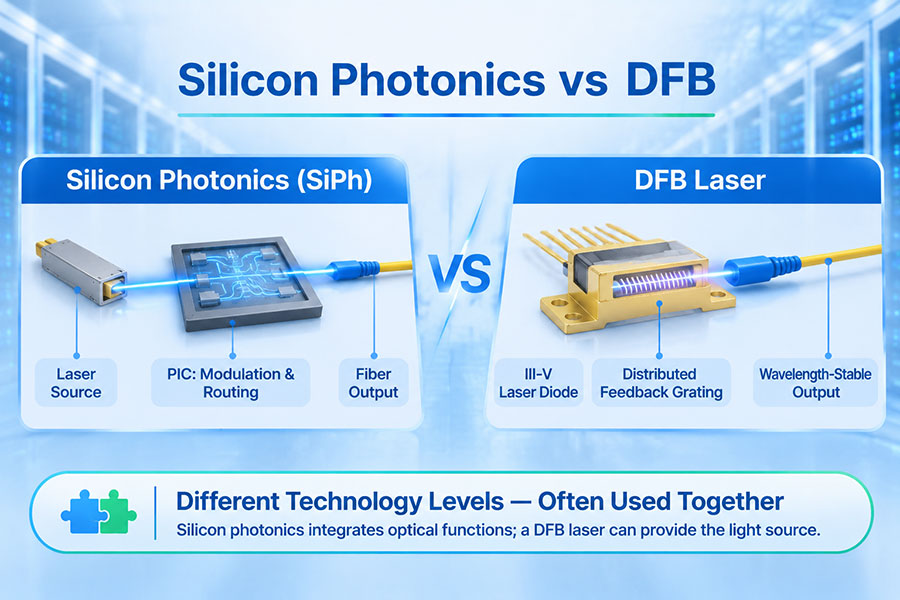
Silicon is well suited to optical routing and integration at communication wavelengths, but it is not an efficient light-emitting material because of its indirect bandgap. Consequently, a silicon photonics system often uses an external laser or integrates a III-V semiconductor light source through hybrid or heterogeneous integration. The optical source does not have to be fabricated directly in the silicon photonics process.
The result is a compact optical circuit that can combine several functions while retaining electrical interfaces and external fiber connections. Silicon photonics is used in optical transceivers and is also relevant to emerging near-packaged and co-packaged optical architectures.
2. What Are Discrete Optical Components?
Discrete optical designs use separate devices to perform individual optical functions. Instead of placing multiple functions on one photonic chip, engineers select and assemble components according to the requirements of the transmitter, receiver, or optical system.
A conventional discrete optical transmitter may contain a laser diode, a modulator or directly modulated laser, optical isolators where required, lenses, and coupling elements. A receiver may use a photodiode or photodetector assembly, optical filters, and associated coupling structures. WDM systems may also use separate optical multiplexers and demultiplexers.
Common discrete optical devices include:
DFB and EML laser diodes: Provide optical carriers for different data rates, wavelengths, and transmission distances.
PIN and APD photodiodes: Convert incoming optical power into electrical current.
Electro-optic modulators: Modulate optical carriers, including devices based on lithium niobate or other specialized materials.
Optical filters: Select or reject specific wavelength channels.
Optical isolators: Reduce unwanted optical feedback into sensitive sources.
Multiplexers and demultiplexers: Combine or separate wavelength channels using technologies such as thin-film filters or arrayed waveguide gratings.
Discrete components can be manufactured using materials selected for their individual optical properties. Indium phosphide is widely used for laser and photonic devices, while other material platforms are chosen for specific modulation, filtering, or detection requirements. This allows designers to select components based on performance rather than requiring every function to fit one semiconductor process.
3. Silicon Photonics vs Discrete Optical Components: Key Differences
The main distinction is how optical functions are implemented and connected. Silicon photonics consolidates multiple functions into an integrated circuit, whereas a discrete architecture uses separate optical devices and interconnections. The actual performance of either approach depends on the device technology, optical design, packaging, and operating conditions.
| Technical Aspect | Silicon Photonics | Discrete Optical Components |
|---|---|---|
| Integration | Multiple optical functions are integrated on a photonic chip. | Individual functions are implemented by separate devices. |
| Material Platform | Primarily silicon or SOI, often combined with other materials. | May use InP, GaAs, lithium niobate, silica, and other materials. |
| Optical Routing | On-chip waveguides connect functional elements. | Optical paths use fibers, lenses, free-space paths, or packaged interfaces. |
| Footprint | Can reduce the size of the photonic circuit. | May require more package space as component count increases. |
| Component Selection | Constrained by the capabilities and design rules of the integration platform. | Allows individual devices to be selected for specific performance requirements. |
| Manufacturing | Can benefit from wafer-scale semiconductor fabrication. | Often involves separate component fabrication, testing, and assembly. |
| Optical Interfaces | Reduces many internal optical connections, but still requires external coupling. | Requires optical alignment and connections between individual devices. |
| Light Source | Often uses an external or integrated III-V laser solution. | Can use a separately packaged laser selected for the application. |
| Design Flexibility | Supports dense integration within the capabilities of the PIC platform. | Offers flexibility to combine different devices and material technologies. |
| Typical Strength | Compact, scalable optical integration and high channel density. | Specialized component performance and flexible optical architecture. |
4. Integration Density and Module Size
Integration density is one of the most visible differences between the two approaches. In a discrete optical assembly, each laser, detector, filter, and other device needs its own physical location and suitable optical and electrical connections. As channel counts increase, the number of components and alignment interfaces can also increase.
Silicon photonics places multiple functions on a common substrate. Waveguides connect modulators, detectors, couplers, and wavelength-selective structures within the PIC. This can reduce the number of separately packaged optical devices and support compact optical engines.
For high-density transceivers, the benefits may include:
More optical functions within a limited package footprint.
Reduced dependence on multiple internal fiber or free-space connections.
Potentially simpler optical assembly for integrated functions.
A scalable platform for multi-lane and wavelength-multiplexed designs.
However, a smaller photonic die does not automatically mean a smaller or simpler complete transceiver. The laser, driver, transimpedance amplifier (TIA), DSP where applicable, power-management circuits, fiber interface, heat spreader, and mechanical housing still occupy space. Total module size depends on the complete electro-optical design.
5. Optical Performance and Material Advantages
Discrete optical components have an important advantage: each device can be built using a material system optimized for its function. For example, III-V semiconductor materials are well established for light generation, while lithium niobate offers strong electro-optic properties for high-performance modulation. Specialized photodetectors and optical filters can also be selected independently.
Silicon photonics offers a different advantage. It combines optical routing and multiple device functions on a common platform, making it possible to build complex photonic circuits with consistent geometries and short internal optical paths.
Neither approach guarantees better optical performance in every application. Engineers need to evaluate parameters such as:
Insertion loss and propagation loss.
Modulator bandwidth, drive voltage, and extinction ratio.
Laser output power, linewidth, and wavelength stability.
Photodetector responsivity, bandwidth, and sensitivity.
Optical crosstalk and channel isolation.
Operating temperature and thermal sensitivity.
For example, a discrete modulator may provide a performance characteristic that is difficult to achieve with a particular silicon photonics process. Conversely, an integrated circuit may reduce the optical loss and alignment complexity associated with multiple separately packaged devices. The correct decision depends on the link budget and system requirements, not the integration label alone.
6. Manufacturing, Assembly, and Reliability
Silicon photonics can leverage semiconductor wafer processing to fabricate large numbers of photonic circuits using repeatable lithographic steps. This provides a potential manufacturing advantage when designs reach sufficient production volume and the process has been optimized for yield.
Discrete optical assemblies typically require separate component production and additional alignment and packaging operations. Active optical alignment may be needed to optimize coupling between devices. More assembly steps can increase manufacturing time and introduce additional sources of variation.
However, wafer-scale fabrication does not eliminate all manufacturing challenges in silicon photonics. Fiber-to-chip coupling, laser integration, electrical interconnection, thermal management, and final package testing remain important. A photonic chip that performs well at wafer level must still be assembled into a complete optical product that meets its specifications.
Reliability also depends on more than component count. Relevant factors include:
Laser aging and optical output stability.
Thermal cycling and temperature-dependent wavelength behavior.
Mechanical stress on fiber and chip interfaces.
Bonding and interconnect integrity.
Contamination, moisture protection, and package sealing.
Manufacturing process control and final optical testing.
Reducing the number of internal optical connections can remove some alignment-sensitive interfaces, but it does not make an integrated optical engine immune to packaging or environmental failures.
7. Power Consumption and Thermal Management
Power consumption is determined by the entire optical and electrical system. Silicon photonics can reduce some optical-engine overhead through integration and shorter internal optical paths, but it does not automatically consume less power than every discrete design.
In a silicon photonics transceiver, power may be required by the laser source, modulator drivers, receiver TIAs, control circuits, thermal tuning elements, and DSP. Some PIC designs use heaters to stabilize resonant structures or adjust wavelength-dependent behavior. These circuits can contribute to the overall power budget.
Discrete designs also have different power characteristics depending on the laser, modulator, receiver, and control architecture. A directly modulated laser, an externally modulated laser, and a discrete electro-optic modulator have different electrical and optical requirements.
Thermal design must account for the location of heat-generating components, temperature sensitivity of optical devices, and the ability of the package to maintain stable operating conditions. For high-speed transceivers, module power and thermal performance should be evaluated from measured product specifications rather than inferred from whether the design uses integrated or discrete optics.
8. Application Scenarios
Both approaches are used in optical communication systems, but their strengths make them suitable for different design priorities.
Silicon photonics is particularly relevant to:
High-speed data-center transceivers: Integrated optical circuits support compact multi-lane designs and high production volumes.
Wavelength-division multiplexing: On-chip wavelength filters and multiplexers can consolidate multiple optical channels.
AI and high-performance computing networks: Dense optical engines can support increasing bandwidth requirements between switches, accelerators, and computing systems.
Near-packaged and co-packaged optics: Silicon photonics can provide an integration platform for optical engines placed close to electronic switching or computing devices.
Discrete optical components remain valuable in:
Specialized optical transmitters: Individual lasers and modulators can be selected for specific wavelength, output-power, or modulation requirements.
Long-haul and coherent systems: Specialized optical devices can be selected to meet demanding linewidth, modulation, and optical-power requirements.
Industrial and telecom equipment: Application-specific component choices can support different environmental and transmission requirements.
Custom optical systems: Separate devices make it possible to combine technologies from different material platforms.
These are application tendencies rather than strict boundaries. Silicon photonics can be used in coherent and long-reach systems, while discrete devices can also be used in high-volume data-center products.
9. Can Silicon Photonics and Discrete Components Work Together?
Yes. Silicon photonics and discrete optical components are not mutually exclusive. Many practical optical engines use a hybrid architecture in which a silicon photonic chip performs several optical functions while separate devices provide functions that are better implemented outside the silicon process.
A typical hybrid arrangement may include:
A silicon photonic chip containing waveguides, modulators, couplers, and wavelength-management structures.
An external or bonded III-V laser supplying the optical carrier.
Separate driver and receiver electronic ICs connected to the photonic circuit.
Fiber arrays or optical connectors coupling the chip to external transmission fibers.
Thermal-control and monitoring components supporting stable operation.
This arrangement combines the integration density of silicon photonics with the material and performance advantages of specialized devices. The laser may be coupled to the PIC through edge coupling or another optical interface, while the photonic circuit handles routing and modulation.
Hybrid integration is especially important because silicon does not efficiently generate light on its own. Rather than forcing every optical function into one material platform, system designers can combine silicon with III-V semiconductors, germanium, or other materials according to the application.
10. How to Select the Right Optical Architecture
The choice between silicon photonics and discrete optical components should begin with the required link performance and production objectives. Selecting an architecture based only on integration density or component count can overlook important system-level constraints.
| Selection Factor | Questions to Evaluate |
|---|---|
| Data Rate and Lane Configuration | What are the required aggregate data rate, lane speed, and modulation format? |
| Transmission Distance | Does the link require short-reach, campus, metro, or long-haul optical performance? |
| Wavelength Plan | Are fixed wavelengths, CWDM, DWDM, or coherent wavelength control required? |
| Optical Budget | Can the transmitter output, receiver sensitivity, insertion loss, and fiber loss meet the link budget? |
| Power and Cooling | What are the module power limits, operating temperature range, and cooling conditions? |
| Manufacturing Volume | Can the expected production volume justify investment in an integrated photonic platform? |
| Packaging | What are the requirements for fiber coupling, alignment, mechanical reliability, and serviceability? |
| Cost and Supply Chain | Are the PIC process, laser source, packaging, testing, and component supply arrangements suitable for the product lifecycle? |
For optical transceiver buyers, the technology platform is only one part of product selection. The exact module specification, host compatibility, optical interface, operating temperature, power consumption, and interoperability should all be verified. Two transceivers with the same data rate and form factor may use different internal optical architectures while meeting the same external interface requirements.
11. Silicon Photonics and Discrete Optics in C-LIGHT Optical Connectivity
Optical connectivity requirements vary across data-center, enterprise, telecom, and industrial networks. Data rate, transmission distance, fiber type, wavelength, host equipment, and environmental conditions determine which transceiver or optical interconnect is appropriate.
C-LIGHT provides optical transceiver solutions across different data rates and application requirements. Its optical transceiver portfolio covers product categories used in fiber-optic connectivity. Buyers evaluating a specific module should confirm its detailed datasheet, optical parameters, operating temperature, power consumption, and equipment compatibility rather than assuming its internal design is silicon photonics or discrete-based.
For network projects involving high-speed optical links, the selection process should consider the complete transmission system, including transceiver specifications, fiber infrastructure, connector interfaces, link budget, and host-device support.
Planning an optical connectivity project?
Contact C-LIGHT for assistance with optical transceiver selection, product specifications, and compatibility requirements.
12. Conclusion
Silicon photonics and discrete optical components represent two different approaches to building optical systems. Silicon photonics integrates multiple functions onto a common chip, supporting compact designs, dense optical routing, and scalable wafer-level manufacturing. Discrete architectures allow engineers to select individual devices and material platforms for specialized optical performance and application-specific requirements.
The distinction is becoming less absolute as hybrid integration combines silicon photonic circuits with separate lasers, electronic ICs, and specialized optical devices. For modern optical transceivers and data-center interconnects, the most suitable architecture is the one that meets the required bandwidth, optical budget, power, thermal, reliability, and cost targets across the complete product lifecycle.
 >

 >
 >
 >
 >
 >
 >
 >