TEL:+86 132 6656 7067





As data center networks move toward 400G, 800G, and 1.6T optical connectivity, the way optical signals are generated, modulated, and detected has become a major factor in transceiver design. Silicon photonics and direct-detect optics are both relevant to high-speed optical interconnects, but they describe different aspects of the technology.
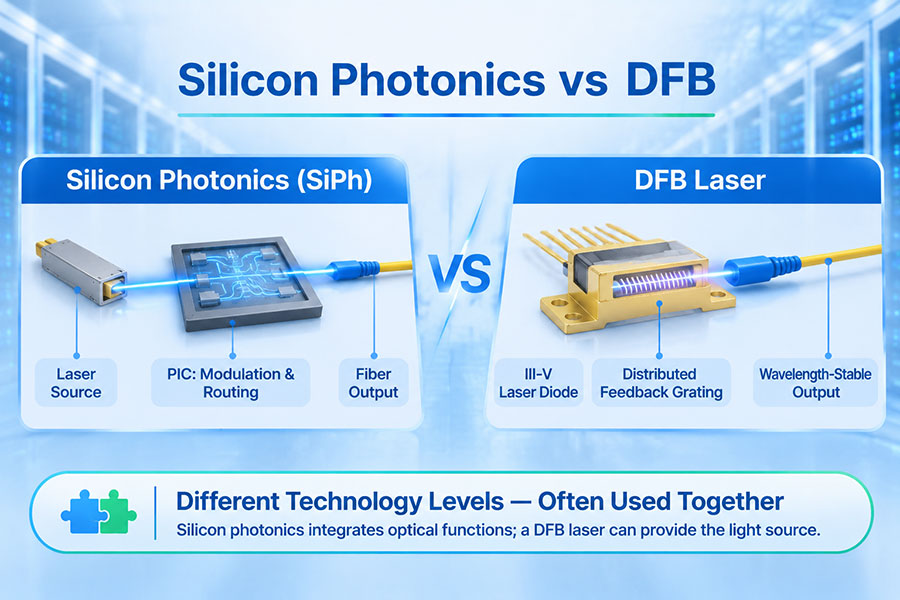
Silicon photonics (SiPh) is an optical integration platform that uses silicon-based photonic integrated circuits (PICs) to perform functions such as light modulation, waveguide routing, multiplexing, and optical detection. Direct detection, commonly implemented as intensity modulation with direct detection (IM-DD), describes a receiver architecture in which a photodetector measures the intensity of the incoming optical signal.
These approaches are not mutually exclusive. A silicon photonic transceiver can use direct detection, while another silicon photonic design can support coherent transmission. The important engineering question is how the photonic integration platform and the signal-detection architecture work together to meet the required bandwidth, distance, power, and cost targets.
1. What Is Silicon Photonics?
Silicon photonics is a technology for integrating optical functions onto a photonic integrated circuit. It uses silicon-based waveguides and optical components to guide, modulate, combine, and detect light within a compact chip.
A silicon photonic integrated circuit may contain several optical functions:
Optical waveguides: Route light between different components on the photonic chip.
Optical modulators: Encode electrical data onto an optical carrier by changing its intensity or phase.
Wavelength multiplexers: Combine multiple optical wavelengths into a shared fiber connection.
Photodetectors: Convert incoming optical signals into electrical current.
Optical couplers: Transfer light between the PIC, laser source, and external fiber.
Polarization components: Split, combine, or manage optical polarization states in more advanced designs.
Silicon itself is not generally used as the light source in conventional fiber-optic communication modules. Many silicon photonic transceivers therefore use an external or hybrid-integrated laser, often based on indium phosphide (InP), to supply the optical carrier.
The photonic circuit then processes this light. Depending on the architecture, the PIC may modulate the optical signal, combine different wavelengths, or perform optical-to-electrical conversion at the receiver.
Common silicon photonic modulator structures include Mach-Zehnder modulators (MZMs), microring modulators, and electro-absorption-based devices such as GeSi EAMs. Different structures offer different combinations of bandwidth, footprint, insertion loss, control requirements, and manufacturing complexity.
2. What Is Direct-Detect Optics?
Direct-detect optics refers to a receiver architecture that detects the optical power of an incoming signal rather than recovering its full optical phase. In conventional IM-DD systems, the transmitter varies the optical intensity to encode data, and a photodiode converts the received optical power into an electrical signal.
The basic signal path is:
Electrical Data → Optical Modulation → Fiber Transmission → Photodetection → Electrical Signal Processing
At the transmitter, a laser generates the optical carrier. A directly modulated laser or an external modulator can encode the electrical signal onto the carrier. At the receiver, a PIN photodiode or avalanche photodiode (APD), depending on the design, converts the incoming optical power into electrical current.
Common modulation formats in direct-detect data center transceivers include:
NRZ: Uses two signal levels to represent binary data and is common in lower-rate optical lanes.
PAM4: Uses four amplitude levels, representing two bits per symbol, to increase the amount of data transmitted at a given symbol rate.
Direct detection is widely used in short-reach and medium-reach optical interconnects because its transmitter and receiver architecture can be simpler than a conventional coherent system.
Direct detection does not mean that a transceiver has no digital signal processing. High-speed IM-DD modules can use DSP, equalization, clock recovery, and forward error correction (FEC) to compensate for signal impairments and improve link performance.
3. Silicon Photonics vs Direct-Detect: Fundamental Differences
The main difference is the engineering layer being described. Silicon photonics concerns how optical functions are integrated, while direct detection concerns how the receiver detects the incoming optical signal.
| Technical Dimension | Silicon Photonics | Direct-Detect Optics |
|---|---|---|
| Technology category | Photonic integration platform | Optical detection architecture |
| Main purpose | Integrates optical functions into a PIC | Recovers transmitted data by detecting optical intensity |
| Optical components | Waveguides, modulators, couplers, multiplexers, and potentially photodetectors | Laser source, optical modulator, fiber interface, and photodetector |
| Light generation | Usually relies on an external or hybrid-integrated laser | Uses a suitable optical source, such as DML, EML, or a CW laser with an external modulator |
| Modulation | Can implement intensity or phase modulation | Conventional IM-DD systems encode data through optical intensity |
| Receiver operation | Can integrate different receiver components, including direct or coherent front ends | Photodetector measures received optical power |
| Phase recovery | Depends on the implemented optical architecture | Conventional IM-DD does not recover the full optical phase information |
| Typical formats | NRZ, PAM4, and coherent IQ modulation can be implemented | Commonly NRZ and PAM4 in high-speed data center applications |
| Typical applications | Data center transceivers, optical interconnects, and coherent optical front ends | Short- and medium-reach Ethernet and data center optical links |
4. How Silicon Photonics Implements Direct Detection
One important application of silicon photonics is the integration of optical transmit and receive functions for IM-DD transceivers. The PIC can contain the components needed to modulate the optical carrier and detect the signal at the opposite end.
In a silicon photonic direct-detect transmitter, the optical source provides continuous-wave light. A silicon photonic modulator then changes the intensity of the carrier according to the electrical data. The modulated signal travels through the fiber to the receiver.
At the receiving end, an integrated photodetector converts the optical signal into an electrical current. A transimpedance amplifier (TIA) converts this current into a usable voltage signal, which is then processed by the receiver electronics and DSP.
A typical silicon photonic IM-DD implementation may include:
An external or hybrid-integrated continuous-wave laser.
A silicon Mach-Zehnder or microring modulator.
Optical waveguides and coupling structures.
Germanium or germanium-silicon photodetectors.
Driver and TIA circuits.
Digital signal processing for equalization and data recovery.
This architecture allows multiple optical functions to be integrated into a compact platform. It can also reduce the need to assemble many separate optical components, depending on the design.
For example, a 400G DR4 transceiver can use a silicon photonic transmitter and receiver while operating as a conventional direct-detection optical link. Its optical data lanes use intensity modulation, and its photodetectors recover the signal without a local-oscillator-based coherent receiver.
5. Direct Detection vs Coherent Detection
Although this article focuses on silicon photonics and direct-detect optics, the distinction between direct and coherent detection is important because silicon photonics can support both architectures.
In a conventional IM-DD receiver, a photodiode measures optical intensity. The receiver does not need a local oscillator or an optical hybrid to recover the signal phase.
A coherent receiver combines the incoming optical signal with a local-oscillator laser. Optical hybrids and balanced photodetectors generate electrical signals that preserve information about the amplitude and phase of the received optical field. Coherent DSP then performs signal recovery and impairment compensation.
| Feature | Direct Detection (IM-DD) | Coherent Detection |
|---|---|---|
| Detected information | Optical intensity | Amplitude and phase, with polarization information in dual-polarization systems |
| Receiver structure | Photodetector and receiver electronics | Local oscillator, optical hybrid, balanced photodetectors, and receiver electronics |
| Typical modulation | NRZ and PAM4 | QPSK, 16QAM, and other coherent formats |
| Signal processing | Equalization, clock recovery, and FEC as required | More extensive DSP for field recovery and transmission impairment compensation |
| Typical reach | Commonly short- and medium-reach links | Commonly metro, DCI, regional, and long-haul links |
| System complexity | Generally simpler receiver architecture | More complex optical and electronic receiver architecture |
| Silicon photonics compatibility | Can integrate intensity modulators and photodetectors | Can integrate IQ modulators, optical hybrids, and photodetectors |
Coherent detection generally supports higher spectral efficiency and improved sensitivity for applications that need to transmit high-capacity signals over longer distances. Direct detection remains attractive for many data center links because it can deliver the required bandwidth with a relatively straightforward optical architecture.
These are common application patterns rather than absolute distance boundaries. Actual reach depends on modulation format, baud rate, fiber dispersion, optical power budget, receiver performance, FEC, and line-system conditions.
6. Bandwidth and PAM4 Transmission in Silicon Photonic Direct-Detect Modules
Data center optical links increasingly use PAM4 to increase the number of bits transmitted per symbol. In PAM4, four optical amplitude levels represent two bits per symbol, compared with one bit per symbol in binary NRZ signaling.
This allows higher data rates without requiring the symbol rate to increase by the same factor. However, the smaller amplitude separation between adjacent PAM4 levels makes the signal more sensitive to noise, distortion, and transmitter or receiver imperfections.
Silicon photonic modulators can support high-speed PAM4 transmission when their bandwidth, linearity, insertion loss, and electrical drive requirements are properly designed.
Important performance factors include:
Modulator bandwidth: Determines how quickly the optical device can respond to electrical data transitions.
Insertion loss: Optical loss through the modulator affects the available transmitter power budget.
Extinction ratio: Influences the distinction between optical signal levels.
Linearity: Helps maintain consistent amplitude spacing between PAM4 levels.
Receiver bandwidth: Determines how accurately the photodetector and TIA can process the incoming waveform.
Equalization: Compensates for frequency-dependent electrical and optical signal distortion.
FEC: Provides error-correction capability when the raw receiver performance is within the required operating range.
As per-lane data rates increase, the electrical and optical design becomes more demanding. Silicon photonic integration can help consolidate the optical components, but the complete module still requires careful optimization of the laser, modulator, driver, photodetector, TIA, DSP, and package.
7. Transmission Distance and Optical Performance
Silicon photonics does not determine the reach of an optical transceiver by itself. Transmission distance depends on the complete optical design, including the laser source, modulator, receiver sensitivity, fiber type, wavelength, and link budget.
Conventional direct-detect optics are widely deployed in data center links over distances ranging from short rack connections to multi-kilometer single-mode fiber routes. Different optical standards use different wavelengths, lane configurations, and fiber interfaces to meet these requirements.
| Optical Type | Typical Fiber | Representative Reach | Common Application |
|---|---|---|---|
| SR / SR8 | Multimode fiber | Up to approximately 100m in common 400G/800G implementations | Short data center connections |
| DR4 / DR8 | Single-mode fiber | Approximately 500m | Switch-to-switch and rack-to-rack connections |
| FR4 / 2×FR4 | Single-mode fiber | Approximately 2km | Longer intra-data-center links |
| LR4 | Single-mode fiber | Approximately 10km | Campus and extended data center links |
| ZR / ZR+ | Single-mode fiber | Application-dependent, often tens to hundreds of kilometers | Coherent DCI and optical transport |
The SR, DR, and FR examples above are commonly implemented using direct-detection architectures. ZR and ZR+ coherent products use a different receiver and signal-processing approach and should not be grouped with conventional IM-DD modules simply because they share a pluggable form factor or product family.
For short and medium distances, direct-detect links can be a practical solution where their optical power budget and dispersion tolerance satisfy the application. For longer distances or spectrally dense transport networks, coherent detection may offer advantages through phase recovery, polarization processing, and DSP-based compensation.
8. Power Consumption, Integration, and Cost
Power consumption is influenced by the complete transceiver architecture, not only by whether the module uses silicon photonics or direct detection. Silicon photonics can integrate multiple optical functions and reduce the number of discrete components in suitable designs. Direct detection can also avoid some of the optical and electronic complexity required by coherent reception.
Potential advantages of silicon photonic integration include:
Compact integration of optical modulators and waveguides.
Integration of multiple wavelength channels on a single photonic circuit.
Potential reduction in discrete optical component count.
Compatibility with scalable semiconductor fabrication processes.
Opportunities to integrate transmit and receive functions on a shared platform.
However, silicon photonic designs also have engineering requirements. Laser coupling, PIC insertion loss, fiber alignment, temperature-sensitive devices, and packaging complexity can affect both power consumption and manufacturing cost.
Direct-detect systems generally have a simpler receiver structure than conventional coherent systems. They do not require a local oscillator and coherent optical hybrid for conventional IM-DD operation. This can help reduce receiver complexity and make direct detection attractive for high-volume data center connectivity.
| Evaluation Factor | Silicon Photonics | Conventional Direct Detection |
|---|---|---|
| Component integration | High potential for integrating optical functions on a PIC | Can use discrete or integrated optical components |
| Receiver complexity | Depends on whether the PIC supports direct or coherent reception | Generally simpler than coherent detection |
| Power consumption | Depends on laser, modulator, control circuitry, and optical losses | Often avoids the power overhead of a full coherent receiver |
| Packaging | Requires precise optical coupling and PIC integration | Depends on the selected laser, modulator, and receiver components |
| Manufacturing cost | Can benefit from wafer-scale integration and production volume | Can be cost-effective for high-volume short-reach applications |
| Thermal requirements | Influenced by laser and PIC characteristics | Influenced by laser, driver, TIA, and DSP operation |
There is no universal rule that silicon photonics always consumes less power or that direct detection is always cheaper. A meaningful comparison must use complete transceiver specifications at the same data rate, reach, operating temperature, and performance target.
9. Silicon Photonics and Direct-Detect Applications in 400G and 800G Networks
Silicon photonics and direct-detect architectures are particularly relevant to modern data center connectivity. As switch and accelerator bandwidth increases, optical transceivers must support higher per-lane rates, compact packaging, and efficient fiber utilization.
400G DR4 and FR4
400G DR4 uses four optical lanes over single-mode fiber, while 400G FR4 uses wavelength multiplexing to carry multiple optical channels over a duplex fiber connection. Both are representative direct-detect data center interfaces.
Silicon photonics can implement the modulators, waveguides, multiplexers, and photodetectors in these kinds of transceivers. A silicon photonic 400G DR4 module is therefore an example of silicon photonics and direct detection operating together, rather than two competing technologies.
800G SR8 and DR8
800G SR8 and DR8 support high-density optical connections inside data centers and AI infrastructure. SR8 is generally used for short multimode fiber links, while DR8 uses single-mode fiber for longer connections.
Silicon photonic integration can support high-speed optical functions in suitable implementations. However, the specific architecture must be confirmed from the module design and datasheet. The optical standard and form factor alone do not prove that a product uses a silicon photonic PIC.
800G 2×FR4
2×FR4 uses two 400G wavelength-multiplexed optical groups within an 800G module architecture. This approach is relevant to longer intra-data-center links where duplex single-mode fiber connectivity is preferred.
For longer-distance DCI, coherent 800ZR modules are a separate architecture. They use coherent modulation and detection rather than conventional direct detection, even though coherent modules may share OSFP or QSFP-DD packaging with IM-DD products.
10. C-LIGHT Direct-Detect Optical Transceiver Solutions
C-LIGHT provides 400G and 800G optical transceiver options for data center, cloud computing, and AI networking applications. The product families cover several parallel-optics and wavelength-multiplexed configurations used in conventional direct-detect network links.
C-LIGHT 400G QSFP-DD Optical Transceiver
The 400G QSFP-DD product family includes SR8, DR4, DR4+, FR4, LR4, and extended-reach DCO configurations. Representative listed models include:
CL400GQDDDR4: 400G, 1310nm, single-mode fiber, 500m, MPO connector.
CL400GQDDDR4+: 400G, 1310nm, single-mode fiber, 2km, MPO connector.
CL400GQDDFR4: 400G, CWDM, single-mode fiber, 2km, LC connector.
CL400GQDDSR8: 400G, 850nm, multimode fiber, 100m, MPO-12 connector.
The DR4, DR4+, FR4, and SR8 variants are relevant to conventional high-speed data center direct-detect links. The same product family also lists DCO models, which use coherent transmission and should be evaluated separately.
C-LIGHT 800G OSFP Optical Transceiver
The 800G OSFP family covers several optical configurations for AI clusters, hyperscale data centers, and high-performance computing networks. Listed configurations include:
800G SR8: Short-reach multimode connectivity, listed up to 100m.
800G DR8: Single-mode parallel optics, listed up to 500m.
800G 2×FR4: Wavelength-multiplexed single-mode transmission, listed up to 2km.
The product family also includes 800ZR coherent solutions. SR8, DR8, and 2×FR4 are relevant to direct-detect data center links, while the ZR variant uses a coherent optical architecture.
These product specifications identify the optical interfaces, fiber types, and listed reaches. They do not by themselves establish the internal photonic integration platform used in each model. Customers requiring a specific silicon photonic implementation should confirm the internal optical architecture for the exact part number.
11. How to Select the Right Optical Architecture
Selecting between different optical transceiver designs requires a system-level evaluation. Silicon photonics should be considered as an integration option, while direct detection should be considered in relation to the required link architecture.
Important selection factors include:
Transmission distance: Determine whether the link is within a rack, between racks, across a data center, or between separate sites.
Data rate: Identify the aggregate bandwidth and required per-lane data rate.
Fiber infrastructure: Confirm whether the network uses multimode or single-mode fiber and whether duplex or parallel-fiber connectivity is available.
Optical standard: Select the appropriate SR, DR, FR, LR, or coherent interface according to the link requirements.
Modulation format: Evaluate NRZ or PAM4 for conventional IM-DD links, or coherent modulation where the application requires it.
Receiver performance: Check sensitivity, overload limits, optical power budget, and the required signal margin.
Power and thermal design: Compare complete module power and verify that switch cooling and port thermal limits are suitable.
Integration requirements: Determine whether a silicon photonic PIC offers useful integration, size, or manufacturing benefits for the required module.
Host compatibility: Verify electrical interface, form factor, management protocol, and equipment compatibility.
For short-reach and medium-reach data center links, conventional direct-detect optics can provide the required capacity without the additional receiver architecture of coherent systems. Silicon photonics can be used to integrate optical functions within these modules.
For DCI, metro, and longer-distance transport, coherent optics may be more appropriate where higher spectral efficiency, sensitivity, and electronic impairment compensation are required. Silicon photonics can also contribute to these coherent systems through integrated modulators and receiver components.
12. Conclusion
Silicon photonics and direct-detect optics describe different aspects of optical communication. Silicon photonics is a platform for integrating optical components, while direct detection is a receiver architecture that recovers data from optical intensity.
Silicon photonic circuits can implement direct-detect transceivers by integrating optical modulators, waveguides, and photodetectors. They can also support coherent optical front ends with IQ modulators, optical hybrids, and other components required for coherent reception.
For 400G and 800G data center networks, direct-detect architectures such as DR4, FR4, SR8, and DR8 provide practical options for short- and medium-reach optical connectivity. Silicon photonics can help integrate the optical functions within these designs, while coherent technologies remain important for higher-capacity and longer-distance transport applications.
The most suitable solution depends on the required bandwidth, fiber distance, modulation format, optical budget, power consumption, and system cost. Evaluating the photonic integration platform separately from the signal-detection architecture provides a more accurate basis for selecting high-speed optical transceivers.
C-LIGHT provides 400G and 800G optical transceiver solutions for data center, AI networking, and high-speed Ethernet applications, including SR, DR, and FR options as well as coherent DCO products. For specific module architecture, product specifications, or equipment compatibility requirements, please Contact C-LIGHT.
 >

 >
 >
 >
 >
 >
 >
 >