TEL:+86 132 6656 7067





The installation environment determines how an optical fiber cable must be constructed. Outdoor routes may expose cables to rain, standing water, sunlight, freezing conditions, temperature fluctuations, soil pressure, and mechanical damage. Indoor routes are generally more controlled, but cables must satisfy building fire-safety requirements and fit the available pathways, risers, ceilings, and equipment spaces.
Outdoor fiber cables therefore commonly use moisture-resistant jackets, water-blocking elements, and stronger mechanical structures. Indoor fiber cables are designed around flame performance, smoke characteristics, manageable dimensions, and convenient termination. Choosing the wrong cable can create problems that are not apparent during initial installation but become important during building inspections, environmental exposure, or long-term network operation.
1. What Is an Outdoor Fiber Optic Cable?
An outdoor fiber optic cable is designed for outside-plant (OSP) installations, including aerial routes, underground ducts, direct-buried networks, and outdoor equipment connections. Its construction protects optical fibers from environmental conditions and mechanical stresses encountered along these routes.
Common outdoor cable designs include loose-tube, central-tube, ribbon, armored, and dielectric constructions. The appropriate structure depends on fiber count, installation method, route conditions, required mechanical strength, and the expected service environment.
Typical outdoor cable features include:
Moisture-resistant outer jacket: Often made from polyethylene (PE) to provide resistance to water and outdoor exposure.
Water-blocking materials: Gel compounds, water-swellable tapes, yarns, or powders help limit water migration along the cable.
UV resistance: Materials are selected to withstand prolonged exposure to sunlight.
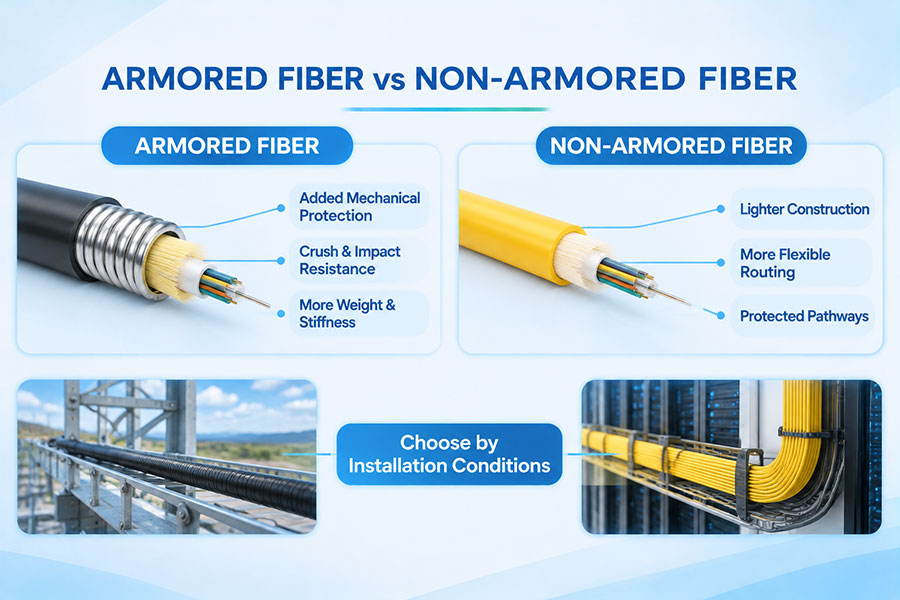
Mechanical protection: Strength members and optional armor help resist pulling forces, crushing, and other installation stresses.
Temperature tolerance: Cable materials and internal structures are selected for the specified outdoor operating range.
Not every outdoor cable includes every feature. For example, aerial cables, duct cables, and direct-buried cables have different structural requirements. A direct-buried cable may require armor or another specified form of mechanical protection, while an aerial cable may need a suitable strength structure for its support and span conditions.
2. What Is an Indoor Fiber Optic Cable?
Indoor fiber optic cables are designed for premises networks, including data centers, enterprise buildings, telecom rooms, office networks, equipment racks, and building backbone connections.
Since indoor cables are normally installed in more controlled environments, their construction focuses on building safety, flexibility, compact dimensions, and ease of installation. Flame-retardant jacket materials and appropriate fire classifications are particularly important.
Common indoor cable constructions include tight-buffered cables, distribution cables, breakout cables, and ribbon cables. These designs support different termination methods, fiber counts, routing arrangements, and installation requirements.
Typical indoor cable characteristics include:
Flame-retardant jacket: Designed to meet the fire-performance requirements applicable to the installation location.
Smoke and material performance: Selected according to relevant building codes and project specifications.
Compact construction: Helps accommodate cable trays, conduits, risers, and high-density equipment spaces.
Flexible handling: Supports routing around racks, patch panels, and building pathways.
Convenient termination: Tight-buffered fibers and suitable cable constructions can simplify connectorization and field installation.
Indoor cables are not all identical. General-purpose, riser, and plenum installations may require different fire ratings. The correct classification depends on the building location and the applicable regional regulations.
3. Outdoor vs Indoor Fiber Cable: Main Differences
The most important difference is the balance between environmental protection and building fire performance. Outdoor cables are optimized for exposure to external conditions, while indoor cables are designed to meet premises installation and safety requirements.
| Feature | Outdoor Fiber Cable | Indoor Fiber Cable |
|---|---|---|
| Primary application | Outside-plant routes and outdoor equipment connections | Building networks, data centers, and equipment rooms |
| Common jacket material | Often PE or another outdoor-qualified material | PVC, LSZH, or other approved premises cable materials |
| Water protection | Often incorporates water-blocking construction | Generally not designed for prolonged water exposure |
| UV resistance | Normally required for exposed outdoor installations | Usually not a primary requirement for conventional indoor cable |
| Flame performance | Depends on cable type and any indoor/outdoor rating | Designed to meet applicable building fire requirements |
| Mechanical protection | May include armor, stronger strength members, or reinforced construction | Designed for indoor pulling, routing, and installation conditions |
| Flexibility and size | Varies by aerial, duct, buried, and other OSP designs | Often optimized for building pathways and high-density routing |
| Typical installation | Aerial, underground duct, direct burial, and outdoor pathways | Racks, trays, conduits, risers, ceilings, and equipment rooms |
| Key selection priority | Weather resistance and mechanical reliability | Fire classification and indoor installation suitability |
4. Jacket Materials: PE, PVC, and LSZH
The cable jacket is an important part of the distinction between indoor and outdoor fiber cables. Its material influences environmental resistance, flexibility, fire behavior, and suitability for particular installation locations.
| Jacket Material | Common Characteristics | Typical Use |
|---|---|---|
| PE (Polyethylene) | Good moisture resistance and suitability for many outdoor environments; UV performance depends on formulation | Outdoor fiber cables |
| PVC (Polyvinyl Chloride) | Available in flame-retardant formulations and widely used in premises cabling | Indoor general-purpose and other rated cables |
| LSZH / LS0H | Designed to reduce smoke and halogen acid gas emissions under specified test conditions | Indoor installations where low-smoke, halogen-free materials are required |
| Specialized indoor/outdoor compounds | Engineered to combine environmental resistance with required indoor fire performance | Indoor/outdoor cable designs |
PE is widely used in outdoor cable jackets because of its moisture resistance and suitability for weather-exposed applications. However, a conventional PE outdoor jacket should not be assumed to satisfy indoor flame requirements.
PVC and LSZH are common choices for indoor cable constructions, but the material name alone does not establish a particular fire rating. The finished cable must be tested and marked for the applicable installation classification.
5. Water Blocking and Moisture Protection
Water protection is one of the defining requirements of many outdoor fiber cable designs. If the outer jacket is damaged, water may enter the cable structure and migrate along its length. This can affect cable components, create problems at closures, and increase the risk of long-term degradation.
Outdoor cables use different water-blocking technologies to reduce this risk:
Gel-filled construction: Water-blocking gel fills spaces within the cable to limit water movement.
Water-swellable tape: Absorbs moisture and expands to restrict water migration.
Water-blocking yarn: Uses moisture-absorbing materials distributed within the cable structure.
Water-blocking powder: Provides a dry alternative in suitable cable constructions.
Dry water-blocking designs can simplify cable preparation compared with traditional gel-filled constructions. However, the choice should be based on the cable's test results and intended application rather than assuming one technology is universally superior.
Conventional indoor cables generally do not need the same longitudinal water-blocking features because they are installed in protected building environments. Indoor cables used in damp or special environments must still follow their specific product and installation requirements.
6. Fire Ratings and Building Installation Requirements
Indoor cable selection must account for the fire-safety requirements of the building. In the United States, optical fiber cables are identified using NEC classifications that distinguish cable construction and intended installation locations.
| NEC Classification | General Application | Installation Consideration |
|---|---|---|
| OFN / OFC | General optical fiber cable classifications | Conductive or nonconductive construction must be considered |
| OFNR / OFCR | Riser-rated optical fiber cables | Used in qualifying vertical pathways between floors |
| OFNP / OFCP | Plenum-rated optical fiber cables | Used in qualifying air-handling spaces and plenums |
| OFNG / OFCG | General-purpose optical fiber cables | Used where the applicable general-purpose rules permit |
The letter "C" identifies a conductive cable construction, while "N" identifies a nonconductive construction. The suffix identifies the relevant application classification. These designations should be checked against the applicable NEC edition, local code, and project requirements.
An outdoor cable with a PE jacket may provide excellent weather resistance but still lack the fire rating needed for unrestricted indoor installation. Do not assume that an outdoor cable can be routed through a building simply because it is physically protected by a conduit.
Where a cable route crosses from outside into a building, the transition arrangement must satisfy the applicable building and fire codes. Depending on the cable's listing and local requirements, this may involve a transition splice, a rated cable section, or a specifically approved indoor/outdoor cable design.
7. Indoor/Outdoor Fiber Cable: One Cable for Both Environments
Indoor/outdoor fiber cables are designed for routes that pass between external pathways and building interiors. They can reduce the need for a separate cable type or transition splice when the selected construction meets the requirements of both environments.
These cables combine outdoor-related features such as moisture resistance and UV stability with the fire performance required for their intended indoor installation. Their construction may use specialized jackets, water-blocking elements, and compact cable structures.
IEC 60794-6 defines an indoor/outdoor cable family with different design categories. These include universal indoor/outdoor cables, flame-retardant outdoor cables, and weatherized indoor cables. They are intended for different installation conditions rather than representing one interchangeable cable type.
| Cable Category | Design Focus | Typical Application |
|---|---|---|
| Universal indoor/outdoor cable | Outdoor environmental performance combined with indoor fire requirements | Continuous routes between outdoor plant and building networks |
| Flame-retardant outdoor cable | Outdoor cable construction with additional indoor fire performance | Routes mainly outdoors with a section entering a building |
| Weatherized indoor cable | Indoor cable construction with added resistance to humidity and UV exposure | Short outdoor extensions from a building to a nearby access point |
IEC 60794-6-30 specifically addresses weatherized indoor cables used in short outdoor environments, including applications where an indoor cable extends a short distance to an external network access point. The permitted distance and installation conditions should be confirmed against the applicable cable specification and local requirements.
8. Loose-Tube vs Tight-Buffered Cable Construction
Fiber cable structure is another important selection factor. Loose-tube and tight-buffered designs are used in different network environments, although neither construction is exclusively limited to one application.
| Feature | Loose-Tube Cable | Tight-Buffered Cable |
|---|---|---|
| Fiber structure | Fibers are housed inside protective buffer tubes | Each fiber has a close-fitting protective buffer coating |
| Common deployment | Outside-plant and building backbone applications | Indoor distribution and equipment connections |
| Environmental design | Can accommodate water-blocking and outdoor cable structures | Often designed for convenient indoor handling and termination |
| Termination | Usually requires additional preparation and fan-out components | Can simplify direct connectorization in suitable designs |
| Installation considerations | Requires attention to tube handling, preparation, and splice organization | Requires attention to bend radius and the cable's mechanical limits |
Loose-tube construction is common in outdoor cables because it can accommodate environmental protection features and multiple fiber groups. Tight-buffered construction is widely used indoors because it supports practical termination and distribution.
The final choice still depends on the complete cable design. Outdoor tight-buffered cables and indoor loose-tube cables are available for specific applications, so construction type alone should not determine installation suitability.
9. Typical Applications of Outdoor and Indoor Fiber Cables
Fiber networks often use several cable types within the same link. An outdoor cable may connect buildings or distribution points, while indoor cables distribute optical signals to racks, switches, patch panels, and end equipment.
| Application | Typical Cable Type | Key Requirement |
|---|---|---|
| Data center rack connections | Indoor fiber cable | Flexible routing and suitable fire rating |
| Building backbone | Indoor or approved indoor/outdoor cable | Fiber capacity and building fire compliance |
| Campus inter-building links | Outdoor or indoor/outdoor cable | Moisture protection and route durability |
| Underground duct networks | Outdoor loose-tube cable | Water blocking and pulling performance |
| Direct-buried routes | Suitable armored or reinforced outdoor cable | Soil, moisture, and mechanical protection |
| Aerial fiber routes | Outdoor aerial cable | Span, tensile load, wind, and weather exposure |
| FTTH distribution | Outdoor drop cable and indoor distribution cable | Transition between access network and premises |
| Industrial equipment connections | Application-rated indoor/outdoor or industrial cable | Temperature, moisture, vibration, and routing conditions |
10. How to Select the Right Fiber Cable
Cable selection should begin with the route and installation conditions rather than fiber count or jacket color alone. The same network may require different cable constructions for underground, aerial, building-entry, and equipment-room sections.
Identify the installation location: Determine whether the cable will be installed indoors, outdoors, underground, aerially, or across multiple environments.
Check the fire classification: Verify the required OFN, OFNR, OFNP, or other applicable rating for the building location.
Evaluate moisture exposure: Confirm whether water-blocking gel, tape, yarn, powder, or another approved construction is needed.
Review UV and temperature requirements: Match the cable's environmental ratings to the actual exposure conditions.
Determine mechanical protection: Consider pulling tension, crush loads, rodent exposure, aerial loading, and the need for armor.
Select the fiber type and count: Confirm single-mode or multimode fiber, connector requirements, and the number of fibers needed for the network.
Check installation dimensions: Review cable diameter, bend radius, weight, duct capacity, and routing space.
Plan the building-entry transition: Confirm that the selected cable and transition arrangement comply with local building codes.
Review the manufacturer's datasheet: Verify operating temperature, installation temperature, tensile rating, crush resistance, water penetration performance, and fire test results.
11. Fiber Cable Protection at Outdoor Network Termination Points
Selecting the correct outdoor cable is only part of building a reliable outside-plant network. Cable entry points, splice locations, and distribution enclosures also need appropriate protection. Water entering through an inadequately sealed closure or cable entry can affect the fiber management system even when the cable itself has suitable water-blocking construction.
Outdoor fiber closures provide enclosed space for organizing cable entries, splice trays, and fiber joints. C-LIGHT's Outdoor Fiber Connector portfolio includes horizontal and dome-style fiber closure configurations for outdoor fiber management. The product range identifies IP67/IP68-rated sealing, UV-resistant reinforced housing materials, and corrosion-resistant components.
A fiber closure is not the same as an outdoor fiber cable. The cable protects the optical fibers along the route, while the closure protects splice and cable-management areas. Both should be selected according to the environmental conditions and installation requirements.
For outdoor fiber routes, FTTH distribution, campus networks, and industrial optical infrastructure, cable construction, closure design, cable-entry sealing, and installation practices should be considered together. For project-specific fiber connectivity requirements, Contact C-LIGHT.
12. Conclusion
Outdoor and indoor fiber cables are designed for different installation environments. Outdoor cables prioritize water blocking, UV resistance, temperature tolerance, and mechanical protection. Indoor cables prioritize flame performance, smoke characteristics, flexibility, and compliance with building installation requirements.
Indoor/outdoor fiber cables provide an option for routes that cross between external plant and building networks, but the specific cable classification and permitted installation conditions must be verified. A suitable cable selection should consider the complete route, environmental exposure, fire regulations, mechanical loads, and termination requirements.
Matching the cable construction to each section of the network helps reduce installation risks and supports reliable optical connectivity throughout the infrastructure.
 >

 >
 >
 >
 >
 >
 >
 >