TEL:+86 132 6656 7067





Optical transceiver procurement involves more than choosing a data rate, wavelength, or transmission distance. Network operators must also determine whether a module is an original product from the equipment brand, a legitimate third-party compatible product, or an unauthorized imitation. These categories can look similar externally, but their manufacturing authorization, product traceability, support arrangements, and quality assurance can be very different.
Original and compatible optical transceivers can both support standardized optical interfaces. A properly engineered compatible module may deliver the required link performance at a lower acquisition cost, while an original product may offer a more direct route to the equipment manufacturer's qualification and support process. The important distinction is whether the product is genuine, technically suitable, and validated for the intended network.
1. What Is an Original Optical Transceiver?
An original optical transceiver is a genuine product supplied under the brand and product identity of a network equipment manufacturer or an authorized product channel. It carries the relevant manufacturer's branding, part number, and product identification, and is subject to the applicable product and support terms.
Original does not necessarily mean that the networking equipment brand physically manufactures every transceiver component. Many branded optical modules are produced by specialist optical manufacturers under contractual manufacturing arrangements. The important point is that the product is genuine and authorized to be sold under the relevant brand.
Original optical transceivers are commonly selected for enterprise networks, telecommunications infrastructure, and data centers where procurement policies require branded components or where operators prefer to follow the equipment manufacturer's documented support process.
2. What Is a Compatible Optical Transceiver?
A compatible optical transceiver is a legitimate third-party product manufactured independently of the network equipment brand. It is designed to meet the applicable optical, electrical, and mechanical interface requirements and may be configured for recognition by a particular equipment platform.
For example, an independent manufacturer may supply SFP+, SFP28, QSFP28, QSFP-DD, or OSFP modules with identification configurations intended for specific Cisco, Juniper, Arista, HPE, or Dell equipment.
Compatible products are not counterfeit simply because they are not manufactured or branded by the equipment vendor. They are independently supplied products with their own manufacturer identity, product documentation, and warranty arrangements.
3. Original vs Compatible Optical Transceivers: Main Differences
| Category | Original Optical Transceiver | Compatible Optical Transceiver |
|---|---|---|
| Product source | Equipment brand or authorized supply channel | Independent optical transceiver manufacturer |
| Branding | Uses the equipment manufacturer's brand | Uses the independent supplier's brand |
| Part number | Official brand-specific part number | Independent product number, sometimes cross-referenced to an OEM application |
| Manufacturing | Manufactured by the brand or its authorized manufacturing partner | Manufactured and supplied independently |
| Host identification | Uses the original product's identification information | May offer platform-specific coding for the target equipment |
| Optical standards | Designed for applicable IEEE, MSA, and other interface specifications | Should meet the same applicable specifications for the intended interface |
| Compatibility validation | Follows the equipment brand's qualification process | Depends on the independent supplier's testing and validation |
| Purchase price | Often higher due to branded product and support arrangements | Often more cost-effective |
| Warranty | Subject to the original brand's applicable warranty terms | Covered by the independent supplier's warranty |
| Technical support | Usually follows the equipment manufacturer's support channel | Provided by the compatible module supplier |
| Multi-vendor sourcing | May require separate branded product lines | Can support multiple equipment brands through different configurations |
These are general differences in product sourcing and support. They do not establish that every original module performs better than every compatible module, or that every compatible module is equivalent to its original counterpart.
4. Original, Compatible, and Counterfeit: Three Different Categories
One of the most important distinctions in optical module procurement is the difference between a genuine original product, a legitimate compatible product, and a counterfeit product. These terms should not be used interchangeably.
| Product Category | Definition | Procurement Consideration |
|---|---|---|
| Original | A genuine product manufactured by or authorized under the equipment brand's product program | Verify the authorized supply channel, part number, and product traceability |
| Compatible | A genuine third-party product independently manufactured for a specified optical application and equipment platform | Verify technical specifications, host compatibility, testing, and supplier warranty |
| Counterfeit | An unauthorized imitation or falsely represented product that misuses another manufacturer's identity or branding | Avoid products with unverifiable origin, misleading labels, or unsupported claims of authenticity |
A compatible module should be identified honestly under its actual manufacturer's name. It should not be sold as an original branded product when it was independently manufactured and has no authorization to carry that brand identity.
5. Optical Performance: Does Original Always Mean Better?
Optical performance is determined by the transceiver's design, components, manufacturing process, and compliance with the relevant interface specifications. The product's branding alone does not determine its optical performance.
When evaluating original and compatible modules for the same application, engineers should check:
Data rate: The supported interface speed, such as 10G, 25G, 100G, 400G, or 800G.
Wavelength: The specified transmit and receive wavelength or wavelength range.
Transmission distance: The supported reach over the required single-mode or multimode fiber.
Transmit power: The minimum and maximum optical output power.
Receiver sensitivity: The minimum optical input level required under specified test conditions.
Optical power budget: The available link budget and permitted channel loss.
Connector type: LC duplex, MPO/MTP, or another specified optical interface.
Power consumption: Typical and maximum power requirements.
Operating temperature: Commercial, extended, or industrial temperature range, as applicable.
Digital diagnostics: Supported monitoring functions and measurement accuracy.
If both products meet the same relevant optical interface specifications and their performance parameters are within the required limits, either may be suitable for the link. Actual equivalence must be demonstrated through datasheet review and appropriate testing.
6. MSA Compliance and Optical Interoperability
Multi-Source Agreements (MSAs) establish common requirements for optical transceiver form factors and interfaces. They allow equipment and module manufacturers to develop products around shared mechanical, electrical, and management specifications.
Different transceiver generations use different standards and management interfaces. Examples include SFF-8472 for many SFP-family modules, SFF-8636 for many QSFP-family modules, and CMIS for several newer high-speed form factors such as QSFP-DD and OSFP.
MSA compliance helps establish standardized interfaces, but it does not guarantee universal compatibility with every switch or router. Equipment manufacturers may implement additional identification checks, supported-module restrictions, firmware dependencies, or platform-specific requirements.
Optical interoperability and host recognition must therefore be evaluated separately. Two modules may implement compatible optical standards while one is not accepted by a particular switch platform.
7. EEPROM Coding and Host Recognition
Optical transceivers contain identification memory that allows the host device to read information about the installed module. Depending on the form factor and management specification, this information may include manufacturer identity, part number, serial number, wavelength, supported data rate, and diagnostic capabilities.
Compatible transceiver suppliers may configure the module's identification information for a specific equipment brand or platform. This process is commonly referred to as vendor coding or compatibility coding.
Correct coding can help a switch recognize and manage a compatible module. However, coding does not change the module's physical optical characteristics. It cannot increase the rated transmission distance, alter the wavelength, or convert an unsupported optical interface into a supported one.
Before ordering, confirm the following information:
Equipment manufacturer and exact switch or router model.
Operating system and firmware version.
Port type and supported transceiver form factor.
Required optical standard and data rate.
Whether third-party modules are accepted under the platform's configuration and support policy.
Whether DDM or DOM monitoring is required.
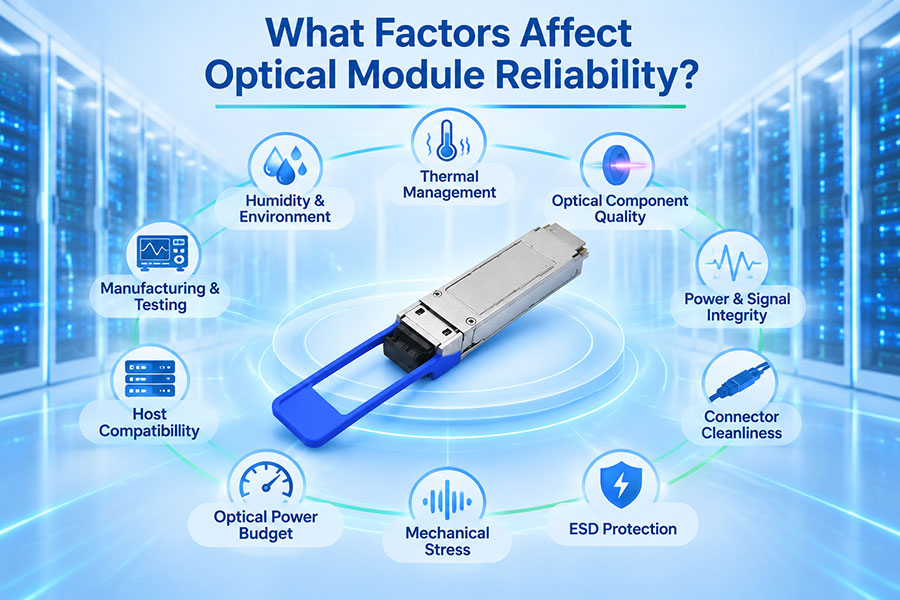
8. Quality Control and Reliability
Quality consistency is an important consideration when choosing between original and compatible optical transceivers. Original products follow the relevant manufacturer's qualification and quality processes. Compatible products depend on the independent supplier's component selection, manufacturing controls, testing procedures, and traceability systems.
For compatible modules, buyers should request evidence of testing that is relevant to the specific product and application.
Optical parameter testing: Verification of transmit power, receiver sensitivity, wavelength, and other specified parameters.
BER testing: Evaluation of bit error performance under defined test conditions.
DDM/DOM verification: Checking temperature, voltage, laser bias current, and optical power monitoring where supported.
Equipment compatibility testing: Testing in the specified switch, router, or network adapter platform.
Interoperability testing: Verifying link establishment and data transmission with the intended remote-end module.
Environmental testing: Confirming performance across the product's specified operating temperature range.
Production traceability: Maintaining serial-number records and test documentation.
Testing should be appropriate to the module's architecture. A 100G QSFP28 SR4 module and an 800G OSFP module have different electrical interfaces, optical lane structures, thermal requirements, and test conditions. A general quality statement is not a substitute for model-specific test evidence.
9. Cost and Total Cost of Ownership
Price is one of the main reasons network operators consider compatible optical transceivers. Original branded modules may carry higher purchase prices, while independent suppliers can offer more competitive alternatives for the same optical application.
For large network deployments, the cost difference across hundreds or thousands of modules can affect the overall project budget. However, purchase price should be evaluated alongside reliability, support, and replacement costs.
Important total-cost factors include:
Initial transceiver purchase price.
Qualification and testing expenses.
Warranty coverage and replacement lead time.
Technical support availability.
Spare-module inventory requirements.
Potential troubleshooting and network downtime costs.
Long-term product availability and supply consistency.
A lower-cost compatible module can be commercially attractive when its specifications, compatibility, and quality are adequately verified. An inexpensive product without reliable documentation or support may create higher operational costs over time.
10. Warranty and Technical Support
Original optical transceivers are generally covered by the applicable warranty and support terms of the equipment manufacturer or authorized sales channel. This can simplify support coordination when the network operator prefers a single vendor for the network equipment and its optical components.
Compatible optical transceivers are covered by the independent supplier's warranty. Buyers should review the warranty duration, replacement procedure, technical support availability, and responsibility for compatibility-related issues.
Third-party module use does not automatically mean that every equipment warranty becomes invalid. Support policies depend on the equipment manufacturer, applicable service agreement, and cause of the reported fault. For example, Cisco's published non-entitlement policy states that it may withhold support under certain circumstances when a reported fault is attributed to unauthorized third-party components. The applicable terms should be reviewed before deployment.
For networks with strict OEM support requirements, original modules may be the preferred option. Compatible products can be considered where third-party modules are permitted and the supplier provides adequate technical documentation and support.
11. Original vs Compatible Modules in Data Centers
Data centers use optical transceivers across server connections, leaf-spine networks, storage infrastructure, and inter-switch links. As port speeds increase, optical module selection becomes an important part of network design and procurement planning.
At 100G and 400G, engineers must consider optical lane configuration, modulation, wavelength, fiber type, and connector arrangement. At 800G and 1.6T, higher bandwidth density and more demanding thermal and electrical requirements make platform validation particularly important.
Compatible modules can support multi-vendor data center environments when they have been qualified for the exact equipment and application. For critical high-speed links, testing should include the intended host platform, software version, remote-end module, fiber infrastructure, and operating conditions.
C-LIGHT offers optical transceiver product families for data center and high-bandwidth network applications, including:
400G QSFP-DD Optical Modules for 400G network connectivity.
400G OSFP Optical Modules for supported OSFP platforms.
800G QSFP-DD Optical Modules for 800G data center links.
800G OSFP Optical Modules for high-density optical connectivity.
1.6T OSFP-RHS Optical Modules for next-generation high-speed network architectures.
Product selection should be based on the target equipment, optical reach, fiber infrastructure, and verified compatibility requirements.
12. How to Choose Between Original and Compatible Optical Transceivers
The right choice depends on network policies, equipment compatibility, project budget, and support requirements. A structured evaluation can reduce the risk of selecting an unsuitable module.
| Selection Factor | What to Verify |
|---|---|
| Product authenticity | Confirm whether the module is original, authorized, or independently manufactured |
| Equipment model | Identify the exact switch, router, or network adapter model |
| Software version | Check the operating system and firmware compatibility requirements |
| Form factor | Confirm SFP, SFP+, SFP28, QSFP28, QSFP-DD, OSFP, or another supported type |
| Optical specification | Verify wavelength, fiber type, reach, connector, and lane configuration |
| Link budget | Check transmit power, receiver sensitivity, and total channel loss |
| Host recognition | Confirm module identification and third-party optic acceptance requirements |
| Quality documentation | Request relevant test records and product traceability |
| Warranty | Review coverage, replacement terms, and support responsibilities |
| Supply capability | Evaluate product availability, lead time, and long-term sourcing stability |
For duplex optical links, both ends must use compatible optical interfaces and operate within the channel's optical power budget. For parallel-optics links, lane mapping, polarity, fiber count, and connector configuration must also be checked. Host recognition at one end does not guarantee that the complete optical link will operate correctly.
13. Conclusion
Original and compatible optical transceivers are two different sourcing options for fiber-optic network infrastructure. Original modules offer genuine equipment-brand product identity and a direct route to the manufacturer's applicable qualification and support arrangements. Compatible modules are independently manufactured alternatives that can provide greater procurement flexibility and lower acquisition costs when their technical specifications and host compatibility are properly validated.
Compatible does not mean counterfeit, and original branding alone does not replace technical verification. Buyers should distinguish genuine branded products, legitimate third-party modules, and unauthorized imitations before making procurement decisions.
The most suitable transceiver is one with verified origin, compliant optical specifications, proven equipment compatibility, consistent quality, and dependable technical support. For optical transceiver requirements across different speeds, form factors, and network platforms, view C-LIGHT optical transceiver products or Contact C-LIGHT for technical assistance.
 >

 >
 >
 >
 >
 >
 >
 >