TEL:+86 132 6656 7067





High-speed optical connectivity in AI data centers depends on more than transmission speed and optical specifications. Host platform recognition, electrical interface requirements, firmware behavior, thermal design, and interoperability testing all influence whether a transceiver operates reliably in a network device. This becomes particularly important when selecting optics for NVIDIA-based AI networking systems and equipment built around Broadcom networking silicon.
NVIDIA-compatible and Broadcom-compatible optics are not necessarily different optical technologies. The distinction primarily concerns the target equipment, compatibility configuration, and validation process. However, the two terms are not perfectly equivalent: NVIDIA provides complete networking platforms, while Broadcom supplies networking semiconductors, PHYs, Ethernet adapters, and other infrastructure components used by multiple equipment manufacturers.
1. What NVIDIA-Compatible and Broadcom-Compatible Optics Mean
NVIDIA-compatible optical transceivers are designed or configured for supported NVIDIA networking equipment. Their target platforms can include NVIDIA Quantum InfiniBand switches, Spectrum Ethernet switches, ConnectX network adapters, and BlueField DPUs, depending on the specific product and application.
NVIDIA's LinkX portfolio includes optical transceivers, direct-attach copper cables, active copper solutions, and other interconnect products developed and validated for its networking platforms. Compatibility is associated with particular product families, port configurations, protocols, and supported hardware generations.
Broadcom-compatible optics require a more specific interpretation. Broadcom develops networking silicon and Ethernet connectivity products, including switch ASICs such as the Tomahawk and Trident families, as well as Ethernet adapter solutions. These components can be integrated into networking equipment manufactured by different system vendors.
Consequently, a transceiver described as Broadcom-compatible may refer to compatibility with a Broadcom-based switch platform, a Broadcom Ethernet adapter, or a particular OEM system using Broadcom silicon. These are not automatically interchangeable compatibility targets.
| Category | NVIDIA-Compatible Optics | Broadcom-Compatible Optics |
|---|---|---|
| Primary ecosystem | NVIDIA networking platforms | Equipment using Broadcom networking components |
| Typical targets | Quantum, Spectrum, ConnectX, BlueField | Broadcom-based Ethernet switches, NICs, and PHY platforms |
| Compatibility focus | Platform recognition, product qualification, protocol, and hardware requirements | Host implementation, ASIC generation, NIC configuration, and OEM system requirements |
| Common applications | AI clusters, InfiniBand fabrics, Ethernet data centers | Cloud data centers, AI Ethernet fabrics, enterprise and carrier networking |
| Validation requirement | Exact NVIDIA hardware and supported interconnect configuration | Exact OEM system, Broadcom component, port configuration, and software environment |
2. Differences in Hardware Platforms and Networking Architecture
The most important distinction is the relationship between the optical module and the host equipment. NVIDIA offers an integrated networking ecosystem in which switches, adapters, DPUs, and interconnect products are designed to work together. Broadcom, in contrast, supplies key networking components that can be incorporated into products from different system manufacturers.
NVIDIA networking platforms
NVIDIA networking includes two major data center switching architectures:
Quantum InfiniBand: Used in high-performance computing and AI fabrics where low latency, high throughput, and advanced fabric management are important.
Spectrum Ethernet: Used in Ethernet-based data center networks, including AI scale-out architectures and conventional cloud infrastructure.
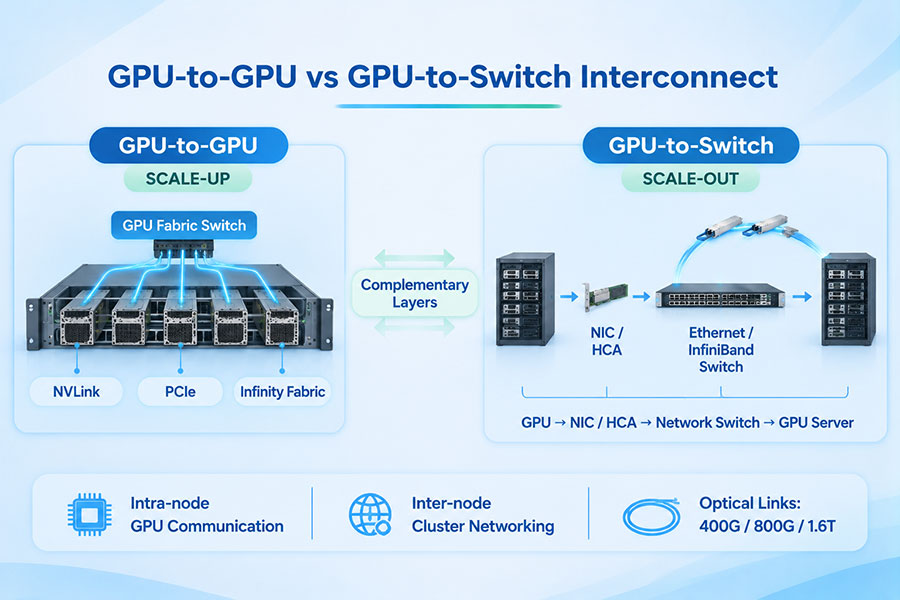
ConnectX network adapters and BlueField DPUs provide additional connectivity options for servers and accelerated computing systems. The required optical module depends on the adapter generation, switch family, port type, signaling rate, and network protocol.
Broadcom-based networking platforms
Broadcom networking silicon is widely used in switching and connectivity products. Examples include:
Tomahawk: A family of high-performance Ethernet switch ASICs used in data center switching architectures.
Trident: A family of Ethernet switch ASICs used in different data center and enterprise networking applications.
Jericho: A networking silicon family associated with scalable routing and switching applications.
Ethernet adapters: Broadcom connectivity products used to connect servers and network equipment.
A switch using a Broadcom ASIC is not necessarily a Broadcom-branded switch. Its operating system, transceiver support policy, port implementation, and compatibility requirements may be determined by the equipment manufacturer. Therefore, identifying the Broadcom ASIC alone is insufficient when selecting a compatible optical transceiver.
3. Optical Module Coding and Host Recognition
Optical transceiver coding is an important consideration when deploying third-party modules. The module's EEPROM or management interface contains identification and capability information that the host can use to recognize the transceiver and determine how to manage it.
Depending on the module form factor and generation, management interfaces and information structures may follow standards such as SFF-8472, SFF-8636, or CMIS. The host platform determines how this information is interpreted and whether the module is accepted, monitored, or flagged with a compatibility warning.
For NVIDIA-compatible optics, the coding and configuration should match the target NVIDIA platform and the specific supported application. A module intended for one NVIDIA switch or adapter generation should not automatically be assumed to work in another generation.
For Broadcom-based equipment, the relevant coding requirements depend on the complete host implementation. Two switches using Broadcom Tomahawk ASICs may have different firmware, management software, port configurations, and transceiver acceptance policies because they are manufactured by different OEMs.
| Technical Factor | NVIDIA-Compatible | Broadcom-Compatible |
|---|---|---|
| EEPROM identification | Configured for the supported NVIDIA platform and product requirements | Dependent on the target OEM equipment or Broadcom adapter platform |
| Host recognition | Depends on switch or adapter model and software | Depends on OEM implementation, NIC firmware, and software |
| Monitoring | Host-supported DOM or module management functions | Host-supported DOM or module management functions |
| Firmware dependency | Platform and release dependent | Platform, OEM software, and adapter firmware dependent |
| Compatibility guarantee | Requires validation for the exact target device | Requires validation for the exact host system and component configuration |
Module coding should not be confused with optical performance. Changing an identification profile does not change the wavelength, modulation format, transmitter output power, receiver sensitivity, or physical reach of the optical hardware. A correctly recognized module can still experience link failures if its optical or electrical characteristics do not match the network.
4. Optical Standards, Data Rates, and Form Factors
Both NVIDIA-based and Broadcom-based networking systems can use standardized optical interfaces, including QSFP28, QSFP-DD, QSFP112, and OSFP. However, the supported form factor and data rate depend on the actual equipment generation and port design.
For example, 400G and 800G data center links may use different electrical lane configurations, optical modulation formats, and transmission architectures. A module with the correct physical connector is not necessarily compatible with every port using that connector.
| Optical Category | Common Form Factors | Typical Applications | Key Selection Factors |
|---|---|---|---|
| 100G optics | QSFP28 | Server connectivity, aggregation, and data center links | 25G NRZ lanes, optical standard, host support |
| 200G optics | QSFP56 | High-speed Ethernet and InfiniBand connectivity | 50G PAM4 lanes, port configuration, protocol |
| 400G optics | QSFP-DD, OSFP | AI clusters and high-density data center switching | 50G or 100G electrical lanes, optical application, FEC |
| 800G optics | OSFP, QSFP-DD800 | Next-generation AI networking and high-capacity switching | 100G electrical lanes, thermal design, port configuration |
| 1.6T optics | OSFP-based implementations | Emerging high-bandwidth AI and data center networks | 200G electrical lanes, host support, power and cooling |
Several optical applications are available within these speed categories:
SR and SR8: Short-reach multimode optical connectivity, commonly used within data center facilities.
DR and DR8: Single-mode parallel optical transmission for short-reach data center connections.
FR and FR4: Single-mode transmission using wavelength multiplexing for longer data center links.
LR: Longer-reach single-mode applications, depending on the specific Ethernet standard and module design.
For example, NVIDIA's published LinkX specifications identify different supported switch and adapter combinations for its 400G and 800G products. Broadcom's 800G PHY portfolio also supports optical applications such as DR8 and 2xFR4. These examples demonstrate that optical interoperability depends on the complete electrical and optical interface rather than the chip vendor name alone.
5. InfiniBand and Ethernet Protocol Requirements
Protocol support is a particularly important consideration when selecting optics for NVIDIA AI networking systems. NVIDIA operates both InfiniBand and Ethernet networking platforms, but not every transceiver or cable supports both protocols.
Some NVIDIA LinkX product families support dual-protocol operation, while other product families are specific to Ethernet or InfiniBand. The supported protocol depends on the particular product generation and part number. The presence of an NVIDIA-compatible label does not automatically mean that the module supports both networking architectures.
Broadcom-based networking deployments are commonly associated with Ethernet switching and Ethernet adapters. In these environments, the selected module must match the Ethernet port speed, lane configuration, optical standard, and host requirements.
| Requirement | NVIDIA Networking | Broadcom-Based Ethernet |
|---|---|---|
| Ethernet | Supported on Spectrum and applicable ConnectX platforms | Supported on compatible Ethernet switch and adapter platforms |
| InfiniBand | Supported on Quantum and applicable adapters and interconnects | Not implied by Broadcom Ethernet ASIC compatibility |
| Dual-protocol optics | Available for selected LinkX product families | Must be confirmed for the specific module and host application |
| FEC requirements | Determined by the port, link standard, and platform configuration | Determined by the Ethernet interface and host configuration |
| Breakout support | Depends on switch port configuration and supported cable or optic | Depends on ASIC capabilities, system implementation, and port configuration |
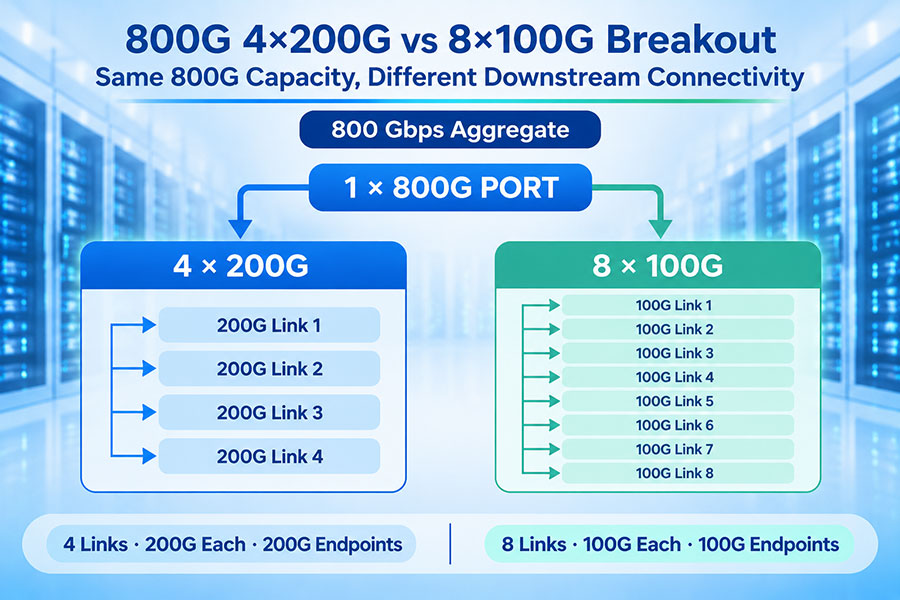
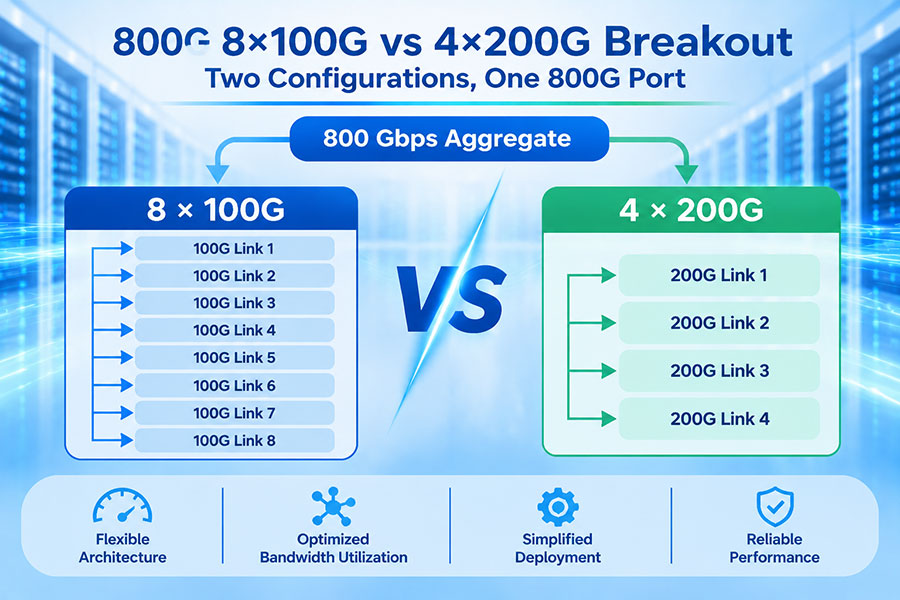
A 400G or 800G module must also match the required lane mapping and breakout arrangement. For example, a 400G port configured as four 100G connections has different connectivity requirements from a single 400G link. The module, fiber assembly, switch configuration, and remote-end interface must all support the intended arrangement.
6. Interoperability Between NVIDIA and Broadcom-Based Equipment
NVIDIA-compatible and Broadcom-compatible optical modules can be used at opposite ends of the same optical link when the complete optical and electrical requirements are satisfied. The two ends do not necessarily need identical vendor coding.
Consider an Ethernet connection between an NVIDIA Spectrum switch and a Broadcom-based Ethernet switch. The local module at the NVIDIA end should be validated for the NVIDIA host, while the module at the Broadcom-based end should be validated for the actual OEM system. The optical interfaces must then be compatible with each other.
Before deploying this type of connection, verify the following:
Protocol: Both devices must operate using the same network protocol, such as Ethernet.
Data rate: Both ends must support the same link speed or a compatible speed configuration.
Optical standard: The transmission applications must be interoperable, such as DR4-to-DR4 or FR4-to-FR4 where the relevant standards and implementations match.
Wavelength: Transmit and receive wavelengths must match the intended optical architecture.
Fiber type: Single-mode and multimode fiber must not be mixed unless the optical system explicitly supports the arrangement.
Connector: MPO, LC, and other connector types must match the transceiver and installed cabling.
FEC: Both endpoints must use compatible forward error correction settings.
Optical power budget: Transmitter output, receiver sensitivity, fiber attenuation, and connection losses must remain within the supported limits.
Host acceptance: Each module must be recognized and supported by its local switch or adapter.
Vendor-specific coding and optical interoperability are separate matters. A module may be correctly coded for an NVIDIA switch but still be unable to establish a link with a Broadcom-based system if the optical applications or link configurations do not match.
7. Thermal Management and Power Considerations
Power consumption and thermal management become increasingly important as data rates rise from 400G to 800G and 1.6T. High-speed transceivers generate heat inside densely populated switch panels, making module cooling characteristics an important part of equipment compatibility.
NVIDIA networking systems may use specific optical module mechanical and thermal designs. For example, NVIDIA documentation distinguishes between integrated heat sink (IHS) and riding heat sink (RHS) transceiver designs for particular systems. These designs address different host cooling arrangements and should not be treated as interchangeable without explicit platform support.
Broadcom-based equipment also requires attention to the thermal and power limits defined by the system manufacturer. A switch built around a Broadcom ASIC may have its own module power restrictions, airflow direction, cage design, and temperature monitoring requirements.
| Parameter | Why It Matters |
|---|---|
| Module power consumption | Must remain within the host port's supported power allocation. |
| Operating temperature | Affects module stability and long-term reliability. |
| Heat sink design | Must match the equipment's mechanical and cooling arrangement. |
| Airflow direction | Influences the cooling performance of high-density optical ports. |
| Port density | High optical density increases the importance of system-level thermal planning. |
For AI clusters with large numbers of 400G and 800G optical links, module-level power and cooling characteristics should be evaluated alongside optical performance and platform compatibility.
8. Selecting the Right Compatible Transceiver
Choosing between NVIDIA-compatible and Broadcom-compatible optics should begin with the equipment model rather than the chipset name or advertised module speed. A clear hardware identification process reduces compatibility risks and avoids unnecessary substitutions.
For NVIDIA equipment, identify whether the target device is a Quantum InfiniBand switch, Spectrum Ethernet switch, ConnectX adapter, or BlueField DPU. Then verify the supported module family, port configuration, protocol, and minimum software or firmware requirements where applicable.
For Broadcom-based equipment, identify the complete system manufacturer and model. If possible, confirm the switch ASIC or adapter model, but do not use the ASIC designation as the only compatibility reference. The system vendor's supported transceiver list and software requirements remain important.
| Selection Step | Information to Confirm |
|---|---|
| 1. Identify the host | Manufacturer, exact switch or adapter model, and hardware generation |
| 2. Confirm the interface | Port speed, form factor, lane configuration, and breakout requirements |
| 3. Define the optical link | SR, DR, FR, LR, fiber type, wavelength, connector, and reach |
| 4. Check platform compatibility | Module coding, host recognition, software, and firmware requirements |
| 5. Verify link interoperability | Remote-end module, FEC, optical power budget, and link configuration |
| 6. Review physical requirements | Power consumption, operating temperature, heat sink, and airflow |
For network operators managing mixed-vendor environments, maintaining separate compatibility records for NVIDIA platforms and each Broadcom-based OEM system can simplify procurement, testing, and future equipment upgrades.
9. C-LIGHT Optical Transceiver Solutions
High-speed data center networks require optical transceivers that match the host platform, optical application, and deployment environment. C-LIGHT provides optical connectivity products across multiple data rates and form factors for data center, enterprise, and AI networking applications.
Relevant product categories include:
400G QSFP-DD Optical Transceivers for high-bandwidth Ethernet connectivity and supported data center applications.
400G OSFP Optical Transceivers for compatible high-density switching platforms.
800G QSFP-DD Optical Transceivers for supported 800G network interfaces.
800G OSFP Optical Transceivers for high-capacity AI and data center interconnects.
1.6T OSFP-RHS Optical Transceivers for next-generation high-bandwidth networking applications.
For NVIDIA and Broadcom-based equipment, compatibility should be checked against the exact device model, port type, software environment, and optical application before ordering. Module coding, host recognition, optical performance, and interoperability testing should be considered together rather than as independent purchasing criteria.
Customers can provide their switch or adapter model, required data rate, optical reach, fiber type, and target application for technical evaluation. For platform-specific requirements and product support, Contact C-LIGHT.
10. Conclusion
NVIDIA-compatible and Broadcom-compatible optics serve different equipment ecosystems, but their underlying optical transmission technologies may follow the same Ethernet standards and multi-source agreements. The main differences lie in the target host platform, module identification, equipment implementation, and validation requirements.
NVIDIA compatibility is generally associated with its Quantum, Spectrum, ConnectX, and BlueField networking platforms. Broadcom compatibility requires identifying the actual switch or adapter using Broadcom networking components, because different OEM systems can implement their own hardware and software requirements.
For reliable high-speed connectivity, the correct approach is to verify the exact host model, module form factor, electrical lane configuration, optical standard, protocol, firmware requirements, and remote-end compatibility. A vendor-compatible label is a useful starting point, but platform-specific validation is what determines whether a transceiver is suitable for a real deployment.
 >

 >
 >
 >
 >
 >
 >
 >