TEL:+86 132 6656 7067





Data center construction is increasingly shaped by deployment speed, power availability, workload density and the need to expand capacity without rebuilding an entire facility. Traditional data centers are generally designed as purpose-built facilities in which the building, electrical system, cooling infrastructure and IT spaces are developed as an integrated project. Modular data centers take a more segmented approach, using standardized or prefabricated infrastructure modules that can be deployed individually or combined as capacity grows.
The difference is therefore broader than whether a data center is built inside a conventional building or a prefabricated enclosure. It affects project planning, construction schedules, capacity expansion, power and cooling design, site requirements, operational flexibility and the way networking infrastructure is deployed.
1. What Is a Modular Data Center?
A modular data center uses pre-engineered modules to provide some or all of the infrastructure required for computing operations. Depending on the design, a module can contain IT racks, power distribution, UPS systems, cooling equipment, fire protection, monitoring systems or other supporting infrastructure.
Modular designs can take several forms, including:
Containerized data centers: IT equipment and supporting systems are installed inside standardized or purpose-built enclosures.
Prefabricated power modules: Electrical distribution, UPS and related equipment are assembled as separate modules.
Prefabricated cooling modules: Cooling systems are designed and assembled as standardized infrastructure blocks.
Modular IT rooms: Racks and supporting infrastructure are deployed in repeatable room or enclosure configurations.
Hybrid modular facilities: A permanent building contains standardized modules for power, cooling and IT capacity.
Modular does not necessarily mean small. A large data center campus can use modular construction principles while eventually reaching substantial IT capacity.
2. What Is a Traditional Data Center?
A traditional data center is normally developed as a purpose-built facility in which the building and its infrastructure are designed around the expected IT load, redundancy level, environmental conditions and operational requirements.
The facility may include dedicated:
Server rooms and data halls
Electrical rooms
UPS systems
Generators
Power distribution equipment
Chillers and cooling systems
Fire detection and suppression systems
Physical security systems
Network rooms and telecommunications spaces
Traditional construction provides considerable freedom to customize the building around a specific site and workload. However, major infrastructure elements are often engineered, constructed and commissioned as part of a longer integrated project.
3. Modular Data Center vs Traditional Data Center: Key Differences
| Factor | Modular Data Center | Traditional Data Center |
|---|---|---|
| Construction approach | Uses standardized, prefabricated or repeatable modules | Primarily constructed as an integrated purpose-built facility |
| Deployment speed | Potentially faster because portions can be manufactured and tested off-site | Usually requires a longer building and infrastructure construction process |
| Customization | Can be customized, but standardized designs are generally favored | High degree of site-specific customization |
| Capacity expansion | Additional modules can be added as demand increases | Expansion may require additional construction and facility modification |
| Site requirements | Can support constrained or distributed deployments depending on module design | Usually requires a dedicated facility with substantial site infrastructure |
| Power architecture | Power systems can be packaged into standardized modules | Electrical infrastructure is typically designed specifically for the facility |
| Cooling | Can use modular cooling blocks or prefabricated systems | Usually designed as an integrated facility cooling system |
| Initial capacity | Can start with a smaller capacity and scale progressively | Often planned around a larger long-term facility capacity |
| Standardization | Generally high | Often lower because systems are highly site-specific |
| Manufacturing | More components can be assembled and tested in controlled factory environments | More work occurs directly at the construction site |
| Best fit | Rapid deployment, incremental capacity and distributed applications | Large permanent facilities requiring extensive customization |
4. Construction and Deployment Speed
One of the strongest advantages of modular construction is the ability to move part of the construction process away from the final site.
Power systems, cooling equipment, racks and other components can be assembled and tested before delivery. Meanwhile, site preparation, foundations and utility work can proceed in parallel.
This parallel workflow can shorten the time between project initiation and operational capacity, particularly when the modular system is based on a repeatable design.
Traditional data center construction can still be preferable when the project requires unusual building geometry, very large-scale infrastructure or extensive customization that cannot easily be standardized.
5. Scalability and Capacity Expansion
Modular architecture is particularly attractive when future demand is difficult to predict. Instead of constructing the maximum expected capacity from the beginning, an operator can establish an initial deployment and add modules as the workload grows.
For example, a facility may initially deploy a limited number of IT racks and associated power and cooling modules. Additional modules can then be added after utilization reaches a defined threshold.
Traditional facilities can also expand incrementally, but expansion may involve:
Building additional data halls
Extending electrical distribution
Increasing cooling capacity
Modifying fire protection systems
Adding generators or UPS systems
Extending structured cabling
Performing construction work around an operating facility
Modular expansion does not eliminate these engineering requirements. Instead, it attempts to make capacity additions more repeatable and predictable.
6. Power Infrastructure
Power is one of the most important constraints in modern data centers. High-density computing, particularly GPU-based AI infrastructure, can increase rack power requirements substantially.
A modular approach can package power distribution, UPS systems, switchgear and related components into repeatable infrastructure blocks. This can simplify deployment when the same electrical architecture is used across multiple capacity stages.
Traditional data centers generally provide more freedom to design the entire electrical system around the site's expected load profile. This can be advantageous for very large facilities or applications with unusual power requirements.
| Power Consideration | Modular Approach | Traditional Approach |
|---|---|---|
| UPS deployment | Can be deployed in standardized capacity blocks | Usually engineered as part of the complete electrical design |
| Capacity growth | Additional power modules can be added | Expansion may require electrical construction and redesign |
| High-density workloads | Can be designed around repeatable high-density modules | Can provide extensive customization for specialized loads |
| Maintenance | Standardized components can simplify replacement and service | Maintenance depends heavily on facility-specific equipment |
7. Cooling Architecture
Cooling design has become increasingly important as server and GPU power densities rise. Both modular and traditional data centers can support air cooling, liquid cooling or hybrid cooling, but the implementation approach can be different.
Modular systems can integrate cooling equipment into repeatable modules. This makes it possible to match cooling capacity to incremental IT deployments instead of building the entire cooling system around a future maximum load.
Traditional data centers often use large centralized cooling plants. This can provide excellent efficiency and capacity when the facility has a stable, predictable load profile and enough space for mechanical infrastructure.
For AI-oriented deployments, cooling requirements can become a major design factor. High-density GPU racks may require liquid-assisted or direct liquid cooling, and both modular and traditional facilities must ensure that power, cooling distribution and rack infrastructure are designed as one system.
8. Networking and Optical Connectivity
Data center networking remains important regardless of whether the facility uses modular or traditional construction. The physical infrastructure may be modularized, but the IT network still needs predictable bandwidth, low latency and appropriate redundancy.
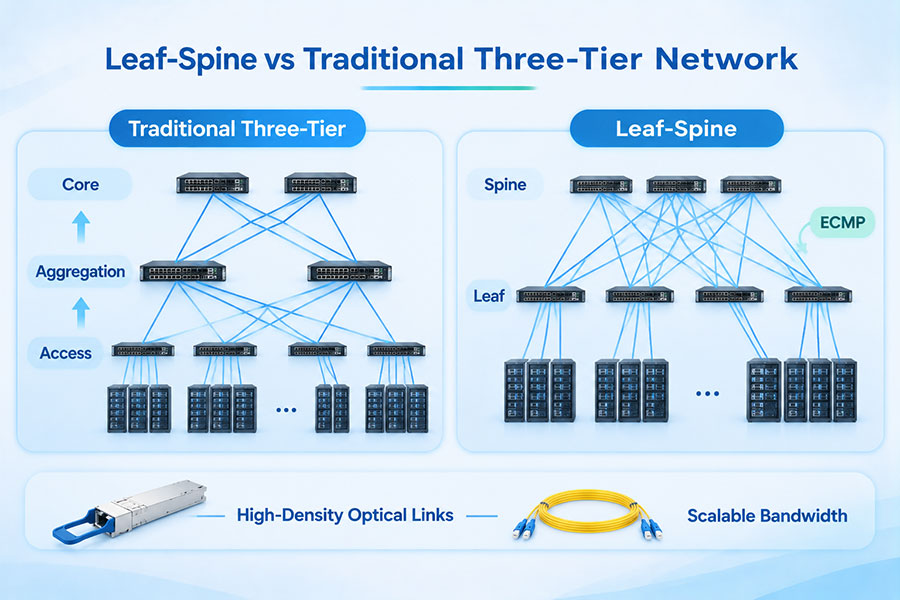
Inside a modular data center, optical connectivity can be deployed between servers, top-of-rack switches, aggregation systems and upstream network equipment. When multiple modules are interconnected, additional fiber links may be required between IT modules, network modules and external facilities.
Traditional data centers generally provide larger dedicated spaces for structured cabling, patching and high-density network fabrics. This can be useful for very large-scale deployments with substantial numbers of 400G or 800G links.
C-LIGHT provides optical transceiver solutions for data center and high-speed network applications. Depending on the architecture, products such as 400G optical transceivers and 800G optical transceivers can support high-bandwidth connections between switches, servers and data center network layers.
For short-reach rack connectivity, C-LIGHT also offers DAC and AOC solutions, which can be used where the required distance and equipment interface are appropriate.
| Network Requirement | Modular Data Center | Traditional Data Center |
|---|---|---|
| Server-to-switch connectivity | Usually concentrated within individual modules | Integrated into larger structured cabling architecture |
| Module-to-module links | Can become important as modules are added | Usually part of the planned facility network fabric |
| High-speed optics | Can support 100G, 400G, 800G and higher-speed architectures | Can support very high-density optical fabrics |
| Fiber management | Standardized routing can simplify repeatable deployments | Highly customizable based on facility layout |
| Expansion | Network capacity can be extended with additional modules and uplinks | Expansion can involve additional cabling and network infrastructure |
9. Physical Footprint and Site Flexibility
Modular data centers can be attractive when conventional data center construction is difficult because of limited space, remote locations or deployment deadlines.
Depending on the design, modules can be deployed inside existing buildings, on industrial sites or as dedicated outdoor enclosures. This makes modular architecture relevant to edge computing, telecommunications, manufacturing and temporary or rapidly expanding capacity.
Traditional data centers generally require a larger purpose-built site. The larger footprint can, however, provide more flexibility for long-term infrastructure expansion and facility-level optimization.
10. Standardization and Manufacturing
Modular data center construction shifts more of the engineering process toward standardized designs and factory assembly.
This can provide several advantages:
Repeatable engineering
Factory-controlled assembly
Pre-deployment testing
Consistent component selection
Predictable installation procedures
Reduced site work for certain infrastructure elements
Faster replication across multiple locations
Traditional construction provides more freedom to optimize each facility around its specific site. This flexibility can be valuable when architectural, electrical, mechanical or environmental conditions differ substantially from one project to another.
11. Reliability and Maintenance
Reliability does not depend solely on whether a data center is modular or traditional. Redundancy design, equipment quality, maintenance procedures, power architecture, cooling architecture and operational discipline are more important factors.
Modular systems can benefit from standardized equipment and repeatable maintenance procedures. A failed module or component may be easier to isolate when the architecture has clearly defined functional blocks.
Traditional facilities can provide extensive redundancy and serviceability because power, cooling and network systems can be designed specifically around the facility's operational requirements.
For both architectures, optical connectivity is another area where component quality and compatibility matter. High-speed optical transceivers should be evaluated against the switch platform, optical reach, fiber type, temperature range and required performance rather than selected solely according to nominal data rate.
12. Deployment Cost and Total Cost of Ownership
It is difficult to state that modular data centers are always cheaper than traditional facilities. The economics depend on site conditions, scale, design standardization, local construction costs, power availability, cooling requirements and the number of deployment sites.
Modular architecture can reduce costs in situations where:
Capacity needs to be deployed quickly.
The same design will be replicated across multiple sites.
Future capacity requirements are uncertain.
Factory assembly reduces site labor.
Infrastructure can be added incrementally.
A traditional facility may become economically attractive when a large amount of capacity is required at one location and the site can support a purpose-built facility with long-term utilization.
| Cost Factor | Modular Data Center | Traditional Data Center |
|---|---|---|
| Initial deployment | Can be lower when only partial capacity is required initially | Potentially higher because a larger facility is built up front |
| Replication | Strong advantage when standardized designs are repeated | Each new facility may require substantial engineering |
| Expansion | Can be incremental | May require additional construction |
| Site labor | Can be reduced through factory assembly | More construction work occurs on-site |
| Customization | Customization can increase cost and reduce modularity | High customization is part of the normal design process |
13. Modular Data Center Use Cases
Modular architecture is especially useful when capacity must be deployed quickly, repeatedly or in locations where conventional construction is inconvenient.
Edge computing: Compact infrastructure can be deployed closer to users and devices.
5G infrastructure: Computing and networking capacity can be positioned near telecom access networks.
Industrial sites: Local computing can support manufacturing, machine vision and industrial analytics.
AI capacity expansion: Additional high-density compute blocks can be introduced as demand grows.
Remote locations: Prefabricated infrastructure can reduce the amount of construction work required at the final site.
Temporary capacity: Modular systems can support projects where capacity requirements are time-limited or uncertain.
14. Traditional Data Center Use Cases
Traditional construction remains highly relevant for large, permanent facilities where the operator needs maximum control over architecture and long-term infrastructure planning.
Hyperscale cloud facilities
Large enterprise data centers
Major colocation facilities
Large AI and HPC campuses
Facilities with specialized cooling requirements
Sites requiring extensive electrical redundancy
Long-term high-capacity infrastructure projects
At this scale, a purpose-built facility can justify the engineering investment because the infrastructure will operate for many years and support substantial IT capacity.
15. Modular and Traditional Construction Can Be Combined
The choice does not have to be binary. Many modern facilities use a hybrid approach in which the building is constructed traditionally while critical infrastructure is delivered through modular or prefabricated systems.
For example, a large data center may use a permanent building shell but deploy standardized power rooms, cooling modules and IT pods. This approach retains the structural flexibility of traditional construction while introducing modularity into the infrastructure layers that benefit most from standardization.
Site and foundation
Structural building
Data hall space
Permanent utility connections
Power modules
Cooling modules
IT pods
Network modules
This hybrid model can be particularly attractive for data centers that need to scale over several construction phases while maintaining a consistent infrastructure architecture.
16. How to Select the Right Architecture
The decision should start with the expected workload, deployment schedule and future expansion requirements.
Rapid deployment is important.
Capacity will grow in stages.
The same architecture will be deployed at multiple sites.
Site space or construction conditions are constrained.
Edge or remote deployment is required.
Standardization can reduce engineering effort.
A large permanent facility is required.
The site can support extensive construction.
Highly customized power and cooling systems are required.
Long-term capacity is relatively predictable.
Facility-level optimization is more important than rapid replication.
The project requires extensive architectural flexibility.
17. Conclusion
Modular data centers and traditional data centers differ mainly in how infrastructure is designed, manufactured, deployed and expanded. Modular architecture emphasizes standardized building blocks, factory assembly, rapid deployment and incremental scaling. Traditional data center construction provides greater freedom to design the entire facility around a specific site, workload and long-term capacity requirement.
For rapidly growing AI, edge computing, 5G and distributed infrastructure, modular deployment can provide a practical way to add capacity without waiting for an entire large facility to be completed. For large permanent cloud, enterprise, colocation and HPC environments, traditional construction can provide the customization and infrastructure scale required by the application.
In many modern deployments, the most practical solution is a hybrid architecture that combines a permanent facility with modular power, cooling, IT and networking systems. Regardless of the construction model, high-speed optical connectivity remains a key part of the data center network. C-LIGHT provides optical transceivers, 400G solutions, 800G solutions and DAC/AOC connectivity for suitable data center applications.
For optical connectivity requirements, equipment compatibility or customized data center solutions, Contact C-LIGHT.
 >

 >
 >
 >
 >
 >
 >
 >