TEL:+86 132 6656 7067





Optical communication systems increasingly require higher bandwidth, smaller footprints, and more efficient use of electrical and optical interfaces. Traditional designs achieve these functions through separately packaged lasers, modulators, photodetectors, filters, and other optical devices. Integrated photonics takes a different approach by combining multiple optical functions on a shared chip or substrate, connecting them through on-chip waveguides.
Integrated and discrete photonics are not simply two generations of the same technology. They represent different engineering approaches with distinct advantages in component selection, optical performance, packaging, manufacturing, and scalability. Integrated photonics supports compact and multifunctional optical circuits, while discrete photonics provides greater freedom to select individual devices and material platforms for specific requirements.
1. What Is Integrated Photonics?
Integrated photonics is a technology approach in which multiple optical functions are fabricated or assembled on a common substrate to form a photonic integrated circuit (PIC) or integrated optical system. Instead of connecting every optical device through separate fiber or free-space interfaces, the components communicate through optical waveguides and integrated structures.
A PIC can incorporate different combinations of the following functions:
Optical waveguides: Confine and guide light between functional elements on the chip.
Laser sources: Generate optical carriers, either through integrated active materials or externally coupled laser devices.
Optical modulators: Convert electrical data signals into modulated optical signals.
Photodetectors: Convert received optical signals into electrical current.
Optical filters: Select specific wavelengths or suppress unwanted optical signals.
Multiplexers and demultiplexers: Combine or separate wavelength channels in WDM systems.
Optical splitters and combiners: Distribute or combine optical power across different paths.
Optical switches: Control signal routing within integrated optical networks.
The degree of integration depends on the application and fabrication platform. Some PICs combine only passive optical functions, while others integrate active devices such as lasers, amplifiers, modulators, and photodetectors. Electrical driver circuits and control electronics may remain on separate dies or be integrated through electronic-photonic co-integration.
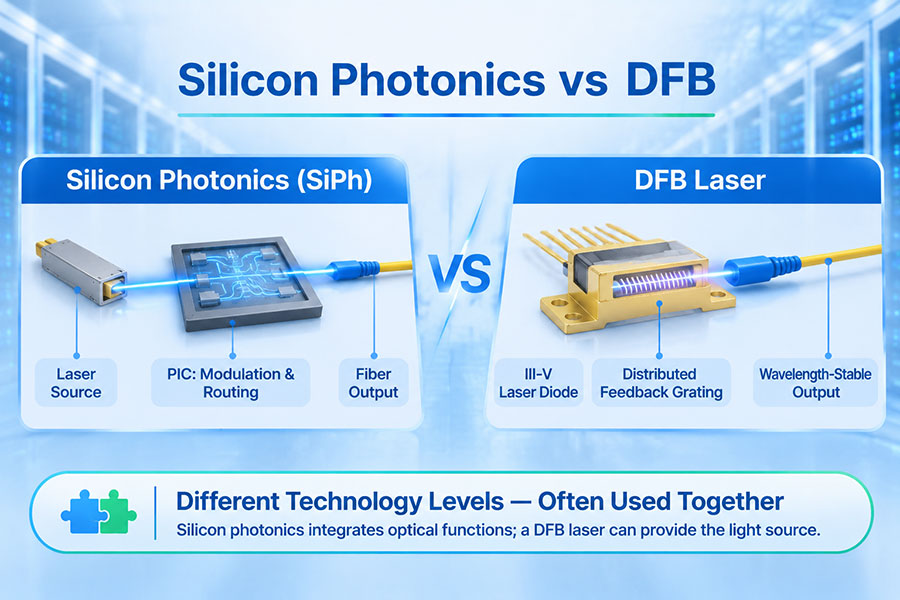
Integrated photonics includes several material platforms, not just silicon photonics. Indium phosphide (InP), silicon-on-insulator (SOI), silicon nitride (SiN), and thin-film lithium niobate are among the technologies used to implement different optical functions.
2. What Is Discrete Photonics?
Discrete photonics uses individual optical components to perform separate functions within a larger optical system. Each device is manufactured and packaged independently, then connected through optical fibers, free-space paths, electrical connections, or mechanical interfaces.
A discrete optical transmitter may contain a separately packaged laser, modulator, optical isolator, and coupling assembly. A receiver may use an independent photodetector, optical filter, and associated optical interface. The exact arrangement depends on the transmission standard, wavelength, data rate, and required optical performance.
Common discrete photonic components include:
DFB laser diodes: Provide stable optical carriers for fiber-optic transmission.
EML devices: Combine a laser source and electro-absorption modulator in a compact device.
PIN and APD photodiodes: Convert incoming optical power into electrical signals.
Electro-optic modulators: Modulate optical signals using materials such as lithium niobate.
Optical amplifiers: Increase optical signal power in applications requiring additional gain.
Optical filters: Select or reject particular wavelength ranges.
Optical isolators: Reduce unwanted optical feedback into sensitive light sources.
WDM multiplexers and demultiplexers: Combine or separate optical channels using dedicated optical devices.
Discrete designs allow engineers to select each device according to its own specifications. A laser can be chosen for wavelength stability and output power, a modulator for bandwidth and modulation performance, and a detector for responsivity and sensitivity. This independence is useful when one material platform cannot provide every required optical function at the desired performance level.
3. Integrated Photonics vs Discrete Photonics: Key Differences
The main difference is the way optical functions are implemented and interconnected. Integrated photonics consolidates multiple functions into a common optical circuit, while discrete photonics distributes them across separate devices.
| Technical Aspect | Integrated Photonics | Discrete Photonics |
|---|---|---|
| Architecture | Multiple optical functions share a chip or integrated substrate. | Individual optical functions are implemented by separate devices. |
| Optical Interconnection | Primarily uses on-chip waveguides between integrated elements. | Uses fibers, lenses, free-space paths, and packaged optical interfaces. |
| Material Platforms | May use silicon, InP, SiN, lithium niobate, or heterogeneous combinations. | Allows independent selection of materials for individual components. |
| Integration Density | Can provide high functional density within a compact footprint. | Physical size generally increases as more separately packaged devices are added. |
| Component Selection | Must account for compatibility with the selected integration process. | Individual components can be selected from different technology platforms. |
| Assembly | Reduces some internal alignment and interconnection steps. | May require more individual alignment and optical connection operations. |
| Manufacturing | Can use wafer-level fabrication and repeatable integrated processes. | Involves separate device production, packaging, and system assembly. |
| Design Flexibility | Depends on the available platform, process design rules, and integration options. | Offers greater freedom to combine specialized devices. |
| Typical Strength | Compactness, functional integration, and scalable optical circuits. | Specialized device performance and flexible component selection. |
| Typical Challenge | Fabrication compatibility, coupling, thermal control, and integrated yield. | Component count, optical alignment, interconnection, and assembly complexity. |
These differences are general architectural tendencies rather than universal performance rules. An integrated circuit does not automatically outperform a discrete assembly, and a discrete design is not necessarily larger or less reliable in every application. The actual result depends on component technology, circuit design, packaging, and manufacturing quality.
4. Integration Approaches and Material Platforms
Integrated photonics is a broad field with multiple integration methods. The material platform determines which optical functions can be implemented efficiently, while the integration method determines how different devices and materials are combined.
Monolithic integration places multiple photonic functions on the same chip using a common fabrication platform. This approach can reduce the number of separately packaged components and optical interfaces. InP is particularly important because it supports active optical functions, including laser generation and amplification, alongside other photonic devices.
Hybrid integration combines separately fabricated optical components or chips into one assembly. Different platforms can be selected for different functions, such as combining an InP laser with a silicon photonic circuit or connecting a low-loss SiN circuit to another active photonic device.
Heterogeneous integration incorporates different material systems onto a common substrate or chip through techniques such as bonding and material transfer. It can combine the advantages of different materials while reducing the limitations of relying on one platform alone.
| Technology Platform | Main Characteristics | Typical Functions |
|---|---|---|
| Silicon Photonics | High-index-contrast waveguides and compatibility with established semiconductor fabrication processes. | Optical routing, modulation, multiplexing, and photonic integration. |
| Indium Phosphide (InP) | Supports active optical devices and monolithic integration of several transmitter and receiver functions. | Lasers, optical amplifiers, modulators, and photodetectors. |
| Silicon Nitride (SiN) | Low propagation loss and broad optical transparency. | Passive routing, filters, resonators, and wavelength management. |
| Thin-Film Lithium Niobate | Strong electro-optic properties and high-speed modulation potential. | High-performance optical modulators and signal processing. |
| Hybrid or Heterogeneous Platforms | Combine different materials to support functions that are difficult to optimize on one substrate. | Integrated lasers, advanced modulators, optical routing, and multifunctional PICs. |
There is no single material platform that provides the best performance for every photonic function. Material selection is therefore a central part of integrated photonics design. A system may use one platform for low-loss waveguides and another for efficient light generation or high-speed modulation.
5. Optical Performance and Signal Quality
Optical performance depends on the characteristics of the individual devices and the complete optical path. Integrated photonics can reduce the number of external optical interfaces between functional elements, but the PIC introduces its own waveguide, coupling, and fabrication considerations.
For integrated designs, engineers need to evaluate:
Waveguide propagation loss: Optical power lost as light travels through the integrated circuit.
Coupling loss: Power loss when light transfers between a fiber, laser, detector, or waveguide.
Modulator performance: Bandwidth, drive voltage, extinction ratio, and insertion loss.
Wavelength stability: Sensitivity of filters and resonant structures to temperature and fabrication variations.
Optical crosstalk: Unwanted coupling between adjacent channels or waveguides.
Photodetector characteristics: Responsivity, bandwidth, noise, and receiver sensitivity.
Discrete photonics offers the ability to select individual devices with characteristics suited to a particular link. A specialized laser, modulator, or detector can be chosen without requiring all other functions to use the same fabrication process.
However, every additional optical interface can introduce insertion loss, alignment sensitivity, and potential variation. The overall link performance must account for the combined effect of all components and connections.
Neither architecture guarantees lower bit error rate (BER), higher receiver sensitivity, or better transmission distance by itself. These parameters depend on the optical power budget, modulation format, transmitter quality, receiver design, fiber characteristics, and signal-processing implementation.
6. Manufacturing, Packaging, and Reliability
Integrated photonics can simplify optical assembly by reducing the number of separately packaged devices and internal optical connections. Wafer-level fabrication also supports repeatable production of photonic circuits, provided that the design and manufacturing process achieve suitable yield.
Discrete photonics typically involves more individual component handling and alignment. Each device must be positioned and connected correctly, and the optical interfaces must remain stable during packaging and operation.
However, integration does not eliminate packaging challenges. Integrated optical devices still require reliable fiber coupling, electrical connections, mechanical protection, and thermal management. Hybrid and heterogeneous designs can also introduce additional material interfaces and bonding requirements.
Reliability evaluation should consider:
Temperature cycling and thermal stress.
Laser aging and optical output stability.
Waveguide and fiber coupling stability.
Mechanical vibration and shock resistance.
Electrical interconnect and bonding integrity.
Moisture protection and package sealing.
Manufacturing variation and production testing.
A reduction in component count may remove some potential failure interfaces, but it does not establish a universal reliability advantage. Qualification testing and long-term operating data remain essential for both integrated and discrete optical products.
7. Power Consumption and Thermal Management
Power consumption is determined by the complete optical system rather than by integration level alone. Integrated photonics can reduce some interconnection losses and support compact optical engines, but active optical devices, electronic drivers, control circuits, and thermal tuning elements still consume power.
For example, silicon photonic circuits may use heaters to adjust resonant wavelengths or stabilize optical filters. These tuning circuits can contribute to power consumption, particularly when several channels require temperature compensation.
Discrete systems also have different power requirements depending on the selected laser, modulator, amplifier, and receiver. A directly modulated laser, an externally modulated transmitter, and a separate electro-optic modulator do not have identical electrical or thermal characteristics.
Thermal management becomes especially important in high-density optical engines. The location of heat-generating devices, thermal resistance between components and the package, and temperature sensitivity of the optical circuit all affect performance.
When evaluating an optical transceiver, buyers should use measured module power consumption and operating-temperature specifications. Integration level alone is not a reliable indicator of energy efficiency.
8. Application Scenarios
Integrated and discrete photonics are both used in optical communications, sensing, industrial systems, and specialized photonic equipment. Their application suitability depends on the required combination of integration density, optical performance, flexibility, and production volume.
Integrated photonics is particularly relevant to:
High-speed optical transceivers: Integrated transmit and receive functions can support compact multi-lane optical architectures.
WDM communication systems: Integrated multiplexers and demultiplexers can reduce the number of separately packaged wavelength-management devices.
AI data-center networks: High-density optical engines support increasing bandwidth requirements between switches, accelerators, and computing systems.
Co-packaged and near-packaged optics: PICs can provide the optical engine in architectures that position optics close to electronic switching or computing devices.
Integrated optical sensors: Compact waveguides, resonators, and interferometers enable multifunctional sensing circuits.
Discrete photonics remains valuable in:
Specialized laser systems: Individual sources can be selected for specific wavelengths, output powers, and linewidth requirements.
High-performance optical modulation: Dedicated modulator technologies can provide characteristics suited to demanding signal formats.
Custom optical instruments: Separate components offer flexibility in system configuration and replacement.
Research and development: Individual optical devices can be evaluated and changed without redesigning an entire PIC.
Application-specific communication equipment: Discrete devices can be selected for specialized transmission, environmental, or interface requirements.
These categories are not exclusive. Integrated photonics can include discrete lasers and other external devices, while discrete optical systems can incorporate integrated subassemblies such as filters or waveguide chips.
9. Can Integrated and Discrete Photonics Be Combined?
Yes. Modern optical systems frequently combine integrated photonic circuits with separately packaged optical and electronic components. This approach allows designers to integrate functions that benefit from compact waveguide connections while retaining separate devices where specialized performance or manufacturing flexibility is important.
A hybrid optical engine may contain:
A PIC with waveguides, modulators, splitters, and wavelength-management functions.
A separately manufactured laser coupled to the photonic circuit.
Discrete driver and receiver ICs connected to the optical engine.
External fiber arrays or fiber-attach units for optical input and output.
Thermal-control circuits and monitoring components.
This arrangement is especially relevant to high-speed optical transceivers. The integrated circuit handles multiple optical functions, while external devices provide light generation, electrical signal processing, and optical connectivity.
Hybrid integration also helps overcome limitations of individual material platforms. For example, silicon provides effective optical routing and integration, while III-V materials provide efficient light generation. SiN can offer low-loss passive waveguides, while lithium niobate can provide strong electro-optic modulation.
10. How to Select the Right Photonic Architecture
Choosing between integrated and discrete photonics requires an assessment of the optical system's performance targets, manufacturing conditions, and lifecycle requirements. Integration density is important, but it should not override the requirements of the optical link.
| Selection Factor | Key Evaluation Points |
|---|---|
| Data Rate | Required aggregate bandwidth, lane rate, modulation format, and signal integrity. |
| Transmission Distance | Short-reach, campus, metro, or long-haul link requirements. |
| Wavelength Plan | Single-wavelength operation, CWDM, DWDM, or coherent wavelength control. |
| Optical Budget | Transmitter output power, receiver sensitivity, insertion loss, and fiber attenuation. |
| Material Requirements | Laser efficiency, modulator performance, waveguide loss, and detector characteristics. |
| Power and Cooling | Module power limits, thermal resistance, operating temperature, and cooling capacity. |
| Production Volume | Wafer-level manufacturing economics, component availability, and assembly yield. |
| Packaging | Fiber coupling, mechanical alignment, electrical interfaces, and environmental protection. |
| Maintenance | Component replacement, product qualification, repair strategy, and lifecycle support. |
For optical transceiver applications, the final selection should also verify the form factor, host-device compatibility, fiber type, connector interface, optical reach, power consumption, and operating-temperature range. Two modules with the same data rate and external form factor may use different internal photonic architectures while providing the required network interface.
11. Integrated Photonics and C-LIGHT Optical Connectivity
As optical networks move toward higher data rates and denser interconnects, transceiver selection increasingly requires attention to the complete optical link. The internal photonic architecture is only one part of the product. Transmission distance, wavelength, fiber type, connector configuration, optical power budget, host compatibility, and thermal conditions all influence system performance.
C-LIGHT provides optical transceiver solutions for different network data rates and application requirements. Its optical transceiver portfolio covers product categories used in fiber-optic communication systems. For a specific project, product selection should be based on verified datasheets and compatibility requirements rather than assuming that a module uses a particular integrated or discrete photonic design.
For high-speed data-center, enterprise, telecom, and industrial networks, evaluating the complete transmission path helps ensure that optical components meet the required performance and deployment conditions.
Planning an optical connectivity project?
Contact C-LIGHT for assistance with optical transceiver selection, product specifications, and compatibility requirements.
12. Conclusion
Integrated photonics combines multiple optical functions on a common chip or substrate, supporting compact architectures, dense optical routing, and scalable manufacturing. Discrete photonics uses independent optical devices, allowing engineers to select specialized components and material technologies according to individual performance requirements.
Neither approach is universally superior. Integrated designs can reduce internal optical interconnections and simplify certain assembly processes, while discrete designs retain advantages in component flexibility and specialized device selection. Hybrid and heterogeneous integration increasingly combine both approaches to balance optical performance, manufacturing efficiency, and system-level requirements.
For modern optical communication systems, the most suitable architecture is the one that meets the required bandwidth, optical budget, power consumption, thermal conditions, reliability, and cost targets throughout the product lifecycle.
 >

 >
 >
 >
 >
 >
 >
 >