TEL:+86 132 6656 7067





As GPU clusters become larger and AI models require more distributed computing resources, network communication has become a critical factor in overall system performance. GPUs in different servers must exchange gradients, activations, model parameters, and other data during distributed training. The network connecting these GPUs can directly affect communication latency, GPU utilization, and training efficiency.
InfiniBand and RoCE (RDMA over Converged Ethernet) are two major technologies used to build high-performance GPU cluster networks. Both support Remote Direct Memory Access (RDMA), which reduces conventional host networking overhead and enables efficient data movement between systems. However, they use different network architectures and have different requirements for congestion management, routing, hardware, and operations.
InfiniBand provides native RDMA over a dedicated fabric, while RoCE enables RDMA communication over Ethernet. Understanding these differences helps infrastructure teams select an appropriate network architecture for AI training, high-performance computing, and large-scale GPU deployments.
1. Why GPU Clusters Need High-Performance Networking
A GPU cluster consists of multiple servers connected through high-speed networks. Each server may contain several GPUs, and workloads can distribute computation across GPUs within one server and across multiple servers.
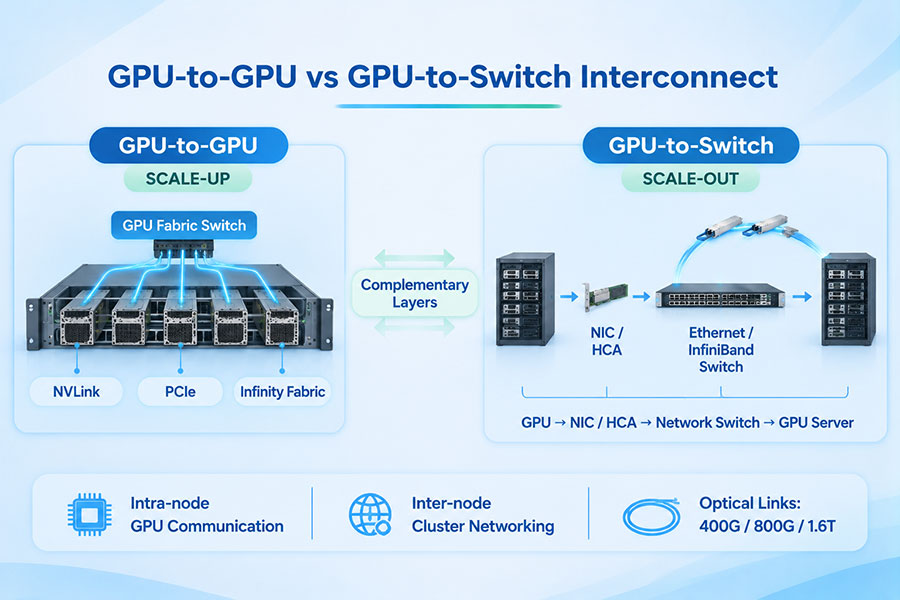
Inside a server, technologies such as NVLink and NVSwitch provide high-bandwidth GPU-to-GPU communication. Between servers, however, a separate network fabric is needed to exchange data across nodes. This is commonly called the scale-out network.
Distributed AI training generates several types of network traffic:
Gradient synchronization: GPUs exchange gradient information during model training.
All-Reduce operations: Multiple GPUs combine distributed data and synchronize results.
All-Gather and Reduce-Scatter: Communication operations distribute or aggregate data across participating GPUs.
Tensor and pipeline parallelism: Model partitions exchange intermediate activations and other information.
Distributed storage access: Compute nodes retrieve datasets and checkpoint information from storage systems.
When network communication is inefficient, GPUs may wait for data or synchronization to complete. This can reduce effective compute utilization and increase the time required to finish training jobs.
A GPU cluster network therefore needs high bandwidth, low and predictable latency, effective congestion management, and sufficient capacity to scale across racks.
2. What Is InfiniBand?
InfiniBand is a high-performance networking technology designed for applications that require efficient communication between computing systems. It is widely used in high-performance computing (HPC), scientific computing, and dedicated AI infrastructure.
Unlike Ethernet, InfiniBand uses its own fabric architecture, protocol stack, and specialized hardware. Servers connect to the fabric through Host Channel Adapters (HCAs), while InfiniBand switches provide connectivity between nodes.
One of its most important capabilities is native RDMA support. InfiniBand allows data to be transferred between registered memory regions on different systems with minimal involvement from the host CPU in the data path.
2.1 Key Features of InfiniBand
Native RDMA: Supports direct memory-to-memory data transfers between compatible systems.
Low-latency communication: Designed for tightly coupled computing workloads.
Dedicated fabric architecture: Uses InfiniBand HCAs, switches, and fabric management components.
Hardware-based flow control: Uses link-level mechanisms to manage traffic and prevent buffer overflow.
Congestion management: Provides mechanisms to respond to congestion within the fabric.
Adaptive routing: Supported systems can distribute traffic across available paths.
2.2 InfiniBand in GPU Clusters
InfiniBand is commonly selected for dedicated GPU training environments where predictable communication performance is a major requirement.
Its native RDMA architecture and specialized fabric capabilities make it suitable for communication-intensive workloads, including distributed model training, large-scale All-Reduce operations, and HPC applications.
InfiniBand deployments typically use a dedicated network fabric rather than treating the GPU network as ordinary enterprise Ethernet traffic.
3. What Is RoCE?
RoCE stands for RDMA over Converged Ethernet. It enables RDMA communication over Ethernet networks, combining RDMA data transfer capabilities with Ethernet and IP infrastructure.
RoCE is based on RDMA transport semantics defined by the InfiniBand Trade Association (IBTA). Instead of using a dedicated InfiniBand physical fabric, RoCE carries RDMA traffic over Ethernet.
There are two main versions:
RoCEv1: Operates directly over Ethernet Layer 2 and is limited to the same Layer 2 broadcast domain.
RoCEv2: Encapsulates RDMA transport packets in UDP/IP, allowing traffic to be routed across Layer 3 networks.
RoCEv2 is the version commonly considered for modern, scalable Ethernet-based AI data center networks.
3.1 How RoCEv2 Works
RoCEv2 uses Ethernet, IP, and UDP headers to transport RDMA packets. The UDP destination port is 4791. Compatible Ethernet network adapters handle RDMA operations in hardware, reducing the need for conventional host networking stack processing.
A simplified RoCEv2 communication process is:
The application prepares and registers memory regions for RDMA operations.
The sender posts an RDMA work request to its network adapter.
The adapter processes the RDMA operation and encapsulates the transport packet in UDP/IP and Ethernet headers.
Ethernet switches and IP routers forward the packet through the network.
The destination adapter processes the packet and places the data into the appropriate memory region.
The receiving application can access the transferred data according to the RDMA operation and completion mechanism.
RoCEv2 therefore provides RDMA capabilities without requiring a dedicated InfiniBand physical network.
3.2 Why RoCE Is Used in AI Ethernet Networks
RoCE allows organizations to build RDMA-capable GPU networks using Ethernet switches, Ethernet network adapters, and compatible optical connectivity.
This can be attractive for data centers that already operate Ethernet infrastructure or want to use Ethernet-based networking across AI compute, storage, management, and cloud services.
However, RoCE is not simply ordinary Ethernet with a different application protocol. A high-performance RoCE fabric requires suitable hardware, traffic classification, congestion management, and careful end-to-end configuration.
4. InfiniBand vs RoCE: Key Differences
Both technologies support RDMA and can be used for GPU-to-GPU communication across servers. Their main differences lie in the underlying fabric, network management, congestion handling, and infrastructure requirements.
| Comparison Point | InfiniBand | RoCE |
|---|---|---|
| Network architecture | Dedicated InfiniBand fabric | RDMA over Ethernet |
| RDMA support | Native RDMA | RDMA over Converged Ethernet |
| Physical network | InfiniBand switches, HCAs and compatible links | Ethernet switches, RNICs and compatible Ethernet links |
| RoCE version | Not applicable | RoCEv2 is commonly used for routed networks |
| Routing | InfiniBand subnet and fabric routing | IP routing for RoCEv2 |
| Latency | Designed for low-latency communication | Can achieve low latency with suitable hardware and tuning |
| Congestion management | Fabric-level flow control and congestion mechanisms | ECN, congestion notification, rate control and optional PFC |
| CPU overhead | Low through RDMA hardware offload | Low through RDMA hardware offload |
| GPU communication | Can support GPUDirect RDMA on compatible platforms | Can support GPUDirect RDMA on compatible platforms |
| Network management | InfiniBand-specific fabric management | Ethernet and IP network management |
| Infrastructure flexibility | Specialized fabric components | Broad Ethernet hardware ecosystem |
| Typical applications | Dedicated AI training and HPC clusters | AI Ethernet fabrics, cloud GPU clusters and converged data centers |
The comparison should not be reduced to a simple statement that one technology is always faster. Actual performance depends on the network adapter, switch generation, topology, traffic distribution, software stack, and application workload.
5. RDMA and GPUDirect RDMA for GPU Communication
RDMA is a central feature of both InfiniBand and RoCE. It allows network adapters to transfer data between memory regions on different systems without requiring every data movement step to pass through the conventional CPU networking stack.
5.1 RDMA in InfiniBand
InfiniBand provides native RDMA through its transport architecture. The HCA handles transport operations and memory placement in hardware, reducing host CPU involvement.
This is useful for GPU clusters because communication tasks can otherwise consume valuable CPU resources that are needed for application orchestration, data preparation, and system management.
5.2 RDMA in RoCE
RoCE provides RDMA over Ethernet. A compatible RNIC handles the RDMA operations while Ethernet switches forward packets through the network.
RoCEv2 makes this approach suitable for routed Ethernet fabrics, but the network must be configured to support the traffic characteristics of RDMA workloads.
5.3 GPUDirect RDMA
GPUDirect RDMA enables supported network adapters to access GPU memory directly, reducing unnecessary data copies through host memory.
Both InfiniBand and RoCE can support GPUDirect RDMA when the GPU, network adapter, driver, firmware, and software stack are compatible.
This distinction is important: GPUDirect RDMA is not exclusive to InfiniBand. A properly supported RoCE platform can also provide direct GPU memory communication.
6. NCCL and Collective Communication Performance
NVIDIA Collective Communications Library (NCCL) is widely used to implement communication operations across multiple GPUs. It supports operations such as All-Reduce, Broadcast, Reduce, All-Gather, and Reduce-Scatter.
In multi-node GPU clusters, NCCL can use supported network transports to communicate across servers. InfiniBand and RoCE are both possible networking paths, depending on the hardware and software configuration.
6.1 All-Reduce Performance
All-Reduce is particularly important in distributed AI training. GPUs calculate partial results locally and then exchange and combine those results across participating devices.
The network affects how quickly these operations complete. High bandwidth is important for large data transfers, while latency and congestion behavior become especially important for frequent synchronization operations.
6.2 What Determines NCCL Performance?
NCCL performance is influenced by several factors:
GPU architecture and interconnect bandwidth within each server.
Network adapter capabilities and PCIe or other host interconnect bandwidth.
InfiniBand or RoCE fabric topology.
GPUDirect RDMA support and configuration.
Switch congestion management and traffic distribution.
Number of GPUs, message sizes, and collective communication patterns.
NCCL version, drivers, firmware, and software configuration.
A high-speed network link alone does not guarantee high All-Reduce performance. The entire communication path must be configured and validated.
7. Latency and Bandwidth: Which Performs Better?
InfiniBand and RoCE are both designed to support high-performance data transfer. However, their actual performance depends on more than the nominal port speed.
7.1 Latency
InfiniBand is designed for low-latency communication and provides specialized fabric-level mechanisms for high-performance computing.
RoCE can also deliver low latency by using RDMA-capable network adapters and carefully configured Ethernet switches. However, congestion, queue buildup, PFC behavior, and traffic imbalance can affect latency consistency.
For GPU training, tail latency is also important. A small number of delayed communication flows can slow down synchronization across many GPUs.
7.2 Bandwidth
Both InfiniBand and RoCE support high-speed network interfaces. The achievable bandwidth of a GPU cluster depends on the number of links, switch capacity, network oversubscription, and how traffic is distributed.
For example, a cluster with high-speed server links can still experience limited aggregate throughput if the spine layer does not provide sufficient capacity or if multiple flows compete for the same output port.
7.3 GPU Utilization
The purpose of a high-performance GPU network is not simply to maximize link speed. It is to keep communication delays from preventing GPUs from completing their assigned work.
Both InfiniBand and well-engineered RoCE networks can support high GPU utilization. Representative distributed training benchmarks are more useful than comparing theoretical bandwidth or isolated latency figures.
8. Congestion Control: InfiniBand vs RoCE
Congestion management is one of the most important differences between InfiniBand and RoCE deployments.
AI training can generate synchronized traffic from many GPUs. If several senders transmit data toward the same destination or switch output port, queues can grow and communication performance may become uneven.
8.1 InfiniBand Congestion Management
InfiniBand includes fabric-level mechanisms such as credit-based flow control, virtual lanes, and congestion-management features.
Credit-based flow control helps prevent a sender from transmitting more data than the downstream link can accept. Virtual lanes provide separate logical traffic channels over a physical link, helping isolate different traffic classes.
Depending on the platform, adaptive routing can also distribute traffic across available paths to reduce congestion hotspots.
8.2 RoCE Congestion Management
RoCEv2 deployments commonly use Explicit Congestion Notification (ECN) and RDMA congestion-control mechanisms such as DCQCN.
In a typical ECN-based design:
A switch detects that a queue is becoming congested.
The switch marks eligible packets with an ECN congestion indication.
The receiving RNIC processes the congestion information.
A Congestion Notification Packet (CNP) can be sent back to the sender.
The sender adjusts its transmission rate to reduce congestion.
Priority Flow Control (PFC) may also be used to pause selected Ethernet traffic classes when buffer pressure becomes high. However, PFC is not a universal requirement for every RoCE design. Its use must be considered alongside ECN, buffer management, traffic engineering, and the overall network architecture.
8.3 Why RoCE Needs Careful Configuration
RoCE performance depends on consistent configuration across the network. Incorrect QoS settings, unsuitable ECN thresholds, poor traffic distribution, or inappropriate PFC behavior can cause congestion spreading, queue buildup, or performance degradation.
Large RoCE deployments therefore require careful validation of network topology, congestion-control parameters, routing behavior, and telemetry.
9. Network Topology and Scalability
Both InfiniBand and RoCE can scale across large GPU clusters, but they use different fabric management and routing approaches.
9.1 InfiniBand Fabric Design
InfiniBand networks use dedicated fabric topologies and subnet management. Depending on the scale of the cluster, the design may include multiple levels of switching and high-radix switches.
Network designers must consider the number of ports, available path capacity, link speed, routing behavior, and failure handling.
9.2 RoCE Ethernet Fabric Design
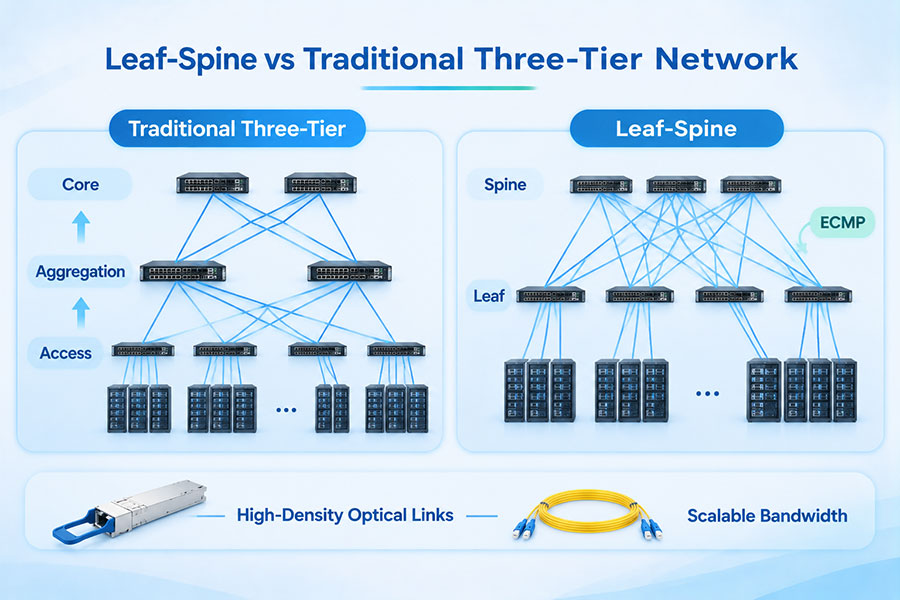
RoCEv2 can use routed Ethernet architectures, including leaf-spine networks. Servers connect to leaf switches, while spine switches provide paths between racks.
For GPU clusters, the Ethernet fabric must provide sufficient bandwidth and predictable traffic behavior. ECMP, adaptive load balancing, QoS, ECN, and suitable buffer configuration can all influence performance.
9.3 Scaling Beyond a Single Rack
As GPU clusters expand, traffic patterns become more complex. Multiple racks may exchange data during the same training operation, and congestion can occur at several network layers.
Neither InfiniBand nor RoCE automatically guarantees linear performance scaling. The network must be designed around the actual number of GPUs, traffic patterns, oversubscription targets, and application communication requirements.
10. Cost and Operational Complexity
InfiniBand and RoCE have different infrastructure and operational considerations. The total cost should include not only switches and network adapters but also optics, cabling, engineering, maintenance, power, and long-term expansion.
10.1 InfiniBand Cost
InfiniBand uses specialized HCAs, switches, cables, and fabric management components. Organizations may need dedicated expertise for deployment, monitoring, and troubleshooting.
For dedicated AI training and HPC clusters, the specialized infrastructure may be justified when communication performance and predictable operation are critical requirements.
10.2 RoCE Cost
RoCE can use the broader Ethernet hardware ecosystem, giving organizations flexibility in switch, network adapter, and optical component selection.
Existing Ethernet operational knowledge may also help with integration into broader data center infrastructure.
However, building a high-performance RoCE fabric still requires engineering effort. Teams must validate congestion control, QoS, traffic distribution, switch buffering, and RDMA compatibility.
10.3 Total Cost of Ownership
A realistic comparison should include:
Switches and network adapters.
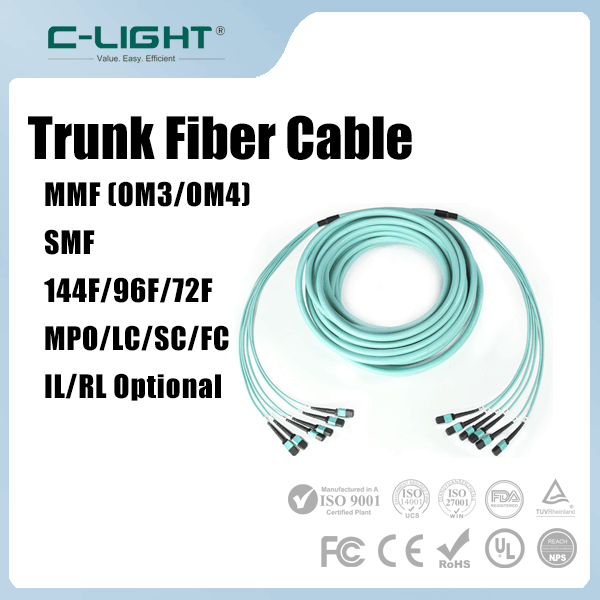
Optical transceivers, AOCs, DACs, and fiber cabling.
Power consumption and cooling requirements.
Network management and monitoring tools.
Deployment and troubleshooting effort.
Hardware support, firmware updates, and maintenance.
Training performance and effective GPU utilization.
Future capacity expansion and compatibility.
A lower initial equipment cost does not necessarily mean a lower total cost. A fabric that delivers more consistent application performance may improve the productivity of an expensive GPU cluster.
11. InfiniBand vs RoCE: Which Is Better for GPU Clusters?
The choice depends on workload requirements, operational expertise, infrastructure strategy, and performance targets.
11.1 When InfiniBand Is a Good Choice
Dedicated large-scale AI training clusters.
GPU workloads with intensive All-Reduce and collective communication.
High-performance computing environments.
Deployments where predictable low-latency communication is a major priority.
Organizations prepared to operate a specialized high-performance fabric.
11.2 When RoCE Is a Good Choice
AI clusters built around Ethernet infrastructure.
Organizations seeking integration with existing IP networking operations.
Multi-purpose data centers combining AI, storage, cloud, and enterprise services.
Deployments requiring routed Layer 3 RDMA connectivity.
Teams with the expertise to engineer and monitor a high-performance RoCE fabric.
11.3 Practical Selection Guide
| Requirement | InfiniBand | RoCE |
|---|---|---|
| Dedicated AI training fabric | Strong fit | Also suitable with proper design |
| Native RDMA architecture | Yes | RDMA over Ethernet |
| Existing Ethernet integration | Requires a separate fabric | Strong fit |
| Layer 3 routing | Uses InfiniBand fabric routing | Supported by RoCEv2 |
| Congestion configuration | InfiniBand-specific fabric mechanisms | Requires careful Ethernet congestion engineering |
| Multi-purpose data center | Often deployed as a dedicated network | Can integrate into an Ethernet-based architecture |
| GPU Direct RDMA | Supported on compatible platforms | Supported on compatible platforms |
These guidelines are not absolute performance rankings. Both technologies can support demanding GPU workloads when the complete hardware and software stack is properly designed.
12. Optical Connectivity for InfiniBand and RoCE GPU Clusters
High-speed optical connectivity is essential in many large GPU clusters. As the number of servers and network ports increases, optical transceivers and active optical cables provide connections between GPU servers, switches, and racks.
Although InfiniBand and RoCE use different networking architectures, both can use optical links. The important requirement is selecting an optical module or cable that matches the actual protocol, interface, data rate, reach, and equipment compatibility.
12.1 800G InfiniBand Optical Transceivers
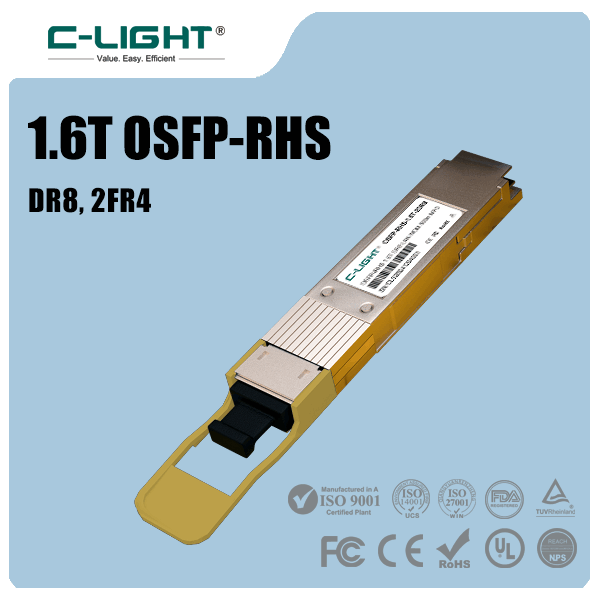
For high-bandwidth InfiniBand networks, 800G OSFP optical transceivers can support next-generation GPU cluster interconnects.
C-LIGHT's 800G OSFP optical transceiver portfolio includes configurations supporting InfiniBand NDR applications, alongside specified Ethernet-related standards. Available configurations include VR8, SR8, DR8, and 2xFR4 options, with different transmission distances depending on the model.
The exact module configuration must be matched to the InfiniBand switch or adapter port. Form factor alone does not guarantee protocol compatibility.
12.2 800G RoCE Ethernet Optical Connectivity
RoCEv2 operates over Ethernet and IP, so its physical links use compatible Ethernet optical transceivers or active optical cables.
C-LIGHT's 800G QSFP-DD optical transceiver portfolio supports high-speed Ethernet connectivity for AI data centers, GPU clusters, and cloud infrastructure. Different optical configurations are available for short-reach and longer-distance applications.
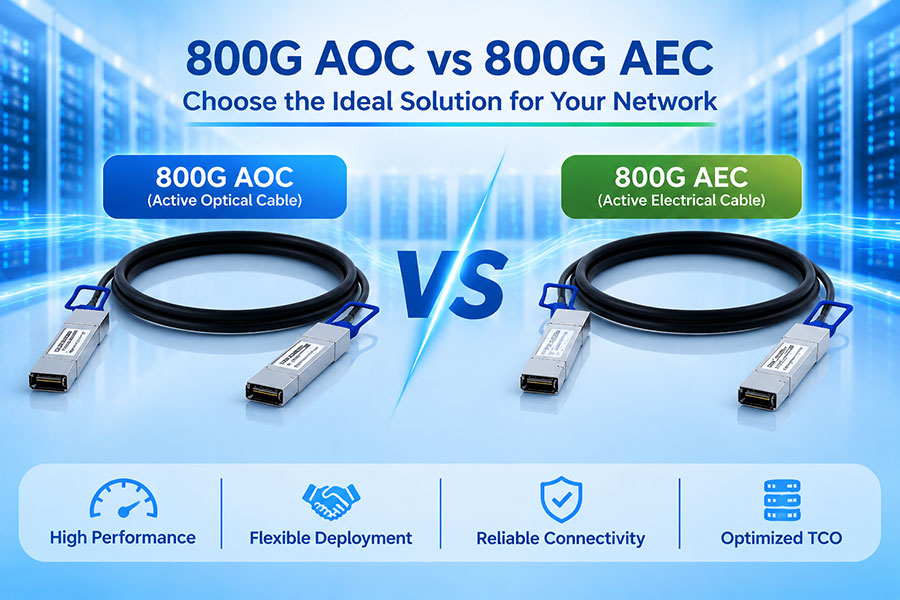
12.3 800G Active Optical Cables
Active Optical Cables integrate optical transmitters and receivers into a cable assembly. They provide a convenient short-reach connection option for high-density GPU cluster environments.
C-LIGHT's 800G AOC product family includes specifically listed InfiniBand configurations, such as 800G QSFP-DD to QSFP-DD and 800G OSFP to OSFP. Other configurations are specified separately for different interfaces and breakout requirements.
When selecting an AOC, verify the protocol configuration, connector type, cable length, and equipment compatibility. An 800G Ethernet cable and an 800G InfiniBand cable should not be treated as interchangeable simply because they share a nominal data rate.
12.4 Optical Interconnect Selection Checklist
Confirm whether the network uses InfiniBand or RoCE Ethernet.
Check the switch and adapter interface specifications.
Verify supported data rate and port generation.
Match the required OSFP, QSFP-DD, or other form factor.
Confirm optical reach, fiber type, and connector.
Check breakout configurations and cable length.
Verify vendor compatibility and firmware requirements.
Correct optical component selection helps maintain link stability and ensures that the physical interconnect matches the intended GPU network architecture.
13. How to Benchmark InfiniBand and RoCE for GPU Clusters
Protocol specifications and theoretical bandwidth are not enough to determine which fabric performs better for a particular GPU cluster. Testing should reflect the actual hardware, topology, software stack, and AI workload.
A useful evaluation process includes:
Verify RDMA connectivity: Confirm that the expected InfiniBand or RoCE interfaces are active and communicating.
Check GPUDirect RDMA: Verify that compatible GPU memory communication is enabled where required.
Run network-level tests: Measure bandwidth and latency between representative nodes.
Run NCCL tests: Evaluate All-Reduce, All-Gather, and other collective communication operations.
Test congestion behavior: Measure latency and throughput under simultaneous multi-node traffic.
Validate failure handling: Test how the network responds to link failures and path changes.
Measure real training performance: Compare training throughput and GPU utilization with representative models.
Useful tools include NVIDIA NCCL Tests for collective communication benchmarking, along with RDMA diagnostic and performance tools appropriate to the selected network platform.
It is also important to verify that the application is using the intended RDMA transport. A test that silently falls back to another communication path cannot provide a reliable comparison of InfiniBand and RoCE performance.
14. Conclusion
InfiniBand and RoCE are both important technologies for high-performance GPU cluster networking. Both support RDMA-based communication and can reduce host CPU involvement during data transfer.
InfiniBand provides native RDMA over a dedicated fabric, with specialized flow control, congestion management, and fabric routing. It is a strong option for dedicated AI training and HPC environments where communication performance and predictable operation are key requirements.
RoCE brings RDMA capabilities to Ethernet networks. It offers integration with Ethernet and IP infrastructure and can support large GPU clusters when switches, network adapters, congestion control, and routing are engineered correctly.
There is no universal winner. The most effective choice depends on the GPU platform, workload communication patterns, network topology, operational expertise, and total cost of ownership. Benchmarking both architectures with representative distributed training workloads is the most reliable way to make a deployment decision.
Frequently Asked Questions
Q1: What is the main difference between InfiniBand and RoCE?
InfiniBand provides native RDMA over a dedicated fabric, while RoCE enables RDMA communication over Ethernet networks.
Q2: Is InfiniBand faster than RoCE for GPU clusters?
Not in every deployment. InfiniBand is designed for high-performance communication, while a properly engineered RoCE fabric can also deliver strong GPU networking performance. Actual results depend on hardware, topology, and workload.
Q3: Does RoCE support RDMA?
Yes. RoCE provides RDMA capabilities over Ethernet. RoCEv2 uses UDP/IP encapsulation and supports routed Layer 3 networks.
Q4: Can RoCE support GPUDirect RDMA?
Yes. Compatible RoCE network adapters and GPU platforms can support GPUDirect RDMA, allowing direct communication with GPU memory.
Q5: Does InfiniBand require Ethernet?
No. InfiniBand uses its own dedicated network fabric, protocol stack, switches, and adapters. Ethernet can operate separately for other data center traffic.
Q6: Does RoCEv2 require PFC?
Not universally. Some RoCE deployments use PFC alongside ECN, while others use different congestion-management designs. The configuration depends on the complete network architecture.
Q7: Can InfiniBand and RoCE run in the same GPU data center?
Yes. They can operate as separate network fabrics in the same data center, supporting different compute, storage, and infrastructure requirements.
Q8: Does NCCL support both InfiniBand and RoCE?
Yes. NCCL can use supported InfiniBand and RoCE networking paths for multi-node GPU communication, depending on the hardware and software configuration.
Q9: What optical modules are used in InfiniBand GPU clusters?
Compatible optical transceivers depend on the InfiniBand generation, switch interface, data rate, reach, and form factor. OSFP and other supported interfaces are used in high-speed cluster deployments.
Q10: Which is more cost-effective, InfiniBand or RoCE?
RoCE may offer more flexibility through the Ethernet ecosystem, while InfiniBand provides a specialized fabric. The better economic choice depends on equipment, engineering, operations, and application performance over the system lifecycle.
 >

 >
 >
 >
 >
 >
 >
 >