TEL:+86 132 6656 7067





Ethernet switches form the foundation of industrial communication networks and modern data center infrastructure. Although both industrial switches and data center switches forward Ethernet traffic between connected devices, their hardware designs, network architectures, and operating priorities are significantly different.
Industrial switches are developed for factory automation, transportation systems, energy infrastructure, outdoor installations, and other environments where temperature fluctuations, electrical interference, vibration, and power availability can affect network operation. Data center switches are designed around high-speed traffic forwarding, large switching capacities, low latency, high port density, and scalable network architectures.
These differences influence everything from enclosure design and power supplies to switching capacity, uplink bandwidth, redundancy protocols, cooling systems, and network management. Selecting the appropriate switch requires evaluating both the physical installation environment and the communication requirements of the complete network.
1. What Is an Industrial Ethernet Switch?
An Industrial Ethernet Switch is a networking device designed to connect Ethernet-based equipment in industrial and infrastructure environments. It forwards data between connected devices and provides network connectivity for automation systems, monitoring equipment, controllers, sensors, and other industrial endpoints.
Unlike conventional enterprise switches, industrial switches are designed to operate in environments where equipment may be exposed to temperature variations, vibration, electrical noise, dust, and limited ventilation.
Common industrial switch characteristics include:
Wide operating temperature: Industrial models commonly support extended operating ranges, with some products specified from -40°C to 75°C.
Rugged enclosure: Metal or aluminum housings provide mechanical protection and support heat dissipation.
Fanless cooling: Many compact industrial switches use passive cooling to reduce moving parts and maintenance requirements.
Redundant power inputs: Selected models support dual DC power inputs to improve power continuity.
DIN-rail installation: Compact mounting designs simplify installation inside industrial control cabinets.
Industrial network protocols: Certain managed switches support industrial communication and redundancy technologies.
PoE functionality: PoE models can supply power to compatible cameras, access points, and other Ethernet devices.
Industrial switches are available in unmanaged, managed, PoE, and Layer 3 configurations. Their port combinations may include Fast Ethernet, Gigabit Ethernet, SFP fiber interfaces, and selected 10G SFP+ uplinks.
2. What Is a Data Center Switch?
A Data Center Switch is a high-performance Ethernet switching device designed to connect servers, storage systems, network appliances, and other infrastructure within a data center.
Data center switches handle large volumes of traffic between servers and network devices. Their design focuses on switching capacity, packet forwarding performance, port density, low latency, scalability, and network availability.
Common data center switch characteristics include:
High switching capacity: Supports large aggregate bandwidth across multiple high-speed ports.
High port density: Provides many Ethernet interfaces within fixed or modular rack-mounted platforms.
High-speed interfaces: Supports 10G, 25G, 100G, 200G, 400G, and 800G Ethernet depending on platform generation.
Low forwarding latency: Designed to process large volumes of packets with predictable performance.
Advanced network functions: Supports VLANs, routing, QoS, link aggregation, telemetry, and automation features.
Scalable architecture: Designed for leaf-spine networks and large multi-rack switching fabrics.
High-capacity cooling: Uses chassis airflow and thermal management systems to support dense switching hardware.
Data center switches are commonly deployed as Top-of-Rack (ToR), End-of-Row (EoR), leaf, spine, and core switches. Their exact configuration depends on the network topology and the bandwidth requirements of connected systems.
3. Industrial Switch vs Data Center Switch: Main Differences
The most important difference is the design objective. Industrial switches prioritize environmental durability and reliable connectivity in demanding physical locations. Data center switches prioritize bandwidth, switching capacity, port density, and scalable network performance.
| Technical Parameter | Industrial Switch | Data Center Switch |
|---|---|---|
| Primary objective | Reliable Ethernet communication in industrial environments | High-performance switching for data center networks |
| Operating environment | Factory floors, outdoor cabinets, substations, transportation systems | Controlled data center and server room environments |
| Temperature range | Selected models support -40°C to 75°C | Model-specific commercial operating range |
| Port density | Typically designed around application-specific port counts | High-density fixed or modular port configurations |
| Port speeds | 10/100M, 1G, 2.5G, 10G and other model-dependent interfaces | 10G, 25G, 100G, 400G, 800G and higher-speed generations |
| Installation | DIN rail, panel, wall, or rack mounting depending on model | Primarily rack-mounted fixed or modular platforms |
| Cooling | Often fanless passive cooling | Active airflow and high-capacity thermal management are common |
| Power supply | Selected models support redundant DC inputs | Redundant AC or DC power configurations depending on platform |
| PoE | Common in industrial access and surveillance networks | Available on selected access and server connectivity platforms |
| Network architecture | Industrial access, aggregation, and redundant ring topologies | Leaf-spine, ToR, EoR, and data center fabric architectures |
| Management priorities | Industrial monitoring, network availability, and operational integration | Automation, telemetry, routing, traffic engineering, and large-scale management |
These are general design tendencies rather than strict limitations. Industrial switches can provide 10G or higher-speed uplinks, and data center switches can support PoE or specialized environmental requirements when designed for those applications.
4. Operating Temperature and Environmental Protection
Operating temperature is one of the clearest differences between many industrial switches and conventional data center switches.
Industrial equipment may be installed in locations without centralized cooling. Factory cabinets, outdoor enclosures, roadside equipment boxes, and utility substations can experience wide temperature fluctuations.
Industrial switch specifications commonly include:
Extended operating temperature ranges.
Fanless or passive cooling designs.
Metal enclosures for mechanical protection and heat dissipation.
Resistance to specified vibration and shock conditions.
Electrical noise and surge immunity requirements.
Ingress protection or conformal coating on selected models.
Data center switches are generally installed in controlled equipment rooms with managed airflow, rack-level cooling, and monitored environmental conditions. Their design places greater emphasis on removing heat generated by high-capacity switching ASICs, power supplies, and high-speed optical interfaces.
| Environmental Factor | Industrial Switch | Data Center Switch |
|---|---|---|
| High temperature | Selected models are qualified for extended temperature operation | Designed around the platform's specified equipment-room conditions |
| Low temperature | Selected models support sub-zero operation | Usually deployed in temperature-controlled facilities |
| Vibration | Industrial models may have dedicated vibration qualification | Generally designed for stationary rack installation |
| Electrical interference | May require industrial EMC and surge protection | Designed for data center electrical infrastructure |
| Dust and moisture | Enclosure protection varies by model | Usually relies on controlled room and rack environments |
| Cooling method | Fanless passive cooling is common in compact models | Active fan-based airflow is common in high-density platforms |
Environmental protection must always be evaluated at the model level. A wide temperature rating does not automatically mean that a switch is waterproof, dustproof, or qualified for every industrial certification.
5. Switching Capacity and Packet Forwarding Performance
Switching capacity is a key performance parameter for data center switches. It describes the aggregate bandwidth that a switch fabric can handle across its interfaces, while packet forwarding rate measures how many packets the device can process per second.
For example, a switch with 48 full-duplex 10GbE ports has a theoretical aggregate port bandwidth of 960Gbps when counting both transmit and receive directions:
48 × 10Gbps × 2 = 960Gbps
This is a port-bandwidth calculation, not proof that a particular switch has non-blocking forwarding performance. The actual switching capacity and packet forwarding specifications must be checked in the manufacturer's datasheet.
Data center switches are designed to support large numbers of simultaneous high-speed connections. Their switching ASICs, buffer architecture, and packet processing pipelines are optimized for high-throughput traffic patterns.
Industrial switches generally serve smaller or more specialized network segments. Their performance requirements are often determined by the number of connected devices, traffic patterns, real-time communication needs, and uplink bandwidth.
Industrial applications may place greater emphasis on predictable traffic handling and network availability than on maximizing aggregate throughput. However, advanced industrial networks can also require high-capacity switching and low-latency forwarding.
6. Port Density and Ethernet Interface Options
Port density affects switch size, rack utilization, cabling, and network expansion. Industrial switches and data center switches are designed around different physical installation requirements.
Industrial switches commonly provide a combination of RJ45 copper ports and SFP fiber interfaces. Compact models may have 5 to 8 ports, while larger managed models can provide 16, 24, or 48 ports.
Data center switches are often designed with much higher port density and faster interfaces. Fixed platforms may provide 24, 32, 48, or more ports, while modular systems can support different line-card and interface configurations.
| Interface Type | Common Industrial Application | Common Data Center Application |
|---|---|---|
| 10/100BASE-T | Legacy industrial endpoints | Limited specialized applications |
| 1000BASE-T | PLC systems, cameras, sensors, access devices | Management and selected server connections |
| 1000BASE-X SFP | Fiber uplinks and industrial aggregation | Legacy or lower-speed network links |
| 10GBASE-SR/LR SFP+ | High-bandwidth industrial uplinks | Server and switch connectivity |
| 25G SFP28 | Selected industrial backbone networks | Modern server access and leaf connectivity |
| 100G QSFP28 | Specialized high-speed infrastructure | Leaf-spine and aggregation links |
| 400G QSFP-DD/OSFP | Specialized high-capacity systems | High-performance data center fabrics |
| 800G OSFP/QSFP-DD | Not typical for conventional industrial access | AI clusters and hyperscale network fabrics |
These are common deployment patterns rather than fixed product boundaries. The availability of each interface depends on the switch platform and its supported optical transceivers.
7. Network Architecture: Industrial Networks vs Leaf-Spine Data Centers
Industrial networks and data center networks often use different topologies because their traffic patterns and availability requirements are different.
Industrial network architecture
Industrial Ethernet networks commonly use hierarchical structures that connect field devices, control systems, aggregation switches, and enterprise networks. Depending on the application, the architecture may include star, ring, redundant ring, or hierarchical topologies.
Ring-based architectures are particularly useful when industrial network segments require an alternate communication path after a link failure. The selected redundancy protocol determines how quickly the network can restore connectivity.
Data center leaf-spine architecture
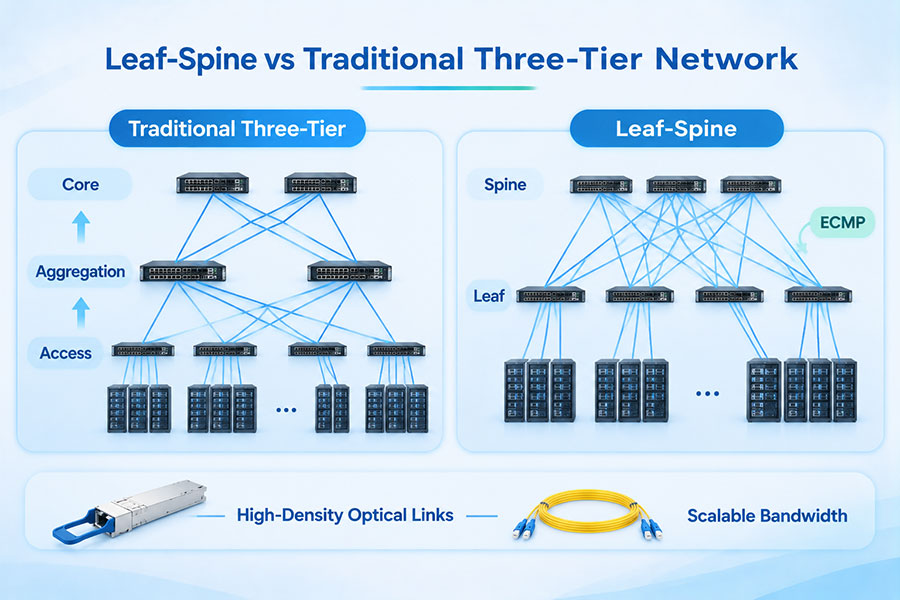
Modern data centers commonly use leaf-spine architectures to provide scalable connectivity between servers and network infrastructure.
Leaf switches: Connect servers, storage systems, and other endpoint devices.
Spine switches: Provide high-speed connectivity between leaf switches.
East-west traffic: Supports communication between servers and distributed applications.
North-south traffic: Connects internal data center resources to external networks and services.
In a typical leaf-spine fabric, every leaf switch connects to every spine switch. This architecture provides multiple paths between network endpoints and supports horizontal expansion by adding switches and uplinks.
8. Network Redundancy and High Availability
Network redundancy is important in both industrial and data center environments, but the mechanisms and recovery objectives may differ.
Industrial networks often connect equipment involved in manufacturing, power distribution, transportation, and infrastructure monitoring. A network interruption may affect production visibility or communication between controllers and field devices.
Common industrial redundancy technologies include:
RSTP: Rapid Spanning Tree Protocol, used to prevent Layer 2 loops and restore connectivity after topology changes.
ERPS: Ethernet Ring Protection Switching, defined by ITU-T G.8032 for Ethernet ring protection.
MRP: Media Redundancy Protocol, used in supported industrial Ethernet environments.
PRP: Parallel Redundancy Protocol, which provides seamless redundancy through duplicated network paths in supported systems.
HSR: High-availability Seamless Redundancy, used in certain industrial and utility networks.
Not every industrial switch supports every protocol. The switch, endpoints, and network architecture must be compatible with the selected redundancy mechanism.
Data center networks commonly use multiple physical paths, link aggregation, Layer 3 routing, equal-cost multipath (ECMP), and redundant switching fabrics. These technologies allow traffic to use multiple available paths and support network expansion.
High availability depends on the complete network design, including redundant switches, links, power supplies, routing configuration, and operational procedures. Installing two switches alone does not guarantee seamless failover.
9. Power over Ethernet (PoE) and Power Supply Design
PoE is an important feature in many industrial access networks because it allows compatible Ethernet devices to receive both data and electrical power through the same cable.
Industrial PoE switches are commonly used to connect:
Industrial IP cameras and surveillance equipment.
Wireless access points.
Access control devices.
Remote monitoring equipment.
Compatible industrial Ethernet endpoints.
Industrial switches may use 12V, 24V, 48V, or other specified DC power arrangements depending on the model. Selected designs provide redundant power inputs through terminal blocks.
Data center switches generally focus on reliable rack-level power delivery and high-capacity switching hardware. Some data center access switches support PoE, but PoE is not a defining feature of high-performance spine switches.
| Power Parameter | Industrial Switch | Data Center Switch |
|---|---|---|
| Power input | DC input common; AC available on selected models | AC or DC depending on platform |
| Redundant power | Dual DC inputs on selected models | Redundant power supplies common on enterprise and data center platforms |
| PoE support | Common in industrial access models | Available on selected access switches |
| Power priority | Power continuity and industrial equipment integration | High-capacity system power and energy efficiency |
| Cooling considerations | Passive cooling common in compact switches | Chassis airflow and thermal management are important |
PoE power budgets must be checked separately from the switch's own power consumption. The available PoE output depends on the power supply, switch design, port count, and supported IEEE PoE standard.
10. Industrial Protocols and Data Center Network Protocols
Industrial switches and data center switches may support many common Ethernet functions, including VLANs, QoS, LACP, SNMP, and Layer 3 routing. However, their application-specific protocol requirements can differ.
Industrial network protocols and technologies
PROFINET: Industrial Ethernet communication technology used in automation systems.
EtherNet/IP: Industrial communication technology based on the Common Industrial Protocol (CIP) over standard Ethernet and IP networks.
EtherCAT: Real-time industrial Ethernet technology used in automation and motion control.
Modbus TCP: Ethernet-based industrial communication protocol used for communication between controllers and field devices.
IEEE 802.1 TSN: A family of Ethernet standards designed to support time-sensitive communication requirements.
IEEE 1588 PTP: Precision Time Protocol for clock synchronization across network devices.
Industrial protocols are not interchangeable, and switch support alone does not establish complete application compatibility. Endpoints, controllers, network configuration, and the selected protocol must work together.
Data center network technologies
VLAN: Provides logical network segmentation.
VXLAN: Extends Layer 2 network connectivity over Layer 3 infrastructure.
EVPN: Provides control-plane functionality for overlay network services.
ECMP: Distributes traffic across multiple equal-cost paths.
LACP: Combines multiple physical links into a logical link aggregation group.
BGP: Supports routing between data center network segments and larger IP fabrics.
Industrial and data center switches can share common Layer 2 and Layer 3 functions, but the required protocol support depends on the intended network architecture.
11. Latency and Real-Time Communication
Latency is important in both industrial automation and data center computing, but the definition of acceptable latency depends on the application.
Industrial control networks may require predictable communication timing between controllers, sensors, actuators, and other devices. In these systems, deterministic behavior and synchronized timing can be more important than maximizing aggregate throughput.
For example, motion control and coordinated automation systems may require tightly controlled communication cycles. TSN, PTP, and supported industrial redundancy technologies can contribute to predictable network behavior when correctly implemented.
Data center networks prioritize low forwarding latency while processing large volumes of traffic. Applications such as distributed storage, high-performance computing, and AI training generate substantial east-west traffic between servers and accelerators.
Data center switch latency depends on factors including:
Switching ASIC architecture.
Packet size and forwarding mode.
Queueing and congestion.
Buffer management.
QoS configuration.
Network topology and traffic load.
A low-latency industrial switch and a low-latency data center switch may use different designs because their traffic patterns and timing requirements are not necessarily the same.
12. Cooling Design: Fanless Industrial Switches vs High-Density Data Center Switches
Cooling design is closely related to switching capacity, port density, power consumption, and the physical environment.
Fanless industrial switch cooling
Many compact industrial switches use passive cooling. Heat is transferred through the internal structure and metal enclosure to the surrounding environment. This design reduces moving parts and avoids the need for internal fans in suitable low- and moderate-power configurations.
Fanless operation does not mean that the switch produces no heat. The installation must still provide sufficient space and airflow around the enclosure to dissipate heat within the manufacturer's specifications.
Data center switch cooling
High-performance data center switches contain switching ASICs, power supplies, and high-speed optical interfaces that generate substantial heat. Active cooling is common, with fans directing airflow through the chassis and heat sinks.
Data center equipment may use front-to-back or back-to-front airflow configurations. The switch airflow direction must match the rack's cooling arrangement to avoid hot-air recirculation.
High-speed optical modules also contribute to the thermal load. Dense 400G and 800G deployments require careful coordination between transceiver power consumption, switch airflow, and chassis cooling capacity.
13. Industrial Switch vs Data Center Switch: Typical Applications
The best switch depends on the type of network being built and the environment in which the equipment will operate.
| Application | Typical Network Requirements | Suitable Switch Category |
|---|---|---|
| Factory automation | Industrial protocols, temperature tolerance, redundancy | Industrial switch |
| Industrial surveillance | PoE, fiber uplinks, remote monitoring | Industrial PoE switch |
| Power substation | Environmental qualification, precise timing, network redundancy | Industrial switch |
| Railway communication | Vibration resistance, temperature tolerance, redundancy | Industrial switch |
| Outdoor telecommunications | Wide temperature operation, fiber connectivity | Industrial switch |
| Enterprise server room | High port density, VLANs, routing, uplink bandwidth | Data center or enterprise switch |
| Cloud data center | High switching capacity, leaf-spine architecture | Data center switch |
| AI training cluster | High-bandwidth, low-latency connectivity | High-performance data center switch |
| High-performance computing | Low latency, high throughput, scalable fabric | Data center switch |
| Data center interconnection | High-speed optical uplinks and routing | Data center switch and compatible optical transport equipment |
Some installations combine both switch categories. For example, a manufacturing facility may use industrial switches near production equipment and enterprise or data center switches in a centralized server room. Fiber uplinks connect the industrial access network to the main network infrastructure.
14. How to Select the Right Industrial or Data Center Switch
Switch selection should be based on environmental requirements, traffic volume, port configuration, network architecture, and future expansion plans.
Step 1: Evaluate the installation environment
Determine whether the switch will operate in a controlled server room, factory cabinet, outdoor enclosure, transportation facility, or utility installation. Record the expected temperature, humidity, vibration, and electrical conditions.
Step 2: Calculate the required port capacity
Identify the number of copper and fiber connections required. Consider endpoint density, PoE requirements, uplink capacity, and future port expansion.
Step 3: Determine switching capacity
Estimate aggregate traffic and check the switch's switching capacity and packet forwarding rate. For data center networks, evaluate oversubscription ratios and the bandwidth between leaf and spine layers.
Step 4: Select the network architecture
Industrial networks may use star, ring, or redundant hierarchical designs. Data centers may use ToR, EoR, leaf-spine, or modular architectures depending on scale and traffic patterns.
Step 5: Verify power and cooling requirements
Check input voltage, redundant power options, PoE budget, maximum system power, airflow direction, and cooling requirements.
Step 6: Check management and protocol support
Confirm the required VLAN, QoS, routing, SNMP, LACP, security, industrial protocol, redundancy, and automation functions.
Step 7: Verify optical compatibility
For fiber uplinks, confirm the supported SFP, SFP+, SFP28, QSFP28, QSFP-DD, or OSFP interfaces. Check data rate, wavelength, fiber type, transmission distance, and module compatibility.
Step 8: Plan for future expansion
Consider additional ports, higher-speed uplinks, network segmentation, redundant paths, and the expected growth of connected devices or server traffic.
15. C-LIGHT Industrial Ethernet Switch Solutions
C-LIGHT provides industrial Ethernet switch products for factory networks, transportation infrastructure, industrial surveillance, energy systems, and other applications requiring reliable copper and fiber connectivity.
C-LIGHT's Industrial Managed Switch series combines managed Ethernet functions with industrial hardware design. The product family includes configurations with 8, 16, 24, or 48 RJ45 ports and different SFP uplink combinations, depending on the model.
Selected models support VLAN, QoS, LACP, SNMP, 802.1X, and IPv6. The product range also lists industrial communication capabilities such as PROFINET and Modbus TCP on supported configurations.
Representative hardware specifications include:
Selected models with 8xRJ45 and 2 or 4 SFP interfaces.
Selected higher-density models with 16 or 24 RJ45 ports and fiber uplinks.
CL-MC2408MP with 8 RJ45 ports, 4 Gigabit SFP interfaces, and 2 10G SFP+ interfaces.
Selected models with redundant DC power inputs.
Listed operating temperature range of -40°C to 75°C.
Compact aluminum enclosure or rack-mount metal enclosure, depending on model.
The exact port combination, management functions, and power configuration must be checked against the selected model.
Product details: C-LIGHT Industrial Managed Switch
C-LIGHT's Industrial Managed PoE Switch series combines managed Ethernet connectivity with PoE power delivery for compatible industrial endpoints.
The product family includes 8-port, 16-port, 24-port, and 48-port configurations. Depending on the model, interfaces include RJ45 PoE ports, Gigabit SFP uplinks, and selected 10G SFP+ uplinks.
Representative features include:
IEEE 802.3af/at PoE support on applicable models.
Multiple copper and fiber port combinations.
VLAN, QoS, LACP, SNMP, and other management functions on supported models.
Selected redundant DC power configurations.
Listed operating temperature range of -40°C to 75°C.
Industrial enclosure and mounting options depending on model.
PoE output power and total power budget vary by model. The product datasheet should be checked before calculating the power requirements of connected cameras, access points, or other devices.
Product details: C-LIGHT Industrial Managed PoE Switch
For applications that require straightforward Ethernet connectivity without advanced network configuration, C-LIGHT also provides Industrial Unmanaged PoE Switch products.
These switches support selected combinations of RJ45 copper ports and fiber interfaces, including SFP, SC, FC, and ST options depending on the model. Selected configurations provide redundant power inputs and industrial temperature operation.
Product details: C-LIGHT Industrial Unmanaged PoE Switch
16. Data Center Switches and High-Speed Optical Connectivity
Data center switches depend on compatible optical transceivers and fiber cabling to establish high-speed connections between servers, leaf switches, spine switches, and other network infrastructure.
As Ethernet speeds increase, the optical interface becomes an important part of the complete switching system. The selected transceiver must match the switch port's supported data rate, form factor, electrical interface, optical standard, and transmission distance.
C-LIGHT's high-speed optical transceiver portfolio includes products for 400G, 800G, and 1.6T data center connectivity.
400G optical modules support high-bandwidth connections in data center switching fabrics, cloud networks, and high-performance computing infrastructure. Common configurations include SR8, DR4, FR4, and other model-specific optical interfaces.
Product details: C-LIGHT 400G QSFP-DD Optical Transceivers
800G transceivers support next-generation high-density switching platforms. C-LIGHT's portfolio includes OSFP and QSFP-DD configurations for short-reach and single-mode fiber applications.
Representative optical configurations include:
800G VR8: 50m-class multimode connectivity.
800G SR8: 100m-class multimode connectivity.
800G DR8: 500m-class single-mode connectivity.
800G 2xFR4: 2km-class single-mode connectivity.
Actual reach and compatibility depend on the selected module and host switch platform.
Product details: C-LIGHT 800G OSFP Optical Transceivers
1.6T optical transceivers are designed for emerging high-bandwidth data center and AI infrastructure. C-LIGHT's 1.6T OSFP-RHS portfolio includes 2x800G optical architectures with eight 200G PAM4 lanes.
Listed configurations include 2DR4 and 2FR4 variants. The exact optical reach, connector, host compatibility, and thermal requirements depend on the selected model.
Product details: C-LIGHT 1.6T OSFP-RHS Optical Transceivers
These optical modules are connectivity components rather than Ethernet switches. The switch performs packet forwarding and network management, while the optical transceiver provides the electrical-to-optical and optical-to-electrical interface for fiber communication.
17. Conclusion
Industrial switches and data center switches serve different network requirements. Industrial switches are designed for demanding physical environments, with features such as extended temperature operation, rugged enclosures, redundant DC power, fanless cooling, and industrial network support.
Data center switches are designed for high-performance network infrastructure. Their key priorities include switching capacity, packet forwarding performance, high port density, low latency, advanced routing, scalable leaf-spine architecture, and high-speed optical connectivity.
Industrial switches are commonly deployed in factory automation, transportation, energy infrastructure, and outdoor communication systems. Data center switches support cloud computing, enterprise server networks, storage infrastructure, AI clusters, and high-performance computing.
Neither category is universally superior. The appropriate switch depends on the network environment, traffic requirements, port density, redundancy design, power availability, and future expansion needs.
For many large industrial facilities, both types can operate together: industrial switches provide connectivity near field equipment, while centralized enterprise or data center switches aggregate traffic and connect the facility to broader network infrastructure.
C-LIGHT provides industrial managed switches, industrial PoE switches, unmanaged switches, fiber media converters, and optical transceivers for industrial and high-speed network applications. Contact our team for port configuration, fiber uplink selection, PoE requirements, and network connectivity solutions.
 >

 >
 >
 >
 >
 >
 >
 >