TEL:+86 132 6656 7067





Optical transceivers used in industrial networks often operate under environmental conditions that differ significantly from those found in temperature-controlled data centers. Outdoor cabinets, factory automation systems, transportation infrastructure, power substations, and remote communication facilities can experience wide temperature fluctuations, vibration, dust, and limited cooling. These conditions make the operating temperature rating of an SFP module an important factor in network design.
Industrial SFP and Commercial SFP modules share the same basic purpose: converting electrical signals into optical signals and receiving optical data through fiber. Their primary difference is the environmental operating range and the design requirements associated with maintaining reliable performance under different conditions.
Commercial SFP modules are generally designed for controlled indoor environments, while Industrial SFP modules are intended for equipment exposed to wider temperature variations. Selecting the correct grade requires more than checking the module's temperature range. Optical performance, component quality, host compatibility, power consumption, and the operating conditions of the complete network must also be considered.
1. What Is a Commercial SFP Transceiver?
A Commercial SFP transceiver is a Small Form-factor Pluggable optical module designed for conventional networking environments where operating temperatures are relatively stable and controlled.
Commercial-temperature SFP modules are widely used in enterprise networks, data centers, office buildings, campus networks, and indoor telecommunications equipment rooms. These environments generally provide air conditioning or other temperature management systems to keep networking equipment within specified operating conditions.
The commonly used commercial operating temperature range is 0°C to 70°C, measured at the module case. This range provides sufficient operating conditions for many conventional Ethernet and fiber communication applications.
Commercial SFP modules are available in various data rates, wavelengths, fiber types, and transmission distances, including:
100BASE-FX SFP: Used for 100Mbps Ethernet fiber connections.
1000BASE-SX SFP: Used for Gigabit Ethernet over multimode fiber.
1000BASE-LX SFP: Used for Gigabit Ethernet over single-mode fiber and supported multimode applications.
1000BASE-ZX SFP: Used for selected long-distance Gigabit Ethernet connections.
10GBASE-SR SFP+: Used for short-reach 10Gbps multimode fiber links.
10GBASE-LR SFP+: Used for 10Gbps single-mode fiber connections.
Commercial SFP modules are suitable when the equipment environment remains within the specified temperature range and the optical interface meets the network's transmission requirements.
2. What Is an Industrial SFP Transceiver?
An Industrial SFP transceiver is an optical module designed to operate across a wider temperature range than a conventional commercial-temperature module. It is intended for network equipment deployed in environments where ambient conditions may fluctuate significantly.
Industrial SFP modules commonly support an operating temperature range of -40°C to 85°C, although the exact specification must be confirmed for each model. Their design and component selection are intended to maintain specified electrical and optical performance across this wider temperature range.
Industrial SFP transceivers are commonly used in:
Industrial Ethernet switches and factory automation networks.
Outdoor telecommunications cabinets and remote access equipment.
Electric power substations and smart grid infrastructure.
Railway communication and transportation systems.
Renewable energy installations, including solar and wind power facilities.
Oil, gas, and other industrial monitoring networks.
Remote security, surveillance, and infrastructure communication systems.
In these applications, network equipment may operate without continuous air conditioning. Industrial-temperature optical modules help reduce the risk of temperature-related performance problems when the equipment is exposed to conditions outside the commercial operating range.
However, an industrial-temperature SFP does not automatically make an entire switch or network installation suitable for harsh environments. The host device, power supply, enclosure, connectors, and fiber infrastructure must also meet the application's environmental requirements.
3. Industrial SFP vs Commercial SFP: Key Differences
The most important distinction between Industrial SFP and Commercial SFP is their specified operating temperature range. Other differences may include component selection, manufacturing controls, testing requirements, and environmental qualification.
| Technical Parameter | Commercial SFP | Industrial SFP |
|---|---|---|
| Typical operating temperature | 0°C to 70°C | -40°C to 85°C |
| Temperature tolerance | Designed for controlled environments | Designed for wider temperature fluctuations |
| Component selection | Components qualified for commercial operating conditions | Components selected and qualified for wider operating conditions |
| Thermal design | Optimized for conventional equipment environments | Designed to maintain performance across a wider temperature range |
| Typical deployment | Data centers, offices, and indoor enterprise networks | Factories, outdoor cabinets, substations, and transportation networks |
| Environmental requirements | Generally less demanding | More demanding temperature-related requirements |
| Cost | Generally lower | Generally higher, depending on specification and model |
| Network application | Conventional Ethernet and fiber communication | Industrial Ethernet and outdoor fiber communication |
Industrial SFP modules are not necessarily faster or capable of longer transmission distances than Commercial SFP modules. Both grades can support similar data rates, wavelengths, and optical interfaces when equivalent product configurations are available.
The difference is primarily environmental qualification, not the basic optical transmission technology.
4. Operating Temperature: 0°C to 70°C vs -40°C to 85°C
Temperature is a critical parameter in optical transceiver operation because semiconductor lasers, photodetectors, driver circuits, and receiver components are affected by changes in temperature.
Commercial SFP modules commonly support a case operating temperature range of 0°C to 70°C. Industrial SFP modules commonly extend this range to -40°C to 85°C.
| Temperature Grade | Common Operating Range | Typical Environment |
|---|---|---|
| Commercial (C-Temp) | 0°C to 70°C | Temperature-controlled indoor equipment |
| Extended (E-Temp) | Manufacturer-specific | Environments with wider temperature variations |
| Industrial (I-Temp) | -40°C to 85°C | Industrial and outdoor equipment installations |
Extended-temperature specifications are not completely uniform across manufacturers. Some products use ranges such as -5°C to 85°C or -20°C to 85°C. Therefore, buyers should verify the exact minimum and maximum operating temperatures rather than relying only on a product description such as Extended or Industrial.
It is also important to distinguish operating temperature from storage temperature. A module may tolerate a wider temperature range while stored or transported than it can support during active optical transmission.
5. Why Temperature Affects SFP Optical Performance
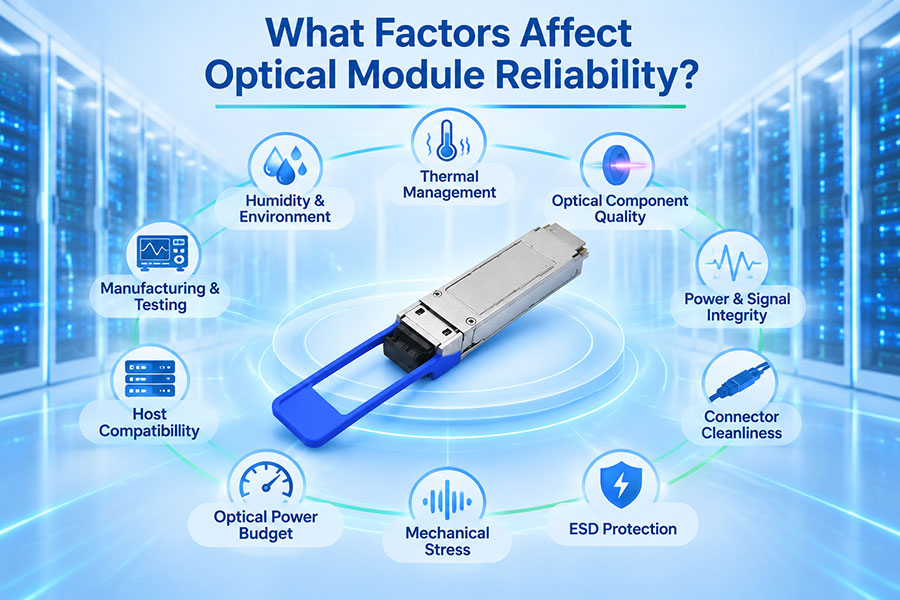
Temperature changes can affect several components inside an optical transceiver. The resulting impact depends on the module design, optical technology, operating wavelength, and thermal management of the host equipment.
Laser wavelength stability
Semiconductor laser characteristics change with temperature. In some laser designs, temperature variation can influence the emitted wavelength and optical output characteristics. Modules must maintain their specified optical performance across the supported operating range.
Transmit optical power
Laser output power can vary as operating temperature changes. If the output falls outside the specified range, the receiving device may experience reduced optical power margin or other link performance problems.
Receiver sensitivity
Photodetectors and receiver circuits also have temperature-dependent characteristics. Changes in receiver sensitivity can influence the minimum optical power required for reliable signal detection.
Electrical performance
Driver circuits, limiting amplifiers, clock recovery circuits, and other electronic components may behave differently at high and low temperatures. Industrial-grade designs must maintain their specified electrical performance within the rated operating range.
Thermal stability and reliability
Repeated temperature changes can place stress on electronic components, solder joints, optical alignment structures, and packaging materials. Appropriate component selection and qualification help address these environmental demands.
6. Industrial SFP Component Selection and Design Requirements
Industrial-temperature qualification requires more than simply assigning a wider temperature rating to an otherwise unchanged commercial module. The internal components and assembly must be suitable for the intended operating conditions.
Important design considerations include:
Laser and photodetector selection: Optical components must maintain their specified characteristics across the required temperature range.
Driver and receiver ICs: Electronic components must support the module's electrical performance requirements under high- and low-temperature conditions.
PCB materials: Circuit board materials and assembly processes must be appropriate for the intended thermal environment.
Thermal management: Heat dissipation and internal temperature distribution must be considered during module design.
Mechanical construction: Packaging and component mounting must withstand the expected environmental conditions.
Manufacturing consistency: Production controls and verification processes help ensure that modules meet their specified operating requirements.
The exact design approach varies by manufacturer and product family. Industrial-temperature performance should be supported by documented specifications and qualification testing rather than marketing descriptions alone.
7. Industrial SFP vs Commercial SFP: Reliability and Testing
Reliability is particularly important in industrial communication networks because equipment may be installed in locations where maintenance access is limited or service interruptions have significant operational consequences.
Industrial SFP modules are designed and qualified for a wider operating temperature range. Their verification should demonstrate that the optical and electrical parameters remain within the specified limits under the required conditions.
Typical qualification and verification activities may include:
High-temperature operating tests: Checking optical and electrical performance at elevated operating temperatures.
Low-temperature operating tests: Verifying module startup and operation under cold conditions.
Temperature cycling: Evaluating the effects of repeated temperature changes.
Optical performance testing: Measuring transmit power, receiver sensitivity, wavelength, and other relevant parameters.
Digital diagnostic verification: Checking monitoring functions such as temperature, voltage, bias current, and optical power when supported.
Compatibility testing: Verifying operation with the intended host equipment and firmware.
These tests should be aligned with the applicable product specifications and qualification procedures. A temperature rating alone does not establish resistance to vibration, shock, humidity, dust, electromagnetic interference, or corrosion.
8. Industrial SFP vs Commercial SFP: Application Scenarios
The correct SFP temperature grade depends on the installation environment. A commercial module can provide reliable service in an industrial facility if it is installed inside a properly controlled equipment room. Conversely, an industrial module may be necessary when network equipment is exposed to temperatures outside the commercial range.
Data centers and enterprise networks
Commercial SFP modules are widely used in data centers, server rooms, and enterprise network cabinets where cooling systems maintain stable equipment temperatures. These installations generally do not require the extended operating range of industrial-temperature modules.
Factory automation
Industrial Ethernet networks connect PLCs, sensors, controllers, industrial computers, and machine vision systems. Equipment may be installed close to production machinery or in areas where temperatures vary significantly. Industrial SFP modules can support fiber links in these environments when the host switch is also appropriately rated.
Outdoor telecommunications cabinets
Outdoor cabinets can experience high summer temperatures and low winter temperatures. When the module case temperature may exceed the commercial specification, an industrial-temperature SFP is a more appropriate choice.
Power substations
Power infrastructure relies on communication networks for monitoring, control, and protection-related applications. Industrial SFP modules can support fiber connectivity in suitably designed substation communication equipment.
Railway and transportation networks
Railway communication systems may include equipment installed in outdoor cabinets, trackside facilities, stations, and vehicles. Temperature range, vibration, electromagnetic compatibility, and equipment certification must all be evaluated for the specific application.
| Application | Typical Environment | Temperature Grade Consideration |
|---|---|---|
| Enterprise data center | Controlled indoor environment | Commercial SFP is commonly sufficient |
| Office network | Indoor equipment room | Commercial SFP is commonly sufficient |
| Factory automation | Variable industrial conditions | Industrial SFP may be required |
| Outdoor telecom cabinet | Wide seasonal temperature changes | Industrial SFP may be required |
| Power substation | Industrial electrical infrastructure | Industrial SFP and additional environmental qualification may be required |
| Railway communication | Outdoor and transportation environments | Industrial SFP plus application-specific certification |
| Renewable energy site | Outdoor solar or wind installations | Industrial SFP may be appropriate |
9. Industrial SFP vs Commercial SFP: Compatibility
Industrial SFP and Commercial SFP modules may share the same physical SFP form factor and electrical interface. Both can use standard SFP host connectors and support compatible Ethernet optical interfaces.
However, having the same physical size does not guarantee that every module will work in every switch.
Compatibility depends on several factors:
Host device support: The switch or router must support the selected SFP module and its operating characteristics.
Data rate: The module's data rate must match the host port's supported speed and interface mode.
Optical standard: The transceiver must use a compatible Ethernet or other communication standard.
Wavelength: The transmitting and receiving wavelengths must match the optical link design.
Fiber type: Single-mode and multimode modules require the appropriate fiber infrastructure.
Transmission distance: The selected optical reach must meet the actual link requirements.
Digital diagnostics: DOM/DDM monitoring and management features should be supported by the host platform where required.
Temperature support: The host equipment must also operate within the required environmental range.
An industrial SFP does not automatically improve the temperature rating of a commercial switch. If the switch itself is rated only for a narrower environmental range, the complete installation remains limited by the system's specifications.
10. How to Choose Between Industrial SFP and Commercial SFP
Selecting the appropriate temperature grade starts with measuring the actual operating conditions of the equipment. The relevant temperature is the transceiver case temperature during operation, not simply the temperature shown by a room thermostat or outdoor weather report.
The following selection process can help network engineers and procurement teams identify the appropriate module.
Step 1: Evaluate the operating environment
Determine whether the optical module will be installed in a temperature-controlled indoor room, an industrial cabinet, an outdoor enclosure, or another environment with significant temperature fluctuations.
Step 2: Confirm the case temperature range
Estimate or measure the expected transceiver case temperature under normal operation and extreme conditions. Consider the heat generated by adjacent ports, airflow, equipment density, and cabinet cooling.
Step 3: Select the required temperature grade
If the expected case temperature remains within the commercial specification, a commercial module may be suitable. If the temperature can exceed that range, choose a module whose specified operating range covers the actual conditions.
Step 4: Verify optical parameters
Check the data rate, wavelength, fiber type, connector, transmission distance, transmit power, receiver sensitivity, and optical power budget.
Step 5: Confirm equipment compatibility
Check the host switch model, firmware requirements, supported module coding, power consumption, and management functions.
Step 6: Review additional environmental requirements
For applications involving vibration, shock, humidity, dust, or electromagnetic interference, verify the complete equipment's relevant environmental and industrial qualifications. Do not assume that an industrial temperature rating covers all of these conditions.
11. Can Commercial SFP Be Used in Industrial Environments?
Commercial SFP modules can be used in industrial facilities when the module is installed in an environment that remains within its specified operating temperature range and other environmental requirements.
For example, a factory may have a central control room with stable air conditioning. In this environment, a commercial SFP can be an appropriate choice if the host switch and network design meet the application requirements.
However, installing a commercial SFP in an outdoor cabinet or an unconditioned industrial enclosure creates a different situation. If the module case temperature falls below 0°C or rises above 70°C, it may operate outside its specified range.
Possible consequences of operation outside the rated range include:
Optical output power moving outside specified limits.
Changes in laser wavelength or receiver characteristics.
Intermittent communication or link instability.
Increased component stress and reduced long-term reliability.
Unpredictable behavior during temperature transitions or cold startup.
Even if a commercial module appears to work temporarily under extreme conditions, this does not establish that it is qualified for continuous operation outside its datasheet limits.
12. Does Industrial SFP Always Cost More Than Commercial SFP?
Industrial SFP modules generally have a higher price than equivalent commercial-temperature versions because their component selection, design requirements, and qualification processes may involve additional costs.
However, the actual price difference depends on the product specification and market availability.
Factors affecting the cost include:
Required operating temperature range.
Optical components and electronic component grades.
Data rate and transmission distance.
Wavelength and optical interface configuration.
Digital diagnostic and monitoring functions.
Production volume and customization requirements.
Testing, qualification, and certification requirements.
Choosing a commercial module solely because it is less expensive may create additional operational risks when the installation environment exceeds its specified limits. Conversely, selecting industrial-temperature modules for a stable, climate-controlled data center may add cost without providing a meaningful operational advantage.
The most appropriate approach is to select the temperature grade according to the actual installation conditions and required equipment specifications.
13. Industrial SFP and Commercial SFP in Industrial Ethernet Networks
Industrial Ethernet networks connect a wide range of equipment, including programmable logic controllers, industrial switches, sensors, monitoring systems, and machine automation platforms. Fiber optic links are frequently used to extend network connections between production areas, control rooms, and remote facilities.
Industrial SFP modules can provide optical connectivity for compatible industrial Ethernet switches, while commercial SFP modules remain suitable for controlled environments within the same network.
A typical industrial fiber network may include:
Industrial Ethernet switches with SFP or SFP+ uplink ports.
Industrial-temperature optical transceivers for exposed network locations.
Single-mode or multimode fiber depending on transmission distance.
Fiber patch panels and optical distribution infrastructure.
Industrial media converters for copper-to-fiber network extension.
Redundant network paths where application availability requires them.
For a large industrial installation, the optical network should be designed as a complete system. Selecting industrial SFP modules alone does not guarantee network reliability if the switches, power supplies, fiber connections, and installation environment are not appropriately specified.
14. C-LIGHT Industrial Optical Connectivity Solutions
C-LIGHT provides optical transceivers and industrial fiber connectivity products for Ethernet and fiber communication applications. Industrial network deployments may require different optical interfaces, transmission distances, and environmental specifications depending on the equipment and installation location.
C-LIGHT's industrial-grade optical transceiver-related product portfolio includes 1.25G, 2.5G, and 10G CSFP configurations. These products are intended for industrial fiber communication applications requiring compact optical connectivity and model-specific interface options.
CSFP is a Compact Small Form-factor Pluggable interface and should not be confused with a conventional single-port SFP module. Buyers should verify the host equipment's supported form factor, port configuration, optical specifications, and temperature range before selecting a product.
Product details: C-LIGHT 1.25G/2.5G/10G Industrial-Grade CSFP Optical Transceivers
C-LIGHT's Industrial Fiber Media Converter series includes CLIMC1100, CLIMC3012, CLIMC3012-SFP, CLIMC1200, CLIMC1200G, CLIMC1200G-SFP, CLIMC2402-OEO, and CLIMC10G-SFP+.
Depending on the model, the series supports 100Base-X, 1000Base-X, 100Base-FX, and selected 10G SFP+ optical interfaces. Selected models provide SFP or SFP+ slots for flexible fiber connectivity.
The listed product specifications include an operating temperature range of -40°C to 75°C, aluminum housing, and selected redundant power configurations. These are media converters rather than standalone SFP transceivers, and their temperature specifications should not be treated as the operating temperature rating of every separately installed SFP module.
Product details: C-LIGHT Industrial Fiber Media Converters
For industrial network projects, C-LIGHT can support product selection based on data rate, fiber type, wavelength, transmission distance, host equipment, and application requirements. The exact temperature grade and compatibility of each optical module should be confirmed through its individual product specification.
15. Conclusion
Industrial SFP and Commercial SFP transceivers share the same basic optical communication function, but they are designed for different environmental operating conditions. Commercial SFP modules commonly support a case temperature range of 0°C to 70°C, making them suitable for many conventional indoor networking environments. Industrial SFP modules commonly support -40°C to 85°C, providing a wider operating range for factories, outdoor cabinets, power infrastructure, and other demanding installations.
The correct choice depends on the actual transceiver case temperature, host equipment specifications, optical interface, transmission distance, and application requirements. Industrial temperature qualification should also be distinguished from other environmental protections, such as resistance to vibration, humidity, dust, and electromagnetic interference.
For network operators and system integrators, selecting the correct SFP temperature grade is an important part of building reliable fiber optic communication infrastructure. Matching the transceiver to the installation environment helps maintain stable optical performance and reduces the risks associated with operating equipment outside its specified conditions.
C-LIGHT provides industrial-grade optical connectivity products, fiber media converters, and a wide range of Ethernet optical transceivers. Contact our team for product specifications, temperature-grade verification, host-platform compatibility, and customized industrial fiber network solutions.
 >

 >
 >
 >
 >
 >
 >
 >