TEL:+86 132 6656 7067





25G Ethernet has become an important connectivity option in modern data centers, telecommunications infrastructure, enterprise aggregation networks, and industrial communication systems. With a nominal data rate of approximately 25.78Gbps per lane, SFP28 transceivers provide higher port bandwidth than traditional 10G SFP+ interfaces while maintaining a compact pluggable form factor.
However, not every 25G deployment operates in a temperature-controlled environment. Industrial switches, outdoor communication cabinets, railway systems, and remote infrastructure may experience significant temperature fluctuations. These conditions make the operating temperature specification of an optical transceiver an important part of network design.
Industrial SFP28 and Commercial SFP28 modules can support similar optical interfaces, transmission distances, and data rates. Their primary difference is the environmental range for which they are designed and qualified. Component selection, thermal management, optical performance, and host compatibility also need to be considered when choosing a 25G optical module.
1. What Is a Commercial SFP28 Transceiver?
A Commercial SFP28 transceiver is a 25G optical module designed for conventional networking environments where equipment operates within a controlled temperature range.
A commonly used commercial operating temperature specification is 0°C to 70°C, measured at the module case. Commercial SFP28 modules are widely deployed in data centers, enterprise networks, server connections, storage networks, and telecommunications equipment rooms.
Common commercial SFP28 configurations include:
25GBASE-SR: Short-reach multimode fiber connectivity, commonly using an 850nm wavelength.
25GBASE-LR: Single-mode fiber connectivity, commonly using a 1310nm wavelength for links up to 10km.
25GBASE-ER: Extended-reach single-mode connectivity, with 40km configurations available.
25G BiDi: Bidirectional transmission over a single optical fiber using separate transmit and receive wavelengths.
25G CWDM: Wavelength-specific optical modules for multiplexed single-mode fiber networks.
25G ZR: Extended-distance configurations, with reach and optical specifications dependent on the manufacturer.
Commercial SFP28 modules are available in different wavelengths, fiber types, transmission distances, and optical power specifications. The selected model must match the requirements of the host device and the optical link.
2. What Is an Industrial SFP28 Transceiver?
An Industrial SFP28 transceiver is a 25G optical module designed to maintain its specified electrical and optical performance across a wider operating temperature range than a conventional commercial-temperature module.
A commonly used industrial operating temperature specification is -40°C to 85°C, measured at the module case. This wider range allows industrial SFP28 modules to operate in environments where conventional commercial-temperature products may exceed their specified limits.
Typical application environments include:
Industrial Ethernet switches and factory automation networks.
Outdoor telecommunications cabinets and remote access equipment.
Power substations and smart grid communication systems.
Railway and transportation communication infrastructure.
Wind farms and solar power installations.
Industrial monitoring and control systems.
Remote network aggregation and outdoor fiber access points.
Industrial SFP28 modules are designed for wider temperature conditions, but industrial temperature qualification does not automatically establish resistance to vibration, shock, moisture, dust, or electromagnetic interference. These properties require separate specifications and testing.
3. Industrial SFP28 vs Commercial SFP28: Main Differences
Both Industrial SFP28 and Commercial SFP28 modules use the same general SFP28 form factor and can provide 25G optical connectivity. Their main distinction is the operating environment covered by their specifications.
| Technical Parameter | Commercial SFP28 | Industrial SFP28 |
|---|---|---|
| Typical operating temperature | 0°C to 70°C | -40°C to 85°C |
| Temperature qualification | Commercial operating conditions | Wider industrial operating conditions |
| Data rate | Up to 25Gbps class | Up to 25Gbps class |
| Form factor | SFP28 | SFP28 |
| Optical interfaces | SR, LR, ER, BiDi, CWDM and other configurations | SR, LR, ER, BiDi, CWDM and other configurations, depending on product availability |
| Component requirements | Qualified for the specified commercial range | Selected and qualified for the specified industrial range |
| Thermal design | Designed for commercial operating conditions | Must maintain performance across a wider temperature range |
| Typical deployment | Data centers and indoor enterprise networks | Industrial networks and outdoor installations |
| Price | Generally lower | Generally higher |
Industrial SFP28 does not inherently provide higher bandwidth, longer transmission distance, or better receiver sensitivity than Commercial SFP28. When two modules use the same optical interface, their nominal data rate and reach may be identical, while their specified operating temperature ranges differ.
4. SFP28 Temperature Grades: Commercial, Extended, and Industrial
Temperature classification is a critical specification for SFP28 optical modules. The following ranges are commonly used in optical transceiver datasheets, although individual manufacturers may offer additional temperature grades.
| Temperature Grade | Common Case Temperature Range | Typical Application |
|---|---|---|
| Commercial (C-Temp) | 0°C to 70°C | Data centers and controlled indoor environments |
| Extended (E-Temp) | -5°C to 85°C | Equipment requiring a wider operating range |
| Industrial (I-Temp) | -40°C to 85°C | Industrial switches and outdoor network equipment |
These ranges are common reference values rather than universal requirements for every SFP28 product. The exact temperature grade must be confirmed through the manufacturer's datasheet.
For example, Cisco's 25GBASE SFP28 documentation identifies commercial-temperature and industrial-temperature operating ranges and lists specific industrial-temperature models, including 10/25GBASE-LR and 25GBASE-ER variants.
Temperature specifications generally refer to the transceiver case temperature rather than the surrounding ambient air temperature. This distinction is especially important in high-density equipment where multiple optical modules operate close together.
5. How Temperature Affects 25G SFP28 Optical Performance
Temperature changes influence semiconductor lasers, photodetectors, driver circuits, and receiver electronics. Industrial SFP28 modules must maintain their specified optical and electrical characteristics across a wider temperature range.
Laser wavelength stability
Laser wavelength can shift as semiconductor temperature changes. This is particularly important in wavelength-sensitive applications such as CWDM, where each optical channel must remain within its assigned wavelength range.
Transmit optical power
Laser output power can vary with temperature. If the optical output moves outside the specified range, the available link margin may change. The transmitter must maintain its specified minimum and maximum optical power under the rated operating conditions.
Receiver sensitivity
Photodetector characteristics and receiver electronics are also temperature-dependent. Receiver sensitivity must remain within the specified limits to maintain reliable signal detection.
Signal integrity
SFP28 electrical interfaces operate at approximately 25.78Gbps. Driver ICs, limiting amplifiers, clock and data recovery circuits, and other components must maintain their required performance across the module's rated temperature range.
Long-term component reliability
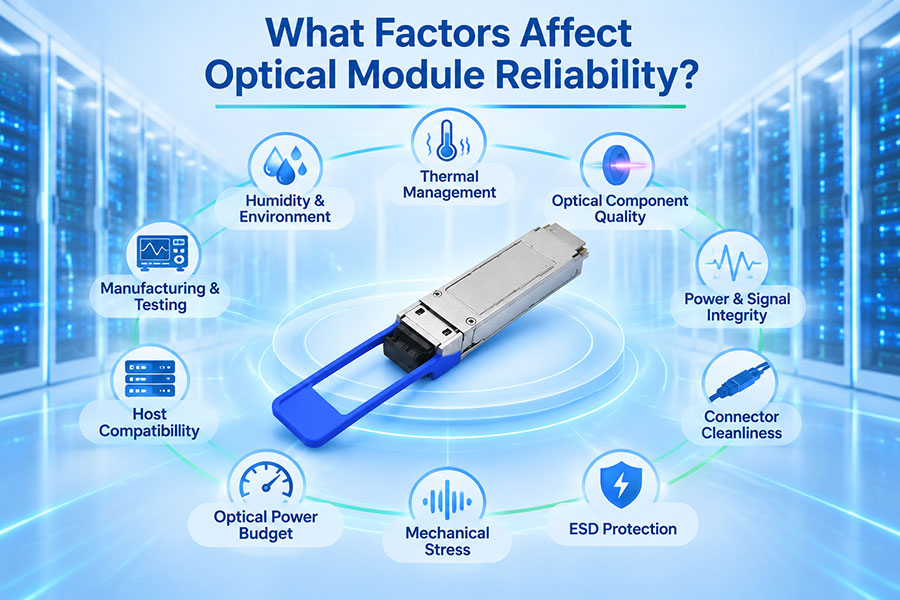
Repeated heating and cooling can place stress on semiconductor packages, solder joints, PCB materials, and internal optical structures. Component selection, assembly processes, and qualification testing help address these thermal conditions.
6. Industrial SFP28 Component Selection and Thermal Design
Industrial-temperature qualification requires careful selection of optical and electronic components. Simply changing the operating temperature label does not make a commercial SFP28 module suitable for industrial applications.
Important design considerations include:
Laser selection: The transmitter must maintain its specified optical output and wavelength characteristics throughout the required temperature range.
Photodetector performance: The receiver must maintain the required sensitivity and operating characteristics under high- and low-temperature conditions.
Driver and receiver ICs: Electronic components must meet their electrical specifications across the complete operating range.
PCB materials: Circuit board materials and assembly processes must be suitable for the expected thermal conditions.
Package construction: The module enclosure and internal structure must support the required thermal and mechanical behavior.
Thermal management: Heat dissipation must be considered in high-density switches and equipment with restricted airflow.
Industrial SFP28 modules also need to operate within the electrical and thermal limits of the host equipment. The transceiver's temperature qualification cannot compensate for inadequate chassis cooling or an unsuitable host device.
7. 25G SFP28 Optical Standards and Transmission Distance
Industrial and Commercial SFP28 modules can support similar optical interfaces. Temperature grade does not determine transmission distance. The optical standard, wavelength, fiber type, transmitter output, receiver sensitivity, and link budget determine the supported reach.
| 25G SFP28 Type | Typical Wavelength | Fiber Type | Common Reference Distance |
|---|---|---|---|
| 25GBASE-SR | 850nm | Multimode fiber | Up to 100m on common OM4 configurations |
| 25GBASE-SR 400m variant | 850nm | Multimode fiber | Up to 400m on supported configurations |
| 25GBASE-LR | 1310nm | Single-mode fiber | Up to 10km |
| 25G extended-reach variants | 1310nm or other specified wavelengths | Single-mode fiber | 20km to 40km, depending on model |
| 25G BiDi | Model-dependent wavelength pair | Single-mode fiber | 10km to 40km or other model-specific distances |
| 25G CWDM | CWDM wavelength grid | Single-mode fiber | Model-dependent |
| 25G ZR | Model-dependent | Single-mode fiber | Extended-distance configurations, depending on optical specifications |
The distances shown are common product configurations rather than universal guarantees. Actual reach depends on the specific module, fiber quality, optical power budget, connector loss, and link design.
For example, a 25GBASE-LR Industrial SFP28 and a 25GBASE-LR Commercial SFP28 may both support 10km over single-mode fiber. Their main difference is the environmental operating range specified by the manufacturer.
8. Optical Power Budget and Link Performance
Optical power budget is an important parameter when designing 25G fiber links. It represents the available optical power margin between the transmitter and receiver specifications.
A simplified calculation is:
Optical Power Budget = Minimum Transmit Optical Power - Receiver Sensitivity
For example, if a 25G SFP28 module has a minimum transmit power of -5dBm and a receiver sensitivity of -12dBm, its theoretical optical power budget is 7dB.
The complete link design must also account for:
Fiber attenuation over the transmission distance.
Connector insertion loss and connector cleanliness.
Fusion splice loss and patch panel connections.
Optical loss introduced by CWDM or other passive components.
Temperature-related changes in transmitter and receiver performance.
Engineering margin for component variation and long-term operation.
For industrial applications, the optical specifications should be checked across the complete rated temperature range. A module that meets its optical budget at room temperature must also satisfy the manufacturer's specified limits under industrial operating conditions.
9. Power Consumption of Industrial and Commercial SFP28 Modules
Power consumption is an important consideration in 25G network design, particularly when multiple SFP28 modules are installed in a high-density industrial switch.
The power requirements of an SFP28 transceiver depend on its optical configuration and internal electronic design. Important factors include:
Laser technology and operating wavelength.
Photodetector and receiver circuit design.
Transmission distance and optical component selection.
Digital diagnostic monitoring functions.
Clock and data recovery circuitry, where implemented.
Operating temperature and thermal management requirements.
Industrial-temperature qualification does not automatically mean that an SFP28 module consumes more power than a commercial equivalent. Power consumption must be checked against the maximum value in the specific product datasheet.
For high-density 25G switches, system designers should calculate the total power consumption of all populated optical ports. The host switch's power supply, cooling capacity, and per-port power limits must be sufficient for the selected modules.
10. Industrial SFP28 vs Commercial SFP28: Application Scenarios
The appropriate temperature grade depends on the actual installation environment. Commercial SFP28 modules remain suitable for many indoor applications, including industrial facilities with controlled equipment rooms.
Data centers and cloud infrastructure
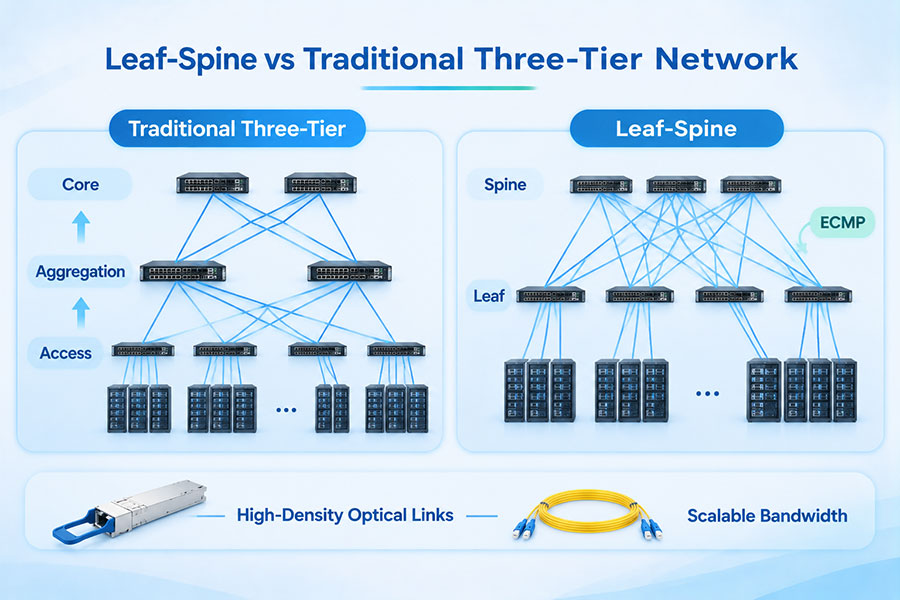
Commercial SFP28 modules are widely used for server connectivity, leaf-spine switching, storage networks, and 25G aggregation links. These environments generally provide controlled temperatures and managed airflow.
Telecommunications networks
25G SFP28 modules can support optical connections in mobile network infrastructure, including suitable fronthaul and aggregation applications. Industrial-temperature models may be required when equipment is installed in outdoor cabinets or exposed locations.
Factory automation
Industrial Ethernet systems connect programmable logic controllers, industrial computers, machine vision systems, and monitoring equipment. When switches operate in areas with significant temperature fluctuations, industrial SFP28 modules can provide a suitable optical interface.
Power substations
Power communication networks support monitoring, protection, automation, and control systems. Industrial-temperature SFP28 modules may be used in compatible network equipment, subject to the project's optical and environmental requirements.
Railway and transportation infrastructure
Railway networks can include outdoor trackside cabinets, station communication equipment, and other installations exposed to changing temperatures. Temperature qualification is important, while vibration, shock, and electromagnetic compatibility require separate verification.
Renewable energy facilities
Solar and wind power installations often rely on remote monitoring and communication equipment. Industrial SFP28 modules can support 25G fiber connectivity where the expected operating conditions exceed commercial temperature limits.
| Application | Typical Environment | Temperature Grade Consideration |
|---|---|---|
| Data center | Temperature-controlled indoor room | Commercial SFP28 is commonly suitable |
| Enterprise network | Indoor equipment room | Commercial SFP28 is commonly suitable |
| Telecom outdoor cabinet | Wide seasonal temperature variations | Industrial SFP28 may be required |
| Factory automation | Variable industrial conditions | Industrial SFP28 when required by case temperature |
| Power substation | Industrial electrical infrastructure | Industrial temperature plus application-specific qualifications |
| Railway communication | Outdoor and transportation environments | Industrial temperature and additional environmental requirements |
| Solar and wind facilities | Outdoor remote installations | Industrial SFP28 where the operating range requires it |
11. SFP28 Compatibility with 25G Ethernet Switches
Industrial SFP28 and Commercial SFP28 modules share the same general physical form factor and electrical interface requirements. However, physical compatibility does not guarantee that every SFP28 module will operate correctly in every switch.
Before deploying a 25G optical module, network engineers should verify the following parameters:
Host device compatibility: Confirm that the switch or router supports the selected SFP28 module.
Port data rate: Verify that the host port supports 25G operation and the required Ethernet interface.
Optical standard: Match the module to the supported 25GBASE interface or vendor-specific implementation.
Wavelength: Confirm that the transmitter and receiver wavelengths match the optical link design.
Fiber type: Select the appropriate single-mode or multimode fiber.
Connector type: Verify the required LC or other supported optical connector.
Power consumption: Check the module's maximum power against the host port's limits.
DDM support: Confirm digital diagnostic monitoring support where required.
Temperature compatibility: Verify that both the module and host equipment support the expected operating conditions.
Some SFP28 modules support multiple data rates, such as 10G and 25G. However, dual-rate capability must be explicitly specified by the manufacturer. A standard 25G SFP28 module should not be assumed to support 10G operation simply because it fits into an SFP28 port.
Host firmware, port configuration, FEC requirements, and module coding may also affect interoperability. These factors should be checked before deployment.
12. Can Commercial SFP28 Modules Be Used in Industrial Environments?
Commercial SFP28 modules can be used in industrial facilities when the actual module case temperature remains within the specified commercial operating range and all other installation requirements are satisfied.
For example, a factory may have a centralized control room with air conditioning and stable equipment temperatures. Commercial SFP28 modules can be suitable for 25G fiber connections in this environment.
However, an outdoor cabinet or an unconditioned industrial enclosure may experience temperatures outside the commercial module's rated range. In such cases, a typical commercial SFP28 module may not be suitable for continuous operation.
Operating beyond the specified temperature range can affect:
Transmit optical power and wavelength stability.
Receiver sensitivity and signal detection performance.
Electrical signal characteristics.
Link stability and available optical margin.
Long-term component reliability.
A commercial module that happens to operate successfully outside its rated temperature range is not necessarily qualified for continuous industrial use. For critical applications, the selected module should have published specifications covering the expected operating conditions.
13. How to Select the Right Industrial or Commercial SFP28
Selecting the correct 25G SFP28 transceiver requires evaluating the environmental conditions, optical link requirements, and host device specifications together.
Step 1: Determine the operating temperature
Identify the expected transceiver case temperature during normal operation and under extreme conditions. Consider cabinet ventilation, neighboring optical modules, equipment density, and heat generated by the host switch.
Step 2: Select the temperature grade
If the module case temperature remains within 0°C to 70°C, a commercial-temperature SFP28 may be suitable. If the expected conditions exceed that range, select an industrial-temperature model with specifications covering the required operating conditions.
Step 3: Choose the optical interface
Determine whether the application requires SR, LR, ER, BiDi, CWDM, or another optical configuration. Match the wavelength, fiber type, connector, and transmission distance to the existing network infrastructure.
Step 4: Calculate the optical power budget
Check minimum transmit power, receiver sensitivity, fiber attenuation, connector loss, and the engineering margin required for reliable operation.
Step 5: Verify host compatibility
Confirm the switch model, firmware requirements, supported data rates, module power limits, FEC configuration, and DDM functions.
Step 6: Review additional environmental requirements
For demanding installations, check whether the complete system requires additional vibration, shock, humidity, dust protection, electromagnetic compatibility, or other application-specific qualifications.
14. C-LIGHT 25G SFP28 Optical Transceiver Solutions
C-LIGHT provides a range of 25G SFP28 optical transceivers for data center, telecommunications, enterprise, and industrial fiber connectivity applications. The product series covers multiple transmission distances and optical configurations, with selected models listed for commercial and industrial temperature operation.
C-LIGHT's 25G SFP28 product range includes several optical configurations for different fiber infrastructures and transmission distances.
| Part Number | Fiber Type | Wavelength | Distance | Case Temperature Listing |
|---|---|---|---|---|
| CLSFP25GSR | MMF | 850nm | 100m | Commercial / Industrial |
| CLSFP25GXSR | MMF | 850nm | 400m | Commercial / Industrial |
| CLSFP25GLR | SMF | 1310nm | 10km | Commercial / Industrial |
| CLSFP25GLR20 | SMF | 1310nm | 20km | Commercial / Industrial |
| CLSFP25GER | SMF | 1310nm | 40km | Commercial / Industrial |
| CLSFP25GER60 | SMF | 1310nm | 60km | Commercial / Industrial |
| CLSFP25GZR | SMF | 1310nm | 80km | Commercial / Industrial |
The product series supports 25Gbps optical connectivity and follows the relevant SFP28 interface and packaging specifications listed by C-LIGHT. Selected products are available with commercial and industrial case-temperature options. The exact temperature range and optical performance should be confirmed for the ordered part number and datasheet revision.
Product details: C-LIGHT 25G SFP28 Optical Transceivers
For industrial 25G fiber projects, product selection should consider the required temperature grade, transmission distance, fiber type, wavelength, optical power budget, and host switch compatibility. C-LIGHT supports product selection and customization based on project requirements.
15. Conclusion
Industrial SFP28 and Commercial SFP28 modules provide 25G optical connectivity through the same general SFP28 form factor, but they are designed for different environmental operating conditions. Commercial SFP28 modules commonly support a case temperature range of 0°C to 70°C, while industrial-temperature versions commonly support -40°C to 85°C.
The temperature grade does not independently determine bandwidth, optical reach, or receiver sensitivity. Both product categories can support similar SR, LR, ER, BiDi, and CWDM interfaces when the corresponding models are available.
For data centers and controlled indoor networks, Commercial SFP28 modules are often sufficient. For outdoor telecommunications cabinets, factory automation, power infrastructure, and other environments with wider temperature fluctuations, Industrial SFP28 modules may provide the operating range required by the application.
By evaluating temperature specifications, optical power budgets, transmission requirements, and host compatibility together, network engineers can select suitable 25G optical transceivers for reliable long-term operation.
C-LIGHT provides 25G SFP28 optical transceivers covering multiple wavelengths, transmission distances, and temperature options. Contact our team for product specifications, compatibility verification, temperature-grade selection, and customized 25G fiber connectivity solutions.
 >

 >
 >
 >
 >
 >
 >
 >