TEL:+86 132 6656 7067





Optical transceivers are used across industrial networks and modern data centers, but the conditions in which they operate can be very different. Industrial installations may expose network equipment to wide temperature fluctuations, vibration, dust, electrical interference, and limited environmental control. Data centers, by contrast, typically prioritize high port density, bandwidth scalability, low power consumption, and predictable operation within controlled equipment rooms.
These different deployment priorities influence optical module selection, including operating temperature, hardware design, power characteristics, supported data rates, and host-device compatibility. However, industrial and data center transceivers are not completely separate technology categories. Both can use standardized optical interfaces, and some transceiver models may serve multiple application environments when their specifications meet the deployment requirements.
1. What Is an Industrial Optical Transceiver?
An industrial optical transceiver is designed for optical communication in demanding operating environments. It converts electrical signals into optical signals for transmission over fiber and converts incoming optical signals back into electrical signals at the receiving end.
Its distinguishing feature is generally its environmental operating capability rather than a particular transmission speed or optical connector. Industrial-grade modules are commonly selected for applications where equipment may operate outside the temperature conditions of a conventional office or data center.
Typical deployment environments include:
Factory automation and industrial control networks.
Outdoor telecommunications cabinets and remote access sites.
Electric power substations and utility communication systems.
Railway, transportation, and traffic management networks.
Oil, gas, and other infrastructure monitoring systems.
Industrial Ethernet networks connecting switches, controllers, and remote devices.
Industrial optical transceivers are available in different form factors and data rates, including SFP, SFP+, and other module types. The correct selection depends on the host interface, optical reach, fiber type, wavelength, and environmental requirements.
2. What Is a Data Center Transceiver?
A data center transceiver is an optical module designed for high-speed connections between switches, servers, storage systems, routers, and other network infrastructure. Its primary design priorities are bandwidth, port density, power efficiency, signal integrity, and scalability.
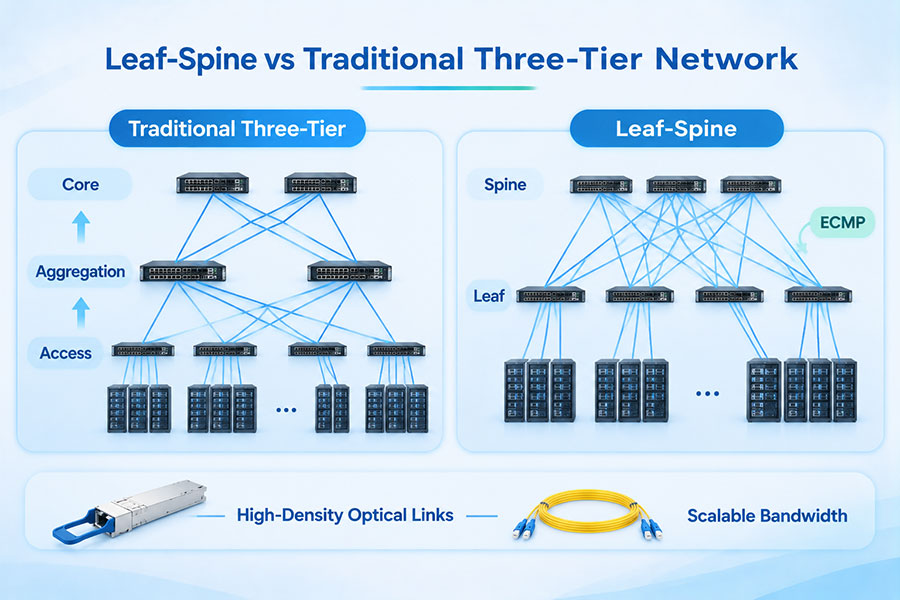
Modern data center networks use optical transceivers to support high-capacity connections across leaf-spine architectures, server access networks, storage networks, and data center interconnects.
Common data center transceiver applications include:
Switch-to-switch connections within leaf-spine networks.
Server-to-switch connections in high-density racks.
Connections between storage systems and network switches.
High-speed links across different data center rooms.
Data center interconnects between geographically separated facilities.
AI and high-performance computing clusters requiring high-bandwidth optical connectivity.
Data center modules include multiple generations of optical interfaces, such as SFP28, QSFP28, QSFP-DD, OSFP, and newer high-speed form factors. Depending on the application, they can support 10G, 25G, 100G, 400G, 800G, and emerging 1.6T connectivity.
3. Industrial vs Data Center Transceiver: Key Differences
The most important distinction is the environment each module is designed to support. Industrial transceivers generally emphasize environmental tolerance, while data center transceivers place greater emphasis on bandwidth density and power efficiency. These are design priorities rather than mutually exclusive technical specifications.
| Parameter | Industrial Optical Transceiver | Data Center Transceiver |
|---|---|---|
| Primary objective | Reliable operation in demanding environments | High bandwidth, density, and network scalability |
| Typical temperature grade | Often industrial temperature, such as -40°C to +85°C | Often commercial temperature, such as 0°C to +70°C |
| Deployment environment | Factories, outdoor cabinets, utilities, and transportation systems | Data center racks, server rooms, and interconnection facilities |
| Data rates | Commonly 1G, 10G, and 25G in many industrial networks; higher rates are available | From 10G and 25G to 100G, 400G, 800G, and 1.6T applications |
| Common form factors | SFP, SFP+, SFP28, and application-specific designs | SFP+, SFP28, QSFP28, QSFP-DD, OSFP, and other high-speed formats |
| Design priorities | Temperature tolerance, environmental robustness, and stable operation | Bandwidth density, power efficiency, thermal management, and scalability |
| Network applications | Industrial Ethernet, control networks, and remote monitoring | Server connectivity, storage, switching, AI clusters, and DCI |
| Host compatibility | Industrial switches, routers, and other compatible network equipment | Data center switches, routers, servers, and compatible host platforms |
These characteristics describe common deployment patterns, not universal rules. An industrial network may require 100G or higher-speed optics, while a data center may use an industrial-temperature module in an environment that requires a wider operating range.
4. Operating Temperature: The Most Important Environmental Difference
Temperature is one of the clearest differences between many industrial and data center optical transceivers. Optical modules are commonly classified by their operating case temperature rather than simply the surrounding room or cabinet temperature.
| Temperature Grade | Typical Operating Case Temperature | Common Deployment |
|---|---|---|
| Commercial (C-Temp) | 0°C to +70°C | Conventional data centers and controlled indoor environments |
| Extended (E-Temp) | Varies by manufacturer; commonly -5°C to +85°C or other specified ranges | Applications requiring broader temperature tolerance |
| Industrial (I-Temp) | -40°C to +85°C | Outdoor cabinets, industrial facilities, and harsh environments |
These ranges are commonly used industry classifications, but the exact limits must always be confirmed in the individual product datasheet. Extended-temperature specifications are not completely uniform across manufacturers.
It is also important to distinguish operating temperature from storage temperature. A commercial transceiver may specify a broad storage range while still requiring a much narrower temperature range during normal operation. A wide storage rating does not make a module suitable for industrial operation.
In enclosed equipment cabinets, the module case temperature can be higher than the surrounding ambient temperature because of heat generated by the host equipment and other components. Engineers should therefore consider actual module temperature, airflow, cabinet design, and host-device thermal conditions when selecting a transceiver.
5. Data Rate and Bandwidth Requirements
Industrial and data center transceivers support different bandwidth requirements in many deployments, but there is no strict data-rate boundary separating the two categories.
Industrial networks commonly use 1G and 10G optical links for control systems, surveillance, machine connectivity, and communication between industrial switches. Some modern industrial and infrastructure networks require 25G, 40G, or 100G connectivity as data collection, video traffic, and centralized processing increase.
Data centers have experienced a faster transition toward higher-speed optical interfaces. The adoption of 100G, 400G, and 800G modules supports growing traffic between switches, servers, and AI computing infrastructure. Higher-speed platforms also require careful attention to electrical lane architecture, signal integrity, cooling, and host compatibility.
The following table shows examples of common application patterns:
| Data Rate | Industrial Network Applications | Data Center Applications |
|---|---|---|
| 1G | Industrial switches, remote monitoring, and access networks | Legacy network connections and selected management links |
| 10G | Industrial backbone and high-capacity equipment links | Server access and network aggregation |
| 25G | High-bandwidth industrial infrastructure and specialized networks | Server-to-switch connections and data center access |
| 100G | High-capacity industrial or utility backbone links where supported | Switch uplinks, aggregation, and network interconnection |
| 400G and 800G | Specialized high-capacity infrastructure applications | High-density switching, AI clusters, and data center fabrics |
| 1.6T | Not a typical industrial access-network requirement | Emerging high-bandwidth data center and AI infrastructure |
Actual module availability depends on the manufacturer, form factor, optical standard, and temperature qualification. A higher data rate does not automatically mean a module is designed for industrial environments.
6. Form Factors and Optical Interfaces
Form factor determines how an optical transceiver fits into the host equipment and connects to its electrical and optical interfaces. Both industrial and data center modules can use standardized form factors, but their most common choices differ according to network architecture and bandwidth requirements.
Industrial deployments frequently use SFP-family modules because they are suitable for many industrial Ethernet switches and access devices. SFP and SFP+ interfaces provide practical options for Gigabit and 10G optical links, while SFP28 supports 25G applications where the host equipment is designed for it.
Data center networks use a broader range of high-density interfaces. QSFP28 is widely associated with 100G applications, while QSFP-DD and OSFP support high-speed 400G and 800G platforms. Newer 1.6T designs continue this transition toward greater bandwidth per port.
| Form Factor | Common Data Rate Applications | Typical Deployment |
|---|---|---|
| SFP | 1G and selected multi-rate applications | Industrial Ethernet and enterprise access |
| SFP+ | 10G | Industrial backbone and data center access |
| SFP28 | 25G | High-speed industrial and data center networks |
| QSFP28 | 100G | Data center switching and aggregation |
| QSFP-DD | 400G and 800G generations | High-density data center switching |
| OSFP | 400G and 800G generations | High-performance data center and AI networks |
The data rates shown are common application examples, not guaranteed capabilities of every module using the same form factor. The host electrical interface, module specification, and supported optical standard must all match.
7. Optical Performance and Transmission Distance
Transmission distance is determined by the optical interface specification rather than whether a transceiver is labeled industrial or data center. Wavelength, transmitter output power, receiver sensitivity, fiber type, dispersion tolerance, connector loss, and link power budget all affect the achievable reach.
For example, industrial networks may use short-reach multimode optics for connections within a facility, or single-mode optics for links between buildings and remote equipment locations. Data centers also use both multimode and single-mode modules, depending on link distance, fiber infrastructure, port density, and cost requirements.
Common optical interface examples include:
SR: Short-reach optical interfaces generally designed for multimode fiber.
LR: Longer-reach interfaces commonly using single-mode fiber.
ER and ZR: Extended-reach interfaces for longer optical links, subject to their specific standards and implementation requirements.
BiDi: Bidirectional optical modules that transmit and receive over a single fiber using different wavelengths.
DWDM: Wavelength-division multiplexing modules used to support multiple optical channels over fiber infrastructure.
An industrial-temperature module can support a long-distance single-mode link, while a commercial-temperature data center module can support a short-reach multimode connection. Temperature grade and transmission distance should therefore be evaluated as separate specifications.
8. Reliability and Environmental Design
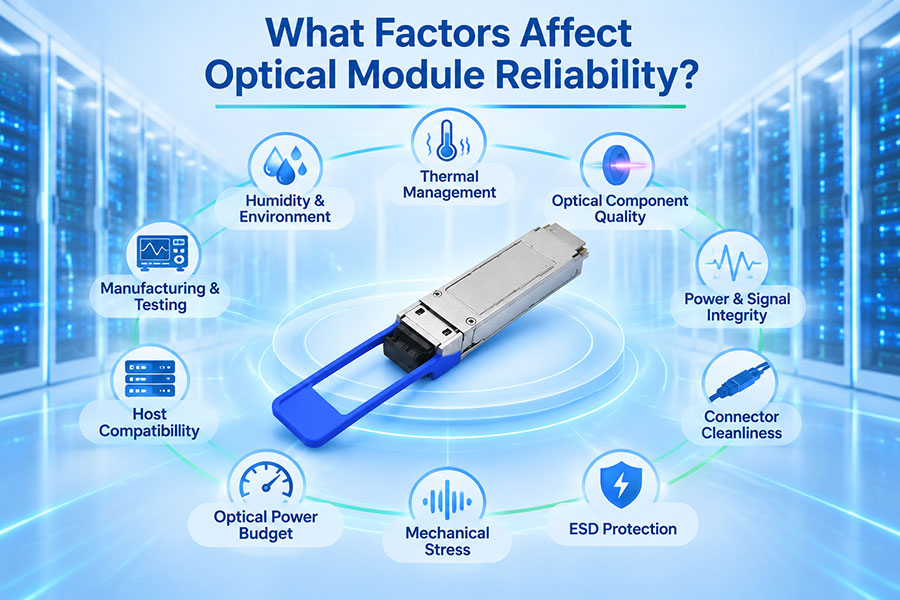
Industrial optical transceivers are often deployed in locations where environmental conditions are less predictable. Their selection may involve additional considerations beyond optical performance, including temperature cycling, vibration exposure, humidity, dust protection at the equipment level, and electromagnetic compatibility of the overall installation.
Industrial reliability should not be judged by temperature rating alone. Engineers should review the complete product qualification and datasheet, including any available information on:
Operating and storage temperature limits.
Humidity and condensation limitations.
Vibration and mechanical shock qualification, where applicable.
Electromagnetic compatibility requirements of the host equipment and installation.
Power supply tolerance and module power consumption.
Digital diagnostic monitoring and alarm thresholds.
Product lifetime, warranty, and manufacturer reliability information.
Data center transceivers also require careful reliability engineering. High port density and high-speed signaling create significant thermal and power-management challenges. Module cooling, airflow direction, connector cleanliness, firmware compatibility, and optical link monitoring all contribute to stable operation.
Neither category is automatically more reliable in every application. A commercial module used within its specified operating conditions can provide dependable service, while an industrial module may be unsuitable if its optical interface or host compatibility does not meet the network requirements.
9. Power Consumption and Thermal Management
Power consumption is an important consideration in both industrial and data center networks, although the reasons for prioritizing it may differ.
In industrial installations, some remote devices operate in enclosed cabinets with limited cooling capacity. Lower module power consumption can help reduce local heat generation and ease thermal management. The host switch's total power budget and ventilation design must also be considered.
In data centers, the power consumption of thousands of optical modules can contribute significantly to overall facility power demand. Higher-speed modules often involve more complex electrical and optical signal processing, making power efficiency an important factor in network design.
When evaluating a transceiver, engineers should check:
Maximum rather than only typical power consumption.
Host port power limits and module power class.
Operating temperature and cooling requirements.
Airflow direction and compatibility with the host platform.
Thermal behavior under the intended traffic and operating conditions.
For high-speed data center modules, the host platform must be able to provide the required electrical power and cooling. For industrial modules, the equipment enclosure and surrounding thermal environment must support the specified operating conditions.
10. Compatibility with Network Equipment
Mechanical fit alone does not guarantee optical transceiver compatibility. A module must match the host device's electrical interface, supported data rate, optical specification, firmware requirements, and vendor compatibility policy.
For industrial Ethernet switches, the key checks usually include:
Supported SFP, SFP+, or SFP28 module types.
Port speed and supported Ethernet standards.
Single-mode or multimode fiber compatibility.
Connector type and optical wavelength.
Operating temperature requirements.
Host-device coding and compatibility requirements.
For data center switches, compatibility checks may also involve lane mapping, modulation format, forward error correction (FEC), breakout configuration, module power class, and the switch's supported optical standards.
For example, a 400G QSFP-DD module cannot be assumed to work in an OSFP port simply because both support high-speed optical connectivity. Their mechanical interfaces and host electrical implementations are different. Likewise, two modules with the same form factor may support different optical reaches or link configurations.
11. Can Industrial Transceivers Be Used in Data Centers?
Yes. An industrial-temperature transceiver may be used in a data center if it is compatible with the host equipment and meets the required optical and electrical specifications.
However, an industrial temperature rating does not automatically provide better performance for every data center application. If a data center maintains controlled environmental conditions, a commercial-temperature module may already satisfy the operating requirements. The additional environmental capability of an industrial module may not provide a practical benefit in that situation.
Industrial-temperature modules can be useful in data center-related installations such as:
Unconditioned network rooms and remote equipment enclosures.
Outdoor fiber distribution and access cabinets.
Network infrastructure installed in industrial facilities.
Remote monitoring and communication equipment.
The final decision should be based on the actual module case temperature, host compatibility, and optical link requirements rather than the location label alone.
12. Can Data Center Transceivers Be Used in Industrial Environments?
Data center transceivers can be used in industrial environments only when the actual installation conditions remain within their specified operating limits. A commercial-temperature module rated from 0°C to +70°C should not be assumed to operate reliably in an enclosure that regularly falls below 0°C or exceeds +70°C at the module case.
Before deploying a commercial module in an industrial network, engineers should evaluate:
Minimum and maximum module case temperature.
Temperature changes during startup and shutdown.
Heat accumulation inside sealed cabinets.
Vibration and mechanical exposure.
Host equipment environmental specifications.
Manufacturer approval for the intended operating conditions.
If the installation exceeds the commercial module's specified operating range, an appropriately qualified industrial-temperature model should be considered. Selecting a module with a suitable temperature rating is essential for maintaining reliable network operation.
13. Industrial Optical Transceiver vs Data Center Transceiver: How to Choose
The selection process should begin with the deployment environment and required network performance. Choosing a transceiver based only on price, form factor, or data rate can lead to compatibility issues or premature operational problems.
| Application Requirement | Recommended Selection Focus |
|---|---|
| Factory automation | Industrial temperature rating, compatible industrial switch ports, and required optical reach |
| Outdoor communication cabinet | Wide operating temperature, enclosure thermal design, and environmental qualification |
| Electric utility network | Environmental requirements, optical link budget, equipment compatibility, and network availability |
| Standard data center rack | Commercial-temperature suitability, port density, power consumption, and supported Ethernet standards |
| AI and high-performance computing cluster | High-speed interface support, lane configuration, FEC, thermal management, and power budget |
| Data center interconnect | Required reach, optical power budget, wavelength plan, fiber infrastructure, and line-system compatibility |
A practical selection process includes the following steps:
Identify the environment: Determine the expected module case temperature and any additional environmental conditions.
Confirm the host interface: Check the switch or router model, port form factor, supported data rate, and compatibility requirements.
Define the optical link: Confirm fiber type, wavelength, connector, transmission distance, and required optical power budget.
Check electrical and optical standards: Verify the module's Ethernet or other protocol support, lane configuration, and FEC requirements.
Evaluate power and cooling: Confirm that the host platform can supply the required power and maintain suitable thermal conditions.
Validate the complete link: Test the selected modules with the intended host equipment and fiber infrastructure before large-scale deployment.
14. C-LIGHT Optical Transceivers and Industrial Network Solutions
Network infrastructure requires optical modules and switching equipment that match the operating environment, transmission distance, and required bandwidth. C-LIGHT provides optical connectivity products and industrial Ethernet equipment for different network deployment requirements.
For optical connectivity, the C-LIGHT Optical Transceiver portfolio provides a starting point for selecting modules according to data rate, form factor, optical interface, and application requirements. The appropriate model should be confirmed against the target host platform and environmental specifications.
For industrial network infrastructure, C-LIGHT offers several equipment categories:
Industrial Managed Switch for managed network deployments requiring functions such as VLAN, QoS, network monitoring, and other model-dependent management features.
Industrial Unmanaged Switch for straightforward industrial Ethernet connectivity.
Industrial Managed PoE Switch for network deployments that require both Ethernet connectivity and power delivery to compatible powered devices.
Industrial Fiber Media Converter for converting between electrical Ethernet and optical fiber interfaces.
When combining industrial switches and optical transceivers, engineers should verify the supported module types, port speeds, optical specifications, and operating temperature requirements of each device. The environmental rating of the complete network installation is determined by all relevant components, not just the transceiver.
For product selection or technical requirements, Contact C-LIGHT.
15. Conclusion
Industrial optical transceivers and data center transceivers serve different deployment priorities, but they share many underlying optical communication technologies. Industrial modules are generally selected for wider operating temperature ranges and demanding installation conditions, while data center modules are designed around high bandwidth, port density, power efficiency, and scalable network architectures.
The most important selection factors are operating case temperature, host-device compatibility, data rate, optical reach, fiber type, power consumption, and environmental qualification. Neither category is universally superior. The right transceiver is the one that satisfies the technical and environmental requirements of the intended network.
 >

 >
 >
 >
 >
 >
 >
 >