TEL:+86 132 6656 7067





Data center infrastructure serves organizations with very different computing requirements. A global cloud platform may need to operate thousands of servers across multiple facilities, while a financial institution, manufacturer or healthcare organization may build its own data center around internal applications, databases and business-critical systems. Both environments require reliable power, cooling, storage and networking, but their approaches to capacity planning and infrastructure management can be substantially different.
Hyperscale data centers are designed for large-scale expansion, standardized infrastructure and automated resource management. Enterprise data centers are generally built around the computing, security, availability and operational requirements of a particular organization. The distinction involves more than physical size: ownership, workload profiles, network architecture, procurement and operating models all influence how these facilities are designed.
1. What Is a Hyperscale Data Center?
A hyperscale data center is a large computing facility designed to expand infrastructure capacity efficiently as demand increases. It typically supports large-scale cloud services, Internet platforms, artificial intelligence, data analytics, content delivery and distributed storage.
Rather than depending on a limited number of individually configured systems, hyperscale infrastructure commonly uses standardized server configurations, modular capacity blocks and software-driven resource management. Additional servers, storage nodes and network equipment can be introduced as new capacity is required.
Hyperscale environments are commonly associated with major cloud service providers and large Internet companies. They may operate facilities across multiple locations, connecting them through high-capacity fiber networks and regional backbone infrastructure.
Typical characteristics include:
Large-scale deployment: Facilities can contain thousands of servers and extensive network and storage infrastructure.
Horizontal scalability: Capacity is expanded by adding standardized servers, racks, clusters or data center modules.
Automation: Provisioning, monitoring, workload placement and infrastructure recovery are managed through software.
Distributed architecture: Compute, storage and network resources are organized into large resource pools.
High-capacity connectivity: Extensive fiber infrastructure supports internal traffic and connections between facilities.
Infrastructure efficiency: Power, cooling, hardware utilization and operating costs are optimized across large deployments.
Hyperscale does not have one universally accepted server-count or floor-area threshold. Scale is better understood through the facility's capacity, architectural approach, ability to expand and operating model rather than a single number.
2. What Is an Enterprise Data Center?
An enterprise data center is a facility operated or commissioned to support the IT requirements of an individual organization. It may be located at the company's own premises, within a dedicated campus, or in a colocation facility where the organization installs and manages its own equipment.
Enterprise data centers commonly host systems that support internal business operations. These include enterprise resource planning, customer relationship management, financial applications, databases, virtualization platforms, file services, backup systems and private cloud infrastructure.
The infrastructure is usually planned around business-specific requirements. A financial organization may prioritize transaction integrity and recovery procedures, while a manufacturer may focus on production systems, industrial applications and connections to operational technology environments.
Common characteristics include:
Organization-focused infrastructure: Capacity and architecture are aligned with the company's applications and business objectives.
Workload-specific design: Hardware, storage and network resources are selected for defined application requirements.
Operational control: Internal IT teams or contracted service providers manage infrastructure and access policies.
Security and compliance: Systems are configured according to organizational policies and relevant regulatory requirements.
Planned expansion: Hardware and facility capacity are added according to business forecasts and approved investment.
Hybrid connectivity: Enterprise environments may connect to public cloud services, remote offices and external data centers.
Enterprise data centers can range from relatively small server rooms to large campus facilities. Their defining feature is their relationship to an organization's IT operations, not necessarily a small physical footprint.
3. Hyperscale vs Enterprise Data Center: Main Differences
| Infrastructure Factor | Hyperscale Data Center | Enterprise Data Center |
|---|---|---|
| Primary purpose | Large-scale cloud, Internet, AI and distributed computing services | Internal business applications and organization-specific IT services |
| Typical operator | Large cloud providers, Internet companies and specialist operators | Individual enterprises or their contracted infrastructure operators |
| Infrastructure scale | Often thousands of servers across large facilities or campuses | Varies from small facilities to large enterprise campuses |
| Expansion model | Horizontal expansion through standardized capacity blocks | Expansion according to business demand and IT investment plans |
| Hardware strategy | Standardized configurations and large-scale procurement | Often combines standardized servers with application-specific systems |
| Workload diversity | Large pools of cloud, Internet, analytics and AI workloads | Business applications, databases, virtualization and internal services |
| Network architecture | Large-scale fabrics, extensive fiber connectivity and automation | Designed around application access, site connectivity and business requirements |
| Storage architecture | Distributed storage systems and large resource pools | Combination of SAN, NAS, DAS, object and cloud storage |
| Power and cooling | Large utility capacity, facility-wide optimization and modular cooling | Designed around the organization's equipment density and expansion needs |
| Automation | Extensive software-driven provisioning and fleet management | Varies according to IT maturity, budget and operational model |
| Availability design | Distributed services, automated recovery and geographic redundancy | Business continuity, redundancy and recovery aligned with service priorities |
| Cost structure | Large capital investment and optimization across massive infrastructure | Budget and lifecycle costs linked to organizational IT demand |
4. Infrastructure Scale and Expansion Strategy
Scalability is one of the defining characteristics of hyperscale infrastructure. New capacity can be introduced through standardized server racks, network modules and facility expansions. This reduces the need to redesign the entire environment whenever computing demand increases.
Horizontal scaling is particularly important for cloud providers. When demand for virtual machines, storage or AI services grows, additional computing resources can be added to existing resource pools. Software platforms then allocate those resources to customer workloads.
Enterprise data centers also use horizontal scaling, but their expansion is generally linked to the needs of a particular organization. A company may add servers, storage shelves or network switches when application usage increases, a new business system is deployed or an existing platform reaches its capacity limit.
The investment process can also differ. Hyperscale operators often plan capacity across regions and facilities, while enterprise IT teams may evaluate each major expansion against business forecasts, application roadmaps, procurement budgets and internal approval processes.
| Expansion Factor | Hyperscale | Enterprise |
|---|---|---|
| Capacity planning | Forecasts demand across large infrastructure fleets and geographic regions | Forecasts application and business growth for an organization |
| Server deployment | Standardized configurations deployed in large quantities | Deployment based on workload requirements and approved budgets |
| Network expansion | Adds network capacity across pods, fabrics and facilities | Upgrades access, core, storage and external connectivity as needed |
| Facility strategy | May add buildings, campuses or regional sites | May expand an existing facility or use colocation and cloud resources |
| Procurement | Large-volume sourcing and standardized hardware programs | Project-based or framework-based purchasing for IT requirements |
5. Server, Compute and Storage Architecture
Hyperscale facilities commonly deploy large fleets of standardized servers that operate as pooled infrastructure. Individual servers may be treated as replaceable units within a larger distributed platform. Software handles workload placement, data distribution and recovery when equipment fails.
This model makes standardization important. Consistent server configurations simplify deployment, monitoring, maintenance and spare-parts management. Specialized systems can still be used for workloads requiring particular processors, accelerators, memory configurations or storage performance.
Enterprise data centers often operate a wider mixture of hardware generations and application-specific systems. An organization may retain older platforms because of software dependencies, certification requirements or migration costs, while deploying newer systems for virtualization, databases and cloud-native applications.
Storage architecture also reflects different operating priorities. Hyperscale platforms commonly use distributed storage across large numbers of nodes, with software handling data placement, replication or erasure coding. Enterprise environments may combine SAN, NAS, direct-attached storage, object storage and cloud services according to application requirements.
| Component | Hyperscale Environment | Enterprise Environment |
|---|---|---|
| Compute | Large pools of standardized servers and workload-specific clusters | General-purpose servers, virtualization platforms and specialized application systems |
| CPU and accelerators | Fleet-scale CPU platforms, GPUs and custom or specialized processors | Primarily general-purpose CPUs, with GPUs or accelerators where required |
| Memory | Designed around pooled compute capacity and application requirements | Configured for database, application and virtualization workloads |
| Storage | Distributed storage and large-scale object or file services | SAN, NAS, DAS, object storage and cloud-based storage |
| Data protection | Automated replication, erasure coding and distributed recovery mechanisms | Backup, replication, snapshots and disaster recovery plans |
6. Network Architecture and Optical Connectivity
Networking is a critical part of both hyperscale and enterprise data centers, but the scale and operating requirements can be different. Hyperscale facilities must connect large numbers of servers, storage systems and network devices while supporting substantial internal East-West traffic.
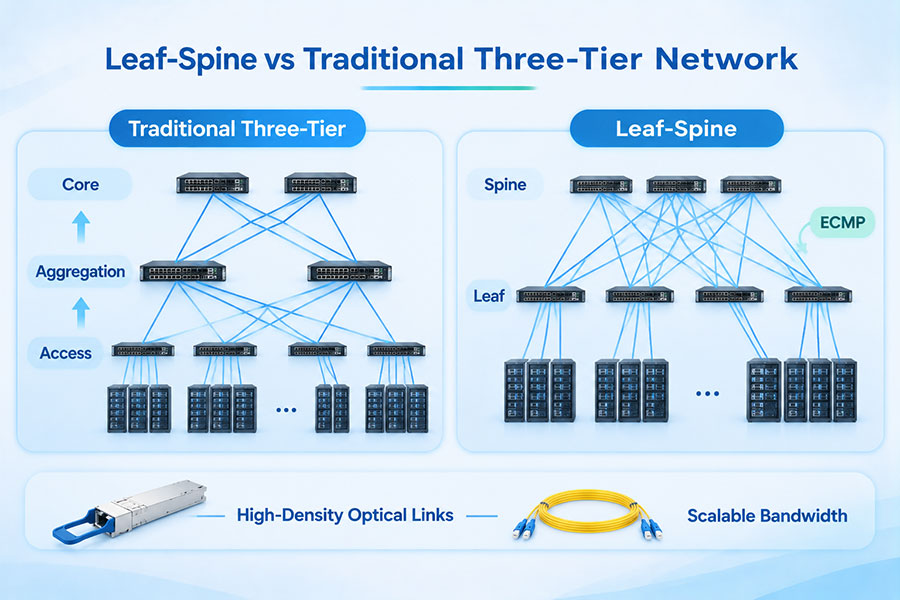
Leaf-spine and Clos-based architectures are widely used in large data center fabrics. Leaf switches connect servers and endpoints, while spine switches provide interconnection between leaf switches. Layer 3 routing and Equal-Cost Multi-Path (ECMP) allow eligible traffic to use multiple paths through the fabric.
Extensive fiber infrastructure is important in hyperscale facilities. High-capacity optical links support connections between racks, network layers, data center buildings and geographically distributed facilities. The number of optical links and fiber pathways can be substantial because of the scale of the deployment.
Enterprise networks also use leaf-spine fabrics, but many environments retain traditional three-tier architectures or hybrid designs. Access, aggregation and core layers may connect servers, storage, office networks, business applications and external sites. The selected topology depends on traffic patterns, facility size, technical requirements and existing infrastructure.
| Network Area | Hyperscale Data Center | Enterprise Data Center |
|---|---|---|
| Internal traffic | Large volumes of East-West traffic across server and storage fleets | Application, database, virtualization and storage communication |
| Network topology | Large-scale Clos and leaf-spine fabrics are common | Leaf-spine, three-tier or hybrid network designs |
| Port density | High-density switching to connect large server populations | Selected according to rack counts, server ports and bandwidth demand |
| Optical connectivity | Extensive fiber links between racks, fabrics and facilities | Fiber uplinks, storage connections, backbones and external connectivity |
| Automation | Large-scale network provisioning and configuration automation | Ranges from manual administration to highly automated management |
| Capacity growth | Designed to expand across pods, fabrics and geographic regions | Expanded according to application growth and infrastructure projects |
For high-speed links, optical interfaces must match the switch port, transmission standard, wavelength, fiber type, connector and required reach. Depending on the network design, deployments may use 100G, 400G, 800G or higher-capacity optical connections.
Enterprise facilities may use a combination of optical transceivers, DAC and AOC assemblies. Hyperscale environments also use these technologies, but typically deploy them across a much larger number of links and with greater emphasis on standardized qualification and large-volume compatibility.
For data center optical connectivity, the C-LIGHT optical transceiver portfolio provides options for different network speeds and link requirements. Additional connectivity products are available in the C-LIGHT product portfolio.
7. Power Density and Cooling Requirements
Power and cooling infrastructure are major design considerations for both categories. Hyperscale facilities require large electrical capacities to support extensive server fleets, network equipment and storage infrastructure. Their cooling systems must maintain suitable operating conditions across large equipment halls and changing workloads.
Enterprise data centers have more varied power profiles. Some operate relatively low-density server racks, while others support high-performance computing, large database systems or AI infrastructure with substantial rack-level loads.
AI has made this distinction less predictable. A hyperscale facility may contain conventional cloud computing halls, high-density GPU clusters or a mixture of both. An enterprise facility can also host dense accelerator systems that require advanced cooling and power distribution.
Common cooling approaches include:
Air cooling: Uses computer room air conditioning, air handling systems and controlled airflow.
Hot-aisle and cold-aisle containment: Separates supply and exhaust air to improve cooling efficiency.
Rear-door heat exchangers: Remove heat from equipment exhaust at the rack.
Direct-to-chip liquid cooling: Transfers heat from processors and other high-power components through cold plates.
Immersion cooling: Uses a compatible dielectric fluid to remove heat from submerged IT equipment.
Cooling selection depends on equipment power, rack density, facility design, operating conditions and service requirements. It should not be assumed that every hyperscale facility uses liquid cooling or that enterprise facilities only use conventional air cooling.
8. Reliability, Redundancy and Disaster Recovery
Both hyperscale and enterprise data centers need to protect services against hardware failures, power interruptions, network faults and facility incidents. Their methods of achieving availability can differ because of scale, workload design and business responsibilities.
Hyperscale platforms commonly combine resilient facility infrastructure with software-driven fault handling. Distributed applications can replicate information, redistribute workloads and recover from failures across infrastructure groups. Standardized hardware also helps operators replace failed components without treating every server as a unique system.
Enterprise data centers often design redundancy around business application requirements. Common mechanisms include redundant power feeds, UPS systems, backup generators, dual network paths, storage replication, clustering and disaster recovery sites.
Important availability considerations include:
Power redundancy: Independent power distribution paths and backup systems where required.
Network redundancy: Multiple network paths, switches and upstream connections.
Storage protection: Replication, backup, snapshots and recovery mechanisms.
Workload recovery: Automated failover or restart procedures after a system failure.
Geographic resilience: Recovery or service continuity across separate facilities when required.
Testing: Regular validation of recovery procedures and failure scenarios.
Availability is not determined by facility size alone. A smaller enterprise data center can be designed for stringent service requirements, while a hyperscale platform may use distributed software architecture to tolerate individual component failures. The correct approach depends on the service-level objectives and acceptable recovery times.
9. Security, Compliance and Infrastructure Control
Security requirements are important in both hyperscale and enterprise environments, but the ownership model can influence how controls are implemented.
Enterprise data centers often operate under organization-specific security policies. Internal IT and security teams may manage physical access, network segmentation, identity systems, encryption, logging, compliance evidence and data retention. Highly regulated organizations may require dedicated infrastructure or specific controls over data location and administration.
Hyperscale providers must protect large infrastructure fleets and support multiple customer environments. They commonly use extensive physical security, automated configuration management, identity controls, network isolation, encryption and centralized security monitoring.
Cloud customers also share responsibility for security. A provider manages the underlying infrastructure according to its service model, while customers remain responsible for areas such as account permissions, application configuration, data access and workload security.
Important security design areas include:
Physical access control and facility monitoring.
Network segmentation and policy enforcement.
Identity and privileged-access management.
Encryption of sensitive data in transit and at rest.
Security logging, monitoring and incident response.
Backup protection, retention and recovery validation.
Compliance with applicable industry and regional requirements.
10. Operating Models and Infrastructure Costs
Hyperscale infrastructure requires large capital investment, extensive facilities planning and long-term coordination of power, cooling, network capacity and hardware procurement. Its operating model is built around automation, standardization and high utilization across large resource pools.
Enterprise data centers are generally managed according to the organization's IT strategy. Some companies own and operate their facilities, while others use colocation, managed hosting, private cloud services or hybrid infrastructure. Operating costs may include hardware purchases, software licenses, maintenance contracts, staffing, power, connectivity and facility services.
Neither category is automatically cheaper. Hyperscale operators can benefit from purchasing volume and infrastructure standardization, but they also face large capital requirements and complex power and facility planning. Enterprise organizations may avoid some construction costs by using colocation or public cloud services, although recurring service costs and migration requirements must be considered.
| Cost Category | Hyperscale | Enterprise |
|---|---|---|
| Initial investment | Large-scale site, power, cooling and infrastructure investment | Varies according to facility ownership, equipment requirements and deployment model |
| Hardware procurement | Large-volume standardized purchasing | Procurement based on projects, refresh cycles and business requirements |
| Operations | Centralized automation and fleet management | Internal IT teams, managed services or a combination |
| Power and cooling | Large utility capacity and facility-level optimization | Costs depend on owned facilities, colocation contracts and equipment density |
| Capacity utilization | Resource pooling across large workloads and customers | Depends on application demand, virtualization and consolidation efforts |
| Expansion costs | Additional modules, buildings, network and power capacity | Hardware upgrades, facility expansion, cloud migration or colocation growth |
11. Hyperscale, Enterprise and Colocation: Understanding the Categories
Hyperscale and enterprise are often presented as two opposing data center categories, but real-world infrastructure models are more diverse. Colocation is another important model, in which a third-party operator provides facility space, power, cooling and connectivity while customers install or manage their own IT equipment.
A hyperscale operator may build a dedicated facility, lease capacity from a data center operator or combine owned and leased infrastructure. An enterprise may operate its own data center while also using colocation and public cloud resources.
The ownership, facility operator and IT workload owner are therefore not always the same organization. The label used to describe a facility should reflect its actual operating and business model.
| Data Center Model | Typical Operator | Primary Purpose | Customer Relationship |
|---|---|---|---|
| Hyperscale | Large cloud or Internet company, or specialist operator | Large-scale computing, cloud services, AI and distributed applications | May support internal services or provide services to external customers |
| Enterprise | Individual organization or contracted operator | Business applications, internal IT and organization-specific workloads | Primarily supports the organization's own operations |
| Colocation | Third-party data center operator | Provides facility space, power, cooling and connectivity | Multiple customers deploy their own infrastructure or lease managed services |
| Managed hosting | Hosting or service provider | Provides managed servers, storage or application infrastructure | Customers subscribe to managed infrastructure services |
An enterprise can operate a large, highly automated campus with distributed architecture. A hyperscale cloud provider can lease space in a third-party facility. Ownership, facility size, service model and technical architecture should be evaluated separately.
12. Which Data Center Model Is Suitable for Different Requirements?
The right infrastructure model depends on computing demand, control requirements, application architecture, investment capacity and operating expertise.
Computing demand is large and expected to grow substantially.
Services must support many customers or globally distributed workloads.
Infrastructure can benefit from large-scale standardization.
Automated provisioning and workload distribution are essential.
Large storage and network resource pools are required.
Substantial power, facility and capital resources are available.
IT systems primarily support one organization's operations.
Applications require organization-specific configuration.
Internal control over data and infrastructure is important.
Workloads have predictable capacity and performance requirements.
Integration with existing business systems is necessary.
A dedicated or hybrid infrastructure model fits the business strategy.
Many organizations combine both approaches. Enterprise applications may remain in private infrastructure or colocation, while public cloud resources provide elastic capacity, analytics platforms and AI services. The resulting hybrid architecture needs reliable connectivity, consistent security policies and a clear division of operational responsibilities.
13. Conclusion
Hyperscale and enterprise data centers are designed around different infrastructure and operating priorities. Hyperscale facilities emphasize massive capacity, horizontal expansion, standardized hardware, software automation and distributed services. Enterprise data centers focus on organization-specific applications, control, security, availability and the integration of business IT systems.
These differences influence server architecture, storage, networking, optical connectivity, power distribution, cooling and operating costs. However, facility size alone does not determine which model is more reliable or efficient. Workload requirements, architecture and operational execution remain decisive.
As AI, cloud computing and high-speed data exchange continue to expand, both hyperscale and enterprise environments need scalable network infrastructure. Selecting compatible optical transceivers, fiber links and high-speed interconnects helps support reliable communication between servers, switches, storage systems and facilities.
For optical connectivity requirements and technical support, Contact C-LIGHT.
 >

 >
 >
 >
 >
 >
 >
 >