TEL:+86 132 6656 7067





Optical transceivers used in Huawei and Cisco networking equipment can share the same form factor, data rate, wavelength, and optical interface while requiring different host compatibility configurations. This distinction is particularly important when deploying third-party optics in enterprise networks, data centers, and multi-vendor switching environments.
Huawei-compatible optics are designed or configured for supported Huawei equipment, while Cisco-compatible optics target Cisco switches, routers, and other supported platforms. The difference is primarily related to host identification, equipment recognition, and platform validation. It does not necessarily indicate a difference in optical transmission technology or performance.
For network operators, selecting the correct compatibility version helps reduce unsupported-transceiver warnings, port recognition problems, and unnecessary troubleshooting. However, compatibility should always be confirmed against the exact equipment model and software version rather than the manufacturer name alone.
1. What Are Huawei-Compatible Optical Transceivers?
Huawei-compatible optical transceivers are modules designed or configured for use in supported Huawei networking equipment. They may be supplied by independent optical module manufacturers rather than manufactured by Huawei itself.
These modules are generally developed to meet the optical, electrical, mechanical, and identification requirements of the intended Huawei platform. Depending on the product and equipment generation, the host may inspect the module's identification information and display its vendor details or compatibility status.
Huawei switches provide transceiver information through commands such as display transceiver and display interface transceiver verbose. Administrators can use these commands to inspect module type, connector, wavelength, transmission distance, digital diagnostic monitoring support, vendor information, and alarm status.
Important selection details include:
Huawei switch series and exact model.
Port type and supported transceiver form factor.
Switch software and firmware version.
Required data rate and optical application.
Vendor identification and module recognition behavior.
DDM or DOM monitoring requirements.
A third-party Huawei-compatible module should not automatically be described as Huawei-certified. Compatibility with a Huawei platform and official certification by Huawei are different claims.
2. What Are Cisco-Compatible Optical Transceivers?
Cisco-compatible optical transceivers are modules designed or configured to operate with supported Cisco networking equipment. They are commonly used as third-party alternatives to original Cisco-branded optical modules.
These products may use the same optical standards and form factors as original Cisco modules, but their identification information and host validation are configured for the intended Cisco platform.
Cisco equipment can apply transceiver identification and validation policies. Depending on the switch model and software, unsupported modules may generate warnings or trigger port-related restrictions. Cisco documentation also provides compatibility information for specific device and transceiver combinations.
Before selecting a Cisco-compatible module, verify:
Exact Cisco switch or router model.
Supported port and transceiver type.
Operating system and software release.
Required optical standard and transmission distance.
Third-party module recognition behavior.
Supported diagnostic and management functions.
Cisco-compatible describes the intended host platform. It does not mean the module is manufactured or officially branded by Cisco.
3. Huawei-Compatible vs Cisco-Compatible Optics: Key Differences
| Category | Huawei-Compatible Optics | Cisco-Compatible Optics |
|---|---|---|
| Target equipment | Supported Huawei switches, routers, and networking platforms | Supported Cisco switches, routers, and networking platforms |
| Host identification | Configured or validated for the intended Huawei platform | Configured or validated for the intended Cisco platform |
| Vendor recognition | Depends on module identification and Huawei equipment policies | Depends on module identification and Cisco equipment policies |
| Compatibility validation | Should be tested on the target Huawei model and software | Should be tested on the target Cisco model and software |
| Optical standards | Can support Ethernet and other applicable optical interfaces | Can support Ethernet and other applicable optical interfaces |
| Available form factors | SFP, SFP+, SFP28, QSFP28, QSFP-DD, OSFP, and others where supported | SFP, SFP+, SFP28, QSFP28, QSFP-DD, OSFP, and others where supported |
| EEPROM configuration | May use Huawei-targeted identification profiles | May use Cisco-targeted identification profiles |
| Third-party availability | Available from independent compatible-optics manufacturers | Available from independent compatible-optics manufacturers |
| Cross-platform use | Not automatically suitable for Cisco equipment | Not automatically suitable for Huawei equipment |
The optical hardware can be identical or similar across different compatibility versions. The main difference may be the identification profile and the host platform for which the module has been tested.
4. EEPROM Coding and Host Recognition
EEPROM identification is one of the important factors in third-party optical module compatibility. The transceiver stores identification and management information that the host equipment reads after installation.
Depending on the form factor and management specification, this information can include:
| EEPROM Field | Purpose | Host Compatibility Relevance |
|---|---|---|
| Vendor Name | Reports the module manufacturer's identification | May be checked by equipment recognition policies |
| Vendor OUI | Identifies the registered organization | Provides manufacturer identification information |
| Part Number | Identifies the module model | Can be used for product recognition and support checks |
| Revision | Indicates the product hardware or firmware revision | Helps distinguish product versions |
| Wavelength | Reports the nominal optical wavelength | Helps identify the optical application |
| Serial Number | Identifies an individual module | Supports inventory and traceability |
| Diagnostic Information | Provides supported operating measurements | Enables monitoring functions where supported |
Huawei-compatible and Cisco-compatible modules may use different identification profiles to meet the requirements of their intended host equipment. A universal or multi-vendor product may offer additional configuration options, depending on its design.
For SFP and SFP+ modules, SFF-8472 defines important serial identification and diagnostic monitoring information. Other form factors use their respective management specifications, including SFF-8636 and CMIS for applicable higher-speed modules.
5. Huawei and Cisco Transceiver Recognition Policies
Huawei and Cisco equipment do not necessarily apply identical transceiver recognition policies. A third-party module that is accepted by one platform may display a warning or encounter restrictions on another.
Huawei technical documentation describes how switches identify certified optical modules and report non-certified transceiver alarms. Depending on the platform, the transceiver information display may include messages such as Non-Huawei-Certified Transceiver or Non-Huawei-Ethernet-Switch-Certified Transceiver.
Cisco platforms also have model- and software-dependent transceiver validation behavior. Cisco troubleshooting documentation describes unsupported-transceiver messages and cases in which an interface can enter an err-disabled state. The appropriate compatibility matrix and platform-specific troubleshooting procedure should be checked before concluding that a module is defective.
| Recognition Aspect | Huawei Equipment | Cisco Equipment |
|---|---|---|
| Module information | Can be inspected through display transceiver commands | Can be inspected through platform-specific transceiver commands |
| Unsupported module indication | May display non-certified transceiver alarms | May display unsupported-transceiver messages |
| Compatibility reference | Huawei platform support information and compatibility guidance | Cisco optics-to-device compatibility matrix |
| Software dependency | Recognition behavior can depend on platform and software | Recognition behavior can depend on platform and software |
| Recommended verification | Check exact switch model, module information, and alarm status | Check exact device model, software, and supported transceiver list |
These behaviors are not universal across every Huawei or Cisco product. Different switch families, hardware revisions, and software releases may implement different checks.
6. Can One Optical Transceiver Work on Both Huawei and Cisco Switches?
A single optical transceiver may be designed to support both Huawei and Cisco equipment, but this capability must be explicitly supported by the product. A module configured for Huawei should not automatically be assumed to work on Cisco equipment, or vice versa.
There are several possible product configurations:
Huawei-specific version: Designed or configured for supported Huawei platforms.
Cisco-specific version: Designed or configured for supported Cisco platforms.
Universal version: Designed to support multiple platforms, subject to the supplier's validated compatibility list.
Configurable version: Can be supplied or configured with different host identification profiles where the product supports this function.
For a multi-vendor network, the important question is not simply whether the module is universal. Buyers should confirm whether the exact product supports the specific Huawei and Cisco models involved and whether separate configurations are required.
7. Can Huawei-Compatible and Cisco-Compatible Optics Work at Opposite Ends of the Same Link?
Yes. The compatibility version at each end of an optical link is determined by the local host equipment, not by the compatibility version installed at the remote end.
For example, a Huawei-compatible module can be installed in a Huawei switch, while a Cisco-compatible module is installed in a Cisco switch at the opposite end. The two modules can establish an optical link if their optical interfaces and transmission parameters are compatible.
Huawei switch → Huawei-compatible 10GBASE-LR SFP+ → Single-mode fiber → Cisco-compatible 10GBASE-LR SFP+ → Cisco switch.
The modules use different host compatibility configurations but share the same optical application. Their wavelength, data rate, fiber type, reach, and other interface requirements must match.
For this type of connection, verify:
Both modules support the same Ethernet optical standard.
Transmit and receive wavelengths are compatible.
Both ends support the required data rate.
Fiber type and connector specifications match.
Transmission distance and optical power budget are suitable.
FEC and other interface settings are compatible where applicable.
The two modules do not normally need identical vendor coding. Each module needs to be accepted by the equipment in which it is installed.
8. Optical Performance: Does Compatibility Coding Affect Transmission?
Huawei-compatible and Cisco-compatible versions of the same optical module specification should be evaluated against the same optical performance requirements. Compatibility coding itself does not determine the optical link budget or transmission distance.
For example, two 10GBASE-LR SFP+ modules may share the same nominal data rate, wavelength, fiber type, connector, and reach while using different host identification profiles.
When evaluating optical performance, focus on the following parameters:
| Parameter | What to Verify |
|---|---|
| Data Rate | Supported Ethernet or other interface speed |
| Wavelength | Nominal transmit and receive wavelength |
| Transmit Power | Specified optical output power range |
| Receiver Sensitivity | Minimum optical input required for specified performance |
| Maximum Input Power | Maximum receiver input level within the specification |
| Transmission Distance | Supported reach under the specified fiber and link conditions |
| Optical Connector | LC, MPO/MTP, or other specified interface |
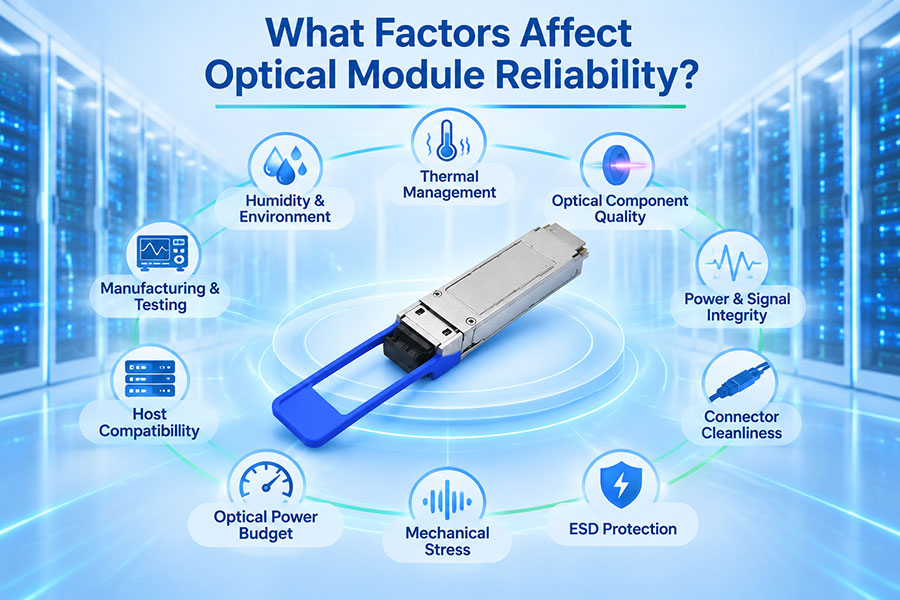
| Power Consumption | Module power requirements and host thermal limits |
| FEC Requirements | Supported coding and host configuration for the interface |
A module can be recognized by the switch and still fail to establish a link if the remote-end optics, fiber, wavelength, or interface configuration are incompatible. Host recognition and optical interoperability must therefore be tested separately.
9. Huawei-Compatible and Cisco-Compatible Optics Across Different Data Rates
Both compatibility categories are available across multiple optical module form factors and data rates. The correct product depends on the host port and the optical application rather than the vendor coding alone.
| Data Rate | Common Form Factor | Typical Applications |
|---|---|---|
| 1G | SFP | Access switching, enterprise networks, and fiber uplinks |
| 10G | SFP+ | Data center links, aggregation, and network uplinks |
| 25G | SFP28 | Server connectivity and data center switching |
| 40G | QSFP+ | High-density aggregation and data center interconnects |
| 100G | QSFP28 | Leaf-spine networks and high-speed uplinks |
| 400G | QSFP-DD / OSFP | High-performance data center and AI infrastructure |
| 800G | QSFP-DD / OSFP | High-bandwidth AI clusters and data center switching |
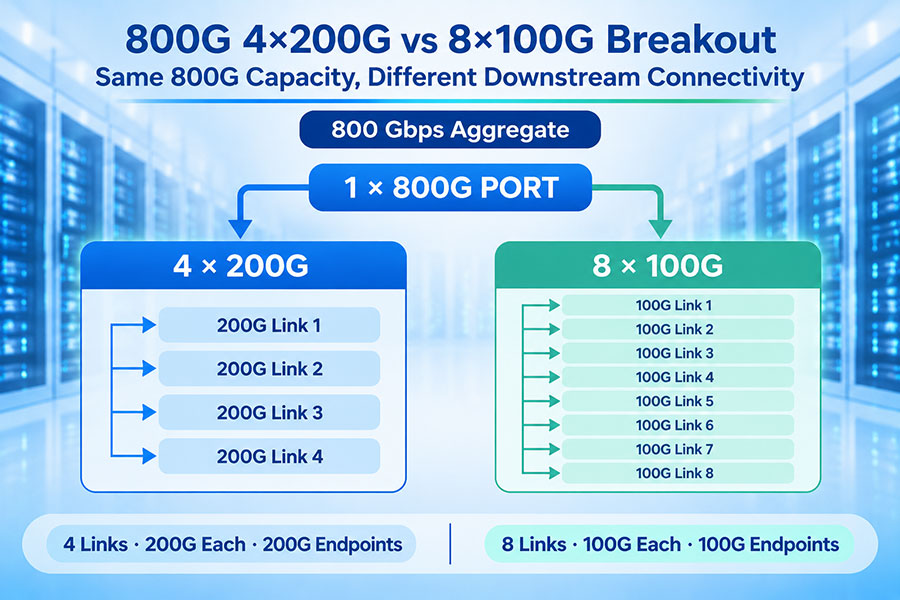
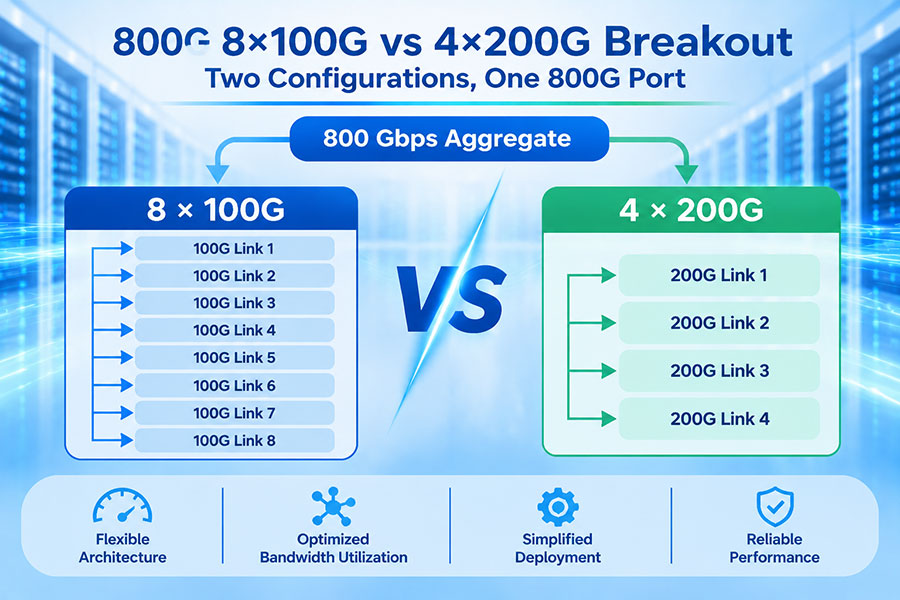
Not every switch supports every form factor or data rate. Port compatibility, breakout configuration, lane mapping, power limits, and supported optical applications must be confirmed for the specific device.
10. How to Select Huawei-Compatible or Cisco-Compatible Optics
Before ordering third-party optical modules, provide the supplier with the exact equipment information. This allows the supplier to identify the appropriate compatibility version and verify the optical requirements.
| Selection Item | Required Information |
|---|---|
| Equipment Brand | Huawei or Cisco |
| Switch Model | Exact product model and hardware revision |
| Software Version | Operating system and firmware release |
| Port Type | SFP, SFP+, SFP28, QSFP28, QSFP-DD, OSFP, or other |
| Data Rate | 1G, 10G, 25G, 40G, 100G, 400G, or 800G |
| Optical Standard | SR, LR, ER, ZR, DR, FR, or another application |
| Fiber Type | Single-mode or multimode |
| Connector | LC duplex, MPO/MTP, or other interface |
| Transmission Distance | Required link reach and optical budget |
| Management | DDM, DOM, or CMIS support requirements |
| Compatibility Testing | Host recognition, port operation, and link validation |
For high-speed modules, also confirm FEC requirements, electrical lane configuration, thermal conditions, and host power limitations. These details are especially important for 400G and 800G deployments.
11. Quality Control and Compatibility Testing
A reliable third-party optical module supplier should validate both optical performance and host compatibility. Correct EEPROM identification alone is not sufficient to demonstrate that a transceiver meets the required operating specifications.
A practical testing process should include:
EEPROM verification: Confirm that identification information is correctly programmed for the intended product version.
Host recognition: Test the module on the specified Huawei or Cisco platform.
Port operation: Verify that the switch recognizes the module and brings the interface into the expected state.
Optical testing: Measure transmit power and verify receiver sensitivity against the product specification.
DDM/DOM validation: Check supported temperature, voltage, bias current, and optical power readings.
Interoperability testing: Connect the module to a compatible remote-end device and verify link stability.
Traffic testing: Confirm operation under the intended network traffic conditions.
Environmental testing: Verify that the module operates within its specified temperature and power limits.
For deployments involving multiple switch models, validation should cover representative devices from each equipment family. A successful test on one Cisco or Huawei model does not automatically qualify the module for every model from that manufacturer.
12. C-LIGHT Optical Transceiver Solutions
C-LIGHT provides optical transceiver solutions for network equipment and fiber communication applications. For third-party compatible optics, the required host platform, optical specifications, and equipment model should be confirmed before production and delivery.
Available product categories cover different data rates and transceiver form factors for enterprise networking, data centers, and high-speed optical connectivity.
When requesting Huawei-compatible or Cisco-compatible optics, provide the switch model, software version, port type, data rate, optical standard, and required transmission distance. This information helps determine the appropriate product configuration and compatibility testing requirements.
13. Conclusion
Huawei-compatible and Cisco-compatible optical transceivers are designed for different equipment environments. Their primary distinction lies in host identification, recognition policies, and platform validation rather than the fundamental optical transmission technology.
A Huawei-compatible module should be validated on the intended Huawei equipment, while a Cisco-compatible module should be checked against the relevant Cisco platform. For links connecting Huawei and Cisco devices, each end can use its own compatible transceiver version, provided that the optical interfaces and transmission parameters are interoperable.
The most reliable selection process combines exact equipment identification, optical specification verification, and platform-level testing. For compatible optical modules across different data rates and form factors, view C-LIGHT optical transceiver products or Contact C-LIGHT for technical support.
 >

 >
 >
 >
 >
 >
 >
 >