TEL:+86 132 6656 7067





AI servers increasingly depend on multiple high-performance processors working as a coordinated system. Within that architecture, GPU-to-GPU and CPU-to-GPU interconnects perform different jobs: GPU-to-GPU links move data between accelerators, while CPU-to-GPU links connect the host processor and memory subsystem to the accelerator complex.
The distinction matters because modern AI workloads are increasingly limited by how efficiently data can move between compute resources. GPU-to-GPU communication is central to distributed tensor and model operations, while CPU-to-GPU connectivity determines how efficiently GPUs receive instructions, input data and system resources. As GPU clusters scale, both local electrical interconnects and external optical networks become part of the overall communication architecture.
1. What Is GPU-to-GPU Interconnect?
GPU-to-GPU interconnect refers to the communication path between two or more GPUs. It allows accelerators to exchange tensors, gradients, activations, model parameters and other data without requiring every transfer to pass through the CPU.
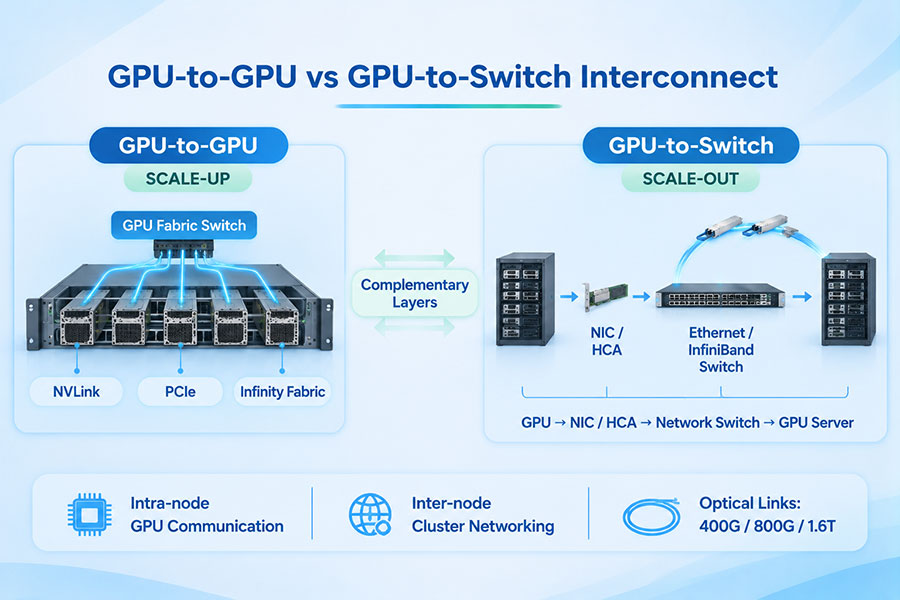
Inside an AI server, GPU-to-GPU communication can use dedicated high-speed accelerator interconnects. Across multiple servers, GPU traffic can traverse high-speed Ethernet or InfiniBand networks using network adapters, switches and optical links.
Typical GPU-to-GPU communication includes:
Tensor exchange during model execution
Gradient synchronization during distributed training
Collective operations such as all-reduce
Model parallel communication
Pipeline parallel communication
GPU memory transfers
Distributed inference traffic
2. What Is CPU-to-GPU Interconnect?
CPU-to-GPU interconnect connects the host CPU and one or more GPUs. It provides the path through which the CPU can communicate with the accelerator and coordinate data movement between system memory, storage and GPU memory.
Common CPU-to-GPU connectivity technologies include PCIe and platform-specific high-speed CPU-accelerator architectures. The exact implementation depends on the processor, GPU, server platform and system generation.
CPU-to-GPU traffic can include:
GPU workload submission
Command and control traffic
Input data transfers
Output data transfers
Memory management operations
Data movement between system memory and GPU memory
Communication with storage and other system resources
3. GPU-to-GPU vs CPU-to-GPU: Key Differences
| Factor | GPU-to-GPU Interconnect | CPU-to-GPU Interconnect |
|---|---|---|
| Primary purpose | Communication between accelerators | Communication between host CPU and accelerators |
| Main workload | Tensor, gradient, activation and collective data exchange | Command, input/output and system-memory data movement |
| Typical scope | GPU-to-GPU within a server or across servers | Usually within a server or compute node |
| Common technologies | Dedicated GPU interconnects, InfiniBand and high-speed Ethernet | PCIe and platform-specific CPU-accelerator links |
| Bandwidth emphasis | Extremely high for AI collective communication | High host-to-accelerator bandwidth |
| Latency sensitivity | Very high for tightly synchronized workloads | High for efficient accelerator feeding and control |
| Optical connectivity | Important for multi-node GPU communication | Usually indirect; external optical links connect the server to the network |
| Scaling concern | GPU count and cluster size | CPU socket, PCIe topology and GPU attachment |
4. Where the Two Interconnects Fit in an AI Server
A modern AI server can contain multiple GPUs connected through a high-bandwidth internal fabric, while the CPU provides access to system memory, storage and external networking.
CPU
PCIe or host accelerator interface
GPU
GPU memory
GPU
Dedicated accelerator fabric
GPU
GPU memory
The two paths can operate simultaneously. A CPU may prepare and schedule work while GPUs exchange large amounts of intermediate data directly with one another.
5. GPU-to-GPU Interconnect Bandwidth
AI training workloads can generate substantial GPU-to-GPU traffic. When a model is distributed across multiple accelerators, each GPU may need to exchange data with several other GPUs during collective operations.
This is why GPU-to-GPU bandwidth is often treated as a critical metric for AI system performance. A high-performance GPU can remain underutilized if the interconnect cannot move data quickly enough.
Dedicated accelerator fabrics are designed to provide much higher bandwidth and lower communication overhead than relying exclusively on the host CPU path.
6. CPU-to-GPU Bandwidth
CPU-to-GPU bandwidth determines how efficiently the accelerator can exchange data with the host system.
For workloads where large datasets must repeatedly move between CPU memory and GPU memory, the host interconnect can become a performance constraint. This is particularly relevant when data preprocessing, storage access or application logic remains CPU-centric.
However, not every AI workload continuously moves large volumes of data between CPU and GPU. Once data has been loaded into GPU memory, much of the intensive computation can occur within the GPU subsystem, making GPU-to-GPU communication more important.
7. GPU-to-GPU Communication Across Multiple Servers
GPU-to-GPU communication does not stop at the server boundary. Large AI clusters distribute GPUs across many compute nodes, requiring network connections between servers.
At this point, the communication path typically becomes:
GPU → network adapter → optical or copper link → switch → optical or copper link → network adapter → GPU
High-speed Ethernet and InfiniBand are widely used for this type of scale-out communication. The network must provide sufficient bandwidth and low latency to prevent communication from becoming the bottleneck during distributed training.
Optical transceivers become particularly important as link speeds and physical distances increase. C-LIGHT provides optical transceiver solutions for data center and high-speed Ethernet applications, including 400G optical solutions and 800G optical solutions.
8. CPU-to-GPU vs GPU-to-GPU Topology
The topology of an AI server has a major influence on communication efficiency.
A simple system may connect several GPUs through PCIe switches, with the CPU serving as the primary host interface. Higher-performance systems can use dedicated GPU fabrics that provide direct paths between accelerators.
| Topology | Communication Characteristic | Typical Consideration |
|---|---|---|
| CPU-centric PCIe topology | GPU communication can share host-side resources | Simple and flexible, but communication paths may become constrained |
| Dedicated GPU fabric | GPUs have direct high-speed communication paths | Designed for intensive accelerator workloads |
| Multi-node GPU fabric | GPUs communicate through network adapters and switches | Requires high-bandwidth, low-latency scale-out networking |
| Hybrid topology | Combines local accelerator fabric with external network connectivity | Common approach for large AI clusters |
9. Scale-Up vs Scale-Out Communication
GPU-to-GPU and CPU-to-GPU interconnects become easier to understand when viewed through the scale-up and scale-out model.
Scale-up connects multiple processors and accelerators within a tightly integrated compute system. GPU-to-GPU communication is a central component of this layer.
Scale-out connects multiple compute servers. Network adapters, switches and optical links provide the communication path between nodes.
CPU-to-GPU communication primarily supports the internal server architecture, while GPU-to-GPU communication can span both the scale-up fabric and the scale-out network.
10. Impact on AI Training
Distributed AI training frequently requires GPUs to synchronize information. During an all-reduce operation, for example, multiple GPUs exchange gradients or other tensors and then continue computation based on synchronized results.
If GPU-to-GPU communication is too slow, GPUs can spend more time waiting for data instead of performing useful computation.
This makes several network characteristics important:
Bandwidth
Latency
Packet processing efficiency
Congestion management
Network topology
Collective communication efficiency
Optical link reliability
11. Impact on AI Inference
Inference traffic can have different communication patterns from training. Some inference systems operate largely within a single GPU, while larger models can be distributed across several GPUs.
CPU-to-GPU communication can become important when requests, preprocessing and control logic are handled by the CPU. GPU-to-GPU communication becomes increasingly important when model execution is distributed across multiple accelerators.
Therefore, the optimal interconnect architecture depends on the inference model, batch size, model partitioning and workload placement.
12. Optical Connectivity in GPU Clusters
Optical networking is generally associated with the network layer rather than the short electrical links inside an individual GPU server. However, as AI clusters expand, optical links become a critical part of GPU-to-GPU communication between servers.
A typical multi-node AI communication path can be represented as:
GPU → NIC → optical transceiver → fiber → data center switch → fiber → optical transceiver → NIC → GPU
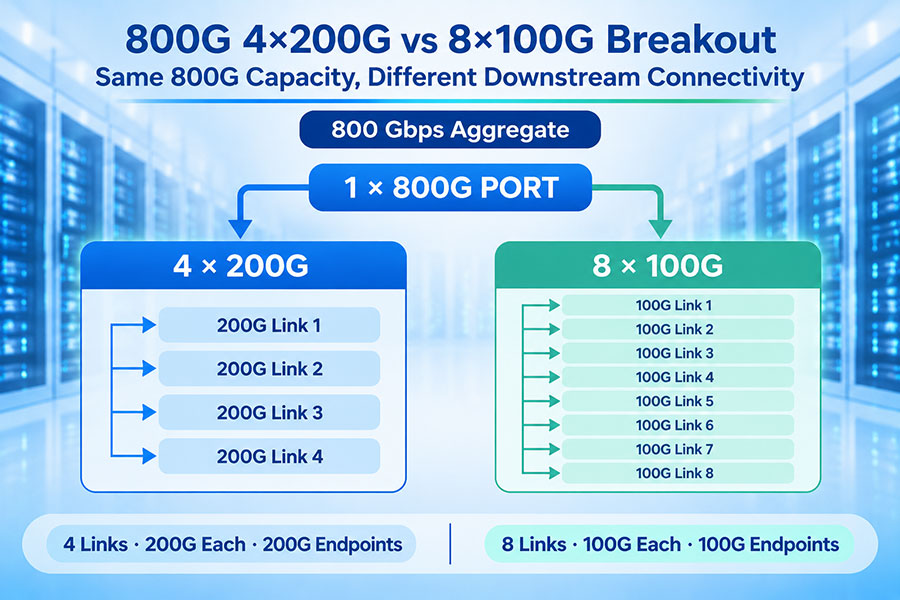
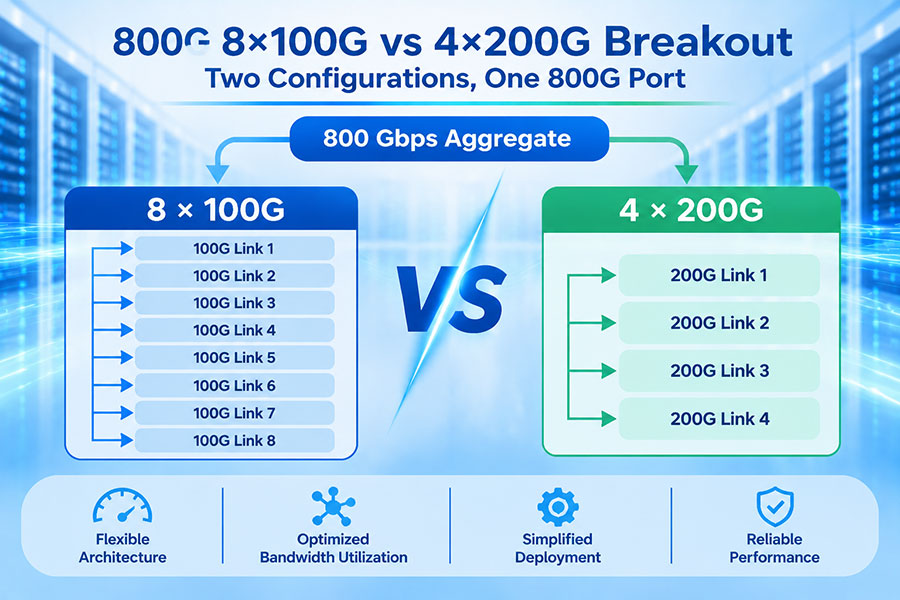
At 400G and 800G, a single optical link can carry a very large amount of traffic. This reduces the number of physical links needed for a given aggregate bandwidth but increases the importance of module power, thermal behavior, signal integrity and compatibility.
C-LIGHT's 800G optical solutions are relevant to high-bandwidth data center architectures where the switch and host platforms support the corresponding interface and optical specification. C-LIGHT also offers 400G optical solutions for current high-speed Ethernet deployments.
13. DAC and AOC in AI Server Connectivity
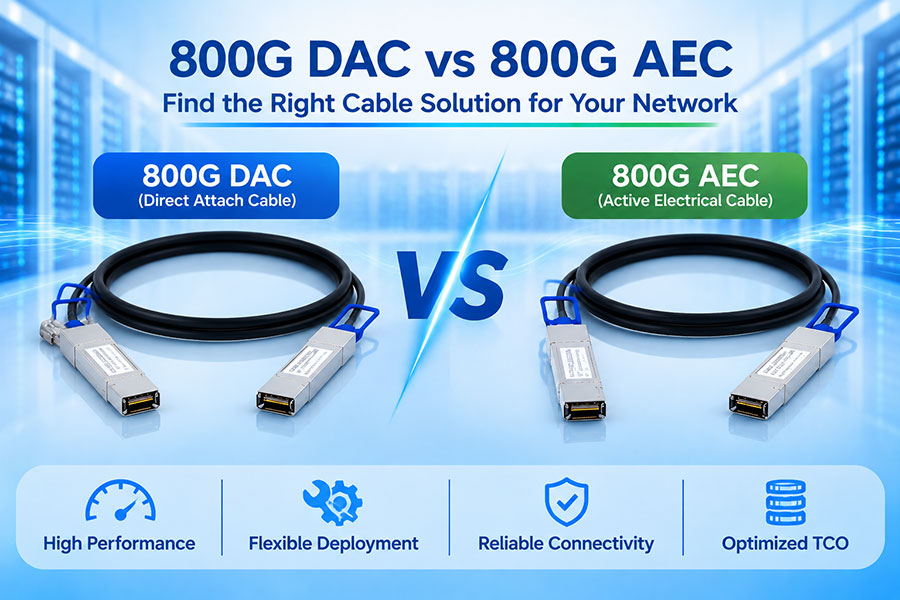
Not every GPU cluster connection requires a pluggable optical module. Short connections inside racks or between closely positioned equipment can use direct attach copper or active optical cables when the required distance and interface configuration are appropriate.
C-LIGHT provides DAC and AOC solutions for suitable high-speed data center connections. DAC can be attractive for very short links because of its low cost and simple architecture, while AOC provides an optical transmission path for longer short-reach connections.
| Connectivity | Typical Role | Primary Advantage |
|---|---|---|
| Internal GPU fabric | GPU-to-GPU within a server | Very high bandwidth and low latency |
| PCIe / host interconnect | CPU-to-GPU communication | Host processor and accelerator connectivity |
| DAC | Short high-speed server or switch connections | Low cost and low power over short distances |
| AOC | Short optical server-to-switch or switch-to-switch links | Optical reach with an integrated cable assembly |
| Pluggable optical transceiver | High-speed switch-to-switch or server-to-switch networking | Flexible fiber infrastructure and longer reach |
14. Power and Thermal Considerations
AI servers already operate at high power densities, making interconnect efficiency increasingly important.
Every additional communication component contributes to the system's power and thermal budget. This applies to internal GPU fabrics, network adapters, switches and optical transceivers.
At higher Ethernet speeds, optical modules can consume several watts per port, and large AI switches may contain many high-speed optical interfaces. As a result, optical power consumption and thermal management can influence the design of the complete AI network.
This is one reason C-LIGHT's 800G optical solutions and other high-speed transceivers should be evaluated together with the host switch platform, airflow, operating temperature and overall rack power budget.
15. Compatibility Considerations
High-speed AI networking requires more than matching the nominal data rate. The complete link must be compatible across the host, NIC, switch, optical module, fiber and software or protocol environment.
Important considerations include:
Port form factor
Electrical interface
Ethernet or InfiniBand support
Optical wavelength
Fiber type
Transmission distance
FEC behavior
Power consumption
Operating temperature
Switch and NIC compatibility
For deployments involving third-party switches or NICs, optical module compatibility testing can be important before large-scale deployment. C-LIGHT's optical transceiver portfolio can be evaluated according to the target equipment and link requirements.
16. How to Choose the Right Interconnect
Multiple GPUs participate in the same model.
Collective operations generate heavy communication traffic.
GPU memory needs to be shared or synchronized efficiently.
Distributed training performance is a major concern.
Multi-node GPU clusters require high-bandwidth scale-out networking.
The workload frequently transfers data between system memory and GPU memory.
CPU preprocessing feeds accelerator workloads.
GPU resources depend heavily on host-side scheduling.
The server platform has multiple GPUs attached through different PCIe paths.
Host-to-accelerator bandwidth limits application performance.
17. Conclusion
GPU-to-GPU and CPU-to-GPU interconnects solve different communication problems within an AI computing system. CPU-to-GPU connectivity links the host processor and accelerator subsystem, while GPU-to-GPU connectivity enables accelerators to exchange data efficiently during computation.
For tightly coupled AI workloads, GPU-to-GPU communication is increasingly critical because distributed training and inference can generate enormous volumes of accelerator-to-accelerator traffic. Within a server, dedicated GPU fabrics can provide high-bandwidth communication. Across servers, that communication extends into the data center network through high-speed NICs, switches and optical links.
As AI clusters move toward 400G, 800G and higher-speed networking, optical connectivity becomes an increasingly important part of the GPU-to-GPU scale-out architecture. C-LIGHT provides 400G optical solutions, 800G optical solutions, DAC/AOC connectivity and optical transceiver solutions for suitable data center networking applications.
For AI cluster optical connectivity, high-speed transceiver compatibility or customized networking requirements, Contact C-LIGHT.
 >

 >
 >
 >
 >
 >
 >
 >