TEL:+86 132 6656 7067





AI data centers increasingly operate with two demanding traffic domains: communication among GPUs and movement of data between compute resources and storage. A GPU network is designed to keep accelerators communicating efficiently across a cluster, while a storage network delivers datasets, checkpoints and application data to and from persistent storage.
Both networks can use high-speed Ethernet, InfiniBand, optical transceivers and large switch fabrics, but their traffic patterns and performance priorities are different. As AI clusters move toward 400G, 800G and higher-speed connectivity, separating these requirements becomes increasingly important for network architecture and optical deployment.
1. What Is a GPU Network?
A GPU network is the high-performance network infrastructure used to connect GPU servers and enable accelerator communication across multiple compute nodes. Its primary purpose is to provide the bandwidth, latency and communication efficiency required by distributed AI workloads.
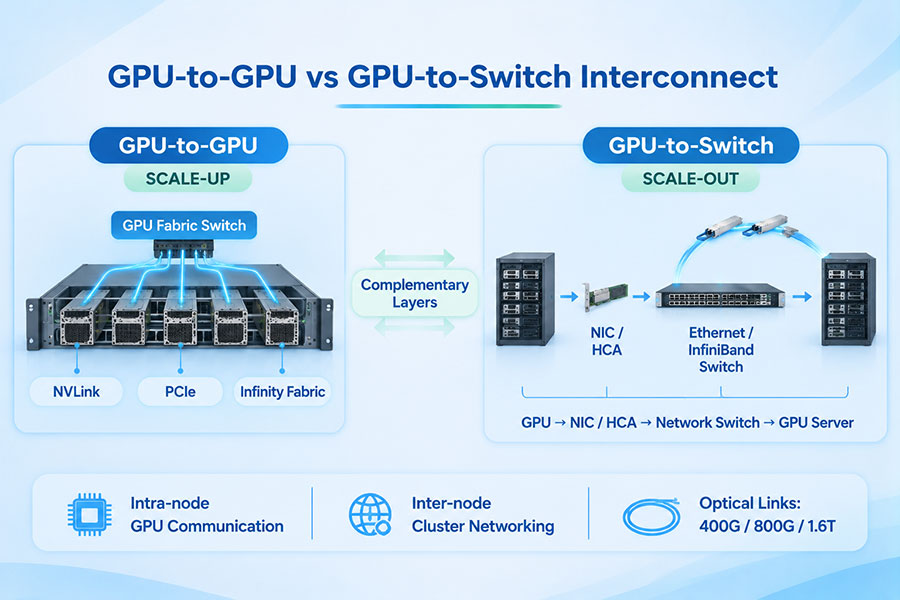
Inside a server, GPUs may communicate through dedicated accelerator fabrics. Once GPUs are distributed across multiple servers, the external network becomes the scale-out communication layer.
A typical multi-node GPU communication path is:
GPU → NIC → optical transceiver → fiber → GPU switch → fiber → optical transceiver → NIC → GPU
GPU networks are particularly important for distributed training, large-model inference and other workloads where multiple GPUs must exchange information continuously.
2. What Is a Storage Network?
A storage network connects compute systems to persistent storage resources. It provides the data path for datasets, model files, checkpoints, databases and other information that must be stored outside GPU memory.
Modern storage networks can use several technologies, including Ethernet, NVMe over Fabrics, Fibre Channel and InfiniBand-based architectures.
A simplified storage path is:
Compute server → storage NIC or adapter → network switch → storage server or array
In AI infrastructure, the storage network must deliver data quickly enough to prevent compute resources from waiting excessively for datasets or model files.
3. GPU Network vs Storage Network
| Factor | GPU Network | Storage Network |
|---|---|---|
| Primary purpose | Connects GPU compute nodes and supports accelerator communication | Connects compute systems to persistent storage |
| Main traffic | Tensors, gradients, activations and collective communication | Datasets, checkpoints, files and application data |
| Latency sensitivity | Extremely high | High, depending on the workload |
| Bandwidth requirement | Extremely high for distributed AI workloads | High for large-scale data access |
| Traffic pattern | Frequent, tightly synchronized accelerator communication | Read/write traffic between compute and storage |
| Typical endpoint | GPU server or accelerator node | Storage server, storage array or distributed storage system |
| Network priority | Low latency and predictable high throughput | High throughput, IOPS and consistent storage access |
| Optical connectivity | Critical for large-scale GPU scale-out | Increasingly important for high-performance storage fabrics |
4. GPU Network Traffic Characteristics
GPU networks carry traffic generated by distributed computation. During AI training, multiple GPUs may repeatedly exchange gradients, tensors or intermediate results.
Collective operations such as all-reduce can generate significant east-west traffic between GPU nodes. The communication pattern can therefore be much more intensive than conventional client-server applications.
Important GPU network characteristics include:
High aggregate bandwidth
Low latency
High port density
Efficient east-west traffic handling
Low congestion
Predictable communication performance
Scalable switch architecture
5. Storage Network Traffic Characteristics
Storage networks carry data between compute nodes and persistent storage. Their traffic patterns can vary considerably depending on the storage architecture and workload.
Typical traffic includes:
Training dataset reads
Model file retrieval
Checkpoint writes
Database operations
Distributed file system traffic
AI inference data access
Backup and replication traffic
Storage performance is influenced not only by network bandwidth but also by storage media, storage controllers, filesystem architecture, IOPS, queue depth and data access patterns.
6. Why GPU Networks Are Highly Sensitive to Latency
Distributed AI workloads often require synchronized communication among many GPUs. When one group of GPUs must wait for another group to finish exchanging data, network latency can directly affect application efficiency.
This makes the communication path, switch architecture and network topology particularly important.
A GPU network therefore tends to emphasize:
Low end-to-end latency
High bisection bandwidth
Efficient collective communication
High-radix switching
Low congestion
Consistent performance under heavy load
7. Why Storage Networks Are Highly Sensitive to Throughput
Storage systems can contain very large datasets that must be delivered to compute nodes. If storage throughput is insufficient, GPUs may spend more time waiting for data.
This creates a potential bottleneck in the AI data pipeline:
Storage → storage network → server memory → GPU memory → GPU computation
Even a high-performance GPU cluster cannot maintain full utilization if the storage subsystem cannot provide data at the required rate.
8. GPU Network Topology
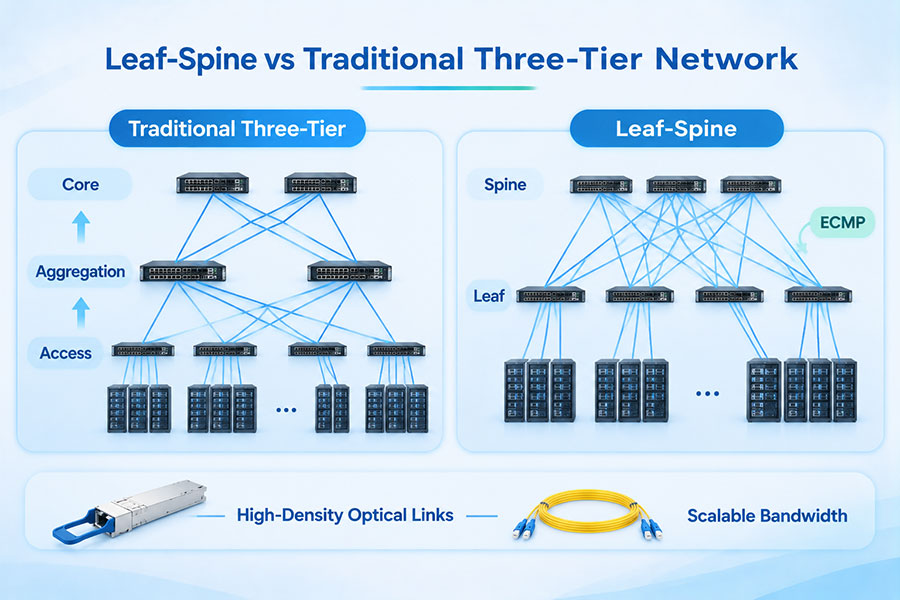
Large GPU clusters commonly use leaf-spine or similar high-bandwidth network architectures to provide scalable connectivity between compute nodes.
The network is designed to support large amounts of east-west traffic rather than primarily north-south traffic.
Connects GPU servers and provides high-density host-facing ports.
Provides high-bandwidth paths between leaf switches and enables cluster-wide communication.
As the number of GPU servers increases, switch port count, oversubscription, link bandwidth and optical transceiver density become major design considerations.
9. Storage Network Topology
Storage networks can use dedicated storage fabrics or share a high-speed Ethernet infrastructure with compute traffic.
A dedicated storage network can isolate storage traffic from GPU communication. A converged Ethernet architecture can reduce physical infrastructure but requires effective congestion management, traffic isolation and quality-of-service policies.
| Architecture | GPU Network | Storage Network |
|---|---|---|
| Dedicated fabric | Optimized for accelerator traffic | Optimized for storage traffic |
| Converged Ethernet | GPU and other traffic share the Ethernet infrastructure | Storage traffic shares the same network fabric |
| Traffic isolation | Important for distributed AI workloads | Important to prevent storage bursts from affecting compute traffic |
| Optical density | Can become extremely high in large GPU clusters | Depends on storage bandwidth and the number of storage clients |
10. Ethernet and InfiniBand in GPU Networks
GPU clusters can use either Ethernet-based or InfiniBand-based networking depending on the system architecture, software ecosystem and performance requirements.
High-speed Ethernet is increasingly important for AI infrastructure because it provides a scalable networking foundation and can support very high-speed optical interfaces.
InfiniBand is also widely used in high-performance computing and AI environments where low latency, high throughput and specialized communication capabilities are important.
The physical optical infrastructure remains an important component of either architecture when links extend beyond the practical reach of direct copper connections.
11. Ethernet in Storage Networks
Ethernet is widely used in storage networks because it can provide a common infrastructure for compute, storage and management traffic.
With technologies such as NVMe over Fabrics and high-speed Ethernet, storage systems can use network connectivity to provide low-latency access to remote NVMe resources.
At higher speeds, 100G, 200G, 400G and 800G network interfaces can be used to build high-throughput storage fabrics, depending on the storage architecture and equipment capabilities.
12. Optical Transceivers in GPU Networks
As GPU clusters scale, optical transceivers become an essential part of the physical network layer. A large GPU cluster may contain thousands of high-speed optical links between servers and switches.
400G and 800G interfaces are increasingly relevant for high-bandwidth AI networks. C-LIGHT provides 400G optical solutions and 800G optical solutions for suitable data center and AI networking applications.
For shorter connections, C-LIGHT DAC and AOC solutions can provide alternatives to individual optical transceiver and fiber assemblies where distance and platform requirements permit.
13. Optical Transceivers in Storage Networks
Storage networks can also require optical connectivity when storage systems are separated from compute racks or when large numbers of servers access centralized storage resources.
A typical high-speed storage connection can use:
Server NIC → optical transceiver → fiber → switch → fiber → optical transceiver → storage NIC
For high-bandwidth storage fabrics, C-LIGHT's optical transceiver portfolio can be evaluated according to interface speed, reach, wavelength, fiber type and equipment compatibility.
14. 400G and 800G Network Evolution
The growth of AI workloads is pushing both GPU and storage infrastructure toward higher-speed network interfaces.
In GPU clusters, higher-speed ports reduce the number of physical links required for a given aggregate bandwidth and can increase switch port efficiency.
In storage environments, higher-speed interfaces can help centralized storage systems serve more compute clients simultaneously.
| Network Speed | GPU Network Application | Storage Network Application |
|---|---|---|
| 100G | Existing high-speed server and switch connectivity | Storage server and network connectivity |
| 200G | Higher-bandwidth AI node connectivity | High-performance storage access |
| 400G | AI leaf-spine and high-density GPU fabrics | High-throughput storage fabrics |
| 800G | Next-generation AI cluster and switch connectivity | Large-scale storage and converged high-bandwidth fabrics |
15. Power and Thermal Considerations
High-speed network equipment adds significant power and thermal load to AI data centers. This becomes particularly important when a GPU cluster contains a large number of high-speed switch ports.
Optical module selection should therefore consider:
Module power consumption
Switch port density
Operating temperature
Airflow direction
Rack thermal capacity
Optical link distance
Required bandwidth
C-LIGHT's high-speed 400G and 800G optical solutions can be selected according to the target platform and deployment environment.
16. Dedicated GPU Network vs Converged Network
AI data centers can deploy separate GPU and storage networks or carry multiple traffic classes across a converged Ethernet infrastructure.
A dedicated GPU fabric provides stronger traffic isolation and allows the network to be optimized specifically for accelerator communication. A converged architecture can reduce the number of separate physical networks, but it places greater emphasis on congestion control and traffic management.
Optimized for GPU-to-GPU communication
Predictable bandwidth
Strong traffic isolation
Suitable for highly demanding distributed training
GPU and storage traffic can share infrastructure
Potentially lower infrastructure complexity
Requires traffic prioritization
Requires careful congestion management
17. Compatibility Requirements
Optical connectivity for either GPU or storage networks must be evaluated against the complete networking environment rather than only the nominal data rate.
Important parameters include:
Switch model and port type
NIC interface
Optical form factor
Ethernet or InfiniBand support
Transmission distance
Fiber type
Wavelength
FEC requirements
Power consumption
Operating temperature
Interoperability with the target equipment
C-LIGHT's optical transceiver solutions can be evaluated for high-speed data center platforms, while DAC and AOC solutions can be considered for suitable short-distance connections.
18. Which Network Matters More for AI?
Neither network is universally more important. The priority depends on where the workload is constrained.
Distributed training generates heavy east-west traffic.
Many GPUs participate in the same workload.
Collective operations are communication-intensive.
GPU utilization is limited by network communication.
The cluster is scaling to a large number of GPU nodes.
Training datasets are extremely large.
Storage throughput limits data delivery.
Checkpoint operations consume substantial bandwidth.
Many GPU servers access centralized storage simultaneously.
Data loading becomes a measurable bottleneck.
19. Conclusion
GPU networks and storage networks serve different but complementary roles in AI data centers. GPU networks are designed to keep accelerators communicating efficiently, with particular emphasis on low latency, high bandwidth and predictable east-west traffic performance. Storage networks provide the data pipeline between compute resources and persistent storage.
As AI clusters become larger, neither network can be designed in isolation. GPU performance depends on efficient accelerator communication, while that compute performance also depends on the ability of the storage infrastructure to supply datasets, model files and checkpoints at sufficient speed.
The increasing adoption of 400G and 800G connectivity is making optical networking a critical part of both architectures. C-LIGHT provides 400G optical solutions, 800G optical solutions, DAC/AOC solutions and optical transceiver solutions for suitable high-speed data center and AI networking deployments.
For GPU cluster networking, storage network connectivity, optical module interoperability or customized high-speed connectivity requirements, Contact C-LIGHT.
 >

 >
 >
 >
 >
 >
 >
 >