TEL:+86 132 6656 7067





As applications move closer to users, machines, sensors and connected devices, the physical location of computing resources becomes an important part of network architecture. An edge data center places compute and storage closer to the point where data is generated or consumed, while a central data center concentrates larger pools of computing, storage and networking resources in fewer locations.
The distinction is not simply a matter of facility size. Edge infrastructure is primarily designed around proximity, latency, locality and distributed operation. Central infrastructure emphasizes resource concentration, scalability, centralized management and large computing capacity. In many production environments, both models operate together rather than replacing one another.
This architecture is particularly relevant to industrial automation, 5G, content delivery, smart cities, video analytics, autonomous systems and edge AI. Local processing can reduce the amount of data that needs to travel to a distant facility, while central infrastructure can provide large-scale storage, model training, analytics and fleet-wide coordination.
1. What Is an Edge Data Center?
An edge data center is a computing facility deployed close to the users, devices, machines or applications it serves. It can range from a small rack or micro data center to a larger regional facility with multiple racks.
The defining characteristic is proximity to the workload, rather than a fixed number of racks or a specific power capacity. Edge facilities can be deployed in factories, telecom locations, retail sites, hospitals, industrial campuses, cell sites or metropolitan areas.
Typical edge data center infrastructure includes:
Compute servers: Run local applications, analytics, AI inference and control workloads.
Storage: Keeps frequently accessed or locally generated data close to the source.
Network switches: Connect local devices, servers and upstream networks.
Optical and copper connectivity: Provides connections to local equipment and central facilities.
Power systems: Support servers and network equipment at sites where electrical capacity may be constrained.
Cooling systems: Remove heat from compact equipment installations.
Remote management: Allows distributed facilities to be monitored and maintained without requiring a permanent IT team at every location.
Because edge sites are frequently distributed across many locations, remote monitoring, automation and standardized deployment become particularly important. Cisco and HPE both describe edge data centers as facilities positioned closer to users, devices or applications to reduce data transit distance and support latency-sensitive workloads. :chatgpt-content-reference{index="0"}
2. What Is a Central Data Center?
A central data center concentrates computing, storage and networking resources in a larger facility or regional location. It can serve a broad geographic area and provide the infrastructure foundation for enterprise applications, cloud services, databases, large-scale analytics and centralized management.
Central facilities typically benefit from resource pooling. Instead of deploying a complete computing environment at every location, organizations can consolidate hardware into a smaller number of facilities and distribute services through wide-area networks.
Common characteristics include:
Large computing pools: Many servers can share common power, cooling, storage and networking infrastructure.
High-capacity storage: Central facilities can host large databases, object storage and backup systems.
High-speed network fabrics: Large numbers of servers and storage systems can be interconnected through structured data center networks.
Centralized operations: Monitoring, security, provisioning and maintenance can be concentrated within a smaller number of locations.
Scalable infrastructure: Additional racks, servers and network equipment can be added as capacity requirements grow.
Extensive connectivity: Facilities can connect to Internet backbones, regional networks, cloud services and other data centers.
A central data center does not necessarily mean a single physical facility. An organization can operate multiple centralized or regional data centers while still using them as the main computing and storage layer for geographically distributed edge locations.
3. Edge Data Center vs Central Data Center: Core Differences
| Factor | Edge Data Center | Central Data Center |
|---|---|---|
| Primary design goal | Bring computing and storage closer to users, devices and data sources | Concentrate large-scale computing and storage capacity |
| Typical location | Near factories, cell sites, retail locations, cities, hospitals or users | Regional, enterprise, cloud or large-scale data center facilities |
| Facility scale | Usually smaller and distributed, ranging from a rack to a regional facility | Usually larger and concentrated, with substantial computing and storage capacity |
| Latency | Optimized for short network paths to local workloads | Higher latency may occur when users or devices are geographically distant |
| Resource pooling | More limited at each individual site | High degree of centralized resource pooling |
| Network role | Aggregates local traffic and connects to central infrastructure | Provides large-scale application, storage and upstream network connectivity |
| Power capacity | Often constrained by the local site | Generally supports substantially larger infrastructure loads |
| Cooling | Compact, site-specific cooling solutions | Purpose-built high-capacity facility cooling |
| Operations | Remote monitoring and automation are especially important | Centralized operational teams can directly manage infrastructure |
| Data processing | Local filtering, analytics, inference and real-time processing | Large-scale analytics, storage, model training and centralized applications |
| Geographic distribution | Many sites may be distributed across cities or service areas | Fewer large sites can serve broader geographic regions |
| Best suited for | Latency-sensitive and location-dependent workloads | Large-scale and resource-intensive workloads |
4. Location Is the Fundamental Difference
The most important distinction is where processing takes place relative to the source and destination of data.
Consider a manufacturing plant with hundreds of cameras and industrial sensors. Sending every video frame and sensor event to a distant central data center may consume significant network bandwidth and introduce unnecessary round-trip delay. An edge facility near the plant can process selected information locally and send only relevant results to the central environment.
In contrast, long-term data storage, enterprise-wide analytics and large model training may benefit from centralized infrastructure because these workloads require substantial computing and storage capacity.
In this model, the edge does not replace the central data center. Instead, the two layers divide workloads according to latency, bandwidth, storage and computational requirements. This complementary relationship is also reflected in edge computing standards and industry architecture guidance. :chatgpt-content-reference{index="1"}
5. Latency and Real-Time Processing
Latency is one of the strongest reasons to deploy computing resources at the edge. When an application requires a fast response, reducing the physical and network distance between the workload and the user or machine can be more effective than increasing the capacity of a distant central facility.
Typical latency-sensitive applications include:
Industrial automation and machine control
Real-time video analytics
Autonomous and assisted transportation systems
Augmented and virtual reality applications
Telecom and 5G services
Retail analytics and smart-store systems
Local AI inference
Smart-city traffic management
For these applications, network round-trip time can directly affect application responsiveness. An edge deployment can process time-sensitive information locally while forwarding selected data to a central system for long-term storage or broader analysis.
However, edge placement does not automatically guarantee a particular latency. Actual performance depends on physical distance, access network architecture, congestion, routing, application processing time and the design of the edge facility.
6. Compute and Storage Architecture
Central data centers can pool large amounts of computing and storage capacity. This makes them well suited to workloads that require substantial resources but do not need to execute close to the data source.
Examples include:
Large database systems
Enterprise applications
Cloud computing platforms
Large-scale data analytics
AI model training
Long-term storage and backup
Centralized management platforms
Edge sites usually deploy a smaller amount of compute and storage. Their purpose is not necessarily to reproduce the complete central environment, but to provide enough local capacity to execute workloads that benefit from proximity.
| Compute / Storage Function | Edge Data Center | Central Data Center |
|---|---|---|
| Local inference | Highly suitable for latency-sensitive AI inference | Suitable when application latency permits centralized processing |
| AI training | Possible for smaller workloads, but resource capacity may be limited | Well suited to large GPU clusters and distributed training |
| Real-time analytics | Strong fit for processing data close to its source | Suitable for large-scale aggregation and historical analytics |
| Long-term storage | Usually stores selected local or frequently accessed data | Well suited to large centralized storage pools |
| Backup | May maintain local copies for resilience | Typically provides large-scale backup and disaster recovery capacity |
| Resource pooling | Limited by the capacity at each site | High because many systems share common infrastructure |
7. Network Architecture and Optical Connectivity
Networking plays a different role in the two architectures. An edge data center normally acts as an aggregation point between local devices and upstream infrastructure. A central facility must connect large numbers of servers, storage systems, external networks and other data centers.
Edge networks may therefore contain short-reach copper or optical connections inside a small facility, together with fiber uplinks toward a regional or central data center.
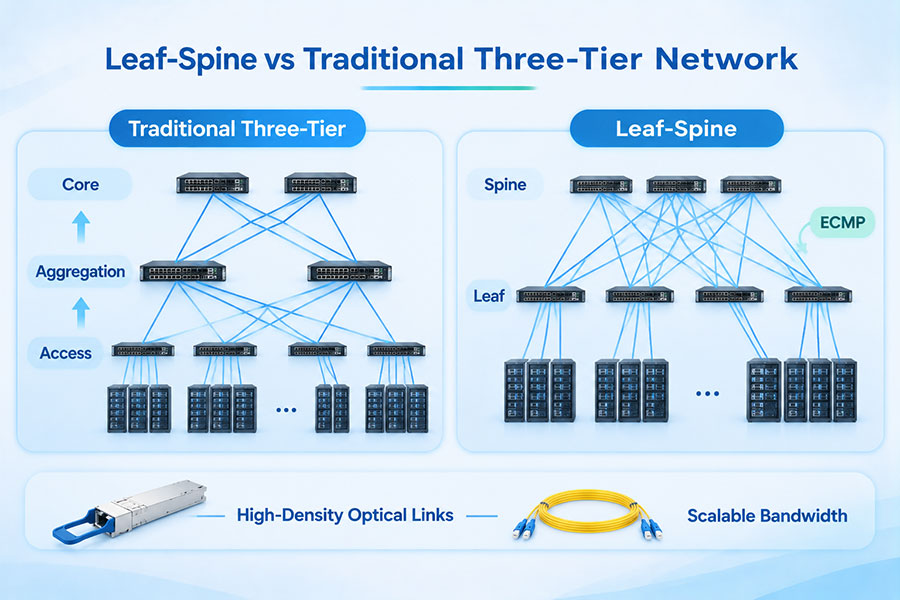
Central data centers commonly use structured high-speed switching architectures such as leaf-spine networks. Large numbers of 100G, 400G and 800G optical links can be deployed between switches, servers and data center interconnection systems.
For edge-to-central connections, the required optical transceiver depends on distance, fiber type, link rate and network equipment. Short metropolitan links may use appropriate multimode or single-mode solutions, while longer regional or inter-data-center links may require longer-reach optical modules.
C-LIGHT provides a range of optical transceivers for data center and network connectivity. For high-speed data center deployments, relevant solutions can include 400G optical transceivers and 800G optical transceivers, depending on the specific equipment and link requirements.
| Network Segment | Edge Data Center | Central Data Center |
|---|---|---|
| Device-to-server | Often short-reach Ethernet, fiber or industrial connectivity | Less focused on direct connection to physical devices |
| Local switching | Compact switching infrastructure | Large leaf-spine or Clos-based switching fabrics |
| Uplink | Connects the edge site to regional or central infrastructure | Connects servers, storage, Internet, WAN and other facilities |
| Optical link density | Usually lower at each individual site | Potentially very high across large switching and server clusters |
| Traffic pattern | Local traffic plus upstream/downstream traffic to central systems | Large East-West and North-South traffic volumes |
8. Power and Cooling Requirements
Edge facilities typically operate under more restrictive site conditions. Available electrical capacity, physical space and cooling options may be limited, particularly when equipment is deployed inside a telecom location, factory, retail facility or compact modular enclosure.
Central data centers can use purpose-built electrical and mechanical infrastructure. Larger facilities can deploy high-capacity UPS systems, generators, switchgear, chillers, cooling towers and other supporting infrastructure at a scale that would be impractical for a small edge site.
| Infrastructure | Edge Data Center | Central Data Center |
|---|---|---|
| Power availability | Often determined by the local building or site | Purpose-designed for large IT loads |
| UPS | Compact systems sized for local equipment | Large centralized or distributed UPS architecture |
| Cooling | Compact air cooling or specialized local solutions | Large-scale mechanical cooling systems |
| Physical constraints | Space, floor loading and environmental conditions can be significant limitations | Facility designed specifically for IT equipment and supporting systems |
| Expansion | Limited by the available capacity at each location | Can add racks, power and cooling capacity as the facility expands |
9. Reliability and Resilience
Centralized infrastructure can achieve high availability by concentrating redundant power, cooling, networking and computing resources in a purpose-built facility. However, concentration also means that a major central facility outage can affect a large number of applications.
Edge architecture approaches resilience differently. Workloads can be distributed across multiple geographic locations so that a local failure does not necessarily affect every service location.
At the same time, distributed edge infrastructure introduces its own operational challenges. A company operating hundreds of edge sites must manage hardware failures, network interruptions, security events and environmental problems across many locations.
For this reason, edge deployments often depend heavily on:
Remote monitoring
Automated configuration
Centralized fleet management
Remote software updates
Local backup power
Redundant network connectivity
Physical security
Standardized hardware configurations
TIA-942-C notes that edge facilities can range from a small number of servers in an enclosure to multiple racks in a regional facility, and highlights the distinct requirements for power, cooling, security, operations and maintenance at distributed sites. :chatgpt-content-reference{index="2"}
10. Operational Management
One of the biggest differences between edge and central infrastructure is not the hardware itself but the operational model.
A central facility can have engineering, network and maintenance personnel working at the same physical location. An edge fleet may consist of hundreds or thousands of geographically dispersed sites, many of which have no permanent technical staff.
Remote monitoring
Automated provisioning
Centralized fleet management
Remote firmware and software updates
Environmental monitoring
Remote troubleshooting
Standardized replacement procedures
Centralized infrastructure management
On-site engineering teams
Large-scale monitoring systems
Automated server provisioning
Network fabric management
Facility-level capacity planning
Large-scale hardware lifecycle management
Edge infrastructure therefore requires strong automation even when each individual site is relatively small. The challenge is managing the entire distributed fleet consistently.
11. Edge Data Center Use Cases
Edge deployments are particularly useful when the physical location of the workload directly affects application performance.
| Application | Why Edge Helps | Potential Central Role |
|---|---|---|
| Industrial automation | Local processing can reduce network round trips for time-sensitive control | Historical analytics, fleet management and long-term storage |
| Video analytics | Video can be filtered or analyzed near cameras | Centralized storage and large-scale analytics |
| 5G applications | Compute can be positioned near mobile users and network access points | Core services and centralized orchestration |
| Retail | Local analytics and application processing at stores | Enterprise applications, reporting and data aggregation |
| Smart cities | Traffic and sensor data can be processed close to urban infrastructure | City-wide analytics and long-term data management |
| Edge AI | Inference can be performed close to cameras, sensors or users | Model training, centralized model management and data analysis |
12. Central Data Center Use Cases
Central facilities remain important for workloads that benefit from large resource pools and centralized management.
AI model training: Large GPU clusters can be concentrated in a purpose-built environment.
Enterprise databases: Centralized infrastructure provides large storage and compute pools.
Cloud services: Multiple customers and applications can share standardized infrastructure.
Big data analytics: Large datasets can be processed using centralized compute resources.
Backup and disaster recovery: Central facilities can provide substantial storage and recovery capacity.
Content and application platforms: Central infrastructure can coordinate services across multiple regions.
Centralized infrastructure is particularly effective when applications do not require every processing step to occur near the data source.
13. Hybrid Edge and Central Architecture
In many real-world deployments, the strongest architecture is not Edge versus Central but Edge plus Central.
The edge layer handles time-sensitive or location-dependent processing, while the central layer provides large-scale computing, storage, analytics, orchestration and long-term data management.
For example, an industrial camera system can perform object detection locally, transmit only events and selected video to a central data center, store historical information centrally and use a central AI cluster to retrain the detection model.
This approach reduces unnecessary data movement while retaining the computing capacity and management capabilities of centralized infrastructure.
14. How Optical Connectivity Supports Edge-Central Networks
As edge infrastructure becomes more distributed, the network connecting edge sites to regional and central facilities becomes increasingly important. Optical fiber is well suited to these links because it provides high bandwidth over distances that exceed practical copper reach.
Depending on the application, an edge site may use optical connectivity for:
Server-to-switch connections
Switch uplinks
Metro aggregation
5G transport
Regional data center connections
Cloud on-ramps
Data center interconnects
For high-speed deployments, module selection should consider transmission rate, optical reach, wavelength, fiber type, connector, form factor, host equipment compatibility and operating temperature.
For edge locations exposed to industrial or outdoor conditions, temperature-rated optical transceivers can also be important. C-LIGHT's optical transceiver solutions can be evaluated according to the network equipment, data rate and environmental requirements of the deployment.
For short-reach server and switch connections, C-LIGHT also provides DAC and AOC connectivity solutions for suitable data center applications.
15. Which Architecture Should You Choose?
The choice should be based on workload characteristics rather than simply selecting the newer or larger architecture.
Low latency is a critical application requirement.
Large amounts of raw data are generated locally.
Network bandwidth between the site and central facility is limited or costly.
Local operation must continue during temporary WAN interruptions.
Data processing or storage needs to remain close to its source.
The application depends strongly on geographic locality.
Large computing resources are required.
Applications benefit from pooled infrastructure.
Large-scale storage is needed.
Workloads do not require ultra-low network latency.
Centralized security and operations are preferred.
AI training or large analytics workloads require substantial compute capacity.
For many organizations, the practical solution is a hybrid architecture. Time-sensitive workloads remain at the edge, while compute-intensive, storage-intensive and management-intensive workloads are handled centrally.
16. Conclusion
Edge data centers and central data centers serve different positions within a distributed computing architecture. Edge facilities move computing and storage closer to users, machines and data sources, making them well suited to latency-sensitive, location-dependent and real-time applications. Central data centers concentrate computing, storage and networking capacity, making them effective for large-scale applications, AI training, analytics, cloud services and centralized data management.
The two architectures should not be treated as competing infrastructure models. Edge sites can act as distributed processing layers connected to powerful central facilities through high-speed fiber networks. This combination allows organizations to process urgent information locally while sending selected data to centralized infrastructure for large-scale analysis, storage and coordination.
As edge AI, industrial networking, 5G and distributed applications continue to expand, optical connectivity will remain an important part of the edge-to-central architecture. Selecting suitable transceivers, fiber links and connectivity solutions according to bandwidth, distance, environment and equipment compatibility can help build a reliable distributed network.
For optical connectivity requirements, product compatibility or customized solutions, Contact C-LIGHT.
 >

 >
 >
 >
 >
 >
 >
 >