TEL:+86 132 6656 7067





Modern data center applications rarely operate through a single server. Web services communicate with application servers, databases, storage systems and distributed computing resources. At the same time, users, enterprise networks and cloud services continuously exchange information with applications hosted inside the facility. These communication patterns create two important categories of network traffic: East-West and North-South.
East-West traffic describes communication between workloads within a defined data center network or computing environment. North-South traffic describes communication across that environment's boundary, typically between internal resources and external clients, networks or services. Their bandwidth requirements, forwarding paths and security considerations can differ significantly, making traffic-flow analysis an important part of data center network design.
1. What Is East-West Traffic?
East-West traffic refers to data exchanged between internal network resources. The communication may take place between two physical servers, virtual machines, containers, application services, databases, storage systems or GPU nodes.
In a distributed application, a single user request can trigger multiple internal operations. An application server may retrieve information from a database, request authentication from another service, access a cache and retrieve files from network storage. These exchanges take place inside the infrastructure and generate East-West traffic.
Common examples include:
Server-to-server communication: Application servers exchange data and coordinate processing tasks.
Application-to-database traffic: Front-end and application services send queries to database servers.
Storage traffic: Compute systems access shared storage, replicate data or transfer backup information.
Virtual machine communication: VMs hosted on different physical servers exchange application data.
Container communication: Microservices exchange requests and responses across distributed application components.
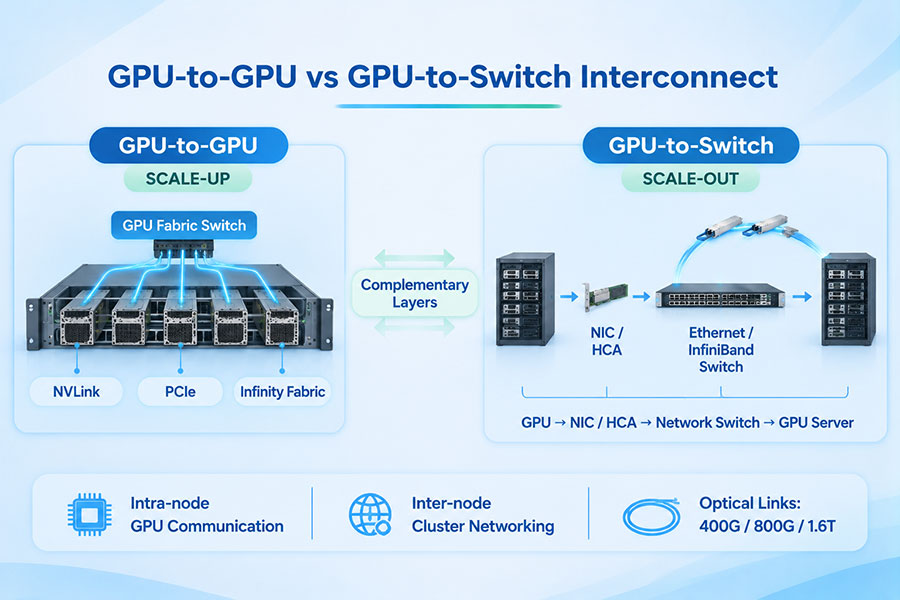
AI cluster communication: GPUs and compute nodes exchange training data, gradients and synchronization information.
As virtualization, distributed applications, cloud platforms and AI computing become more widespread, internal communication can account for a substantial share of data center network activity. The actual traffic distribution depends on workload design, application placement and data movement requirements rather than a fixed industry-wide percentage.
2. What Is North-South Traffic?
North-South traffic describes communication entering or leaving a defined data center network. It commonly connects external clients, enterprise users, remote offices, public cloud services and other networks to applications hosted inside the facility.
For example, when a user opens a website hosted in a data center, the request travels from the user's network toward the data center. The application processes the request and sends a response back to the user. The communication across the data center boundary is North-South traffic.
Typical examples include:
Internet access: External users connect to websites and services hosted in the data center.
Enterprise application access: Employees connect to internal business applications from office networks.
Remote access: Remote users connect through VPN gateways or other secure access services.
Cloud connectivity: Data moves between an on-premises data center and external cloud platforms.
External API requests: Applications exchange information with third-party services and external systems.
Content delivery: Data center applications deliver content to users through external networks.
North-South traffic is often handled by network edge infrastructure, including routers, firewalls, load balancers, gateways and other security or traffic-management systems. These devices control how external communication enters and leaves the internal environment.
3. East-West vs North-South Traffic: Key Differences
| Network Factor | East-West Traffic | North-South Traffic |
|---|---|---|
| Traffic direction | Between internal network resources | Between internal resources and external networks |
| Typical endpoints | Servers, VMs, containers, GPUs and storage | External users, enterprise networks, cloud services and internal applications |
| Main purpose | Internal processing, data exchange and synchronization | External access, service delivery and network connectivity |
| Common applications | Distributed databases, microservices, storage replication and AI training | Web access, remote connections, external APIs and cloud access |
| Network architecture | Leaf-spine fabrics and internal switching networks | Network edge, border routing and external connectivity |
| Traffic management | ECMP, congestion management, segmentation and internal routing | Routing policies, firewalls, load balancing and gateway services |
| Major design concern | Internal bandwidth, latency, oversubscription and east-west security | External connectivity, security boundaries, availability and ingress/egress capacity |
| Common bottleneck locations | Inter-rack links, leaf uplinks and oversubscribed fabric paths | Border links, firewalls, gateways and external WAN connections |
4. How East-West and North-South Traffic Flow Through a Data Center
The distinction becomes clearer when the two traffic patterns are mapped onto a simplified network. Internal servers communicate through the data center switching fabric, while external users reach internal applications through the network edge.
External clients communicate with services hosted inside the data center.
East-West traffic flow
Internal workloads exchange information through the data center network.
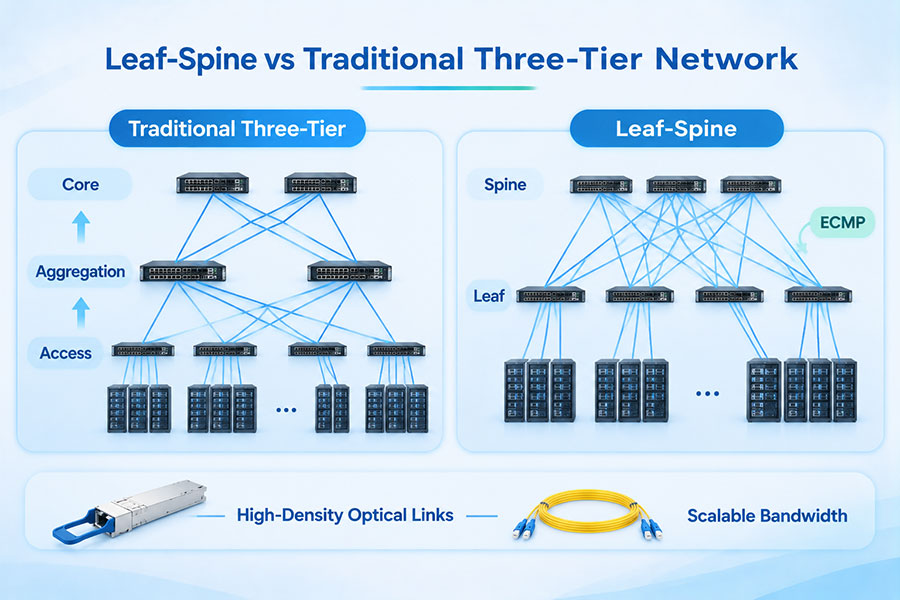
In a traditional three-tier network, internal traffic may pass through access, aggregation and core layers depending on the source and destination. A well-designed network keeps traffic on the shortest appropriate path while applying the required routing and security policies.
In a leaf-spine architecture, servers connect to leaf switches, and each leaf connects to the spine layer. Traffic between servers attached to different leaves normally travels through a spine switch. Communication between servers connected to the same leaf may remain local to that switch.
North-South traffic generally reaches the data center through border or edge devices. The precise path depends on routing, security policies, service placement and the network's logical design.
5. Why East-West Traffic Is Increasing
Traditional enterprise networks were often designed around users accessing centralized applications. As applications have become more distributed, more processing and data exchange now occur between internal infrastructure components.
Several technology trends contribute to this change.
Virtualization: Applications and services are distributed across virtual machines hosted on different physical servers.
Microservices: A single application is divided into smaller services that communicate through internal network connections.
Distributed storage: Storage clusters replicate data and coordinate operations between multiple nodes.
Cloud computing: Distributed workloads require communication between compute, storage and management resources.
Big data processing: Large datasets are divided across multiple servers for parallel processing.
Artificial intelligence: Distributed training and inference systems exchange data between GPUs and compute nodes.
These workloads can generate sustained internal traffic even when external user activity remains relatively stable. Data center networks therefore need to account for internal traffic patterns when planning capacity, latency and resilience.
6. The Role of East-West Traffic in AI Data Centers
AI training clusters place demanding requirements on internal network infrastructure. A distributed training job may involve hundreds or thousands of accelerators working together. These devices exchange data during collective communication operations, synchronize model parameters and coordinate processing across compute nodes.
Operations such as All-Reduce, All-Gather and Reduce-Scatter generate traffic between participating GPUs. When accelerators are distributed across multiple servers, this communication must traverse the network fabric. The resulting East-West traffic can become a major factor in overall training performance.
Important AI networking considerations include:
Bandwidth: The fabric must support the communication demand generated by the workload.
Latency: Delays between participating compute nodes can affect synchronization and job efficiency.
Congestion: Simultaneous transfers can create contention on shared network links.
Path diversity: Multiple network paths can improve resilience and provide opportunities for load distribution.
Traffic balance: The network should avoid persistent hot spots caused by uneven traffic distribution.
Collective communication: The fabric must accommodate the communication patterns used by distributed training frameworks.
High-speed Ethernet using RoCEv2 and InfiniBand are two important networking approaches in AI infrastructure. Their performance depends on the complete design, including adapters, switches, congestion control, routing, topology and endpoint configuration. A high port speed alone does not guarantee efficient distributed training.
7. How Leaf-Spine Architecture Supports East-West Traffic
Leaf-spine architecture is widely used in modern data centers because it provides a scalable switching fabric for communication between racks. Each leaf switch connects to the spine layer, creating multiple available paths between different leaf switches.
When a server communicates with another server attached to a different leaf, traffic travels from the source leaf through a spine switch and then to the destination leaf. Equal-Cost Multi-Path (ECMP) routing can distribute eligible traffic flows across multiple available paths.
Key advantages for East-West traffic include:
Predictable path structure: Cross-leaf communication follows a consistent leaf-spine path in a conventional two-tier fabric.
Horizontal scalability: Additional leaf switches can support more server racks, while additional spine capacity can increase fabric connectivity.
Multiple paths: ECMP can distribute traffic across available equal-cost routes.
High-capacity interconnection: The fabric can be designed with substantial aggregate bandwidth between server groups.
Support for distributed workloads: Internal compute, storage and application traffic can be handled without relying exclusively on a traditional centralized core.
Actual performance depends on the number and speed of uplinks, oversubscription ratios, ECMP behavior, traffic patterns and congestion management. A leaf-spine topology does not automatically eliminate bottlenecks if the fabric is undersized or traffic is unevenly distributed.
8. Bandwidth and Oversubscription Requirements
East-West and North-South traffic create different capacity-planning requirements. Internal traffic can be distributed across many server-facing links and fabric uplinks, while external traffic may converge on a smaller number of border connections, firewalls or gateway devices.
Network engineers need to evaluate both the total bandwidth demand and the location where traffic is concentrated. A network with sufficient aggregate switch capacity can still experience congestion if individual links or processing devices become overloaded.
| Capacity Factor | East-West Planning | North-South Planning |
|---|---|---|
| Primary capacity area | Leaf uplinks, spine links and internal switching capacity | Border links, WAN connections and edge devices |
| Traffic concentration | Across multiple server racks and compute nodes | At external network gateways and service entry points |
| Oversubscription | Important between server-facing ports and fabric uplinks | Important at external links and security appliances |
| Performance indicators | Inter-rack throughput, latency, packet loss and congestion | Ingress/egress throughput, gateway utilization and external latency |
| Expansion approach | Increase leaf, spine or internal link capacity as required | Increase border, firewall, WAN or Internet capacity as required |
A common way to evaluate a fabric is to calculate the ratio between aggregate server-facing bandwidth and aggregate uplink bandwidth. This provides an oversubscription indicator, but it does not predict every traffic pattern or guarantee a particular application performance level.
For example, a rack with many 100G server connections may require substantial uplink capacity if its workloads frequently communicate with systems on other racks. The required ratio depends on measured traffic demand, workload placement and acceptable congestion under peak conditions.
9. Security Differences Between East-West and North-South Traffic
North-South security traditionally focuses on protecting the data center boundary. Firewalls, intrusion prevention systems, secure gateways and web application firewalls can inspect or control traffic entering and leaving the environment.
East-West security addresses communication between internal resources. Internal traffic should not automatically be considered trustworthy simply because it remains inside the data center. A compromised server, virtual machine or application could potentially communicate with other internal systems if access controls are insufficient.
Important security measures include:
Network segmentation: Separate workloads according to application roles, security requirements and operational boundaries.
Microsegmentation: Apply more granular policies to communication between workloads.
Access control: Restrict internal communication to the services and systems that require it.
Traffic monitoring: Identify unusual communication patterns, unexpected connections and potential lateral movement.
Encryption: Protect sensitive data in transit when required by application and security policies.
Zero Trust principles: Evaluate access based on identity, authorization and context rather than network location alone.
Security architecture should address both traffic directions. Protecting the external perimeter without monitoring internal communication can leave important visibility gaps, while inspecting every internal flow without considering performance can introduce unnecessary latency and processing overhead.
10. Optical Connectivity for East-West and North-South Traffic
Both traffic patterns rely on the physical network infrastructure that connects servers, switches, storage systems and external networks. As data rates increase, optical connectivity becomes important for links that exceed practical copper reach or require high bandwidth over fiber.
East-West optical links are commonly used for connections between leaf and spine switches, inter-rack communication and high-speed storage or compute networks. Depending on the topology and distance, these links may use 100G, 400G or 800G optical interfaces.
North-South optical connectivity may be used for links between data center border switches, routers, transport equipment and external network infrastructure. The required optical specification depends on the transmission distance, fiber route, network interface and service requirements.
| Connectivity Area | Typical Link | Relevant Selection Factors |
|---|---|---|
| East-West | Leaf-to-spine switch connections | Switch port speed, uplink count, fiber type, optical reach and link budget |
| East-West | Inter-rack server or storage connectivity | Server interface, network topology, distance and traffic demand |
| North-South | Data center border and external network connections | Router interface, transmission distance, wavelength and service capacity |
| North-South | Data center interconnection | Reach, fiber infrastructure, optical budget and transport architecture |
Optical module selection should match the complete link specification, including data rate, form factor, wavelength, fiber type, connector, transmission distance and host compatibility. The C-LIGHT optical transceiver portfolio provides a starting point for evaluating optical connectivity options across different data rates and applications.
11. How to Monitor and Optimize Both Traffic Patterns
Effective network optimization begins with understanding where traffic originates, where it travels and how its behavior changes over time. Aggregate bandwidth figures alone may hide congestion on specific links or unusual communication between internal workloads.
Useful monitoring and planning practices include:
Flow analysis: Use NetFlow, IPFIX, sFlow or equivalent telemetry to identify traffic sources, destinations and application patterns.
Interface monitoring: Track utilization, errors, discards and congestion indicators on access, fabric and border links.
Latency measurement: Monitor response times across internal services and external connections.
Capacity forecasting: Estimate future bandwidth requirements from workload growth and historical traffic trends.
Application mapping: Identify which services communicate frequently and where their compute resources are located.
Security analytics: Monitor internal and external flows for unusual access or communication behavior.
Path analysis: Verify routing, ECMP distribution and link utilization across the switching fabric.
Optimization should follow actual workload behavior. Increasing spine bandwidth may help a fabric experiencing cross-rack congestion, but it will not resolve an overloaded external firewall. Similarly, upgrading an Internet connection will not solve congestion between GPU servers exchanging large volumes of training data.
12. Conclusion
East-West and North-South traffic represent two fundamental communication patterns in data center networks. East-West traffic connects internal workloads such as servers, databases, storage systems, virtual machines and GPUs. North-South traffic connects those internal resources with external users, enterprise networks, cloud services and other destinations outside the defined data center boundary.
Distributed applications and AI workloads increase the importance of internal network capacity, while external connectivity remains essential for application delivery and service access. A well-designed infrastructure must provide suitable bandwidth, routing, security, redundancy and optical connectivity for both patterns.
For high-speed Ethernet, AI clusters and data center interconnection, selecting the appropriate switches, DAC and AOC assemblies, optical transceivers and fiber links helps build a network that can support growing traffic demands. For optical connectivity requirements and technical support, Contact C-LIGHT.
 >

 >
 >
 >
 >
 >
 >
 >