TEL:+86 132 6656 7067





Modern enterprise networks increasingly span multiple buildings, data halls and geographically separated facilities. A campus network is designed primarily to connect users, devices and systems across a defined local site, while Data Center Interconnect (DCI) links separate data center environments and carries traffic between computing facilities.
The distinction becomes particularly important as enterprises deploy private clouds, distributed applications, disaster recovery sites and AI infrastructure. Campus networks typically prioritize user access, local mobility and building-to-building connectivity. DCI environments place greater emphasis on high bandwidth, low latency, optical reach, traffic engineering and resilient facility-to-facility connections.
1. What Is Data Center Interconnect?
Data Center Interconnect refers to the networking infrastructure used to connect two or more data centers. The facilities may be located within the same metropolitan area, across a region or, in some architectures, across much longer distances.
DCI links can support applications such as:
Active-active data center architectures
Disaster recovery
Cloud and private data center interconnection
Data replication
Storage synchronization
Distributed application environments
AI and high-performance computing infrastructure
Colocation facility interconnection
Depending on distance and network design, DCI may use dedicated fiber, leased wavelengths, DWDM systems, coherent optical technology, Ethernet services or other optical transport solutions.
2. What Is a Campus Network?
A campus network connects buildings and devices within a relatively localized geographic area. Universities, corporate campuses, hospitals, manufacturing sites and large enterprise facilities commonly use campus networks.
A typical campus network can include:
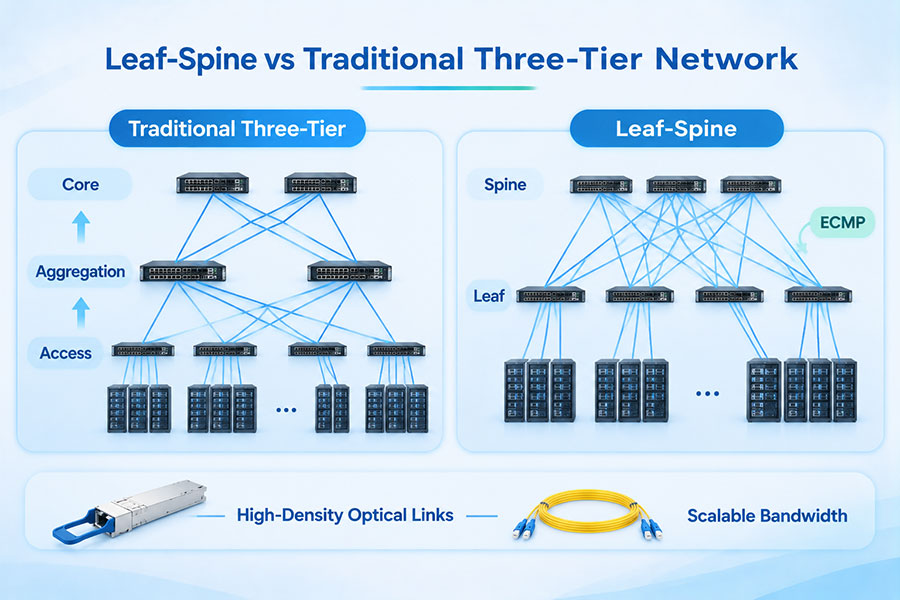
Access switches
Distribution or aggregation switches
Core switches
Wireless access infrastructure
Building-to-building fiber links
Servers and local applications
Security appliances
Internet and WAN connections
Unlike DCI, the campus network is normally designed around users, endpoints, buildings and local services rather than primarily around the movement of large volumes of traffic between independent data center facilities.
3. Data Center Interconnect vs Campus Network: Key Differences
| Factor | Data Center Interconnect | Campus Network |
|---|---|---|
| Primary purpose | Connects separate data center facilities | Connects users, devices and buildings across a local site |
| Typical traffic | Data replication, storage, application and data center traffic | User, application, voice, video, IoT and local service traffic |
| Distance | Can range from a few kilometers to metropolitan or longer distances | Usually limited to a campus or local site |
| Bandwidth | Often very high, including 100G, 400G and 800G-class links | Ranges from access speeds to high-speed core and building uplinks |
| Optical technology | May use high-speed Ethernet optics, DWDM or coherent optics | Commonly uses multimode or single-mode Ethernet optics depending on distance |
| Latency | Critical for active-active and synchronous applications | Important for user and application responsiveness |
| Topology | Point-to-point, ring, mesh or provider-based architectures | Often hierarchical or fabric-based campus architecture |
| Redundancy | High redundancy is often required between facilities | Redundancy is normally concentrated at distribution and core layers |
| Primary design concern | Capacity, distance, latency, resilience and optical performance | User access, mobility, segmentation and building connectivity |
4. Network Architecture
DCI and campus networks can both use Ethernet, fiber and high-speed switches, but their architectural objectives are different.
Data Center A
High-speed edge or DCI switches
Optical transport or dedicated fiber
Data Center B
Redundant paths between facilities
End-user devices
Access switches
Distribution or aggregation layer
Core network
Internet, WAN and data center connections
A campus network can contain a data center, but that does not automatically make every campus link a DCI connection. DCI is specifically concerned with interconnecting separate data center environments.
5. Distance and Fiber Infrastructure
Distance is one of the clearest technical differences between the two environments.
Campus fiber links commonly connect buildings within the same property or local area. Multimode fiber can be suitable for some short-distance links, while single-mode fiber is commonly used when building separation and reach increase.
DCI links may extend beyond a single campus. Metropolitan DCI can connect facilities several kilometers or tens of kilometers apart, while longer DCI architectures can extend much farther through optical transport systems.
This makes optical budget, chromatic dispersion, wavelength management, amplification and coherent modulation increasingly important as DCI distance increases.
6. Optical Transceivers in DCI and Campus Networks
Optical transceiver selection depends heavily on link distance, fiber type, data rate and network equipment.
Campus networks may use short-reach SR optics for connections within buildings or between nearby network rooms. Longer building-to-building links can use LR or other single-mode optical solutions.
DCI applications can require LR, ER, ZR, ZR+ or coherent optical technologies depending on the required reach and bandwidth.
C-LIGHT provides optical transceiver solutions for Ethernet and data center networking applications. For high-bandwidth architectures, C-LIGHT offers 400G optical transceivers and 800G optical transceivers for suitable network platforms and link requirements.
For shorter campus or data center connections, DAC and AOC solutions can also be considered where the required distance and interface configuration are appropriate.
| Application | Common Optical Direction | Primary Considerations |
|---|---|---|
| Short campus link | SR / short-reach optics | MMF, connector type, reach and switch compatibility |
| Long campus building link | LR / single-mode optics | Fiber distance and optical power budget |
| Metro DCI | LR / ER / ZR-class or coherent solutions | Distance, dispersion, power budget and fiber route |
| Long-distance DCI | Coherent optical technology | Reach, wavelength architecture, OSNR and transport design |
7. Bandwidth Requirements
Campus networks support a broad range of traffic. Individual users may connect at 1G or 2.5G, access switches may use 10G or 25G uplinks, and aggregation or core links can operate at much higher speeds.
DCI bandwidth requirements can be significantly more concentrated. A single facility-to-facility connection may carry traffic generated by thousands of servers, storage systems and applications.
Modern data centers therefore increasingly deploy 100G, 400G and 800G optical connectivity for high-capacity interconnects. As AI clusters expand, the aggregate bandwidth required between computing facilities can grow even faster.
For these environments, C-LIGHT's 400G solutions and 800G solutions provide relevant options for evaluating high-speed optical network deployments.
8. Latency Requirements
Latency matters in both network types, but the consequences can be different.
Campus applications generally need responsive access to servers, cloud services, databases and communication systems. A modest increase in latency may be acceptable for many applications.
DCI can involve more demanding synchronization requirements. Applications such as synchronous storage replication and active-active databases may require carefully controlled latency between facilities.
9. Redundancy and Resilience
A campus network normally uses redundant uplinks, switches and core paths to prevent a single equipment or fiber failure from disconnecting a building or user group.
DCI resilience often requires physically diverse paths between facilities. Two logical links that share the same fiber route do not provide the same level of protection as genuinely diverse physical paths.
DCI operators may therefore consider:
Dual fiber routes
Separate optical paths
Redundant DCI switches
Independent power systems
Multiple carrier connections
Protection or restoration mechanisms
For disaster recovery, geographic separation also matters. Two facilities that are physically close may not provide sufficient protection against a regional event.
10. Traffic Patterns
Campus networks commonly carry a mixture of north-south and east-west traffic. User devices access applications and services, while local systems also communicate with one another.
DCI traffic is often more heavily focused on facility-to-facility communication. Examples include database replication, storage synchronization, backup traffic and application workloads distributed between sites.
| Traffic Type | Campus Network | DCI |
|---|---|---|
| User-to-application | Very common | Usually indirect or application-dependent |
| Building-to-building | Common | Not the primary definition of DCI |
| Data center-to-data center | Possible but not necessarily DCI | Primary traffic category |
| Storage replication | Limited in typical campus environments | Important DCI application |
| Disaster recovery traffic | Usually crosses WAN/DCI infrastructure | Major use case |
| AI cluster traffic | Usually local to the data center | Can become important when compute resources span facilities |
11. Equipment and Switching
Campus networks typically contain access switches optimized for connecting large numbers of users, wireless access points, IP phones, cameras and IoT devices. Aggregation and core switches then consolidate traffic from multiple buildings or network segments.
DCI environments generally emphasize high-density switching and optical interfaces. The equipment must handle large volumes of traffic while providing sufficient interface density for connections to multiple data center networks or optical transport systems.
The interface speed can also influence optical selection. A campus access layer may use 1G or 10G optics, while modern data center and DCI architectures can require 100G, 400G or 800G interfaces.
12. DCI for Cloud and Data Center Expansion
DCI has become increasingly important as organizations distribute workloads across multiple facilities rather than maintaining all computing resources in one location.
Examples include:
Primary data center to disaster recovery site
Enterprise data center to colocation facility
Private data center to cloud on-ramp
Data center to data center storage replication
AI infrastructure distributed across multiple facilities
Multiple regional data centers serving different geographic markets
In these environments, DCI becomes part of the overall application architecture rather than simply being another network connection.
13. Campus Network Use Cases
Campus networks are optimized for local connectivity across a defined organization or site.
Corporate office campuses
Universities and research institutions
Hospitals
Manufacturing facilities
Industrial campuses
Government facilities
Large commercial buildings
Fiber is frequently used for building uplinks because it provides high bandwidth and immunity to electromagnetic interference. In industrial environments, fiber can be particularly useful where electrical noise or long cable distances make copper less attractive.
14. When DCI and Campus Networking Overlap
The boundary between the two can become less obvious in large enterprise environments. A corporate campus may contain several data centers, server rooms and network facilities. A fiber link between two buildings may therefore carry data center traffic without necessarily being classified as a formal DCI architecture.
The more useful distinction is the function of the link:
If the primary purpose is connecting users and buildings, it is generally part of the campus network.
If the primary purpose is connecting independent data center facilities, it is generally DCI.
If a campus network provides the physical path for a data center interconnection, both architectures can coexist.
15. Choosing the Right Optical Architecture
Optical connectivity should be selected based on the actual physical and network requirements rather than simply choosing the highest available data rate.
Important factors include:
Required link speed
Transmission distance
Single-mode or multimode fiber
Optical power budget
Connector type
Switch and port compatibility
Operating temperature
Power consumption
FEC requirements
Future bandwidth requirements
For campus deployments, short-reach and standard Ethernet optical modules may be sufficient for many links. For DCI, longer-reach optics or coherent solutions may be necessary as distance and bandwidth increase.
C-LIGHT's optical transceiver portfolio can be evaluated for different Ethernet and data center connectivity scenarios, including high-speed 400G and 800G applications.
16. Conclusion
Data Center Interconnect and campus networking serve different network objectives. Campus networks connect users, buildings, devices and local services across a defined geographic site. DCI connects separate data center facilities and is designed around high-capacity traffic, optical reach, latency, redundancy and facility-to-facility resilience.
The difference becomes especially significant as organizations adopt distributed cloud infrastructure, private AI clusters, disaster recovery sites and multi-data-center architectures. A campus network may rely heavily on access and aggregation switching, while DCI increasingly depends on high-speed optical interfaces and, for longer distances, advanced optical transport technologies.
For high-bandwidth DCI and data center networking, C-LIGHT provides 400G optical solutions, 800G optical solutions, optical transceivers and DAC/AOC products for suitable network architectures.
For optical module compatibility, DCI requirements or customized optical connectivity solutions, Contact C-LIGHT.
 >

 >
 >
 >
 >
 >
 >
 >