TEL:+86 132 6656 7067





Where computing infrastructure is hosted has a direct impact on capital investment, operational control, scalability, security, networking and application deployment. A cloud data center provides infrastructure as a service through a cloud provider's facilities, while an on-premises data center is owned or directly operated by the organization using the infrastructure.
The distinction is not simply physical location. Cloud infrastructure changes the way computing, storage and networking resources are acquired and managed, while on-premises infrastructure gives an organization direct control over the hardware, facility and network environment. Many enterprises now use a combination of both models because different workloads have different performance, compliance and cost requirements.
1. What Is a Cloud Data Center?
A cloud data center is a physical facility operated by a cloud service provider to deliver computing, storage, networking and other digital services to customers. Customers generally do not own the underlying servers, switches, power systems or cooling infrastructure.
Instead, cloud providers operate large-scale data center environments and expose infrastructure through services such as:
Virtual machines
Containers
Object and block storage
Managed databases
Virtual networking
Load balancing
GPU and AI computing
Backup and disaster recovery services
Major cloud platforms operate geographically distributed regions and availability zones so applications can be deployed across multiple physical locations. The customer interacts primarily with the service layer rather than directly managing the underlying data center equipment.
2. What Is an On-Premises Data Center?
An on-premises data center is infrastructure owned or directly controlled by the organization using it. The facility can be located at a corporate campus, manufacturing site, dedicated data center building or another controlled location.
The organization is generally responsible for a much larger portion of the infrastructure stack, including:
Servers and storage
Network switches and routers
Optical transceivers and fiber infrastructure
Power distribution
UPS systems and backup generators
Cooling equipment
Physical security
Hardware maintenance
Capacity planning
Data center operations
Some organizations operate their own facility, while others deploy dedicated infrastructure in a colocation environment. A colocation facility can provide the building, power and cooling while the customer retains ownership or control of its IT equipment. Therefore, colocation should not automatically be treated as identical to a fully owned on-premises data center.
3. Cloud Data Center vs On-Premises Data Center: Key Differences
| Factor | Cloud Data Center | On-Premises Data Center |
|---|---|---|
| Infrastructure ownership | Primarily owned and operated by the cloud provider | Owned or directly controlled by the organization |
| Capital investment | Lower direct infrastructure investment for the customer | Requires substantial investment in hardware and facility infrastructure |
| Payment model | Typically usage-based, subscription-based or reserved-capacity based | Primarily capital expenditure plus ongoing operating costs |
| Scalability | Resources can generally be provisioned rapidly | Expansion depends on purchased hardware and available facility capacity |
| Hardware control | Limited direct control over physical hardware | High control over server, storage and network hardware |
| Facility management | Managed primarily by the provider | Managed by the organization or its facility partners |
| Network design | Uses the provider's network architecture and available connectivity services | Can be designed around specific organizational requirements |
| Security model | Shared responsibility between provider and customer | Organization has direct control over physical and infrastructure security |
| Deployment speed | Virtual resources can often be deployed quickly | New physical capacity may require procurement and installation |
| Customization | Constrained by provider services and supported configurations | High degree of hardware and software customization |
| Maintenance | Physical infrastructure maintenance is handled by the provider | Organization is responsible for most hardware and facility maintenance |
| Best fit | Elastic workloads, rapid deployment and distributed applications | Workloads requiring direct infrastructure control or specialized environments |
4. Ownership and Infrastructure Control
The fundamental difference is who controls the physical infrastructure.
With cloud computing, customers consume infrastructure as a service. They can provision virtual machines, storage and network resources without purchasing the underlying physical equipment. The cloud provider is responsible for operating the physical data center and maintaining the hardware infrastructure.
With on-premises infrastructure, the organization determines which servers, switches, storage systems and optical components are installed. This creates greater control but also transfers more responsibility to the organization.
Provider operates physical facilities.
Provider manages physical servers and networking.
Customer configures its cloud resources.
Customer manages applications and data according to the selected service model.
Organization manages physical infrastructure.
Organization selects hardware platforms.
Organization manages power and cooling directly or through a facility provider.
Organization controls the complete infrastructure environment.
Cloud platforms therefore reduce the amount of physical infrastructure management required by customers, while on-premises infrastructure provides greater control over the physical implementation.
5. Cost Structure
Cloud and on-premises environments use fundamentally different cost structures.
Cloud services can reduce the need for large upfront investments in servers, storage, networking and data center facilities. Instead, organizations pay for resources according to the provider's pricing model.
On-premises environments require capital expenditure for hardware and facilities. The organization must also account for electricity, cooling, maintenance, replacement hardware, software licensing, physical security and personnel.
| Cost Category | Cloud | On-Premises |
|---|---|---|
| Servers | Included in service pricing | Purchased and maintained by the organization |
| Storage | Generally billed according to capacity and usage | Hardware must be purchased and expanded |
| Networking | Provider-managed infrastructure with service-specific charges | Organization purchases switches, routers, optics and cabling |
| Power and cooling | Generally included in provider infrastructure costs | Direct operating expense for the organization |
| Facility | Provided by the cloud operator | Owned, leased or colocated by the organization |
| IT personnel | Less physical infrastructure staffing may be required | Requires infrastructure and facility expertise |
| Capacity expansion | Can generally be provisioned through cloud services | Requires additional hardware and infrastructure investment |
6. Scalability and Resource Provisioning
Scalability is one of the strongest advantages of cloud infrastructure. A customer can often increase virtual CPU, memory, storage or network capacity through software interfaces without physically installing new equipment.
On-premises infrastructure has a more physical scaling process. Additional servers, storage systems or network equipment must be purchased, delivered, installed and configured.
However, on-premises environments can provide predictable dedicated capacity. An organization that consistently operates a large workload may prefer owning enough hardware to support its normal and peak requirements.
7. Network Architecture and Optical Connectivity
Networking is important in both environments, but the level of physical control is different.
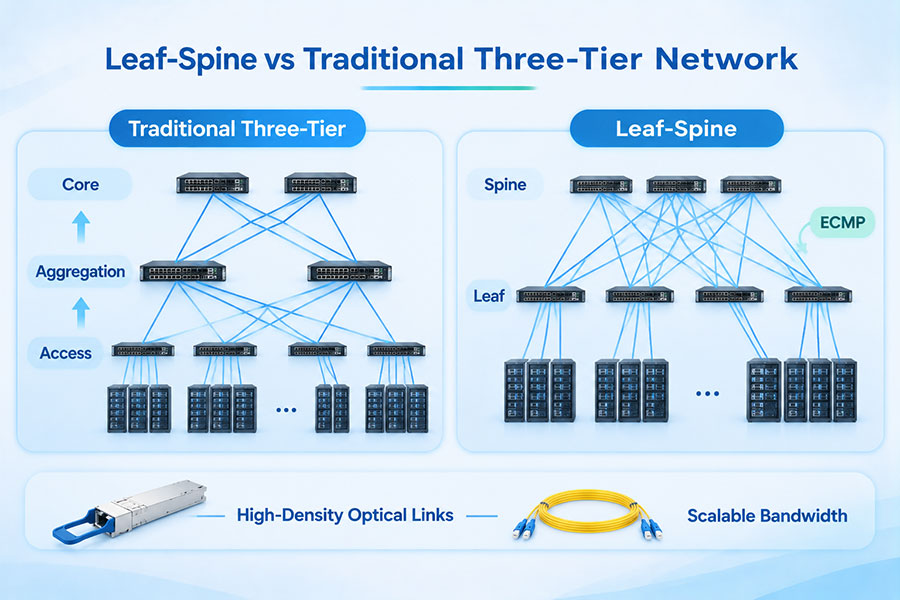
Cloud providers operate extremely large network fabrics connecting servers, storage systems, availability zones and external networks. High-speed optical links are extensively used inside these facilities and between geographically separated sites.
On-premises environments allow the organization to select its own switching architecture, optical transceivers, fiber infrastructure and network topology. This can be especially important when an application requires specialized Ethernet configurations, specific switch compatibility or dedicated bandwidth.
C-LIGHT provides optical transceivers for data center and Ethernet networking applications. For high-speed data center fabrics, relevant C-LIGHT solutions include 400G optical transceivers and 800G optical transceivers.
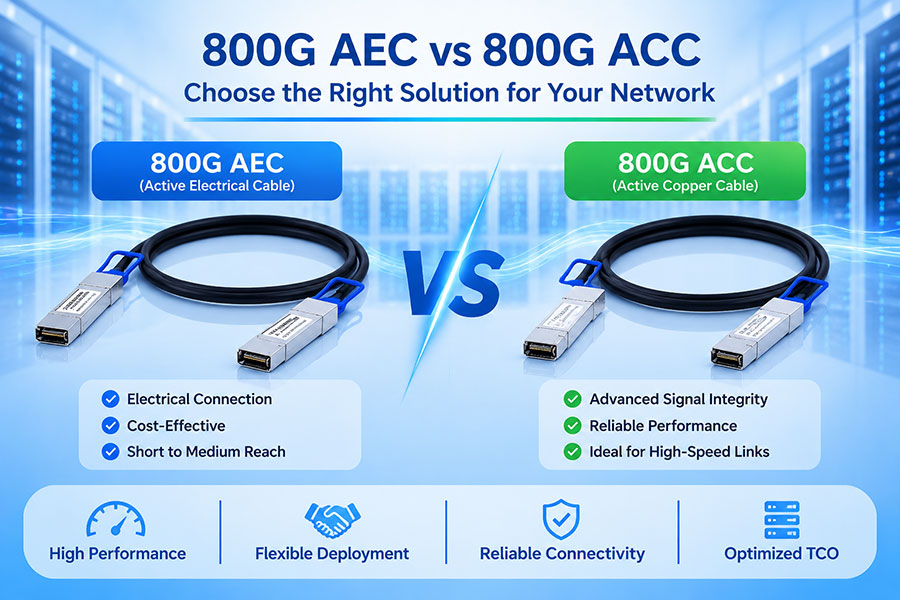
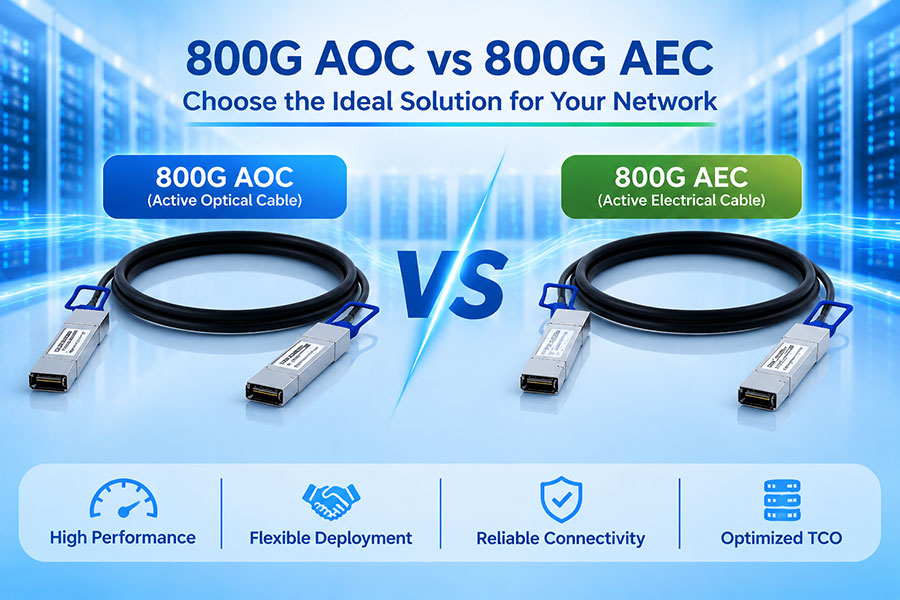
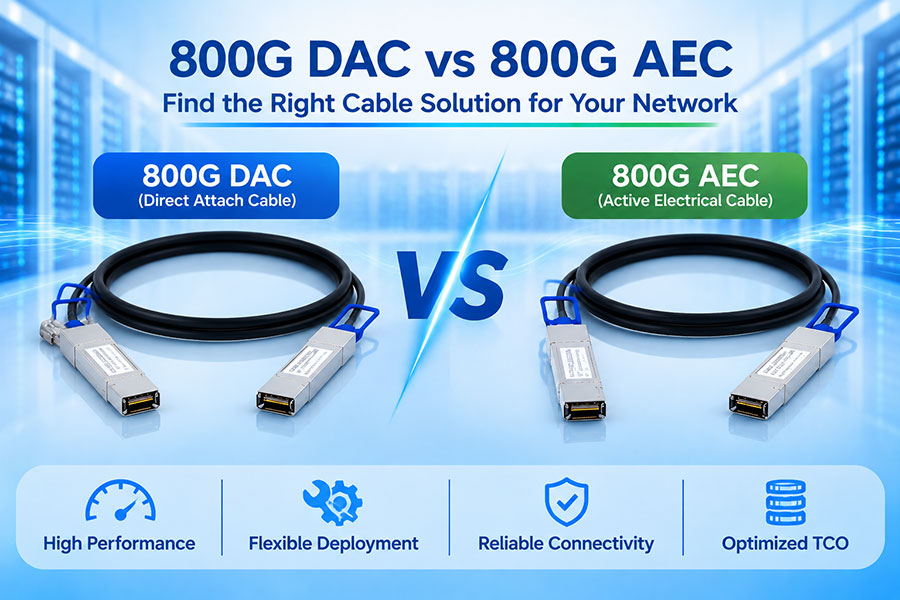
For shorter server-to-switch connections, C-LIGHT also provides DAC and AOC solutions where the link distance, host interface and application requirements are suitable.
| Network Element | Cloud Data Center | On-Premises Data Center |
|---|---|---|
| Switching fabric | Designed and operated by the provider | Designed and operated by the organization |
| Optical transceivers | Usually selected and qualified by the provider | Can be selected according to network equipment and project requirements |
| Fiber infrastructure | Provider-managed inside cloud facilities | Organization-controlled within its own environment |
| WAN connectivity | Provider offers regional and global connectivity options | Organization selects carriers and network architecture |
| Bandwidth expansion | Usually provisioned through cloud services | Requires physical infrastructure expansion when existing capacity is insufficient |
8. Latency and Application Placement
Cloud infrastructure can provide multiple geographic regions, but the physical distance between a user and the selected cloud region still affects network latency.
On-premises infrastructure can place servers directly inside a corporate campus, factory or other location where applications operate. This can be advantageous for workloads that require extremely short network paths to local systems.
Examples include:
Industrial automation
Machine vision
Local manufacturing control
Specialized enterprise applications
Low-latency database access
Applications that depend on local devices
Cloud infrastructure may still be appropriate when the application can tolerate WAN latency or when the benefits of elastic cloud resources outweigh the additional network distance.
9. Security and Compliance
Security is often cited as a reason to choose on-premises infrastructure, but physical ownership alone does not determine security. Cloud providers operate highly controlled facilities and invest heavily in physical, network and infrastructure security.
The more relevant question is which organization controls each security layer and whether the platform satisfies the application's regulatory requirements.
Cloud security commonly follows a shared responsibility model. The provider secures the underlying infrastructure, while the customer remains responsible for aspects such as identity management, application configuration and data protection depending on the service.
On-premises infrastructure gives the organization direct control over physical equipment and network boundaries, but that control also means the organization must implement and maintain the associated security controls.
10. Reliability and Disaster Recovery
Cloud platforms can provide multiple availability zones and geographic regions, allowing applications to distribute workloads across separate facilities.
On-premises environments can also implement redundancy, but achieving geographic resilience generally requires additional facilities or external disaster recovery infrastructure.
| Resilience Feature | Cloud | On-Premises |
|---|---|---|
| Redundant servers | Commonly available through service architecture | Must be designed and purchased by the organization |
| Multiple facilities | Can be available through provider regions and zones | Requires multiple organizational sites or service providers |
| Backup | Cloud-native backup services are widely available | Organization designs and operates backup infrastructure |
| Disaster recovery | Can leverage geographically distributed cloud resources | Requires dedicated DR planning and infrastructure |
| Physical infrastructure failure | Provider handles underlying hardware replacement | Organization handles hardware replacement |
11. Hardware Customization
On-premises infrastructure has a major advantage when applications require hardware configurations that are not available through standard cloud services.
An organization can select:
Specific server CPUs
GPU models
Memory configurations
Storage technologies
Network switches
Optical transceivers
Fiber cabling
Specialized accelerators
This is useful for specialized workloads such as industrial computing, private AI infrastructure, telecom systems and applications with unusual hardware requirements.
Cloud platforms generally provide a defined set of instance types and hardware configurations. This simplifies provisioning but limits direct physical customization.
12. AI and GPU Infrastructure
AI infrastructure introduces additional considerations because GPU clusters require high-density power, cooling and network bandwidth.
Cloud providers can make large GPU pools available without requiring the customer to build a dedicated AI data center. This is useful for organizations with fluctuating AI workloads or projects that need substantial computing capacity for limited periods.
On-premises AI infrastructure can be attractive for organizations that run GPUs continuously and need direct control over the hardware, data locality, network fabric and performance characteristics.
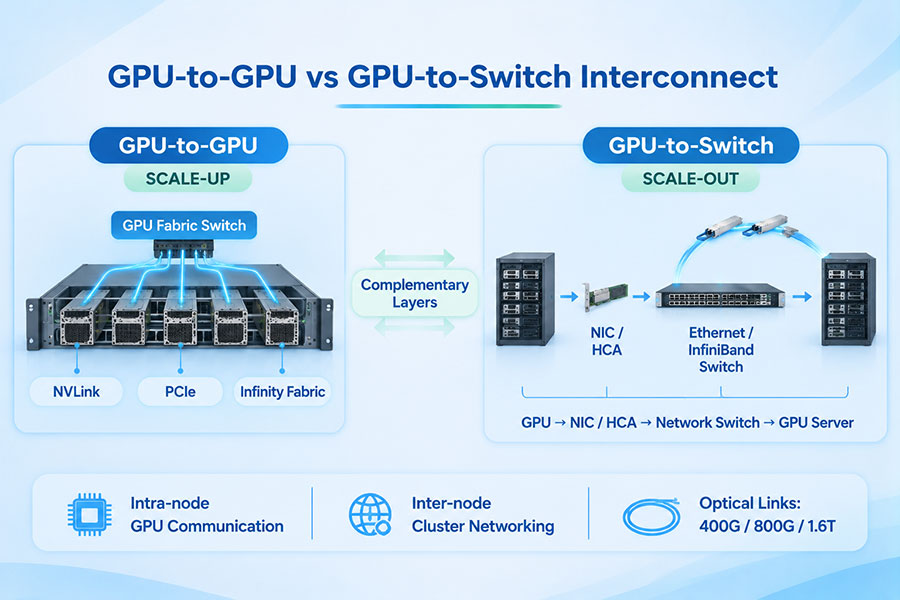
Large AI clusters also create demanding optical networking requirements. 400G and 800G optical connectivity is increasingly relevant to high-bandwidth server and switch fabrics, while future architectures are moving toward even higher aggregate bandwidth.
C-LIGHT's 800G optical solutions can be considered for suitable high-speed data center network deployments, subject to switch compatibility, optical reach, fiber type, power and environmental requirements.
13. Management and Operations
Cloud infrastructure shifts much of the physical infrastructure operation to the cloud provider. Customers can focus more heavily on applications, services and data rather than maintaining servers, power systems and cooling equipment.
On-premises environments require internal teams or managed service providers to handle a broader infrastructure stack.
Virtual resource provisioning
Cloud network configuration
Identity and access management
Application monitoring
Cloud cost management
Service-level configuration
Server maintenance
Switch and router management
Optical and fiber infrastructure
Power and cooling management
Hardware replacement
Facility monitoring
14. Cloud Data Center Use Cases
Cloud infrastructure is particularly attractive when organizations need flexibility, rapid deployment or access to geographically distributed resources.
Web applications: Resources can scale with changing traffic.
Development and testing: Temporary environments can be created without purchasing dedicated hardware.
AI workloads: GPU resources can be rented according to project requirements.
Global applications: Multiple cloud regions can support geographically distributed users.
Disaster recovery: Cloud infrastructure can provide an alternative location for critical services.
Data analytics: Large computing resources can be provisioned when required.
15. On-Premises Data Center Use Cases
On-premises infrastructure remains valuable when direct control, data locality, hardware customization or predictable long-term capacity is important.
Industrial systems: Local computing can remain close to production equipment.
Private AI clusters: Organizations can build dedicated GPU infrastructure.
Regulated workloads: Some applications require specific data handling and infrastructure controls.
Predictable workloads: Continuously operating applications can benefit from dedicated infrastructure.
Specialized hardware: Custom accelerators and network configurations can be deployed directly.
Low-latency applications: Servers can be positioned directly within the local network.
16. Hybrid Cloud: Combining Both Architectures
Many enterprises do not need to choose exclusively between cloud and on-premises infrastructure. A hybrid architecture can place different workloads in the environment that best matches their technical and business requirements.
Latency-sensitive applications
Private databases
Specialized hardware
Industrial workloads
Local data processing
Elastic computing
Large-scale analytics
Backup and disaster recovery
Global applications
Temporary GPU capacity
In this architecture, the connection between the private environment and cloud infrastructure becomes a critical component. High-capacity fiber links, reliable routing and suitable optical transceivers can be required when large volumes of data move between the two environments.
For enterprise and data center interconnection projects, C-LIGHT provides optical transceiver solutions that can be evaluated according to link speed, distance, fiber type, switch platform and environmental requirements.
17. How to Choose Between Cloud and On-Premises Infrastructure
The right choice depends on workload behavior, control requirements, network architecture and long-term economics.
Workloads fluctuate significantly.
Rapid deployment is important.
Large infrastructure investments should be avoided initially.
Global geographic coverage is required.
Temporary computing resources are needed.
Internal teams want to reduce physical infrastructure management.
Workloads are stable and predictable.
Direct hardware control is important.
Specialized hardware is required.
Very low local network latency is important.
Data locality is a major consideration.
The organization already operates substantial data center infrastructure.
18. Conclusion
Cloud data centers and on-premises data centers represent two different approaches to infrastructure ownership and operation. Cloud computing reduces the need for customers to purchase and manage physical infrastructure while providing flexible access to computing, storage and networking resources. On-premises infrastructure requires greater investment and operational responsibility but provides much greater control over hardware, networking, data locality and the physical environment.
Neither architecture is universally superior. Cloud infrastructure is particularly effective for elastic, distributed and rapidly changing workloads, while on-premises infrastructure can be advantageous for predictable workloads, specialized hardware, strict control requirements and low-latency local applications.
For many enterprises, the practical direction is hybrid cloud. Local infrastructure can handle workloads requiring direct control and low latency, while cloud data centers provide elastic capacity, geographic distribution, backup, analytics and additional computing resources.
High-speed optical connectivity is an important part of both architectures, particularly when connecting servers, switches, private data centers and cloud or colocation facilities. C-LIGHT provides optical transceivers, 400G solutions, 800G solutions and DAC/AOC connectivity for suitable data center networking applications.
For optical connectivity requirements, equipment compatibility or customized solutions, Contact C-LIGHT.
 >

 >
 >
 >
 >
 >
 >
 >