TEL:+86 132 6656 7067





Outdoor fiber optic networks face different physical and environmental challenges depending on where the cable is installed. Underground routes may encounter soil pressure, excavation damage, moisture, and rodents, while overhead installations must withstand continuous tensile loading, wind, ice, temperature changes, and ultraviolet exposure. Cable construction must therefore match the installation environment rather than rely on a general description such as heavy-duty or outdoor-rated.
Armored fiber optic cable and ADSS (All-Dielectric Self-Supporting) fiber cable address different engineering requirements. Armored cable incorporates an additional protective layer to improve resistance to external mechanical damage. ADSS uses a dedicated dielectric strength system to support itself between poles or towers without a separate messenger wire. These categories are not mutually exclusive in every design: an aerial cable can include protective reinforcement, but it must still meet the mechanical requirements of its intended installation.
1. What Is Armored Fiber Optic Cable?
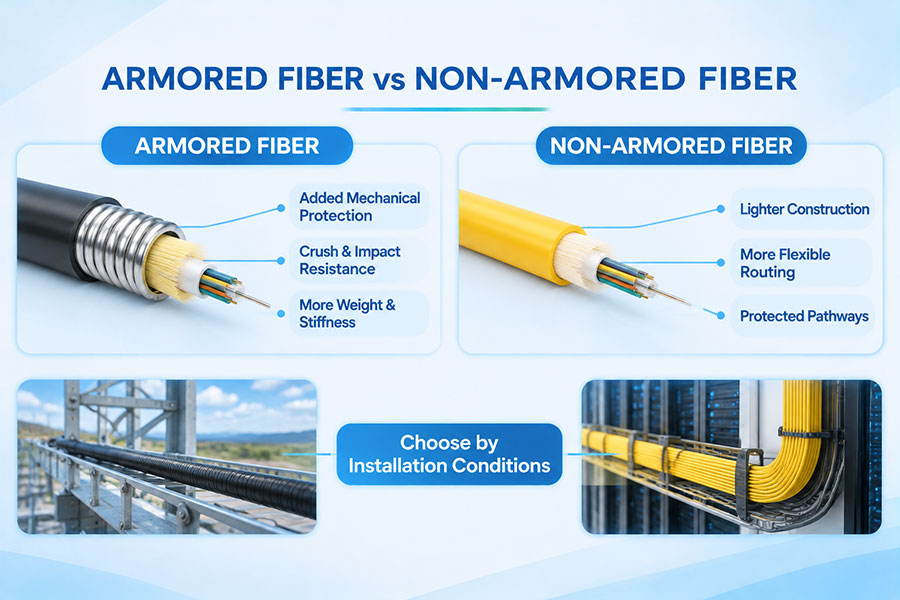
Armored fiber optic cable is a cable construction that incorporates an additional protective layer around the optical cable core. Its purpose is to improve resistance to mechanical damage, such as crushing, impact, abrasion, and rodent intrusion, depending on the armor material and design.
Armored cables are commonly used in direct-buried routes, ducts, industrial facilities, equipment areas, and other environments where the cable may be exposed to physical hazards. The armor does not automatically make a cable suitable for every installation method. Its tensile strength, bend radius, water-blocking design, jacket, and environmental ratings must match the intended route.
Common armored fiber constructions include:
Steel tape armored cable: Uses a corrugated or wrapped steel tape layer to improve crush resistance and provide a physical barrier against external damage.
Steel wire armored cable: Uses metallic wires around the cable core, often where additional mechanical strength is required.
Aluminum tape armored cable: Uses metallic tape for mechanical protection and, depending on construction, moisture-related protection.
Non-metallic armored cable: Uses materials such as aramid yarn or glass-fiber-reinforced elements to improve mechanical protection without introducing metallic conductivity.
A typical armored cable may contain optical fibers, loose tubes, a central strength member, water-blocking materials, an armor layer, and one or more protective jackets. The exact arrangement varies with fiber count, application, and manufacturer design.
2. What Is ADSS Fiber Cable?
ADSS stands for All-Dielectric Self-Supporting. It is an aerial optical fiber cable designed to carry its own mechanical load between support structures without relying on a separate metallic messenger wire.
Unlike conventional armored cable designed primarily for physical protection, ADSS is engineered around span length, tensile loading, sag, wind, ice, temperature, and the electrical environment near power infrastructure. Its load-bearing system uses non-metallic reinforcement, such as aramid yarn or glass-fiber-reinforced materials.
Typical ADSS construction includes:
Optical fibers: Usually single-mode fibers for access, distribution, utility, and backbone networks.
Loose tubes: Protect fibers and accommodate movement caused by mechanical and temperature changes.
Central strength member: Helps maintain the cable's structural geometry.
Dielectric reinforcement: Provides the tensile strength needed for unsupported aerial spans.
Outer sheath: Protects the cable against moisture, ultraviolet exposure, and environmental aging.
ADSS cables are available in different mechanical designs for different span lengths and loading conditions. Some designs use single sheaths, while others use double-sheath constructions. The correct design depends on the electrical environment, cable route, required mechanical rating, and manufacturer specifications.
3. Armored Fiber vs ADSS: Main Differences
The fundamental difference is the engineering priority. Armored cable adds a protective layer to resist physical damage, while ADSS is designed to support aerial tensile loads without a separate messenger. One category describes a protective construction feature; the other describes a self-supporting aerial cable design.
| Feature | Armored Fiber Cable | ADSS Fiber Cable |
|---|---|---|
| Primary purpose | Additional protection against external mechanical damage | Self-supporting aerial installation |
| Typical installation | Direct burial, duct, industrial, and selected aerial applications | Overhead pole and tower routes |
| Protective structure | Metallic or non-metallic armor, depending on design | Dielectric reinforcement and protective sheath |
| Separate messenger | Usually required for conventional aerial installation unless specifically designed otherwise | Not required |
| Tensile support | Depends on the cable's specified strength members and application rating | Built into the self-supporting cable design |
| Crush resistance | Often enhanced by the armor layer | Depends on the cable's specified construction and test rating |
| Rodent protection | Can be enhanced by suitable armor construction | Depends on sheath and optional protective design |
| Electrical characteristics | Metallic armor may require bonding and grounding; dielectric armor does not | Fully dielectric cable construction |
| Installation hardware | Depends on burial, duct, or aerial installation method | Requires ADSS-specific suspension and dead-end hardware |
| Main selection criteria | Physical protection, route conditions, and cable ratings | Span, sag-tension design, electrical environment, and aerial loading |
4. Armor Materials and Mechanical Protection
The effectiveness of armored fiber cable depends on the type, thickness, arrangement, and material of the armor. Steel tape and steel wire constructions provide different mechanical characteristics, and neither should be selected without reviewing the cable's test results.
Metallic armor can improve resistance to crushing and certain forms of external impact. It may also provide a physical barrier against rodents. However, metallic armor increases cable weight and stiffness and introduces electrical considerations. Where metallic armor is electrically continuous, the installation must follow the applicable bonding and grounding requirements.
Non-metallic protective reinforcement can provide additional mechanical protection without creating a conductive path. Its performance against rodents and crushing depends on the specific material and construction; it should not automatically be treated as equivalent to steel tape armor.
| Armor Type | Typical Characteristics | Important Considerations |
|---|---|---|
| Corrugated steel tape | Provides radial protection and improved resistance to crushing | Metallic conductivity, corrosion protection, and bending limits |
| Steel wire armor | Provides a robust mechanical structure and may contribute to tensile performance | Weight, cable flexibility, corrosion, and termination requirements |
| Aluminum tape | Provides a metallic barrier and may contribute to moisture protection | Specific construction and electrical continuity must be verified |
| Aramid reinforcement | Lightweight, non-conductive tensile reinforcement | Does not automatically provide the same rodent or crush protection as metallic armor |
| Glass-fiber reinforcement | Non-metallic reinforcement with useful mechanical and environmental characteristics | Protection level depends on the design and test requirements |
5. Aerial Installation and Span Requirements
ADSS is specifically engineered for aerial installation. Its internal dielectric strength members carry the cable's tensile load, while dedicated suspension and dead-end fittings transfer mechanical forces to the poles or towers.
A conventional armored cable is not automatically suitable for unsupported aerial spans. A standard direct-buried or duct cable may have an armor layer but lack the mechanical design required to support its own weight over a pole span. If armored cable is used overhead, the installation must follow a construction specifically approved for that method, such as a suitable messenger-supported or self-supporting design.
Aerial cable engineering must account for:
Span length and pole spacing.
Cable weight and rated tensile strength.
Maximum allowable installation tension.
Final sag under the specified temperature conditions.
Wind pressure, ice loading, and vibration.
Minimum bend radius and compatible attachment hardware.
Electrical clearance and the surrounding power-line environment.
| Installation Factor | Armored Fiber Cable | ADSS Fiber Cable |
|---|---|---|
| Overhead support | Usually requires a messenger or a specifically rated aerial construction | Supports itself through internal dielectric reinforcement |
| Span engineering | Depends on the approved cable and support arrangement | Integral to cable selection and installation design |
| Installation hardware | Messenger clamps or hardware suitable for the specific aerial construction | Dedicated ADSS suspension and dead-end fittings |
| Wind and ice loading | Must be evaluated for the complete cable-support system | Must be evaluated for the self-supporting cable and attachment system |
| Power-line environment | Requires assessment of metallic components and electrical clearance | Requires assessment of electric-field exposure, sheath performance, and clearance |
6. Direct Burial, Duct and Industrial Applications
Armored fiber cable is commonly selected for routes where physical protection is a major concern. Direct-buried installations may expose cables to soil pressure, stones, excavation activity, and rodents. Metallic armor can provide an additional barrier against these hazards, while water-blocking materials and suitable outer jackets protect the cable core from moisture.
In duct installations, armor may be useful where additional crush or rodent protection is needed, but the cable must also meet the duct's dimensional, pulling-tension, and bend-radius requirements. A heavily armored cable is not necessarily the best choice for every conduit because its stiffness and outer diameter can complicate installation.
ADSS is primarily intended for aerial spans rather than direct burial. Its dielectric strength system is optimized for overhead mechanical loading, not necessarily for the crush, impact, and rodent hazards encountered underground.
| Application | Armored Fiber Cable | ADSS Fiber Cable |
|---|---|---|
| Direct burial | Common option when the cable is rated for direct burial | Generally not intended for this application |
| Underground duct | Can be used if diameter, pulling tension, and bend limits are suitable | Generally not intended for duct deployment |
| Industrial facilities | Useful where physical protection is required | Useful for approved overhead routes |
| Outdoor pole routes | Requires a suitable messenger-supported or aerial-rated construction | Designed for self-supporting aerial installation |
| Utility transmission corridors | Not a direct substitute for ADSS or OPGW | Designed for appropriate overhead power-line applications |
| Rodent-prone underground routes | Suitable armor can improve physical protection | Requires a separate cable design specifically rated for the route |
7. Electrical Characteristics and Grounding
Electrical behavior depends on the armor and reinforcement materials. Metallic armored fiber cable contains conductive components that may require bonding and grounding according to the installation design and applicable electrical codes.
ADSS is fully dielectric. It contains no metallic messenger or conductive armor, which makes it suitable for overhead applications where a non-conductive cable construction is required. However, dielectric construction does not eliminate the need to evaluate electrical clearances, electric-field exposure, or the performance of the outer sheath when installed near energized conductors.
This distinction is particularly important when comparing conventional armored cable with ADSS for utility routes. A metallic armored cable should not be treated as an ADSS replacement simply because both can contain optical fibers and reinforcement.
| Electrical Characteristic | Metallic Armored Fiber | ADSS Fiber |
|---|---|---|
| Metallic components | Present in metallic armor designs | None |
| Electrical conductivity | Conductive armor may form an electrical path | Fully dielectric construction |
| Bonding and grounding | May be required according to the armor design and installation rules | No cable armor grounding function |
| Power-line proximity | Requires careful assessment of metallic components and clearances | Requires assessment of electric-field conditions and sheath requirements |
| Corrosion considerations | Metallic armor requires suitable corrosion protection | No metallic cable armor to corrode |
8. Fiber Count and Optical Transmission Performance
Armored fiber and ADSS describe cable construction rather than transmission speed. Both can be manufactured with different fiber counts and optical fiber categories according to network requirements.
Single-mode fiber is widely used in outdoor networks because it supports long-distance transmission and high-capacity optical communication. The actual link performance depends on fiber attenuation, wavelength, connector and splice losses, dispersion characteristics, optical transceiver specifications, and the total link budget.
When selecting either cable type, engineers should verify:
Fiber category: Confirm the required ITU-T G.652, G.655, G.657, or other specified fiber type.
Fiber count: Match current network demand and expected expansion.
Attenuation: Check the manufacturer's maximum attenuation at the operating wavelengths.
Water blocking: Confirm the cable's resistance to longitudinal water penetration.
Bending performance: Review minimum installation and long-term bend-radius limits.
Mechanical test results: Review tensile, crush, impact, torsion, and environmental performance.
Optical test documentation: Confirm factory test results and installation acceptance measurements.
The presence of armor does not automatically improve optical attenuation or bandwidth. Likewise, ADSS does not inherently support a higher data rate than armored fiber. Optical transmission capability is determined by the fiber and the active equipment, while cable construction primarily addresses installation and environmental requirements.
9. Weight, Flexibility and Installation Complexity
Armor generally adds material, weight, and stiffness to the cable. These characteristics can be beneficial where physical protection is required, but they may increase pulling effort, reduce flexibility, and require larger bending spaces.
ADSS avoids metallic armor and a separate messenger by using dielectric reinforcement within the cable. Its construction can reduce the need for additional support components, but it requires dedicated fittings and careful control of installation tension and sag.
| Factor | Armored Fiber Cable | ADSS Fiber Cable |
|---|---|---|
| Cable weight | Often higher when metallic armor is used | Depends on span rating, fiber count, and reinforcement design |
| Flexibility | Can be reduced by the armor layer | Designed for aerial handling and controlled tensioning |
| Minimum bend radius | Must account for armor construction and cable diameter | Must follow ADSS-specific installation and operating limits |
| Installation equipment | Depends on burial, duct, or approved aerial method | Requires suitable aerial tensioning equipment and fittings |
| Support components | May require a duct, messenger, or other support arrangement | Does not require a separate messenger |
10. Maintenance and Long-Term Reliability
Maintenance requirements depend on the installation environment and cable construction. For armored cable, inspections should consider outer-jacket damage, armor corrosion, water ingress, and the condition of cable entry and termination points.
ADSS maintenance focuses on sheath condition, suspension fittings, dead-end assemblies, sag, tension, and environmental exposure. Where installed near energized conductors, the electrical environment and sheath condition should also be included in the inspection program.
| Maintenance Area | Armored Fiber Cable | ADSS Fiber Cable |
|---|---|---|
| Outer jacket | Inspect for cuts, abrasion, cracks, and water entry | Inspect for aging, abrasion, cracking, and environmental damage |
| Protective structure | Check armor condition and corrosion where metallic | Check cable reinforcement indirectly through mechanical condition and manufacturer guidance |
| Support hardware | Inspect ducts, messenger arrangements, or other support components | Inspect suspension and dead-end fittings |
| Mechanical condition | Check for crushing, impact, and excessive bending | Check sag, tension, vibration, and span condition |
| Optical testing | OTDR and end-to-end optical measurements | OTDR and end-to-end optical measurements |
11. How to Choose Between Armored Fiber and ADSS
The first selection question should be where the cable will be installed. If the route is underground or exposed to physical damage, suitable armored fiber may be appropriate. If the route is overhead and requires a self-supporting cable between poles or towers, ADSS is generally the more relevant cable category.
Identify the installation route: Determine whether the cable will be directly buried, installed in duct, routed indoors, or suspended overhead.
Assess physical hazards: Review excavation risk, crushing, impact, rodents, abrasion, and moisture exposure.
Define mechanical requirements: For aerial routes, specify span length, tension, sag, wind, ice, and pole or tower loading.
Evaluate electrical conditions: Check whether metallic components are permitted and whether bonding, grounding, or electrical clearance requirements apply.
Choose the protective construction: Select suitable metallic or non-metallic armor for physical protection, or an ADSS design for self-supporting aerial installation.
Verify optical requirements: Specify fiber type, fiber count, attenuation, and connector or splice arrangements.
Check installation compatibility: Confirm cable diameter, bend radius, pulling tension, fittings, and installation procedures.
Review long-term maintenance: Consider inspection access, environmental exposure, replacement procedures, and future network expansion.
12. C-LIGHT Fiber Connectivity for Outdoor Networks
Outdoor fiber networks require more than the correct cable construction. Splice protection, cable entry, fiber distribution, connector interfaces, and optical endpoint equipment all contribute to the reliability of the completed link.
C-LIGHT's Outdoor Fiber Connector product family includes outdoor fiber management and splice-closure solutions. These products can be considered for suitable outdoor fiber protection and management arrangements, subject to the required cable entry configuration, environmental rating, and fiber capacity. A splice closure is a fiber-management enclosure rather than a substitute for the aerial cable's mechanical support system.
At the network endpoints, C-LIGHT's Optical Transceiver portfolio supports different optical networking applications. The appropriate module should be selected according to data rate, wavelength, fiber type, connector interface, transmission distance, optical budget, and equipment compatibility.
Armored or ADSS cable provides the physical transmission path, while optical transceivers perform electrical-to-optical and optical-to-electrical conversion. Correctly matching the cable's attenuation and connection losses with the transceiver specifications is essential for stable network operation.
13. Conclusion
Armored fiber optic cable and ADSS fiber cable are designed around different installation requirements. Armored fiber adds a protective layer to improve resistance to physical damage, making suitable constructions useful in direct-buried, duct, and industrial environments. ADSS uses an internal dielectric strength system to support itself across overhead spans without a separate messenger wire.
For underground routes exposed to crushing, excavation, or rodents, an appropriately rated armored cable may be the better choice. For overhead routes requiring self-supporting installation, ADSS is generally more suitable. If an armored cable is intended for aerial deployment, its specific construction must be approved for that installation method.
Final selection should consider mechanical loading, electrical characteristics, environmental exposure, fiber requirements, installation hardware, and maintenance. The best cable is the one whose complete construction and test ratings match the actual route conditions.
 >

 >
 >
 >
 >
 >
 >
 >