TEL:+86 132 6656 7067





Data center networking is evolving as artificial intelligence becomes a major source of computing demand. General-purpose cloud infrastructure must connect virtual machines, containers, databases, storage systems, enterprise applications and external users. AI infrastructure adds another demanding requirement: coordinating large numbers of GPUs and accelerators through high-bandwidth communication fabrics.
An AI network and a cloud data center network are not necessarily separate technologies or competing architectures. An AI cluster can operate inside a cloud provider's data center and use the cloud platform's front-end, storage, management and security services. The important distinction is between the accelerator-optimized fabric that connects AI compute resources and the broader network infrastructure that supports cloud services and multiple tenants.
This difference influences network topology, traffic patterns, congestion management, isolation, optical connectivity and capacity planning. As AI clusters grow across multiple racks or facilities, their networking requirements increasingly become a central part of data center architecture.
1. What Is an AI Network?
An AI network is the communication infrastructure used to connect accelerators, compute nodes, storage systems and supporting services in an AI environment. Its most demanding role is often connecting GPUs across servers so that distributed training and inference workloads can operate efficiently.
Unlike many general-purpose applications, distributed AI training can produce synchronized communication between large groups of accelerators. GPUs may exchange gradients, model parameters and intermediate data through collective operations. Network congestion, packet handling and communication delays can therefore affect accelerator utilization and overall job completion time.
A production AI environment may include several logical or physical network domains:
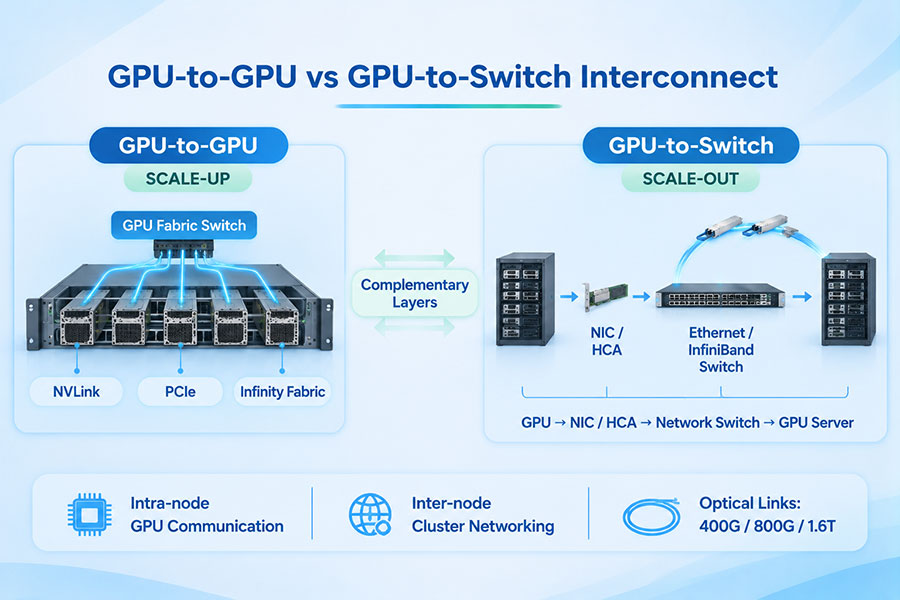
Scale-up interconnect: Connects accelerators within a server or rack through high-bandwidth platform-specific technologies.
Scale-out fabric: Connects GPU servers and racks through Ethernet or InfiniBand.
Tenant access network: Provides access to storage, external services and user workloads.
Storage network: Connects compute resources to datasets, model repositories and checkpoint systems.
Management network: Supports provisioning, monitoring, configuration and infrastructure administration.
The exact number of networks and their physical separation depend on the platform, deployment size, service model and security requirements. Some environments use dedicated fabrics, while others combine functions through carefully designed logical segmentation.
2. What Is a Cloud Data Center Network?
A cloud data center network connects the physical infrastructure that delivers cloud computing services. It must support a diverse range of workloads, from virtual machines and container platforms to databases, storage services, application gateways and AI instances.
Cloud providers operate networks across multiple layers. These commonly include facility-level switching, data center fabrics, regional connectivity, wide-area networks and external edge connections. The infrastructure must provide reliable communication between servers, storage systems, customers and services running in different locations.
Important cloud networking components include:
Data center fabric: Connects servers and infrastructure devices within a facility.
Edge network: Connects cloud infrastructure to the Internet and external enterprise networks.
Regional backbone: Connects data centers and cloud regions.
Virtual networking: Creates logical networks for customer workloads through overlays and software-defined networking.
Security infrastructure: Enforces routing policies, access controls, filtering and network isolation.
Management and control plane: Provisions and monitors network resources through software and automation.
Cloud networks must handle different traffic patterns and service requirements simultaneously. A virtual machine hosting a web application, a database cluster, an object storage service and a GPU instance may all use the same underlying data center infrastructure, while receiving separate logical connectivity and security policies.
3. AI Network vs Cloud Data Center Network: Main Differences
| Network Factor | AI Network | Cloud Data Center Network |
|---|---|---|
| Primary purpose | Connects accelerators and compute resources for AI workloads | Connects cloud infrastructure, applications, tenants and external services |
| Main traffic pattern | Often intensive East-West communication between GPUs and compute nodes | Mixed East-West and North-South traffic across many applications |
| Performance priority | High effective bandwidth, low and predictable latency, congestion control | Availability, scalability, tenant isolation and application connectivity |
| Scale-up connectivity | Platform-specific accelerator interconnects within servers or racks | Not normally a universal requirement across general-purpose cloud workloads |
| Scale-out connectivity | Dedicated or optimized Ethernet and InfiniBand fabrics for distributed AI jobs | General-purpose data center Ethernet fabrics and cloud service networking |
| Network protocols | Ethernet, RoCEv2, InfiniBand and accelerator-specific interconnects | Ethernet, IP routing, overlays and cloud network virtualization |
| Traffic management | Collective communication, congestion control, adaptive routing and fabric tuning | Routing, load balancing, tenant policies, service discovery and traffic engineering |
| Isolation requirements | Job, tenant, accelerator and fabric isolation | Strong multi-tenant separation across virtual networks and services |
| Typical endpoints | GPUs, AI servers, storage nodes and cluster services | VMs, containers, application servers, databases, storage and gateways |
| Capacity planning | Model communication patterns, GPU count, fabric bandwidth and storage throughput | Tenant demand, workload diversity, service capacity and regional connectivity |
4. AI Network Architecture: Scale-Up, Scale-Out and Scale-Across
AI networking is commonly divided into multiple communication domains. These domains serve different distances and functions, and their performance requirements are not interchangeable.
Scale-up refers to communication between accelerators within a tightly connected system or rack. Specialized interconnect technologies provide high-bandwidth communication between GPUs. NVIDIA NVLink is one example of a platform-specific scale-up technology.
Scale-out connects servers and racks across the AI cluster. Ethernet-based fabrics, including deployments using RoCEv2, and InfiniBand are common approaches. They carry distributed training communication between accelerators located on different servers.
Scale-across extends AI infrastructure across multiple data centers or sites. This requires additional consideration of geographic distance, propagation delay, routing, synchronization and the type of distributed workload being run. It is not equivalent to simply extending a local rack-scale fabric over a long-distance WAN.
Conceptual communication layers. Actual connectivity and supported distances depend on the accelerator platform and application architecture.
These layers allow an AI system to use different technologies for local accelerator communication, inter-rack networking and longer-distance connectivity. A single AI deployment may therefore include both specialized accelerator links and conventional Ethernet infrastructure.
5. Cloud Data Center Network Architecture
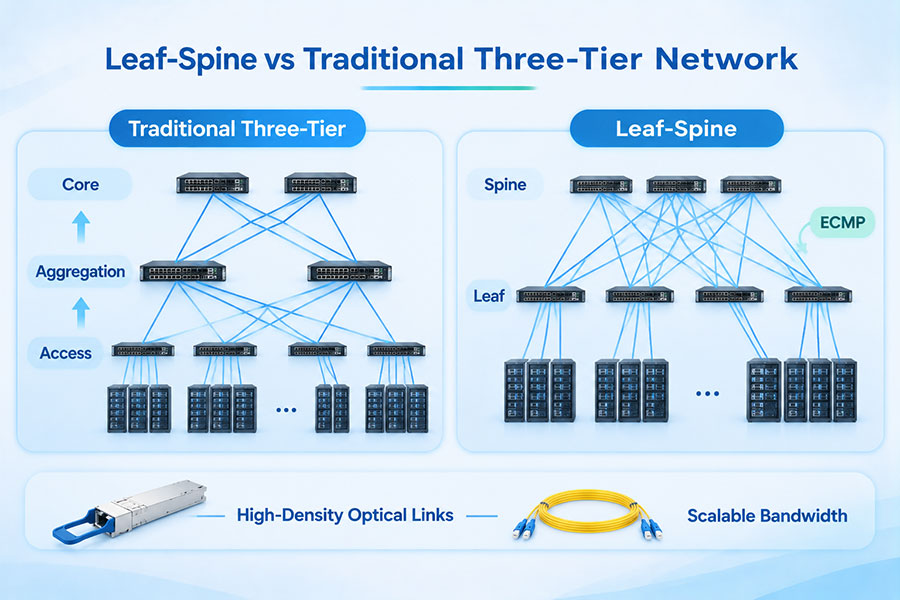
Cloud data center networks are generally designed to provide scalable connectivity for a large number of servers and customer workloads. A Clos-based or leaf-spine fabric is widely used to provide multiple paths between different parts of the data center.
Leaf switches connect physical servers and other endpoints. Spine switches interconnect the leaf layer and provide paths for inter-rack communication. Layer 3 routing and Equal-Cost Multi-Path (ECMP) can distribute eligible traffic across available paths, helping scale network capacity and resilience.
Above the physical fabric, cloud platforms use software-defined networking and virtual network overlays to separate customer environments. Virtual Private Clouds (VPCs), Virtual Networks (VNets), virtual routing, security groups and network policies allow multiple tenants to use shared physical infrastructure without sharing the same logical network.
Cloud network architecture also includes connectivity beyond a single facility. Edge networks provide Internet and enterprise connectivity, while regional and wide-area networks connect data centers across different locations.
Microsoft's published Azure architecture, for example, describes edge, wide-area, regional gateway and data center network components. Its data center fabric uses a modified Clos topology, Layer 3 routing and ECMP for resilient, high-bandwidth connectivity.
6. Traffic Patterns: GPU-to-GPU vs General Cloud Communication
Traffic behavior is one of the most important reasons AI networking can require specialized fabric design. Distributed AI training often involves many accelerators communicating as participants in the same job. These communications may be synchronized and repeated throughout the training process.
Collective operations such as All-Reduce, All-Gather and Reduce-Scatter exchange model information between participating accelerators. If some communication paths become congested, the entire operation may be affected by slower participants or delayed data transfers.
Cloud data center workloads produce a wider variety of communication patterns. These can include user requests, API calls, database queries, virtual machine communication, object storage access, replication, backup and inter-service messaging.
| Traffic Pattern | AI Network | Cloud Data Center Network |
|---|---|---|
| East-West traffic | Often includes synchronized GPU communication and large inter-node transfers | Includes application, database, storage and VM-to-VM communication |
| North-South traffic | Supports tenant access, model requests, data ingestion and external services | Supports Internet access, customer applications and external enterprise connectivity |
| Communication timing | May involve tightly coordinated collective operations | Varies across application requests and distributed services |
| Large data transfers | Training data, gradients, model state and checkpoints | Storage, backups, application data and customer content |
| Performance sensitivity | Fabric congestion and communication delays can affect accelerator utilization | Depends on service-level objectives, application response time and throughput |
Cloud workloads can also generate intense East-West traffic, and not every AI application uses the same communication pattern. The main architectural difference is the degree to which the network must be optimized for coordinated accelerator communication and predictable performance under sustained load.
7. InfiniBand vs Ethernet in AI and Cloud Networks
Ethernet is the foundation of most general-purpose cloud data center networking. It supports IP routing, virtual network overlays, application connectivity, storage access and connections to external networks.
AI clusters can also use Ethernet, but distributed training may require more specialized configuration and optimization. RoCEv2 carries Remote Direct Memory Access (RDMA) over Ethernet, allowing eligible applications to transfer data between system memories with reduced host processing overhead. Congestion management, traffic engineering and network adapter support are important parts of a successful implementation.
InfiniBand is another important option for AI and high-performance computing. It provides a dedicated high-performance fabric ecosystem for accelerator communication, with its own switches, adapters, subnet management and operational tools.
| Factor | Ethernet / RoCEv2 | InfiniBand |
|---|---|---|
| Technology foundation | Standards-based Ethernet and IP networking | Dedicated high-performance interconnect ecosystem |
| Common application | Cloud networking, enterprise networks and AI scale-out fabrics | AI training, HPC and tightly coupled distributed computing |
| RDMA support | RoCEv2 provides RDMA over converged Ethernet | RDMA is integrated into the InfiniBand architecture |
| Operations | Can align with established Ethernet routing and operations skills, with AI-specific tuning | Requires InfiniBand fabric management and operational expertise |
| Interoperability | Depends on Ethernet standards, supported features and endpoint compatibility | Depends on supported InfiniBand adapters, switches and fabric configuration |
| Deployment decision | Suitable for general cloud and AI networking when designed and tuned for the workload | Suitable when a dedicated high-performance fabric aligns with workload and operational requirements |
Neither technology is automatically the right choice for every AI or cloud deployment. Ethernet can be optimized for large AI clusters, while InfiniBand provides a dedicated fabric option for demanding distributed workloads. Selection should reflect accelerator compatibility, cluster scale, application behavior, operations expertise and total infrastructure cost.
8. Multi-Tenancy and Network Isolation
Cloud data centers are designed to host workloads belonging to many customers. Their networking architecture must keep tenant environments isolated while allowing each customer to configure virtual networks, access policies and service connectivity.
Software-defined networking provides programmable network control. Overlay technologies such as VXLAN can create logical tenant networks on top of a shared physical fabric. Virtual routing and firewall policies further control which services and resources can communicate.
AI cloud infrastructure has similar multi-tenant requirements, but accelerator clusters introduce additional isolation considerations. Different customers or jobs may share physical GPU infrastructure, network ports or storage resources. The system must protect tenant data and prevent one workload from disrupting another.
AI network isolation can involve:
Tenant isolation: Separates customer networks and access permissions.
Job isolation: Limits the network resources and communication domain assigned to a training or inference job.
Fabric partitioning: Uses supported network mechanisms to separate traffic between workloads.
Performance isolation: Controls congestion and resource contention between tenants.
Management separation: Keeps infrastructure administration traffic distinct from tenant workloads.
Storage access control: Restricts access to datasets, model assets and checkpoint data.
AI infrastructure does not remove the need for conventional cloud security. Authentication, authorization, encryption, tenant isolation, monitoring and workload protection remain essential across the entire environment.
9. Bandwidth, Latency and Congestion Management
AI network capacity planning must account for the number of accelerators, the bandwidth of each network adapter, the topology of the fabric and the communication patterns generated by distributed workloads. A large cluster may require substantial aggregate bandwidth between racks, but the network must also maintain efficient performance when many jobs communicate simultaneously.
Congestion can arise when multiple traffic flows compete for the same links or switch resources. In synchronized training workloads, delayed transfers can affect collective communication and reduce overall accelerator efficiency.
AI network engineering therefore pays close attention to:
Effective bandwidth: The throughput available to applications after accounting for protocol overhead and contention.
Latency and tail latency: Typical and worst-case communication delays under workload conditions.
Congestion control: Mechanisms that manage traffic when demand exceeds available link or buffer capacity.
Adaptive routing: Supported methods for distributing traffic across available network paths.
Oversubscription: The relationship between endpoint bandwidth and uplink capacity.
Fabric telemetry: Measurements that help identify hot spots, packet drops, queue behavior and link utilization.
Cloud networks also require extensive congestion management and capacity engineering. Their planning must account for application diversity, service-level objectives, tenant behavior and the distribution of traffic across data center and regional infrastructure.
10. Optical Connectivity and High-Speed Network Links
Both AI networks and cloud data center networks rely on optical connectivity when bandwidth, physical distance or cable-management requirements make fiber suitable. The difference often lies in the number of high-speed links and the traffic patterns they must support.
AI scale-out fabrics can require large numbers of high-speed connections between leaf and spine switches, compute racks and storage systems. Depending on the platform and network design, 100G, 400G and 800G optical interfaces may be used. The scale-up connections between accelerators may use a separate platform-specific interconnect rather than conventional pluggable Ethernet transceivers.
Cloud networks use optical links throughout the infrastructure, including server-to-switch connections, data center backbones, regional connectivity and data center interconnection. The appropriate interface depends on transmission distance, bandwidth, fiber infrastructure and network topology.
| Connectivity Area | AI Network | Cloud Data Center Network |
|---|---|---|
| Compute rack connections | High-speed links connect accelerator servers to the AI scale-out fabric | Server NICs connect to access or leaf switches |
| Switch-to-switch links | High-capacity links support GPU cluster communication between racks | Links support leaf-spine, aggregation and core connectivity |
| Storage connections | High-throughput dataset access and checkpoint traffic | Block, file and object storage connectivity |
| Inter-facility links | Connects distributed AI facilities where supported by the workload | Connects regional data centers and cloud backbone infrastructure |
Optical module selection should not be based on nominal data rate alone. Engineers need to verify form factor, host interface, lane configuration, wavelength, fiber type, connector, reach and optical link budget. Compatibility between the switch and transceiver must also be confirmed.
For high-speed data center and AI infrastructure connectivity, the C-LIGHT optical transceiver portfolio provides a starting point for evaluating optical interfaces across different data rates and transmission requirements. Additional connectivity categories are available in the C-LIGHT product portfolio.
11. Storage and Management Networks
AI networks need reliable access to large datasets, model repositories and checkpoint storage. The storage infrastructure may include local NVMe drives, high-performance parallel file systems, object storage and shared block storage. Each option has different latency, throughput and capacity characteristics.
Cloud networks support a broader range of storage services, including virtual machine disks, databases, object storage, shared file systems and backup systems. Their network architecture must accommodate different customer access patterns and service-level requirements.
Both environments also need separate or logically isolated management connectivity. Management traffic includes configuration, monitoring, infrastructure provisioning, telemetry collection and administrative access. Keeping this traffic isolated from high-volume data transfers helps protect operational systems and maintain visibility during network incidents.
In AI cloud environments, the management layer must coordinate not only network and storage resources but also accelerator allocation, job scheduling, workload isolation and cluster health. The result is a more tightly integrated infrastructure control system.
12. Power, Cooling and Physical Infrastructure
AI networking adds physical infrastructure demands because accelerator-rich systems and high-speed switching equipment can create significant power and thermal loads. Network adapters, switches, optical modules and their supporting infrastructure must be included in rack-level power and cooling calculations.
High-density AI racks may use advanced air cooling, direct-to-chip liquid cooling or other thermal-management approaches according to equipment requirements. Switches and optical components also need sufficient airflow and operating-temperature margins.
Cloud data centers manage a broader mixture of rack densities. General-purpose compute, storage, network and accelerator racks can coexist in the same facility. Cooling and power distribution must support different equipment profiles while maintaining redundancy and efficient resource utilization.
Physical design considerations include:
Power capacity and redundancy for compute and network equipment.
Thermal limits for switches, network adapters and optical modules.
Airflow direction and rack-level cooling configuration.
Fiber routing, cable density and connector access.
Equipment serviceability and replacement procedures.
Expansion capacity for additional network ports, racks and compute nodes.
13. Can an AI Network Run Inside a Cloud Data Center?
Yes. AI networks and cloud data center networks are frequently deployed together. A cloud provider can use its general-purpose data center network for tenant access, control-plane services, external connectivity and shared storage, while providing a specialized cluster interconnect for GPU-to-GPU communication.
This architecture allows AI workloads to use cloud services without forcing every accelerator communication flow through the same general-purpose network domain. The AI fabric can be dedicated to a cluster or logically isolated within a larger shared infrastructure.
A conceptual deployment may include:
Conceptual model. The degree of physical separation between networks depends on the cloud provider and AI platform.
This combined approach supports cloud-based AI services, GPU infrastructure as a service and multi-tenant AI platforms. It also means that traditional cloud networking capabilities remain essential, even when a dedicated AI fabric is deployed.
14. How to Choose the Right Network Architecture
The decision should begin with the application requirements rather than a preference for a particular networking technology. A general-purpose cloud environment, a dedicated AI training cluster and a multi-tenant AI cloud have different capacity, isolation and operational priorities.
Training large models across multiple GPU servers.
Running distributed workloads with frequent accelerator communication.
Supporting high-bandwidth East-West traffic.
Managing RoCEv2 or InfiniBand cluster fabrics.
Reducing congestion and unpredictable communication delays.
Scaling accelerator capacity across multiple racks.
Hosting virtual machines, containers and enterprise applications.
Connecting multiple tenants through isolated virtual networks.
Providing Internet, WAN and regional connectivity.
Supporting shared databases, storage and cloud services.
Managing diverse application traffic and service-level requirements.
Providing centralized network automation and security controls.
For a large AI cloud, both capabilities are necessary. The cloud network provides the shared service environment, while the AI fabric provides the specialized communication needed by accelerator workloads. Network boundaries, storage access, tenant isolation and management responsibilities must be clearly defined between the two.
15. Conclusion
AI networks and cloud data center networks serve related but different infrastructure roles. AI networks prioritize accelerator communication, scale-up and scale-out connectivity, high effective bandwidth and predictable performance under demanding distributed workloads. Cloud data center networks support a broader ecosystem of tenants, applications, virtual networks, storage systems and external services.
They are not mutually exclusive. An AI cluster can operate inside a cloud data center, using a dedicated accelerator fabric alongside general-purpose cloud networking. This combined model allows each network domain to serve its intended purpose while sharing storage, security, management and external connectivity where appropriate.
As AI infrastructure expands toward larger GPU clusters and higher-speed Ethernet fabrics, optical connectivity becomes increasingly important for inter-rack and inter-switch links. Selecting compatible optical transceivers, fiber links and high-speed cabling is an essential part of building a reliable and scalable network.
For optical connectivity requirements and technical support, Contact C-LIGHT.
 >

 >
 >
 >
 >
 >
 >
 >