TEL:+86 132 6656 7067





AI Fabric and Storage Fabric are both high-performance network architectures, but they are designed for different workloads. AI Fabric focuses on connecting GPUs, servers, and accelerators with extremely high bandwidth and low latency, while Storage Fabric is designed to provide efficient and reliable connectivity between servers and shared storage systems.
As AI clusters become larger and storage systems become more distributed, understanding the difference between AI Fabric and Storage Fabric is important when designing data center networks. The choice of switches, optical transceivers, DACs, AOCs, network protocols, and topology can vary significantly between the two architectures.
1. What Is AI Fabric?
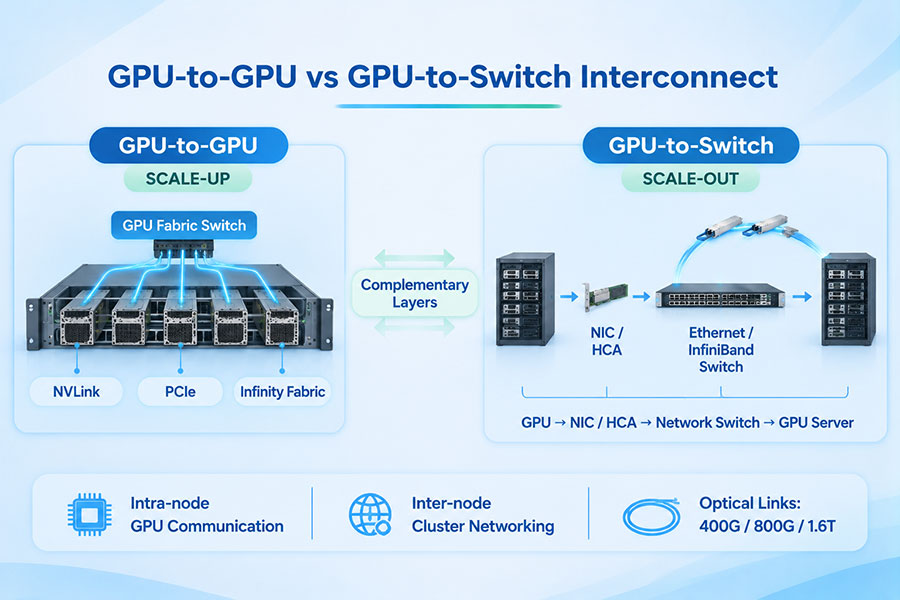
AI Fabric is a high-performance network architecture designed specifically for AI and machine learning workloads. It connects GPUs, CPUs, accelerators, and other compute resources so that large amounts of data can move between processing nodes with minimal communication overhead.
Modern AI training workloads generate massive amounts of east-west traffic. GPUs frequently exchange model parameters, gradients, activations, and other data during distributed training. As a result, the network can become a critical part of overall cluster performance.
AI Fabric typically emphasizes:
Very high network bandwidth
Extremely low latency
High port density
Efficient east-west traffic handling
Lossless or near-lossless network behavior
Scalable GPU-to-GPU connectivity
Advanced congestion management
800G and emerging 1.6T optical connectivity are becoming increasingly important as AI clusters scale to thousands or tens of thousands of accelerators.
2. What Is Storage Fabric?
Storage Fabric is a network architecture that connects servers to storage resources. Instead of focusing primarily on GPU-to-GPU communication, Storage Fabric provides high-throughput and reliable access to shared or distributed storage.
Storage Fabric can be implemented using technologies such as Fibre Channel, Ethernet-based storage, NVMe over Fabrics (NVMe-oF), and other storage networking protocols.
Typical Storage Fabric requirements include:
High storage throughput
Low and predictable latency
Reliable data delivery
High availability
Storage traffic isolation
Scalable server-to-storage connectivity
Modern Ethernet-based Storage Fabric architectures are increasingly adopting high-speed 100G, 200G, 400G, and higher-speed interfaces as storage performance continues to increase.
3. AI Fabric vs Storage Fabric: Key Differences
| Feature | AI Fabric | Storage Fabric |
|---|---|---|
| Primary purpose | Connect GPUs, CPUs, and accelerators | Connect servers with storage systems |
| Typical traffic | GPU-to-GPU and server-to-server | Server-to-storage and storage-to-storage |
| Traffic pattern | Highly intensive east-west traffic | Storage access and data transfer |
| Primary requirement | Bandwidth and ultra-low latency | Throughput, latency, and reliability |
| Common speeds | 200G, 400G, 800G, 1.6T | 25G, 100G, 200G, 400G and higher |
| Common technologies | Ethernet, InfiniBand, RoCE | Ethernet, Fibre Channel, NVMe-oF |
| Typical endpoints | GPU, CPU, accelerator | Server, storage array, storage appliance |
| Network priority | Maximum cluster performance | Reliable and efficient storage access |
4. AI Fabric vs Storage Fabric: Network Architecture
4.1 AI Fabric Architecture
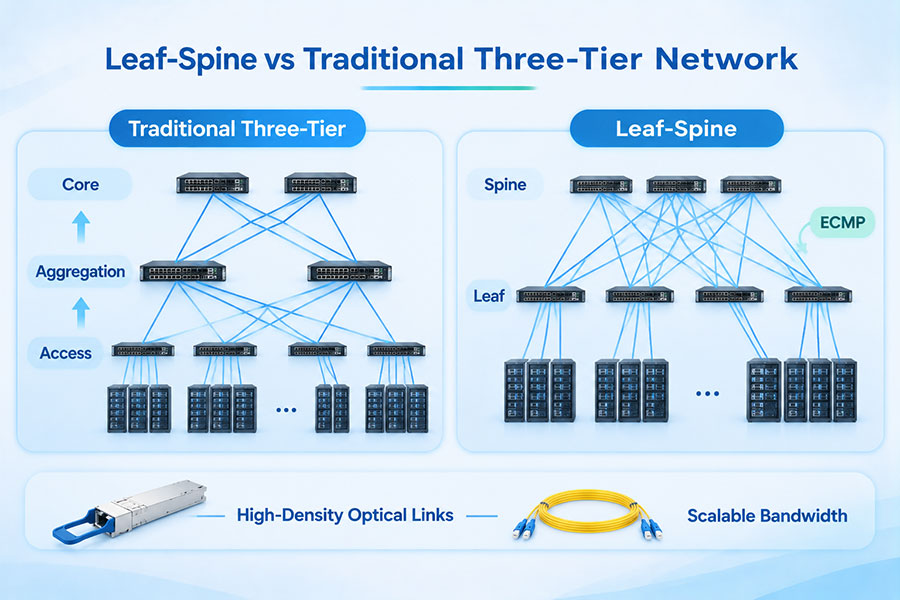
AI Fabric is typically built around a high-performance leaf-spine or similar scalable topology. GPU servers are connected to high-speed switches, allowing large numbers of accelerators to communicate across the cluster.
In large AI data centers, the network may contain multiple layers of switches. The architecture must provide sufficient bandwidth between GPU nodes while minimizing oversubscription and congestion.
Optical transceivers play an important role in these networks because high-speed connections between switches can quickly exceed the practical reach and bandwidth capabilities of copper cabling.
4.2 Storage Fabric Architecture
Storage Fabric can also use leaf-spine Ethernet architectures, but its topology is usually optimized around server-to-storage communication.
For example, an Ethernet-based NVMe-oF environment may connect compute servers to storage clusters through high-speed switches. The network must provide consistent performance while maintaining reliable access to storage resources.
In Fibre Channel environments, dedicated Fibre Channel switches are commonly used to create a separate storage network. This provides traffic isolation and predictable behavior for storage workloads.
5. AI Fabric vs Storage Fabric: Bandwidth Requirements
Bandwidth is one of the most significant differences between modern AI Fabric and traditional Storage Fabric deployments.
AI workloads can generate enormous amounts of traffic because many GPUs may need to communicate simultaneously. A single GPU server can contain multiple high-speed network interfaces, creating substantial aggregate bandwidth requirements.
For example, 400G and 800G optical interfaces are increasingly relevant for AI clusters. Future AI architectures are also moving toward 1.6T connectivity to accommodate higher accelerator bandwidth.
Storage Fabric bandwidth requirements are also increasing. High-performance NVMe storage systems can deliver hundreds of gigabytes per second of aggregate throughput, making 100G, 200G, and 400G Ethernet increasingly relevant for storage networks.
6. AI Fabric vs Storage Fabric: Latency
Latency is critical in both architectures, but AI Fabric can place particularly demanding requirements on network response time.
Distributed AI training requires frequent communication between accelerators. If network latency or congestion causes GPUs to wait for data, overall cluster utilization can decrease.
Storage Fabric also requires low latency, particularly for NVMe-based storage systems. However, the performance impact depends on the storage protocol, application, storage architecture, and workload.
7. Optical Transceivers in AI Fabric
High-speed optical transceivers are an important component of modern AI Fabric networks. As switch port speeds increase, optical connectivity provides the bandwidth and reach required for connections between GPU servers, leaf switches, and spine switches.
Common optical solutions include:
200G QSFP56 optical transceivers
400G QSFP-DD optical transceivers
800G QSFP-DD optical transceivers
800G OSFP optical transceivers
Emerging 1.6T optical transceiver solutions
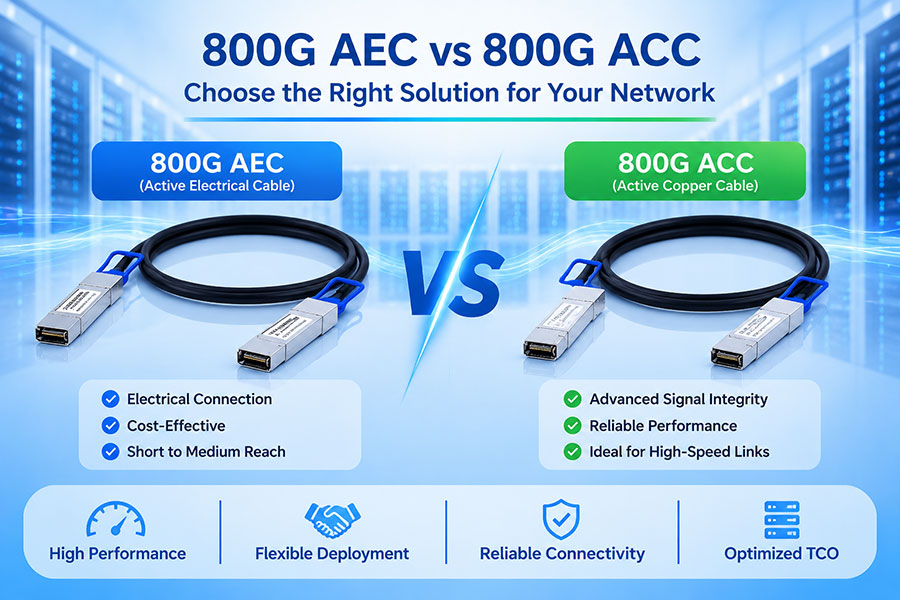
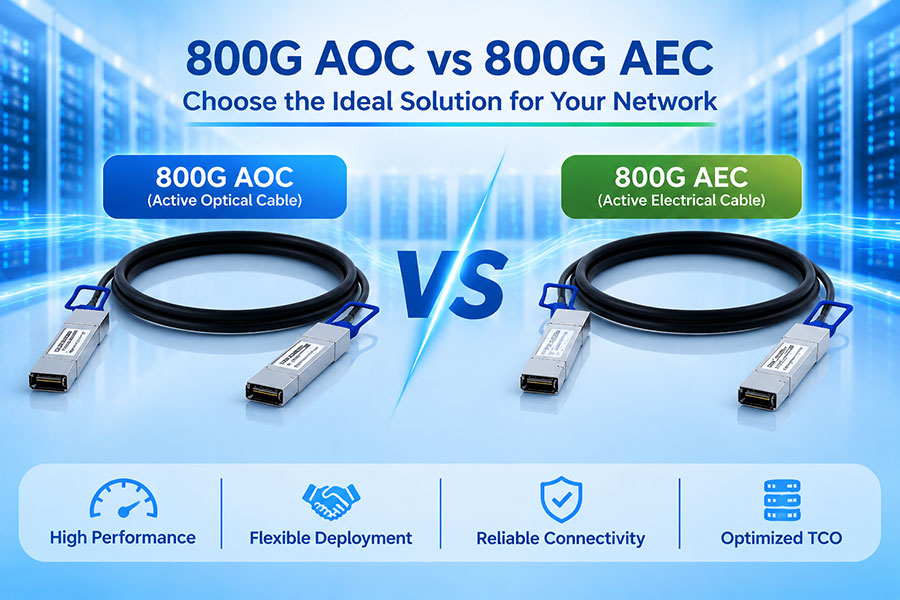
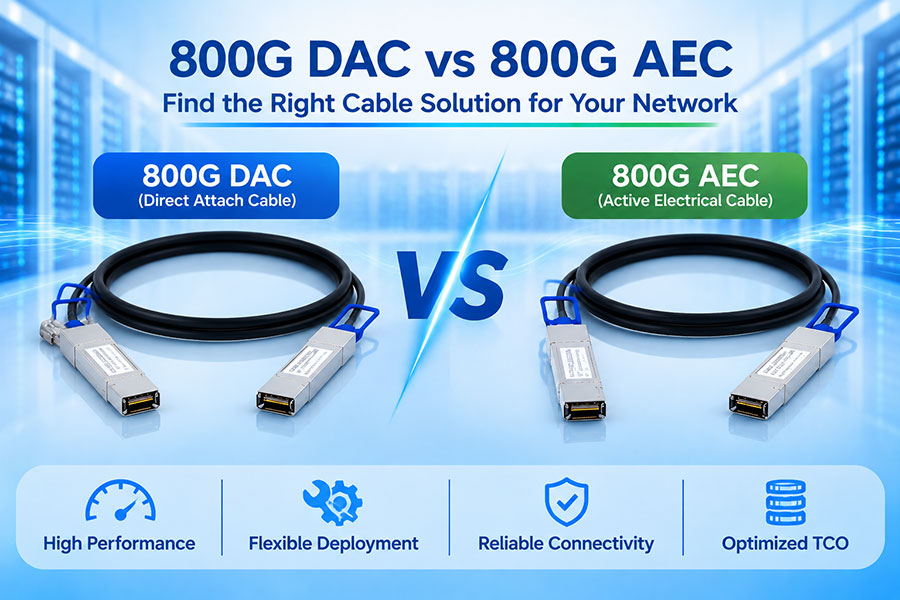
For short connections inside a rack or between adjacent racks, DAC and AOC solutions can also provide a practical alternative to pluggable optical transceivers.
8. Optical Connectivity in Storage Fabric
Storage Fabric also uses optical transceivers when the distance, bandwidth, or network architecture requires optical connectivity.
100G and 200G optical modules are commonly suitable for high-speed storage networking, while 400G connectivity can be used in larger storage clusters and high-performance data center environments.
The appropriate optical module depends on the switch interface, transmission distance, fiber type, connector, and network protocol.
9. AI Fabric vs Storage Fabric: DAC, AOC, and Optical Transceivers
| Connectivity | AI Fabric | Storage Fabric |
|---|---|---|
| DAC | Common for short GPU and switch connections | Suitable for short server and switch connections |
| AOC | Used for short-to-medium high-speed connections | Used where optical reach is needed within the data center |
| 400G optics | Important for modern AI clusters | Used in high-performance storage networks |
| 800G optics | Increasingly important for AI infrastructure | Relevant to future high-bandwidth storage architectures |
| 1.6T optics | Emerging for next-generation AI networks | Potential future application |
10. AI Fabric vs Storage Fabric: Protocols
10.1 AI Fabric Protocols
AI Fabric can use Ethernet with technologies such as RoCE, as well as InfiniBand in some high-performance AI environments.
RoCE enables RDMA over Ethernet and is designed to provide efficient, low-latency data movement between computing nodes. Network design, congestion management, and traffic control are particularly important in large RoCE-based AI clusters.
10.2 Storage Fabric Protocols
Storage Fabric can use Fibre Channel or Ethernet-based storage protocols. NVMe over Fabrics is increasingly important because it allows NVMe storage to be accessed across a network while maintaining the performance characteristics required by modern storage systems.
NVMe-oF can operate over different transport technologies, including Ethernet-based RoCE and TCP environments.
11. Why AI Fabric Is Becoming More Demanding
The rapid development of AI accelerators is increasing the bandwidth requirements of data center networks.
Modern GPU clusters may contain thousands of accelerators that need to exchange data continuously. As accelerator performance increases, the network must scale accordingly.
This creates a strong demand for:
800G optical transceivers
1.6T optical connectivity
High-density switch ports
Low-loss optical components
High-speed DAC and AOC cables
Advanced congestion management
For this reason, optical interconnects are becoming an increasingly important part of AI infrastructure.
12. Can AI Fabric and Storage Fabric Share the Same Network?
Yes, AI and storage traffic can operate over the same physical Ethernet infrastructure, but the network must be carefully designed.
Traffic isolation, quality of service, congestion management, bandwidth allocation, and loss-handling mechanisms become particularly important when different workloads share the same fabric.
In some environments, separate fabrics are preferred because they provide better traffic isolation and simplify performance management.
13. AI Fabric vs Storage Fabric: Which One Should You Choose?
The appropriate architecture depends on the workload.
AI Fabric: Choose when the primary requirement is high-performance GPU-to-GPU or accelerator-to-accelerator communication.
Storage Fabric: Choose when the primary requirement is high-performance and reliable server-to-storage connectivity.
Converged Ethernet Fabric: Consider when compute, AI, and storage traffic need to share a common Ethernet infrastructure.
Dedicated fabrics: Consider separate networks when traffic isolation, predictable latency, or operational simplicity is a priority.
14. AI Fabric vs Storage Fabric: Frequently Asked Questions
Q1: What is the main difference between AI Fabric and Storage Fabric?
Q2: Is AI Fabric faster than Storage Fabric?
Q3: Does AI Fabric require 800G optical transceivers?
Q4: What protocols are used in AI Fabric?
Q5: What protocols are used in Storage Fabric?
Q6: Can Ethernet be used for both AI Fabric and Storage Fabric?
Q7: Are optical transceivers important for AI Fabric?
Q8: Can DAC cables be used in AI Fabric?
Q9: Is NVMe-oF an AI Fabric technology?
Q10: Will AI Fabric require higher speeds in the future?
15. Conclusion
AI Fabric and Storage Fabric serve different but increasingly interconnected roles in modern data centers. AI Fabric is optimized for massive east-west traffic between GPUs and other compute resources, while Storage Fabric focuses on efficient and reliable access to high-performance storage.
As AI workloads continue to grow, the boundary between compute networking and storage networking is becoming increasingly important. High-speed Ethernet, RoCE, NVMe-oF, 400G and 800G optical transceivers, DACs, and AOCs are all contributing to the evolution of next-generation data center fabrics.
For data center operators and network designers, selecting the right fabric architecture and optical connectivity is essential for achieving the required bandwidth, latency, scalability, and reliability.
SEO Title: AI Fabric vs Storage Fabric: What Is the Difference?
Keywords: AI Fabric vs Storage Fabric, AI Fabric, Storage Fabric, AI networking, storage networking, GPU network, NVMe-oF, RoCE, 800G optical transceiver, data center fabric
Meta Description: Understand the differences between AI Fabric and Storage Fabric, including network architecture, bandwidth, latency, protocols, optical connectivity, and data center applications.
 >

 >
 >
 >
 >
 >
 >
 >