TEL:+86 132 6656 7067





Ethernet has been the foundation of enterprise and data center networking for decades. However, the rapid growth of artificial intelligence (AI), large language models (LLMs), and distributed GPU computing is changing the requirements of modern networks. Traditional Ethernet is designed to support a broad range of applications, while AI Ethernet is optimized for the demanding communication patterns of AI training and inference workloads.
Although both use Ethernet technology, AI Ethernet introduces additional network optimizations to improve bandwidth utilization, reduce latency, manage congestion, and support efficient communication between large numbers of GPUs and computing nodes. These requirements are also driving demand for 400G, 800G, and next-generation 1.6T optical connectivity.
1. What Is AI Ethernet?
AI Ethernet is an Ethernet-based networking approach designed to support artificial intelligence workloads, particularly distributed AI training and large-scale GPU clusters. It uses Ethernet infrastructure together with specialized switching, network adapters, transport protocols, and congestion-management technologies.
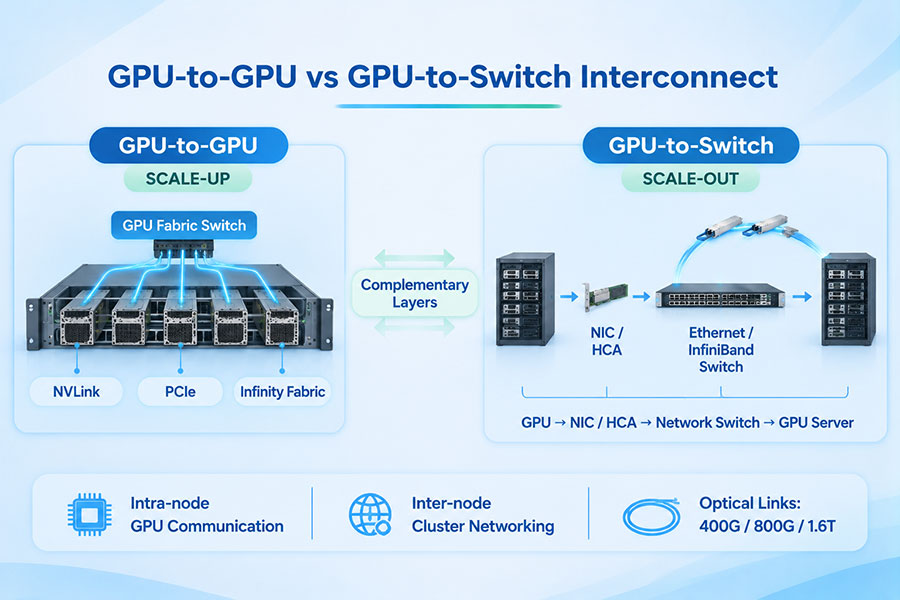
Unlike general-purpose networking, AI Ethernet must handle intensive east-west traffic generated by GPUs communicating with one another. Operations such as AllReduce, AllGather, and parameter synchronization require large volumes of data to move between computing nodes efficiently.
Common characteristics of AI Ethernet include:
High-bandwidth 400G and 800G Ethernet connectivity
Low and predictable network latency
RDMA support through technologies such as RoCE
Advanced congestion management
ECN-based congestion notification
Adaptive routing and load balancing
High-density switching for GPU clusters
High-speed optical interconnects between switches and servers
AI Ethernet is not a completely new Ethernet standard. It is an optimized networking architecture built on Ethernet technologies to address the performance requirements of AI infrastructure.
2. What Is Traditional Ethernet?
Traditional Ethernet refers to general-purpose Ethernet networking commonly deployed in enterprise networks, campus environments, cloud infrastructure, and conventional data centers.
It connects servers, workstations, storage systems, switches, routers, and other network devices using standardized Ethernet technologies. Its flexibility and interoperability make it suitable for a wide range of applications.
Traditional Ethernet networks commonly support:
Enterprise applications and business systems
Virtualization and cloud computing
Database and application servers
File sharing and storage access
Internet and client-server communication
Voice, video, and collaboration services
General-purpose data center networking
Traditional Ethernet can operate at speeds ranging from 1G and 10G to 25G, 100G, 400G, and beyond. Its main objective is to provide reliable, scalable, and interoperable connectivity across different network environments.
3. AI Ethernet vs Traditional Ethernet: Key Differences
| Feature | AI Ethernet | Traditional Ethernet |
|---|---|---|
| Primary purpose | AI training, inference, and GPU communication | General-purpose networking |
| Typical traffic | GPU-to-GPU and server-to-server | Client-server, application, and storage traffic |
| Traffic pattern | Intensive and synchronized east-west traffic | Mixed north-south and east-west traffic |
| Bandwidth priority | Very high aggregate bandwidth | Application-dependent bandwidth |
| Latency requirements | Low and predictable latency | Varies by application |
| RDMA | Common in RoCE-based deployments | Not generally required for ordinary applications |
| Congestion management | Advanced and workload-aware optimization | Conventional Ethernet congestion and QoS mechanisms |
| Switch architecture | High-performance leaf-spine or multi-tier fabric | Access, aggregation, core, or leaf-spine |
| Common interfaces | 200G, 400G, 800G, emerging 1.6T | 1G, 10G, 25G, 100G, 400G and higher |
| Typical endpoints | GPUs, AI servers, accelerators | Servers, clients, storage, and network devices |
4. AI Ethernet vs Traditional Ethernet: Traffic Patterns
4.1 AI Ethernet Traffic
AI Ethernet handles large volumes of east-west traffic between GPU servers and computing nodes. During distributed model training, GPUs exchange gradients, model parameters, and intermediate data through collective communication operations.
These communication patterns can generate synchronized bursts of network traffic. When many GPU servers transmit simultaneously, congestion can develop at shared switch links and network bottlenecks.
Consequently, AI Ethernet designs must consider not only the bandwidth of individual connections but also the aggregate bandwidth and traffic distribution across the entire network fabric.
4.2 Traditional Ethernet Traffic
Traditional Ethernet handles a broader mixture of network traffic. For example, an enterprise data center may simultaneously support database queries, application requests, virtual machine communication, file transfers, backups, and user access.
These workloads have different bandwidth and latency requirements. Network administrators typically use VLANs, QoS, routing, and traffic prioritization to maintain application performance and network availability.
5. AI Ethernet vs Traditional Ethernet: Bandwidth Requirements
Bandwidth is one of the most important considerations when designing AI Ethernet networks.
A modern AI server may contain multiple GPUs and high-speed network interfaces. When hundreds or thousands of servers operate together, the total bandwidth requirement can reach hundreds of terabits per second across the network fabric.
400G and 800G Ethernet interfaces are increasingly relevant to large AI clusters, while 1.6T connectivity is emerging for next-generation infrastructure.
Traditional Ethernet also supports high-speed interfaces, but deployments typically select bandwidth according to individual application requirements rather than optimizing the entire network for synchronized GPU communication.
The following table illustrates common interface speeds used across different networking environments.
| Ethernet Speed | Typical Application | AI Networking Relevance |
|---|---|---|
| 10G | Enterprise access and server connectivity | Limited AI deployment scenarios |
| 25G | Server connectivity and data center access | Smaller AI server deployments |
| 100G | Data center switching and uplinks | AI infrastructure and supporting networks |
| 200G | High-performance data center networks | GPU and AI cluster connectivity |
| 400G | High-density data center switching | Modern AI fabric deployments |
| 800G | Next-generation high-capacity networks | Large-scale GPU clusters |
| 1.6T | Emerging next-generation Ethernet | Future AI infrastructure |
6. AI Ethernet vs Traditional Ethernet: Latency
Latency is important in both networking environments, but its impact on distributed AI workloads can be particularly significant.
During distributed training, GPUs frequently exchange data with other GPUs. If communication is delayed, some processors may need to wait for data before continuing their operations. This can reduce GPU utilization and increase overall training time.
AI Ethernet therefore focuses on reducing network latency and, equally importantly, minimizing latency variation under heavy traffic conditions.
Traditional Ethernet also supports low-latency applications such as financial systems, databases, and real-time communication. However, ordinary enterprise deployments do not necessarily require the same coordinated communication performance as large GPU clusters.
7. RDMA and RoCE in AI Ethernet
Remote Direct Memory Access (RDMA) allows data to move between the memory of different computing systems with reduced CPU involvement. This can improve communication efficiency in high-performance computing and AI environments.
RoCE (RDMA over Converged Ethernet) enables RDMA communication over Ethernet networks. It is an important technology in many Ethernet-based AI deployments.
RoCE can help reduce communication overhead, but achieving reliable performance requires careful configuration of the network, including congestion management, traffic engineering, and compatible network adapters.
Traditional Ethernet applications generally rely on conventional TCP/IP communication and do not require RDMA. However, RDMA is not exclusive to AI Ethernet and can also be used in other high-performance networking environments.
8. Congestion Management: AI Ethernet vs Traditional Ethernet
Congestion management is a major design consideration in AI Ethernet because large GPU clusters can generate synchronized traffic bursts across many network paths.
Common technologies and mechanisms include:
ECN (Explicit Congestion Notification): Allows network devices to mark packets to signal congestion without relying exclusively on packet loss.
PFC (Priority Flow Control): Provides priority-based pause mechanisms in Ethernet networks. It may be used in RoCE deployments but requires careful configuration to avoid undesirable congestion propagation.
Adaptive Routing: Helps distribute traffic across available network paths according to network conditions.
Load Balancing: Distributes traffic to improve network utilization and reduce bottlenecks.
Network Telemetry: Provides visibility into congestion, link utilization, and network performance.
Traditional Ethernet also supports congestion control, QoS, ECN, and traffic prioritization. The difference is that AI Ethernet typically requires more coordinated tuning around GPU communication patterns and high-volume traffic bursts.
9. AI Ethernet vs Traditional Ethernet: Network Architecture
9.1 AI Ethernet Architecture
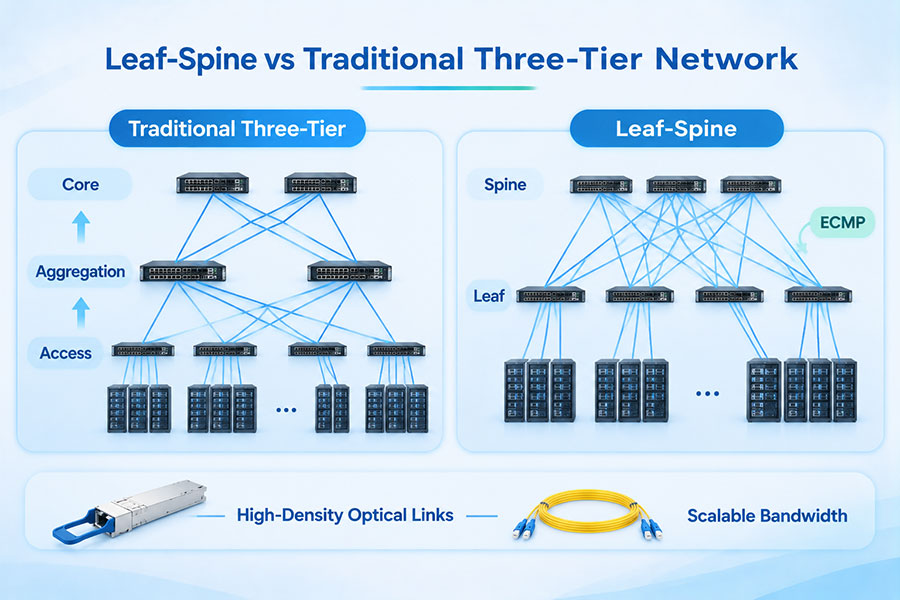
AI Ethernet networks commonly use high-performance leaf-spine or multi-tier architectures. GPU servers connect to leaf switches, which communicate through high-capacity spine switches.
The architecture is designed to provide sufficient bandwidth between GPU nodes while minimizing oversubscription and uneven traffic distribution.
Large AI clusters may also use dedicated network planes for different communication functions. The exact design depends on the number of GPUs, network interface speeds, switch capacity, and workload characteristics.
9.2 Traditional Ethernet Architecture
Traditional Ethernet networks may use a three-tier architecture consisting of access, aggregation, and core layers. Modern data centers also commonly use leaf-spine designs.
Unlike AI-specific deployments, traditional enterprise networks must accommodate a wide range of devices and applications. Network segmentation, security, availability, and operational management are therefore important design priorities.
10. Optical Transceivers in AI Ethernet
High-speed optical transceivers are essential components of many AI Ethernet deployments. As GPU clusters expand, optical connectivity provides the bandwidth and transmission distance required for connections between servers, leaf switches, and spine switches.
Common optical connectivity options include:
200G QSFP56 optical transceivers
400G QSFP-DD optical transceivers
400G QSFP112 optical transceivers
800G QSFP-DD optical transceivers
800G OSFP optical transceivers
Emerging 1.6T OSFP optical transceivers
For high-bandwidth AI data center connections, C-LIGHT 800G QSFP-DD optical transceivers provide options for compatible 800G Ethernet and AI networking equipment. The product family includes different optical configurations for short-reach and longer-reach applications.
For 400G infrastructure, C-LIGHT 400G QSFP-DD optical transceivers support different transmission distances and network applications, including AI data centers and high-speed Ethernet networks.
11. DAC and AOC Connectivity in AI Ethernet
Not every AI network connection requires a separate optical transceiver and fiber patch cable. DAC and AOC cables are also widely considered for short-distance high-speed interconnections.
11.1 DAC Cables
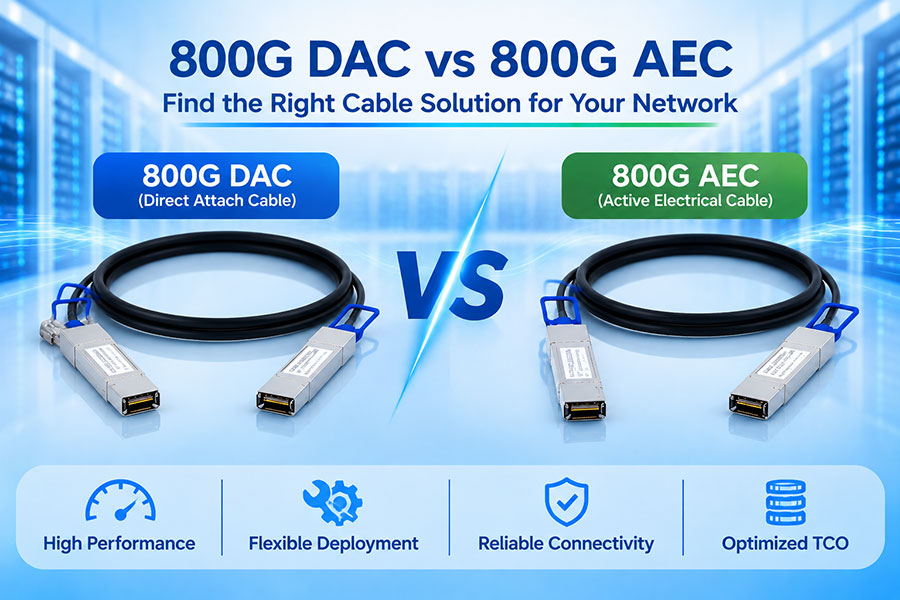
Direct Attach Copper (DAC) cables use copper conductors with integrated transceiver interfaces. They are suitable for short connections between compatible servers and switches, offering a relatively simple and cost-effective cabling option.
DAC is particularly useful for connections within a rack where cable distance is limited and power consumption is an important consideration.
11.2 AOC Cables
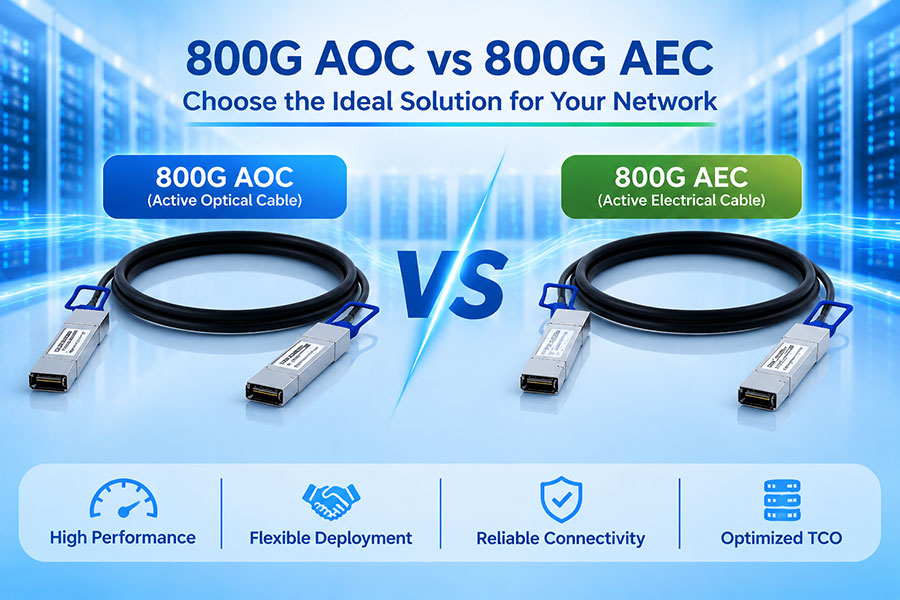
Active Optical Cables (AOCs) integrate optical transmission components into a cable assembly. They provide optical connectivity without requiring separate pluggable transceivers at both ends.
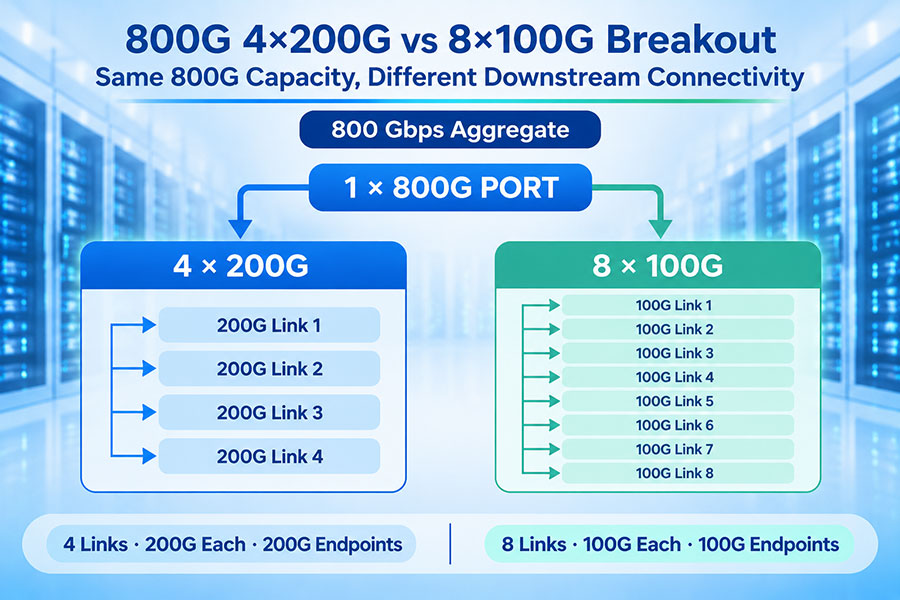
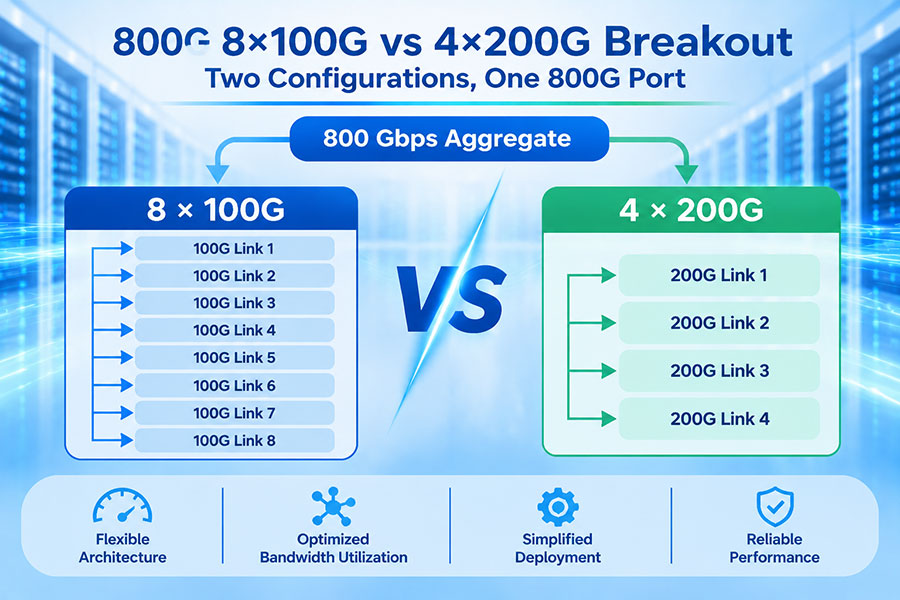
For high-density AI environments, C-LIGHT 800G AOC cables support short-reach connections using QSFP-DD and OSFP interfaces. The product family includes standard cable lengths from 1m to 30m and breakout configurations for different network architectures.
12. Can Traditional Ethernet Support AI Workloads?
Yes. Ethernet can support AI workloads, and many AI networking solutions are built directly on Ethernet standards and infrastructure.
However, a conventional enterprise Ethernet network may not provide the performance required by a large distributed GPU cluster without additional optimization.
Depending on the workload, an AI-ready Ethernet network may require:
Higher-capacity switches and network interfaces
RDMA-capable NICs or SuperNICs
RoCE support where required
Carefully configured congestion management
Appropriate routing and load-balancing mechanisms
Optimized leaf-spine topology
High-speed optical interconnects
For smaller AI environments, existing Ethernet infrastructure may be sufficient. For large-scale distributed training, a purpose-designed AI Ethernet fabric is often more appropriate.
13. AI Ethernet vs Traditional Ethernet: Application Scenarios
| Application | AI Ethernet | Traditional Ethernet |
|---|---|---|
| Large-scale AI training | Highly suitable | Requires AI-specific optimization |
| GPU cluster communication | Primary application | Not the primary design target |
| AI inference | Suitable for distributed inference | Suitable for many inference deployments |
| Virtualization | Not the primary target | Common |
| Enterprise applications | Not the primary target | Common |
| Database networking | Possible | Common |
| Cloud infrastructure | AI-specific cloud infrastructure | General cloud networking |
| Storage connectivity | AI storage integration | Common |
| Campus networking | Not the primary target | Common |
14. AI Ethernet vs Traditional Ethernet: Which One Should You Choose?
The choice depends on the scale of the deployment, workload characteristics, and performance requirements.
Choose AI Ethernet for large GPU clusters, distributed model training, and AI workloads that require high bandwidth and carefully managed latency.
Choose Traditional Ethernet for general enterprise applications, virtualization, databases, office networks, and conventional data center connectivity.
Consider Ethernet-based AI Fabric when building an AI network that needs Ethernet interoperability together with RDMA and AI-specific congestion management.
Consider high-speed optical connectivity when network links require 400G, 800G, or higher bandwidth over distances that are unsuitable for direct copper connections.
15. C-LIGHT Optical Connectivity for AI Ethernet Networks
The development of AI Ethernet is increasing demand for high-speed optical transceivers and interconnect solutions. Network operators need to select optical interfaces according to switch compatibility, transmission distance, fiber type, connector, and bandwidth requirements.
C-LIGHT provides optical connectivity solutions for data centers, high-speed Ethernet networks, and AI infrastructure.
400G QSFP-DD Optical Transceivers for high-speed data center and Ethernet connectivity.
800G QSFP-DD Optical Transceivers for next-generation AI clusters and high-bandwidth network infrastructure.
800G AOC Cables for short-reach optical connections between compatible switches and computing equipment.
C-LIGHT Optical Transceiver Products for additional data rates, form factors, and transmission distances.
Selecting the right optical connectivity solution helps ensure that the physical network infrastructure can support the required bandwidth, reach, and scalability of AI Ethernet deployments.
16. Frequently Asked Questions
Q1: What is the main difference between AI Ethernet and Traditional Ethernet?
Q2: Is AI Ethernet a different Ethernet standard?
Q3: Does AI Ethernet require RDMA?
Q4: Why is congestion management important in AI Ethernet?
Q5: Can Traditional Ethernet support GPU clusters?
Q6: What Ethernet speeds are commonly used in AI networks?
Q7: Are optical transceivers necessary for AI Ethernet?
Q8: Can DAC cables be used in AI Ethernet?
Q9: What is the difference between RoCE and traditional Ethernet communication?
Q10: Will AI Ethernet replace Traditional Ethernet?
17. Conclusion
AI Ethernet and Traditional Ethernet share the same Ethernet foundation, but their network design priorities are different. Traditional Ethernet focuses on flexible, reliable connectivity for diverse enterprise workloads, while AI Ethernet is optimized for the intensive communication patterns of distributed AI systems.
As GPU clusters continue to expand, bandwidth, latency, congestion management, RDMA, and network scalability are becoming increasingly important. High-speed 400G and 800G optical transceivers, DAC cables, and AOCs provide essential connectivity options for building modern AI Ethernet infrastructure.
For data center operators and network designers, the key is to match the Ethernet architecture and optical interconnect technology to the actual workload, ensuring sufficient bandwidth and predictable network performance as AI infrastructure scales.
 >

 >
 >
 >
 >
 >
 >
 >