TEL:+86 132 6656 7067





As AI models become larger and GPU clusters expand, network performance has become a critical factor in data center design. Two major technologies used for high-performance AI networking are AI Ethernet and InfiniBand. Both support high-bandwidth communication between computing nodes, but they differ in network architecture, protocols, congestion management, ecosystem, and deployment flexibility.
AI Ethernet uses Ethernet as its foundation and commonly incorporates technologies such as RDMA over Converged Ethernet (RoCE) to support distributed AI workloads. InfiniBand is a dedicated high-performance interconnect technology designed for low-latency communication, high throughput, and efficient data movement in computing clusters.
Choosing between them requires more than comparing link speeds. Network operators must consider GPU communication patterns, end-to-end latency, congestion behavior, scalability, equipment compatibility, and the overall cost of deployment.
1. What Is AI Ethernet?
AI Ethernet is an Ethernet-based networking architecture optimized for artificial intelligence workloads, especially distributed model training and large-scale GPU communication.
Traditional Ethernet provides the underlying connectivity, while AI-oriented implementations add technologies and configurations to improve performance under intensive east-west traffic. These may include RoCE, RDMA-capable network adapters, advanced congestion control, adaptive routing, and high-performance switching platforms.
Key characteristics of AI Ethernet include:
Standard Ethernet-based connectivity and switching.
RDMA support through RoCE in many deployments.
High-bandwidth 200G, 400G, and 800G interfaces.
Congestion management for synchronized GPU traffic.
Adaptive routing and load-balancing capabilities.
Integration with Ethernet-based data center infrastructure.
Support for large-scale AI training and inference networks.
AI Ethernet is not a separate Ethernet standard. It describes an optimized Ethernet networking approach designed to meet the communication requirements of AI infrastructure.
2. What Is InfiniBand?
InfiniBand is a high-performance networking technology developed for applications that require fast, efficient communication between computing systems. It is widely used in high-performance computing (HPC), scientific research, supercomputing, and large-scale AI clusters.
Unlike Ethernet, InfiniBand uses its own networking architecture, protocol stack, switches, host channel adapters (HCAs), and management mechanisms.
Its key characteristics include:
Native RDMA support.
Low-latency communication between computing nodes.
High-throughput data transmission.
Hardware-assisted transport and data movement.
Advanced congestion management.
Adaptive routing and network management capabilities.
Support for large-scale HPC and AI clusters.
InfiniBand is designed to provide efficient communication between processors, GPUs, memory, and storage systems. Its specialized architecture makes it particularly suitable for workloads where communication overhead can directly affect computing performance.
3. AI Ethernet vs InfiniBand: Key Differences
| Feature | AI Ethernet | InfiniBand |
|---|---|---|
| Network foundation | Ethernet | InfiniBand architecture |
| Primary applications | AI data centers and cloud infrastructure | AI clusters, HPC, and supercomputing |
| RDMA support | Commonly through RoCE | Native RDMA support |
| Protocol ecosystem | Ethernet and IP-based ecosystem | Dedicated InfiniBand protocol stack |
| Latency characteristics | Low latency with appropriate optimization | Designed for low-latency communication |
| Congestion management | ECN, PFC, adaptive routing, and other mechanisms depending on implementation | InfiniBand-specific congestion management and routing mechanisms |
| Switching equipment | Ethernet switches | InfiniBand switches |
| Network adapters | Ethernet NICs and SuperNICs | InfiniBand HCAs |
| Interoperability | Broad Ethernet equipment ecosystem | Specialized InfiniBand ecosystem |
| Deployment flexibility | Can integrate with existing Ethernet infrastructure | Requires InfiniBand-compatible infrastructure |
| Typical applications | AI training, inference, cloud, and enterprise networking | Distributed AI training, HPC, and scientific computing |
The main distinction is the networking architecture and ecosystem rather than simply the transmission speed. Both technologies can deliver high bandwidth and support RDMA-based communication, but they achieve this through different protocols and infrastructure.
4. AI Ethernet vs InfiniBand: Network Architecture
4.1 AI Ethernet Architecture
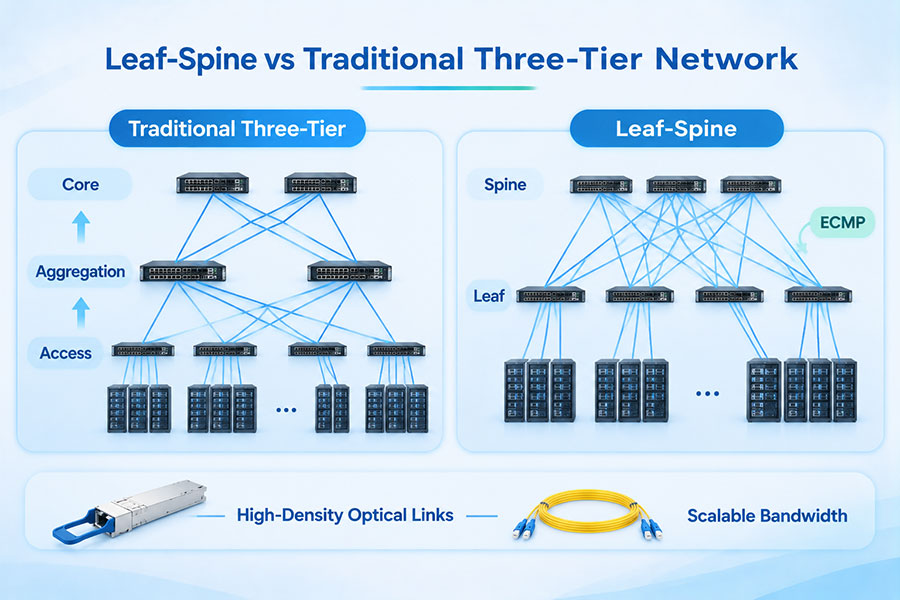
AI Ethernet commonly uses a leaf-spine architecture to connect GPU servers, storage systems, and high-performance switches.
GPU servers connect to leaf switches, while spine switches provide high-capacity connections between network segments. This topology helps distribute traffic across multiple paths and supports horizontal expansion as additional GPU nodes are added.
Depending on the implementation, AI Ethernet may incorporate:
Ethernet switches with high-capacity switching ASICs.
RoCE-capable network adapters.
ECN-based congestion notification.
Priority Flow Control where appropriate.
Adaptive routing and load balancing.
Network telemetry and performance monitoring.
The architecture can also coexist with conventional Ethernet networks, although large AI clusters often benefit from dedicated network resources and carefully designed traffic policies.
4.2 InfiniBand Architecture
InfiniBand uses a dedicated fabric architecture consisting of HCAs, InfiniBand switches, links, and subnet management components.
Computing nodes connect to the fabric through InfiniBand HCAs. Switches forward traffic across the fabric, while subnet management handles network configuration, routing, and topology-related operations.
InfiniBand fabrics are commonly designed around high-performance switching and multiple network paths. Large clusters may use multi-tier topologies to connect thousands of computing nodes.
Its specialized architecture is intended to deliver efficient communication between GPUs and other computing resources without relying on the conventional Ethernet and TCP/IP networking path.
5. RDMA vs RoCE: How Do They Differ?
RDMA is an important technology in both AI Ethernet and InfiniBand environments. It allows data to move between the memory of different systems with reduced CPU involvement.
However, RDMA and RoCE are not competing technologies. RDMA describes a method of direct memory access across networked systems, while RoCE is a technology that enables RDMA communication over Ethernet.
5.1 RDMA in InfiniBand
InfiniBand provides native RDMA capabilities as part of its networking architecture. Its HCAs handle many communication operations in hardware, reducing the processing burden on host CPUs.
This is particularly useful for distributed computing workloads where GPUs and other accelerators frequently exchange large volumes of data.
5.2 RoCE in AI Ethernet
RoCE enables RDMA communication over Ethernet networks. It allows applications to benefit from reduced CPU overhead while using Ethernet-based infrastructure.
RoCE deployments require compatible network adapters and switches, together with appropriate configuration of congestion management and traffic handling. RoCEv2 operates over UDP/IP, making it suitable for routed Ethernet environments.
In practical terms, RoCE allows Ethernet networks to support many of the high-performance communication requirements associated with AI and HPC workloads.
6. Latency and Network Performance
Latency is a major consideration when designing networks for distributed AI training. GPUs frequently exchange gradients, parameters, and intermediate results during collective communication operations. Delays in network communication can reduce overall GPU utilization.
InfiniBand was designed specifically for high-performance communication and provides a specialized architecture for low-latency data movement.
AI Ethernet can also deliver low latency, particularly when deployed with high-performance switching platforms, RDMA-capable adapters, and properly configured congestion management.
However, actual performance depends on several factors:
Switch architecture and forwarding latency.
Network adapter capabilities.
Link bandwidth and oversubscription.
Network topology and routing.
Congestion and traffic distribution.
Collective communication algorithms.
End-to-end system configuration.
There is no universal latency figure that applies to every AI Ethernet or InfiniBand deployment. Meaningful comparisons require testing under equivalent hardware, topology, traffic patterns, and workload conditions.
7. Congestion Management: AI Ethernet vs InfiniBand
Large GPU clusters generate intensive communication traffic. During operations such as AllReduce and AllGather, many GPUs may transmit data simultaneously, creating congestion at shared network links.
Both AI Ethernet and InfiniBand include mechanisms to manage network congestion, but their implementation differs.
7.1 AI Ethernet Congestion Management
AI Ethernet deployments may use several mechanisms to improve traffic handling:
ECN (Explicit Congestion Notification): Marks packets to indicate congestion and allows endpoints to adjust their transmission rates.
PFC (Priority Flow Control): Provides priority-based pause mechanisms. It may be used in RoCE environments, but requires careful configuration to avoid congestion propagation.
Adaptive Routing: Distributes traffic across available paths according to network conditions.
Load Balancing: Helps improve link utilization and reduce traffic concentration.
Telemetry: Provides visibility into congestion, utilization, and network behavior.
7.2 InfiniBand Congestion Management
InfiniBand provides dedicated congestion-management and routing mechanisms as part of its networking architecture.
Its fabric can use congestion feedback, traffic control, and adaptive routing features to maintain communication performance under demanding workloads.
Both technologies require careful network engineering. The quality of congestion management depends on the equipment, firmware, topology, configuration, and workload rather than the protocol name alone.
8. Bandwidth and Port Speed
Bandwidth is another important factor when comparing AI Ethernet and InfiniBand. Both technologies have evolved to support increasingly high data rates for modern AI infrastructure.
Common Ethernet interface generations include:
100G Ethernet
200G Ethernet
400G Ethernet
800G Ethernet
Emerging 1.6T Ethernet
InfiniBand has its own speed generations and naming conventions, including HDR, NDR, and XDR. These generations represent different link-rate capabilities and should not be confused with Ethernet speed labels.
| InfiniBand Generation | Nominal Port Rate | Common Context |
|---|---|---|
| HDR | 200 Gb/s | High-performance computing and GPU clusters |
| NDR | 400 Gb/s | Large-scale AI and HPC networks |
| XDR | 800 Gb/s | Next-generation high-performance fabrics |
These are nominal generation rates, not guaranteed application throughput. Actual usable bandwidth depends on encoding, protocol overhead, port configuration, and traffic conditions.
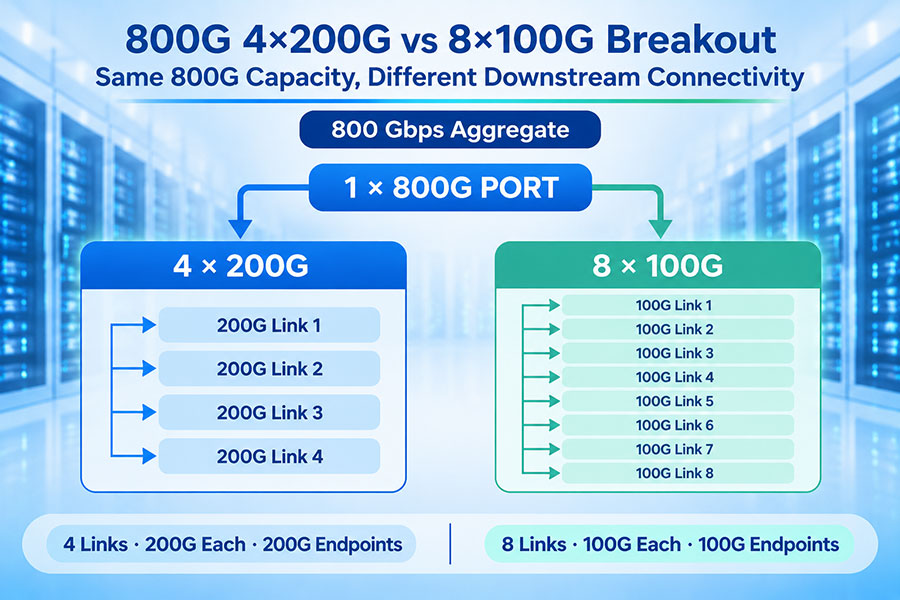
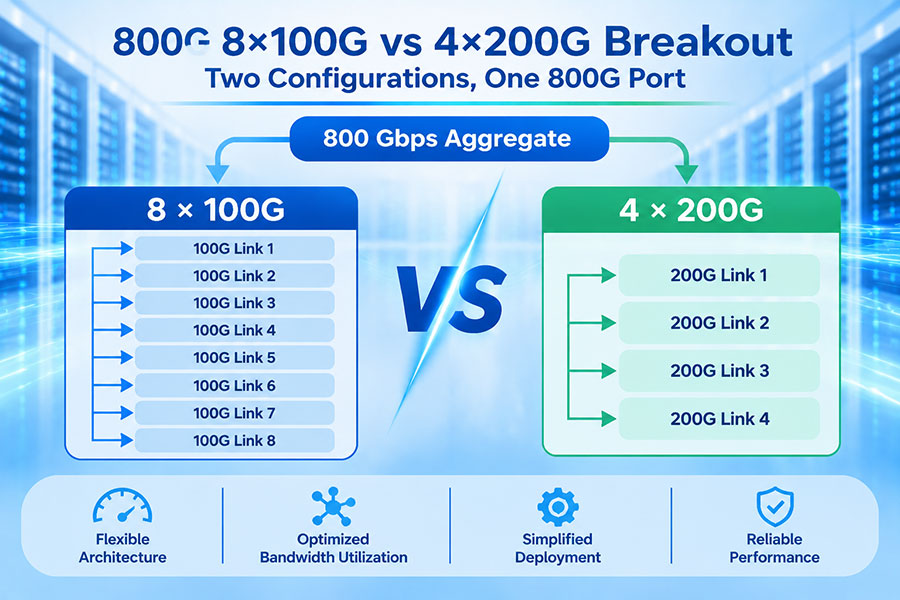
It is also important to distinguish a port's aggregate bandwidth from its individual lane speed. Breakout configurations and multi-lane interfaces can produce different port arrangements while retaining the same aggregate data rate.
9. AI Ethernet vs InfiniBand: Scalability
Scalability is essential when building AI infrastructure that may expand from a small GPU deployment to a large cluster containing thousands of accelerators.
9.1 Scaling AI Ethernet
Ethernet benefits from a broad ecosystem of switches, network adapters, optical transceivers, and cabling solutions. This provides flexibility when designing networks with different bandwidth requirements and deployment sizes.
Organizations with existing Ethernet infrastructure may also be able to reuse parts of their operational processes, network management systems, and cabling environment.
However, scaling an AI Ethernet fabric still requires careful planning of oversubscription, routing, congestion management, and end-to-end compatibility.
9.2 Scaling InfiniBand
InfiniBand is designed to support large high-performance computing fabrics. Its specialized switching, adapter, and management ecosystem can provide a consistent networking environment for large GPU clusters.
As the cluster grows, network designers must consider switch radix, fabric topology, link utilization, cable reach, and the number of required network ports.
InfiniBand can scale to large deployments, but it requires compatible InfiniBand infrastructure rather than relying on ordinary Ethernet switches and adapters.
10. Optical Transceivers and Cables for AI Ethernet
High-speed optical connectivity is important in AI Ethernet networks, particularly when connecting GPU servers, leaf switches, spine switches, and other equipment across longer distances.
Common Ethernet optical connectivity options include:
400G QSFP-DD optical transceivers.
400G QSFP112 optical transceivers.
800G QSFP-DD optical transceivers.
800G OSFP optical transceivers.
High-speed AOC and DAC cables.
For AI Ethernet deployments, C-LIGHT 800G QSFP-DD optical transceivers provide high-bandwidth connectivity options for AI data centers and Ethernet infrastructure. The product family includes different optical configurations for transmission distances such as 100m, 500m, and 2km, depending on the specific model.
For 400G networks, C-LIGHT 400G QSFP-DD optical transceivers cover a range of data center and network interconnect applications, with different transmission distances and optical configurations.
When selecting optical modules, network operators should verify the Ethernet standard, switch compatibility, supported transmission distance, fiber type, connector, and host interface requirements.
11. InfiniBand Optical Transceivers and AOC Cables
InfiniBand networks also rely on optical interconnects for high-speed connections between servers and switches, particularly in large clusters where copper cable reach is insufficient.
Depending on the generation and equipment platform, InfiniBand connectivity may use:
InfiniBand-compatible optical transceivers.
QSFP and OSFP form factors supported by the equipment.
Active Optical Cables (AOCs).
Direct Attach Copper (DAC) cables for short connections.
Multimode or single-mode fiber, depending on the optical interface.
One important consideration is that a shared physical form factor does not automatically mean Ethernet and InfiniBand modules are interchangeable. The module must support the relevant protocol, signaling rate, host interface, and equipment requirements.
C-LIGHT's 800G AOC product family includes configurations identified for 800G InfiniBand, including QSFP-DD and OSFP connections. The same product family also lists Ethernet configurations, so the exact part number and interface type should be selected according to the intended network.
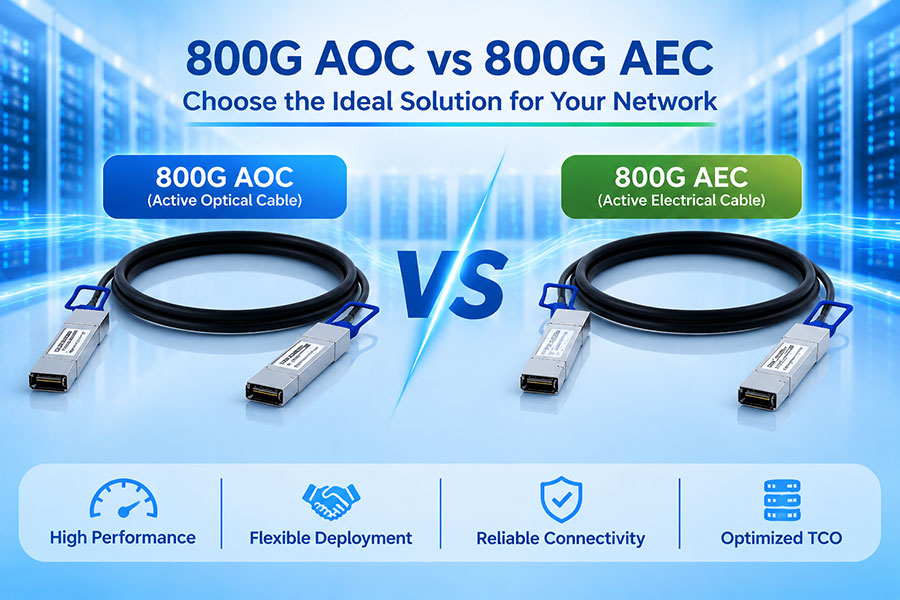
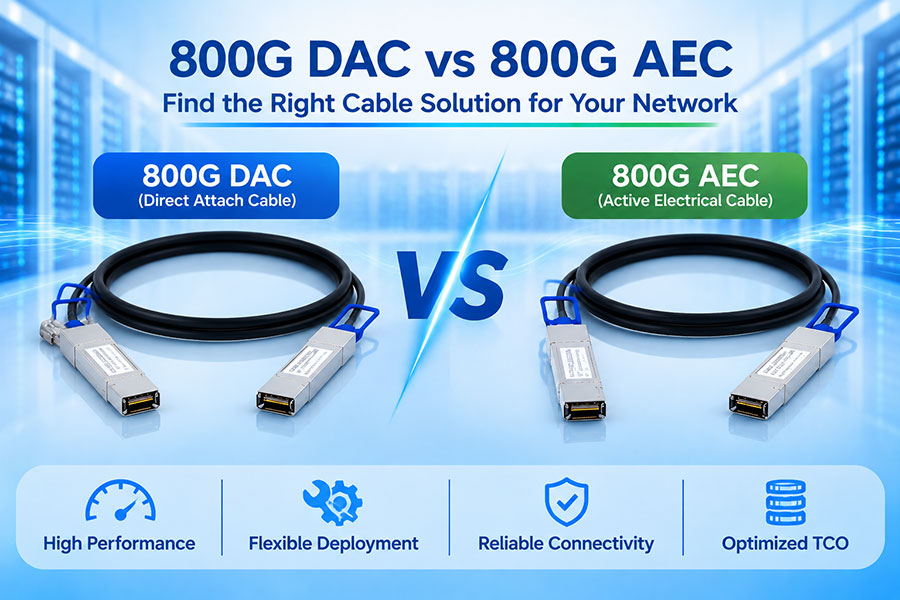
For shorter connections, AOCs integrate optical components into a cable assembly, reducing the need for separate pluggable modules and fiber patch cables. DAC cables are another option where the required reach and equipment compatibility permit direct copper connectivity.
12. AI Ethernet vs InfiniBand: Compatibility and Ecosystem
One of the most important differences between the two technologies is their equipment ecosystem.
12.1 Ethernet Compatibility
Ethernet is widely deployed across enterprise networks, cloud platforms, and data centers. It has a broad ecosystem of switches, routers, network adapters, optical transceivers, and network management tools.
This ecosystem provides flexibility when integrating AI infrastructure with existing data center networks. However, AI Ethernet deployments still need to verify compatibility between switches, NICs, firmware, RoCE implementations, and optical interfaces.
12.2 InfiniBand Compatibility
InfiniBand requires compatible HCAs, switches, cables, optical modules, and management software. It is designed as a dedicated fabric rather than an extension of an ordinary Ethernet network.
This specialized ecosystem can provide a consistent environment for HPC and AI workloads, but it also means that equipment selection and interoperability must be evaluated within the InfiniBand platform.
13. AI Ethernet vs InfiniBand: Cost and Deployment Considerations
Network cost is not determined by the switch price or optical module price alone. A complete AI network includes adapters, switches, cables, optical transceivers, software, power, cooling, installation, and ongoing maintenance.
| Cost Factor | AI Ethernet | InfiniBand |
|---|---|---|
| Infrastructure reuse | May reuse parts of existing Ethernet infrastructure | Usually requires dedicated InfiniBand equipment |
| Network adapters | Ethernet NICs or SuperNICs | InfiniBand HCAs |
| Switches | AI-capable Ethernet switches | InfiniBand switches |
| Optical connectivity | Ethernet-compatible optical modules and cables | InfiniBand-compatible optical modules and cables |
| Management | Ethernet network management tools and AI fabric optimization | InfiniBand fabric management tools |
| Operational skills | Ethernet and RoCE expertise | InfiniBand-specific expertise |
AI Ethernet may offer advantages when an organization already operates a large Ethernet environment. InfiniBand may be attractive when a dedicated high-performance fabric is the primary requirement.
Actual total cost of ownership depends on cluster scale, performance targets, equipment selection, software licensing, power consumption, and operational requirements. Neither technology is automatically less expensive in every deployment.
14. AI Ethernet vs InfiniBand: Application Scenarios
| Application | AI Ethernet | InfiniBand |
|---|---|---|
| Large-scale AI training | Suitable with AI-specific optimization | Widely used |
| GPU cluster communication | Suitable with RoCE and high-performance fabric design | Well suited |
| AI inference | Suitable for distributed inference systems | Suitable for high-performance deployments |
| High-performance computing | Suitable for Ethernet-based HPC environments | Established HPC technology |
| Enterprise networking | Broadly suitable | Not a general-purpose enterprise replacement |
| Cloud data centers | Common Ethernet-based infrastructure | Used in specialized high-performance environments |
| Scientific computing | Suitable depending on workload requirements | Widely deployed |
| Mixed enterprise and AI environments | Can integrate with Ethernet infrastructure | Often deployed as a dedicated fabric |
15. Which Is Better for AI: Ethernet or InfiniBand?
There is no single answer for every AI deployment. The right choice depends on workload characteristics, performance requirements, infrastructure, budget, and operational expertise.
Choose AI Ethernet When:
You want to build an AI fabric using Ethernet-based infrastructure.
Your data center already has substantial Ethernet networking expertise.
You need to integrate AI networking with broader cloud or enterprise environments.
You plan to use RoCE and compatible high-performance network adapters.
You require flexible options for 400G, 800G, and future Ethernet connectivity.
Choose InfiniBand When:
You are building a dedicated high-performance computing fabric.
Low-latency communication is a major design priority.
Your applications rely heavily on distributed GPU communication.
You want a specialized RDMA networking architecture.
Your organization can support InfiniBand-specific equipment and operations.
For large-scale AI training, both technologies can provide high-performance connectivity. Benchmarking with the intended GPU platform, collective communication workload, and network topology is the most reliable way to evaluate them.
16. C-LIGHT Optical Connectivity for AI and HPC Networks
As AI Ethernet and InfiniBand deployments continue to expand, high-speed optical interconnects play an increasingly important role in connecting GPU servers, switches, and computing infrastructure.
C-LIGHT provides optical transceivers and active optical cables for high-speed data center, AI, and high-performance computing applications.
800G QSFP-DD Optical Transceivers for high-bandwidth Ethernet and AI data center connectivity.
400G QSFP-DD Optical Transceivers for 400G data center and high-speed network applications.
800G AOC Cables with listed InfiniBand and Ethernet configurations for short-reach interconnects.
400G AOC Cables for high-speed short-distance connections in data centers and HPC environments.
C-LIGHT Optical Connectivity Products for additional data rates, form factors, and transmission distances.
When selecting an optical solution, it is essential to confirm the intended protocol, switch and adapter compatibility, form factor, transmission distance, fiber type, and connector configuration. A product designed for Ethernet should not be assumed to support InfiniBand unless its specifications explicitly confirm compatibility.
17. Frequently Asked Questions
Q1: What is the main difference between AI Ethernet and InfiniBand?
Q2: Is InfiniBand faster than Ethernet for AI?
Q3: Does AI Ethernet support RDMA?
Q4: Is RoCE the same as InfiniBand?
Q5: Can Ethernet replace InfiniBand in AI data centers?
Q6: What are HDR, NDR, and XDR in InfiniBand?
Q7: Can Ethernet optical transceivers be used in InfiniBand networks?
Q8: What is the role of AOC cables in AI networks?
Q9: Which network is more suitable for large GPU clusters?
Q10: Does InfiniBand use QSFP or OSFP connectors?
18. Conclusion
AI Ethernet and InfiniBand are two important networking approaches for modern AI infrastructure. AI Ethernet combines the flexibility of Ethernet with technologies such as RoCE, advanced congestion management, and high-speed optical connectivity. InfiniBand provides a specialized fabric designed for high-performance communication and native RDMA operations.
InfiniBand remains an established choice for dedicated HPC and large-scale AI environments, while AI Ethernet offers an increasingly capable option for organizations seeking high-performance AI networking within an Ethernet-based ecosystem.
As network speeds advance toward 800G and 1.6T, selecting the right switches, adapters, optical transceivers, and AOC or DAC cables will be essential to building scalable AI infrastructure. The best solution is the one that meets the workload's actual performance requirements while maintaining compatibility, reliability, and manageable operating costs.
 >

 >
 >
 >
 >
 >
 >
 >