TEL:+86 132 6656 7067





Artificial intelligence is changing the physical and technical requirements of data center infrastructure. GPU-based computing requires high-bandwidth communication, substantial electrical capacity, efficient heat removal and storage systems capable of supplying large datasets. At the same time, cloud providers continue to expand large-scale facilities to support distributed applications, global services and AI workloads.
An AI data center and a hyperscale data center are not mutually exclusive categories. The first term describes infrastructure designed around artificial intelligence workloads, while the second describes a facility and operating model built for massive, scalable computing capacity. A hyperscale facility can host AI clusters, traditional cloud services or both. An AI data center can also be deployed as a smaller enterprise facility, a dedicated on-premises cluster or a colocation installation.
This distinction is important when evaluating server density, GPU architecture, network fabrics, fiber connectivity, power distribution and cooling systems. The workload determines many of the technical requirements, while the scale and operating model determine how infrastructure is deployed and expanded.
1. What Is an AI Data Center?
An AI data center is a facility or dedicated computing environment designed to train, fine-tune and run artificial intelligence models. Its infrastructure is optimized for parallel processing, high-throughput data movement and communication between large numbers of accelerators.
Instead of relying primarily on conventional CPU servers, AI infrastructure commonly uses GPUs, TPUs or other specialized accelerators. These processors work alongside host CPUs, high-bandwidth memory, high-speed network adapters and storage systems to execute demanding machine learning workloads.
Important components include:
GPU and accelerator servers: Provide parallel computing resources for model training and inference.
High-bandwidth memory: Supplies accelerators with rapid access to model parameters and intermediate data.
Scale-up interconnects: Connect accelerators within a server or rack through high-bandwidth platform-specific technologies.
Scale-out network fabrics: Connect GPU servers and racks through Ethernet or InfiniBand.
High-performance storage: Delivers training datasets, model files, embeddings and checkpoint data.
Advanced power and cooling: Supports dense computing equipment and sustained accelerator workloads.
Cluster management: Coordinates accelerator allocation, job scheduling, monitoring and workload recovery.
AI data centers can support different workloads. Training clusters focus on distributed computation and synchronization, while inference environments prioritize model serving, request processing, response time and efficient accelerator utilization. Some facilities support both.
2. What Is a Hyperscale Data Center?
A hyperscale data center is a large-scale computing facility designed to expand capacity through standardized infrastructure, horizontal scaling and extensive software automation. It commonly supports public cloud platforms, large Internet services, distributed storage, data analytics and enterprise computing.
Rather than relying on a small number of individually configured systems, hyperscale architecture uses large fleets of servers, switches and storage resources. These resources are managed as pools, allowing operators to add capacity without redesigning the entire infrastructure every time demand increases.
Typical characteristics include:
Large infrastructure footprint: Facilities may contain thousands of servers and extensive power, cooling and network systems.
Horizontal scalability: Additional servers, racks, pods and buildings can be introduced as demand grows.
Standardization: Hardware configurations and deployment procedures are designed for repeatability.
Automation: Provisioning, monitoring, workload placement and recovery are managed through software.
Distributed architecture: Computing and storage resources operate across large infrastructure pools.
Geographic connectivity: Multiple facilities can be connected through regional and long-distance fiber networks.
Hyperscale refers to an architectural and operational approach rather than one universally defined server count or building size. The central idea is the ability to expand computing capacity while maintaining manageable operations, performance and resource efficiency.
3. AI Data Center vs Hyperscale Data Center: Core Differences
| Design Factor | AI Data Center | Hyperscale Data Center |
|---|---|---|
| Classification basis | Defined by AI workload requirements and specialized infrastructure | Defined by large-scale architecture and operational model |
| Primary purpose | Model training, fine-tuning and AI inference | Large-scale cloud, Internet, enterprise, analytics and AI services |
| Compute architecture | GPU and accelerator-intensive systems with host CPUs | Large pools of standardized compute resources, potentially including GPUs |
| Network priorities | High-bandwidth accelerator communication and predictable fabric performance | Scalable connectivity across large server, storage and application populations |
| Storage requirements | High-throughput datasets, model repositories and checkpoint storage | Distributed storage for cloud services, applications and large data platforms |
| Power density | Often high because of dense accelerator configurations | Varies by workload; can include conventional server halls and high-density AI zones |
| Cooling requirements | May require direct-to-chip liquid cooling or other high-capacity thermal solutions | Uses cooling strategies suited to a broad range of equipment densities |
| Expansion approach | Increases accelerator and fabric capacity according to AI workloads | Expands standardized infrastructure across clusters, pods and facilities |
| Typical operator | Enterprises, AI service providers, cloud providers and research organizations | Large cloud providers, Internet companies and large-scale infrastructure operators |
| Relationship | Can operate independently or inside a hyperscale facility | Can host AI workloads, general-purpose cloud services or both |
4. The Relationship Between AI and Hyperscale Infrastructure
The two categories describe different dimensions of data center design. AI identifies the workload and the specialized computing requirements. Hyperscale describes the way infrastructure is organized and expanded to support very large computing demand.
This means an AI data center does not have to be hyperscale, and a hyperscale data center does not have to be dedicated entirely to AI.
A dedicated enterprise GPU cluster.
An on-premises AI training environment.
A university or research computing facility.
A smaller AI inference deployment.
A specialized GPU installation in a colocation facility.
Public cloud computing services.
Large distributed storage platforms.
Internet and SaaS infrastructure.
High-performance analytics systems.
Dedicated AI training and inference clusters.
A hyperscale operator can allocate specific buildings, halls or infrastructure pods to AI workloads while continuing to run general-purpose cloud services elsewhere. This approach allows the operator to apply specialized power, cooling and network configurations to GPU clusters without requiring every part of the facility to use the same design.
Conceptual classification. AI workloads can be deployed at different scales and in different facility ownership models.
5. GPU Servers and Compute Architecture
AI data centers place a strong emphasis on accelerator performance. GPU servers combine host CPUs with multiple accelerators, high-bandwidth memory and high-speed network interfaces. The architecture is designed to keep processors supplied with data and coordinate computation across devices.
Within an AI server, the host CPU manages system operations, application processes, memory and I/O. GPUs execute parallel workloads such as matrix operations and neural network computations. Accelerator memory, including HBM on supported platforms, provides high-bandwidth access to frequently used model data.
Hyperscale infrastructure can include the same GPU-based systems, but its compute architecture is generally broader. A hyperscale facility may operate general-purpose CPU fleets, storage nodes, network infrastructure, AI accelerator racks and specialized hardware for different services.
| Compute Component | AI Data Center | Hyperscale Data Center |
|---|---|---|
| Processors | GPUs, TPUs or other specialized accelerators alongside host CPUs | Large-scale CPU fleets, GPUs and workload-specific processors |
| Memory | HBM and host DRAM work together in accelerator systems | Memory configurations vary across general-purpose and specialized servers |
| Server design | High-density accelerator systems and tightly integrated compute trays | Standardized server configurations across different workload pools |
| Resource allocation | GPU-aware scheduling and topology-sensitive placement | Large-scale allocation of CPU, memory, storage and accelerator resources |
| Primary efficiency target | Accelerator utilization and model execution performance | Infrastructure utilization, service efficiency and fleet-level operating cost |
The two designs can share hardware platforms. The difference is how compute resources are organized, allocated and optimized for the intended workloads.
6. Network Architecture: AI Fabric vs Hyperscale Network
Networking is one of the most important areas where AI-focused infrastructure can require a specialized design. Distributed training involves repeated communication between accelerators, often through collective operations such as All-Reduce, All-Gather and Reduce-Scatter. Congestion or delayed data transfers can reduce the effective utilization of GPUs.
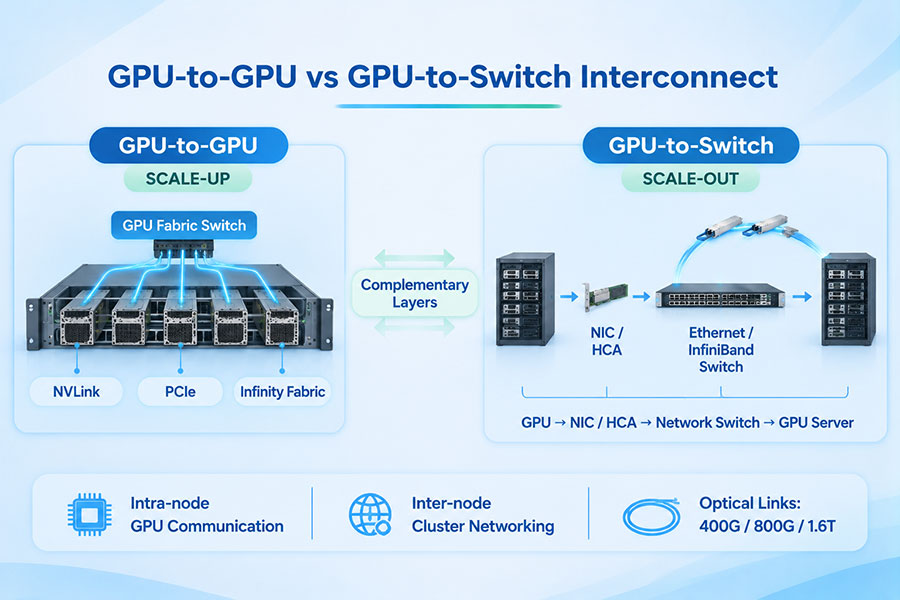
AI networks commonly distinguish between scale-up and scale-out connectivity.
Scale-up networking connects accelerators within a server or rack. Platform-specific technologies provide high-bandwidth, low-latency communication between GPUs. NVIDIA NVLink is one example.
Scale-out networking connects GPU servers and racks. Ethernet with RoCEv2 and InfiniBand are two important approaches for distributed AI communication. Their performance depends on adapters, switches, topology, congestion management and application configuration.
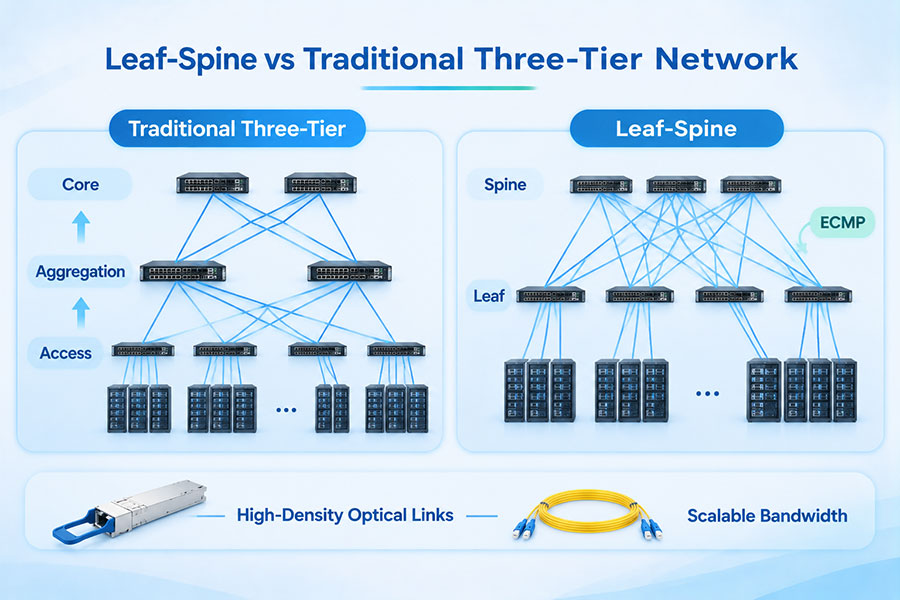
Hyperscale network architecture must support a much wider range of services. Large-scale leaf-spine or Clos-based fabrics connect server fleets, storage systems and network gateways. Software-defined networking, routing automation and network telemetry help operators manage infrastructure across large clusters and facilities.
| Network Layer | AI Data Center | Hyperscale Data Center |
|---|---|---|
| Local accelerator links | Specialized scale-up interconnects within systems or racks | Used in dedicated AI clusters when accelerator workloads require them |
| Inter-rack fabric | Optimized for distributed GPU communication and high East-West traffic | Connects large server, storage and service populations |
| External connectivity | Connects AI services, users, storage and data sources | Connects cloud customers, Internet services, enterprise networks and regions |
| Network control | May include accelerator-aware placement and AI job isolation | Large-scale routing, provisioning, automation and tenant network management |
| Traffic optimization | Congestion management, path selection and collective communication performance | Traffic engineering, load balancing, service availability and network utilization |
Hyperscale networks can contain dedicated AI fabrics rather than forcing accelerator traffic through the same logical network used by general cloud applications. This separation can help meet the performance and operational requirements of different workloads.
7. Optical Connectivity and High-Speed Fiber Infrastructure
Large data centers depend on fiber connectivity to support high-bandwidth communication between switches, server racks, storage systems and separate facilities. As link rates increase, optical transceivers and fiber assemblies become important components of the physical network design.
AI-focused facilities can require extensive high-speed optical connections between GPU racks and the scale-out switching fabric. The required link rate and reach depend on the selected network architecture, accelerator platform, switch ports and physical layout.
Hyperscale facilities also deploy large quantities of optical connectivity across server pods, leaf-spine networks, facility backbones and regional interconnection systems. Their primary distinction is the scale of deployment and standardization across large infrastructure fleets.
| Connectivity Area | AI Data Center | Hyperscale Data Center |
|---|---|---|
| GPU rack uplinks | High-speed optical connections for scale-out fabric links | Used in dedicated AI zones and other high-bandwidth server environments |
| Leaf-to-spine links | Designed around accelerator communication bandwidth and fabric topology | Connects large numbers of server racks and network pods |
| Storage connections | Supports dataset delivery and checkpoint traffic | Connects distributed storage systems and large-scale service infrastructure |
| Inter-facility links | Connects distributed AI resources where application requirements permit | Connects data center campuses, regions and backbone networks |
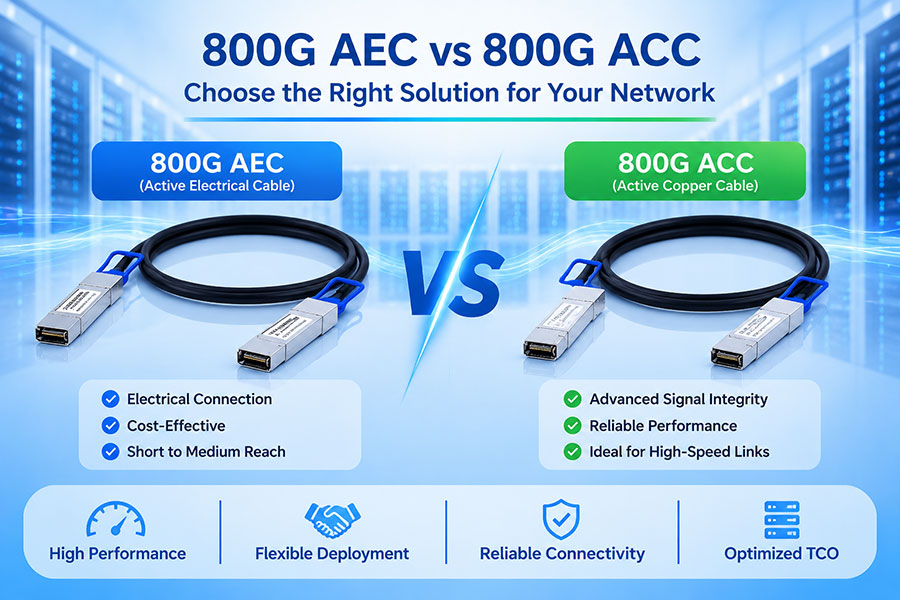
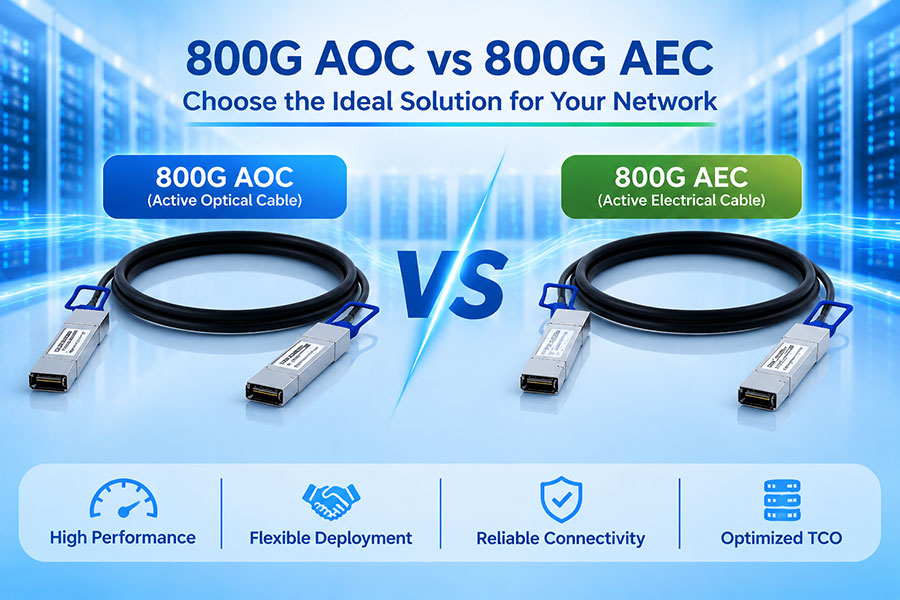
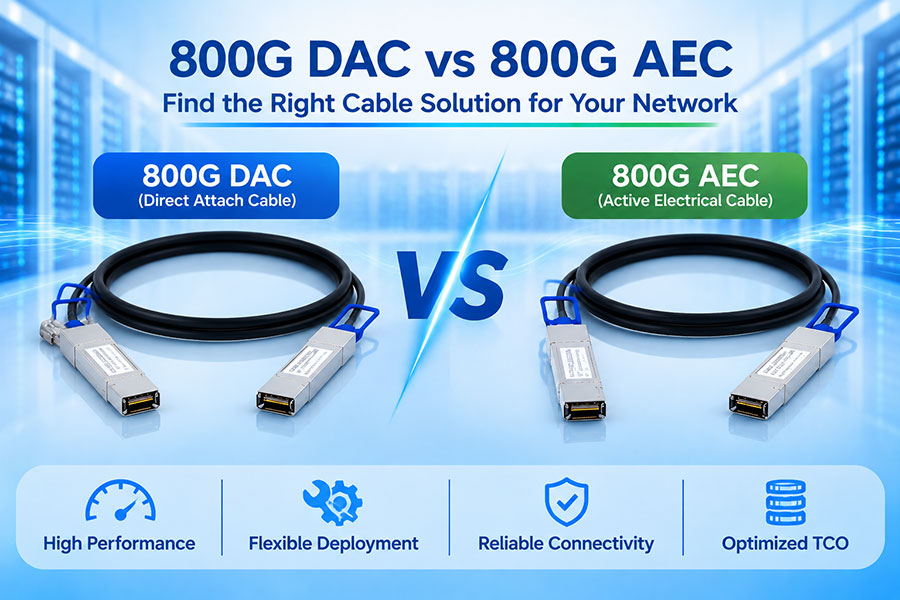
| Short-reach connections | May use supported DAC, AEC or AOC assemblies, alongside specialized accelerator links | Uses copper and optical assemblies according to equipment placement and reach |
For 400G and 800G Ethernet connections, engineers need to verify the optical standard, lane configuration, form factor, wavelength, connector, fiber type and supported transmission distance. The module must also be compatible with the host switch or network adapter.
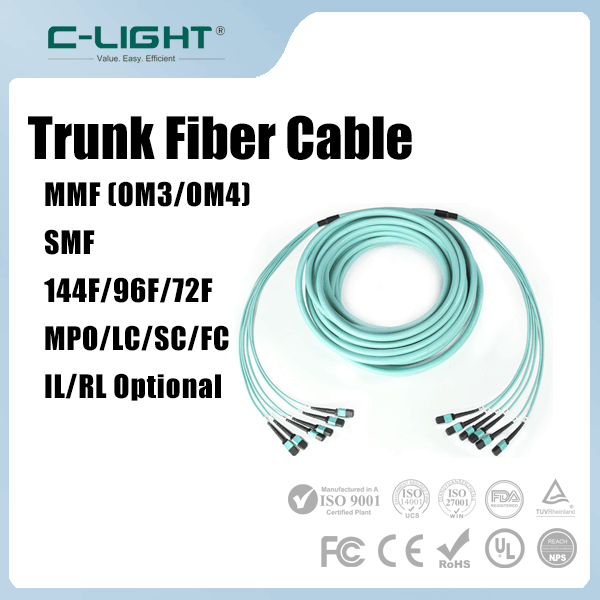
The C-LIGHT optical transceiver portfolio provides options for different data center optical link requirements. Other connectivity categories are available through the C-LIGHT product portfolio.
8. Power Density and Cooling Infrastructure
AI-focused infrastructure can place substantially different demands on power distribution and cooling compared with conventional server environments. Multiple high-performance GPUs, HBM and high-speed network equipment concentrate power consumption and heat generation within a relatively small physical space.
The OECD's 2026 Digital Economy and Society Outlook describes current AI racks as commonly requiring approximately 100–200 kW, compared with around 10–15 kW for standard IT racks. These figures are indicative industry ranges rather than universal specifications; actual rack requirements depend on accelerator generation, server configuration and deployment design.
High-density AI systems can require:
High-capacity power distribution: Electrical infrastructure must support dense accelerator systems and their network equipment.
Redundant power paths: Power architecture must meet availability requirements for critical workloads.
Direct-to-chip liquid cooling: Cold plates remove heat from high-power processors and other components.
Advanced facility heat rejection: Cooling plants and heat exchangers must handle the resulting thermal load.
Structural planning: Rack weight and equipment density may require floor loading and structural assessment.
Hyperscale facilities may contain both conventional IT halls and high-density AI zones. Their cooling infrastructure therefore needs to accommodate multiple equipment profiles, sometimes through different cooling systems within the same campus.
Liquid cooling is increasingly important for high-density AI infrastructure, but it is not a defining requirement of every hyperscale data center. Cooling technology should be selected according to actual equipment specifications and facility engineering requirements.
9. Storage and Data Throughput
AI data centers need to move large datasets into accelerator systems while maintaining sufficient throughput for training, fine-tuning and inference. Storage performance can become a bottleneck when accelerators process data faster than the storage infrastructure can supply it.
AI environments may use parallel file systems, NVMe storage, object storage and local SSDs. Training systems also need checkpoint storage so that model state can be saved and recovered after interruptions.
Hyperscale storage architecture is generally broader. It may support object storage, databases, virtual machine disks, content delivery, distributed file systems, backup services and AI datasets. Software-defined storage and large distributed resource pools allow capacity to expand as service demand grows.
| Storage Requirement | AI Data Center | Hyperscale Data Center |
|---|---|---|
| Primary data | Training datasets, model weights, embeddings and checkpoints | Customer data, application files, databases, media and AI datasets |
| Performance priority | High throughput and predictable data delivery to accelerators | Scalable capacity, service performance and distributed access |
| Architecture | Parallel file systems, NVMe tiers and object storage | Distributed object, file and block storage systems |
| Data movement | Large training transfers and frequent checkpoint operations | Application traffic, replication, backups and service delivery |
| Expansion | Must grow with accelerator capacity and dataset demand | Designed for large-scale capacity and geographically distributed services |
10. Deployment Models: On-Premises, Colocation and Cloud
AI infrastructure and hyperscale infrastructure can be deployed under different ownership and facility arrangements. These deployment models should be evaluated separately from the workload classification.
An enterprise may build an on-premises AI data center to retain direct control over hardware, data and security. A research organization may install a dedicated GPU cluster in a colocation facility. A cloud provider may offer AI compute through a hyperscale facility, while another operator may lease AI-ready capacity to multiple customers.
| Deployment Model | AI Infrastructure | Hyperscale Infrastructure |
|---|---|---|
| On-premises | Dedicated GPU cluster operated by an enterprise or research organization | Possible for organizations operating very large private infrastructure estates |
| Colocation | AI racks deployed in facilities with suitable power and cooling capacity | Hyperscale operators may lease capacity or use third-party facilities |
| Public cloud | GPU instances and managed AI platforms run in provider infrastructure | Large-scale cloud facilities provide the underlying infrastructure |
| Hybrid environment | Combines private accelerator clusters with cloud AI resources | Connects private infrastructure to large-scale cloud platforms and regions |
Existing facilities can sometimes be upgraded to support AI workloads, but the changes may extend beyond installing GPU servers. Power distribution, cooling, floor loading, network pathways and operational procedures may all require modification.
11. Reliability, Automation and Operations
AI data centers and hyperscale data centers both need reliable infrastructure, but their operating priorities differ according to workload and deployment scale.
AI environments must monitor accelerator health, GPU utilization, memory, network congestion, storage throughput and cooling conditions. Distributed training jobs can involve many interconnected devices, so a problem affecting one server or network path may influence the performance of a larger job.
Hyperscale operators manage infrastructure fleets that can include thousands of servers, switches and storage devices. Automation is essential for provisioning, configuration control, hardware replacement, workload placement, capacity forecasting and service recovery.
Important operational capabilities include:
Hardware monitoring: Tracks server, accelerator, switch, storage and power-system health.
Network telemetry: Identifies link utilization, congestion, packet errors and fabric performance issues.
Automated provisioning: Deploys and configures hardware and software resources consistently.
Workload scheduling: Assigns resources according to application requirements and available capacity.
Failure recovery: Supports workload restart, hardware replacement and data recovery.
Lifecycle management: Coordinates upgrades, equipment replacement and capacity expansion.
Standardization and automation can help both types of facilities. Their implementation differs according to the number of systems, degree of workload specialization and the organization's operational model.
12. Choosing Between AI-Focused and Hyperscale Infrastructure
The most suitable design depends on the organization's workload requirements and expected growth. These categories do not represent mutually exclusive purchasing decisions. An organization may need specialized AI infrastructure while also benefiting from hyperscale-style architecture and automation.
GPU training or large-scale inference is the primary workload.
Accelerator communication requires a specialized network fabric.
High-bandwidth storage is necessary for large datasets and checkpoints.
Power and cooling infrastructure must support dense GPU systems.
Dedicated control over AI hardware and data is important.
Performance needs justify specialized accelerator infrastructure.
Computing capacity must grow across large infrastructure pools.
Many services or customers share the same platform.
Standardized hardware and automated operations are priorities.
Distributed storage and large network fabrics are required.
Infrastructure must expand across facilities or regions.
Long-term resource utilization and fleet management are central concerns.
For many large AI service providers, the practical solution is a hyperscale operating model with dedicated AI infrastructure zones. This combines large-scale deployment, automation and resource management with specialized GPU servers, AI network fabrics and high-density power and cooling systems.
13. Conclusion
AI data centers and hyperscale data centers describe different but overlapping aspects of modern computing infrastructure. AI data centers are optimized for accelerator-intensive workloads, high-bandwidth communication, fast data access and demanding thermal requirements. Hyperscale data centers are designed for massive capacity, horizontal expansion, standardized hardware and software-driven operations.
A hyperscale facility can host dedicated AI clusters alongside conventional cloud services. An AI data center can also operate independently as an enterprise, research or colocation deployment. The most appropriate design depends on workload characteristics, network topology, power availability, cooling capacity, storage performance and long-term expansion plans.
As AI systems continue to increase the demand for accelerator computing and high-speed data movement, optical connectivity becomes an important part of infrastructure planning. Selecting compatible optical transceivers, fiber links and high-speed interconnects helps support reliable communication across GPU racks, network fabrics and data center facilities.
For optical connectivity requirements and technical support, Contact C-LIGHT.
 >

 >
 >
 >
 >
 >
 >
 >