TEL:+86 132 6656 7067





Artificial intelligence workloads are changing the way data center clusters are designed. A traditional enterprise cluster is generally built to run business applications, databases, virtual machines, storage services and distributed computing tasks. An AI cluster has a different infrastructure priority: coordinating large numbers of GPUs or other accelerators so they can process data and execute model operations as a unified computing system.
The distinction goes beyond replacing CPUs with GPUs. AI infrastructure places greater emphasis on accelerator memory bandwidth, high-speed interconnects, synchronized communication, parallel storage, power delivery and advanced cooling. The network must move data between compute nodes fast enough to keep expensive accelerators productive, while storage systems must deliver datasets and checkpoint data at the required rate.
Both architectures use servers, switches, storage, operating systems and management platforms. Their main differences lie in workload behavior, hardware balance, communication patterns and infrastructure priorities.
1. What Is an AI Cluster?
An AI cluster is a group of interconnected compute nodes designed to train, fine-tune or run artificial intelligence models. Each node may contain one or more GPUs, TPUs or other specialized accelerators, together with host CPUs, system memory, local storage and high-speed network interfaces.
Instead of treating every server as an independent application host, an AI cluster coordinates accelerator resources across multiple machines. A distributed training job, for example, can divide model operations among GPUs and exchange intermediate results through high-bandwidth interconnects.
Important components of an AI cluster include:
GPU or accelerator nodes: Provide parallel computing resources for matrix operations and other AI workloads.
High-bandwidth accelerator memory: HBM stores model parameters, intermediate tensors and other frequently accessed data close to the accelerator.
Scale-up interconnects: Connect accelerators within a server or rack to support high-bandwidth communication.
Scale-out network fabric: Connects compute nodes and racks for distributed training and inference.
High-performance storage: Supplies training datasets, model files and checkpoint data.
Management infrastructure: Handles scheduling, provisioning, monitoring, security and workload orchestration.
AI clusters can be relatively small, supporting a few accelerator servers, or scale across multiple racks and data center zones. Their architecture depends on model size, workload type, accelerator platform and performance requirements.
2. What Is a Traditional Data Center Cluster?
A traditional data center cluster generally refers to interconnected servers designed to provide shared computing resources, application availability, workload distribution and scalable enterprise services. Most general-purpose deployments rely primarily on CPU-based servers, system DRAM, storage platforms and Ethernet networking.
Common workloads include enterprise resource planning, customer relationship management, web hosting, application servers, relational databases, virtualization platforms, file services and business-critical systems.
Traditional clusters may use virtualization, container platforms, load balancing, distributed storage and high-availability mechanisms. Their nodes can operate independently for many tasks, with communication taking place when applications need to exchange information or access shared resources.
Typical infrastructure components include:
CPU-based servers: Execute operating systems, application logic, database operations and general-purpose computing tasks.
System memory: DRAM supports operating systems, application processes, virtual machines and database workloads.
Storage systems: SAN, NAS, DAS, SSD and HDD platforms provide application data and persistent storage.
Ethernet network: Connects servers, storage, users, management platforms and external networks.
Virtualization and container platforms: Allocate computing resources and support application deployment.
High-availability systems: Provide failover, replication, backup and service continuity.
Traditional does not mean low performance or outdated. Large enterprise and cloud data centers can use high-speed Ethernet, distributed databases, accelerator hardware and advanced storage systems. The defining distinction is the workload and infrastructure design objective, not a fixed hardware specification.
3. AI Cluster vs Traditional Data Center Cluster: Main Differences
| Infrastructure Factor | AI Cluster | Traditional Data Center Cluster |
|---|---|---|
| Primary workloads | Model training, fine-tuning, distributed inference and AI processing | Enterprise applications, databases, virtualization, web and business services |
| Compute hardware | GPUs, TPUs, AI accelerators and host CPUs | Primarily general-purpose CPU servers, with accelerators where required |
| Memory architecture | HBM on accelerators combined with host DRAM | Primarily server DRAM, with memory architecture varying by application |
| Network priority | High-bandwidth, low-latency communication between accelerators and nodes | Application access, service connectivity, storage and general data exchange |
| Interconnect design | Scale-up accelerator links and scale-out cluster fabrics | Ethernet-based server, storage and application networks |
| Storage requirements | High-throughput dataset access, model storage and checkpointing | Application databases, virtual machine storage, files and backups |
| Power density | Often high because of accelerator-rich servers and dense racks | Varies by server type and application, often more distributed across racks |
| Cooling | Air or liquid cooling, depending on accelerator and rack thermal load | Commonly air cooling, with liquid cooling in higher-density deployments |
| Workload scheduling | GPU allocation, accelerator-aware placement and distributed job scheduling | VM, container, application and CPU resource scheduling |
| Performance priorities | Accelerator utilization, collective communication and time to train or serve models | Application response time, throughput, availability and resource utilization |
4. CPU Servers vs GPU and Accelerator Servers
Compute hardware is one of the clearest differences between the two cluster types. General-purpose data center servers are commonly built around CPUs, which execute a broad range of operating system, application and database instructions. AI servers combine host CPUs with specialized accelerators designed to process large numbers of parallel mathematical operations.
GPUs are widely used for AI training and inference because their parallel processing architecture is suited to many tensor and matrix operations. Other platforms, including TPUs and application-specific AI accelerators, provide alternative approaches to specialized computation.
The host CPU remains important in an AI server. It manages system operations, data movement, application processes, accelerator coordination and I/O. The GPU does not replace every CPU function; both processing types work together.
Traditional compute node
General-purpose CPU processors
System DRAM
Local or network storage
Ethernet network adapters
Virtual machines and application services
AI compute node
Host CPU processors
Multiple GPUs or specialized accelerators
High-bandwidth accelerator memory
High-speed cluster network adapters
AI frameworks and distributed computing software
The difference also affects server balance. An AI node may contain substantial accelerator compute capacity, but its performance can be limited by insufficient memory, slow data input, network congestion or inadequate storage throughput. Adding more GPUs does not automatically produce proportional application performance.
5. HBM vs Traditional Server DRAM
AI accelerators depend on fast access to large volumes of model data and intermediate tensors. High Bandwidth Memory (HBM) is integrated closely with supported accelerators to provide very high memory bandwidth. It is designed to feed parallel computing units efficiently during demanding AI operations.
Traditional CPU servers commonly rely on DDR memory, which supports general-purpose applications, operating systems, databases and virtualization workloads. Capacity, latency and memory-channel configuration are important factors in these systems.
AI servers still use host DRAM. HBM does not replace system memory; the two memory types serve different roles within the same compute node.
| Memory Characteristic | HBM in AI Accelerators | System DRAM in General-Purpose Servers |
|---|---|---|
| Primary role | Feeds accelerator processing units with high-bandwidth data | Stores operating system, application and general computing data |
| Physical placement | Closely integrated with the accelerator package | Installed as system memory modules or platform-integrated memory |
| Bandwidth priority | Very high bandwidth for parallel accelerator workloads | Balanced memory bandwidth and capacity for CPU workloads |
| Typical use | Model parameters, tensors and accelerator working data | Applications, databases, virtual machines and system processes |
| System relationship | Works with host CPU and system memory | Supports the general-purpose CPU and operating environment |
6. AI Cluster Networking: Scale-Up and Scale-Out
AI cluster networking is not simply a faster version of conventional server connectivity. Distributed training requires accelerators to exchange intermediate results and synchronize operations across multiple compute nodes. Communication performance can directly affect how efficiently accelerators complete a training job.
Two important networking concepts are scale-up and scale-out.
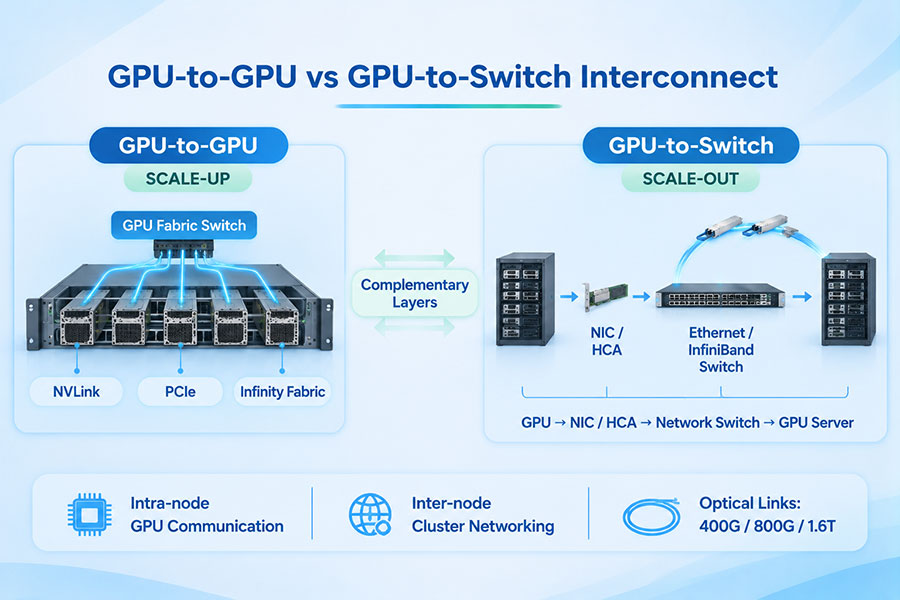
Scale-up networking connects accelerators within a server or rack. High-bandwidth accelerator interconnects allow GPUs to exchange data without sending every communication operation through the general-purpose data center Ethernet fabric. NVIDIA NVLink is one example of a platform-specific scale-up technology.
Scale-out networking connects compute nodes and racks. This fabric supports communication between accelerators located on different servers and is essential when distributed workloads extend beyond a single server or rack.
Conceptual illustration. Actual network fabrics and traffic separation vary by accelerator platform and deployment architecture.
InfiniBand and Ethernet are both used for AI scale-out networking. Ethernet-based deployments may use RoCEv2 and require careful configuration of congestion management, routing, traffic handling and loss behavior. InfiniBand provides a separate networking ecosystem with its own fabric management and communication mechanisms.
The right choice depends on the accelerator platform, application software, cluster size, performance requirements, operational experience and infrastructure budget. Neither technology is automatically the best option for every AI cluster.
7. Traditional Data Center Networking Architecture
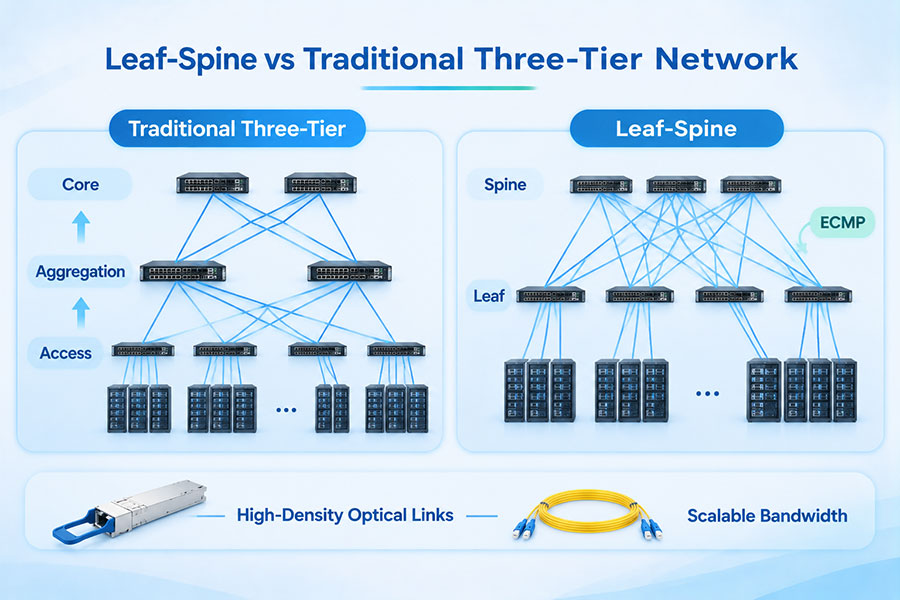
Traditional data center clusters commonly use Ethernet networking to connect servers, storage, user-facing applications and management systems. A leaf-spine fabric is widely used when a facility needs scalable inter-rack connectivity and predictable network paths.
In this architecture, access or leaf switches connect servers and other endpoints. Spine switches provide the interconnection between leaf switches. Routing protocols and Equal-Cost Multi-Path (ECMP) can distribute eligible traffic across multiple paths.
Different applications create different traffic patterns. A database cluster may generate frequent server-to-server communication, while a web application may handle a substantial amount of client-facing traffic. Storage traffic and backup operations can also place significant demand on the network.
Traditional data center networking may therefore use high-speed Ethernet, fiber connections and dedicated storage networks. AI-specific networking is distinguished not by the absence of these technologies, but by the need to coordinate large-scale accelerator communication with greater attention to bandwidth, latency and synchronized traffic patterns.
8. AI Workloads and Internal Network Traffic
Distributed AI training can generate substantial East-West traffic. Multiple GPUs cooperate on a single job and exchange intermediate data through collective communication operations such as All-Reduce, All-Gather and Reduce-Scatter.
These operations help synchronize model information across participating devices. If network links are congested or communication paths are poorly designed, GPUs may spend time waiting for data instead of performing computations.
Inference has different traffic characteristics. A single inference request may be handled by one accelerator or a distributed serving system. Larger deployments can distribute model components across devices, move requests between services, access retrieval databases and exchange information through shared caches.
| Workload | Typical Communication Pattern | Important Network Requirements |
|---|---|---|
| Distributed model training | Frequent GPU-to-GPU synchronization and collective communication | High bandwidth, low latency, congestion control and path efficiency |
| Fine-tuning | Accelerator communication with repeated model and gradient updates | Predictable fabric performance and sufficient inter-node bandwidth |
| Distributed inference | Communication among model partitions, serving nodes and shared services | Low latency, predictable response times and scalable connectivity |
| Retrieval-Augmented Generation | Application, model-serving and retrieval systems exchange requests and data | Balanced compute, storage and service-network performance |
| Model checkpointing | Large volumes of model state move from compute nodes to storage | High storage throughput and sufficient network capacity |
Network design must reflect the actual workload. A training cluster with frequent synchronization has different communication requirements from an inference service that primarily handles external requests and retrieval operations.
9. Storage Architecture and Data Throughput
Storage is another major difference between AI-focused and general-purpose clusters. Traditional enterprise systems often prioritize reliable application data access, transaction consistency, database performance, backup and recovery.
AI infrastructure must also support large datasets, model checkpoints, training output, model repositories and inference data. Training pipelines may read large volumes of data repeatedly, while distributed jobs may periodically write checkpoints so work can resume after interruption.
AI storage architectures can combine parallel file systems, high-performance NVMe storage, object storage and local SSDs. The appropriate combination depends on dataset size, access pattern, retention requirements and workload throughput.
Important design factors include:
Dataset throughput: Storage must supply data at a rate that prevents accelerators from waiting unnecessarily for input.
Metadata performance: Large training datasets may contain many files, making metadata operations an important consideration.
Checkpoint performance: Distributed jobs may need to write substantial model state within an acceptable time window.
Data locality: Placement of datasets and cached information can influence network traffic and processing efficiency.
Storage scalability: Capacity and throughput should grow with the compute environment.
Reliability: Data protection, replication and recovery remain essential for valuable datasets and model assets.
Adding more accelerators without providing corresponding storage and data-delivery capacity can create an imbalance. The storage network and the compute network should be sized as parts of one system.
10. Power Density and Cooling Requirements
AI clusters can create much higher rack-level power and heat loads than conventional CPU-oriented deployments. Accelerator-rich servers contain multiple high-performance processors, high-bandwidth memory and high-speed network components. When many such systems operate in the same rack, electrical and thermal requirements become central infrastructure considerations.
Traditional data center racks can often be supported by established air-cooling designs, depending on equipment density and facility conditions. AI racks may require more sophisticated airflow management, higher-capacity power distribution or liquid cooling to remove heat efficiently.
Common AI cooling approaches include:
Air cooling: Suitable for equipment and rack configurations within the cooling system's capacity.
Direct-to-chip liquid cooling: Circulates coolant through cold plates connected to high-heat components.
Rear-door heat exchangers: Remove heat from exhaust air at the server rack.
Immersion cooling: Places compatible IT equipment in a dielectric cooling fluid.
Liquid cooling is increasingly relevant for high-density AI systems, but it is not mandatory for every AI cluster. Cooling selection depends on server design, rack power, facility infrastructure, operating temperature and service requirements.
Power planning must also account for the complete system: accelerators, CPUs, memory, switches, optical modules, storage, power conversion losses and cooling equipment. A cluster that has sufficient server capacity but inadequate power or thermal infrastructure cannot reliably sustain its intended workload.
11. Optical Connectivity in AI and Traditional Clusters
Both cluster types use optical connectivity when link distance, bandwidth density, electrical reach or infrastructure layout makes fiber appropriate. The difference is often the intensity and scale of interconnect requirements.
AI clusters may require extensive high-speed connections between leaf and spine switches, accelerator racks and storage systems. Depending on the platform and network design, these links can use 100G, 400G, 800G or higher-capacity interfaces. Short connections within a server or rack may use dedicated accelerator interconnects or supported copper assemblies.
Traditional data center clusters also use high-speed optical links for inter-rack Ethernet, storage connectivity, backbone networks and data center interconnection. Their actual requirements vary according to application throughput and facility scale.
| Optical Connectivity Area | AI Cluster | Traditional Cluster |
|---|---|---|
| Switch-to-switch links | High-capacity scale-out fabric connections between AI racks and switching layers | Ethernet leaf-spine, core and aggregation connections |
| Storage connectivity | High-throughput dataset and checkpoint traffic | Database, file, block and backup traffic |
| Rack interconnection | Optical links according to accelerator fabric and Ethernet or InfiniBand design | Optical links according to server, switch and storage interface requirements |
| Data center interconnection | Connects distributed AI infrastructure or storage locations where required | Connects enterprise facilities, disaster recovery sites and external networks |
Optical module selection should be based on the complete link specification, not data rate alone. Engineers need to verify the host interface, form factor, lane configuration, wavelength, fiber type, connector, transmission distance and optical link budget.
For high-speed data center connectivity, C-LIGHT optical transceivers provide a product range for different optical link requirements. Other connectivity options can be found in the C-LIGHT product portfolio.
12. Software, Scheduling and Cluster Management
Traditional clusters commonly use virtualization platforms, container orchestration, workload schedulers and enterprise monitoring systems to manage applications and infrastructure. Resource allocation is often based on CPU capacity, memory, storage, availability and application placement requirements.
AI clusters introduce additional scheduling dimensions. The system must consider GPU availability, accelerator memory, interconnect topology, model parallelism and the number of devices required by each job. Placing GPUs on separate nodes without considering network topology can lead to inefficient communication and lower training performance.
AI infrastructure may use Kubernetes, Slurm and other orchestration or scheduling platforms, together with accelerator drivers, collective communication libraries and model-serving frameworks. The software stack coordinates hardware allocation, job execution, monitoring and recovery.
Important management capabilities include:
Accelerator-aware scheduling: Allocates GPUs or other accelerators according to job requirements.
Topology-aware placement: Considers the physical relationship between accelerators and network paths.
Workload isolation: Separates tenants and jobs while controlling access to shared infrastructure.
Cluster monitoring: Tracks accelerator utilization, memory, network performance, storage and thermal conditions.
Job recovery: Uses checkpointing and orchestration to support recovery from failures.
Resource accounting: Measures accelerator usage and infrastructure allocation across teams or customers.
13. Which Cluster Architecture Is Suitable for Your Workload?
The appropriate architecture depends on the applications being deployed, the expected workload profile and the infrastructure's growth requirements.
AI cluster is suitable when:
Training or fine-tuning large machine learning models.
Running accelerator-intensive AI inference services.
Coordinating GPUs across multiple servers or racks.
Processing large datasets with high-throughput storage.
Supporting distributed AI workloads with high-speed interconnects.
Optimizing accelerator utilization and model execution time.
Traditional cluster is suitable when:
Running enterprise applications and business systems.
Hosting databases, web services and virtual machines.
Supporting general-purpose computing and application workloads.
Providing shared storage, backup and recovery services.
Prioritizing application availability and service continuity.
Consolidating general-purpose infrastructure resources.
Many organizations need both architectures. A traditional enterprise environment may host identity services, databases, web applications and management platforms, while a separate AI cluster provides model training and inference capacity. These systems can be connected through carefully designed storage, security and network interfaces.
Some AI workloads also run on smaller accelerator systems integrated into conventional enterprise infrastructure. A dedicated AI data center is not always required. The scale and design should match actual application needs.
14. Conclusion
AI clusters and traditional data center clusters share many infrastructure building blocks, but they are optimized for different workloads. Traditional clusters generally emphasize general-purpose computing, application availability, virtualization, storage and service connectivity. AI clusters focus on accelerator performance, high-bandwidth memory, scale-up and scale-out networking, parallel data access and demanding power and cooling requirements.
The most important design consideration is balance. Compute performance depends on how well accelerators, memory, network fabrics, storage systems and facility infrastructure work together. Increasing GPU capacity without sufficient interconnect bandwidth, data throughput or cooling can limit the benefits of an AI deployment.
As AI adoption grows, many data centers will operate a combination of general-purpose and accelerator-focused infrastructure. Selecting the right network topology, Ethernet or InfiniBand fabric, DAC and AOC assemblies, optical transceivers and fiber connectivity will be essential to supporting these different workloads.
For high-speed optical connectivity requirements and technical support, Contact C-LIGHT.
 >

 >
 >
 >
 >
 >
 >
 >