TEL:+86 132 6656 7067





400G QSFP-DD ZR+ Optical Transceiver
With the exponential growth of data in modern applications such as cloud computing, big data analytics, and high-definition video streaming, there is a continuous need for higher-speed data transmission. Data centers are handling ever-increasing amounts of data, and the traditional lower-capacity optical transceivers are no longer sufficient to meet the bandwidth requirements. For example, in a large-scale cloud service provider's data center, thousands of servers need to communicate with each other and with external networks. The 400G QSFP-DD ZR+ is developed to address this demand for high-speed data transfer between these entities.
Product Features of C-light 400G QSFP-DD ZR+
Full Spectrum 400G ZR+ Coherent 60GBaud DP-16QAM design
Support ZR dual data rates: 4x100 GbE & 400 GbE
Support ZR+ OFEC and SFEC configurations
High Tx Launching Power up to +4dBm
Integrated Erbium Doped Fiber Amplifier (EDFA) and Tunable Optical Filter (TOF)
Compliant with IEEE 802.3-2022 standard:
4x100GAUI-2 or 400GAUI-8 electrical interface
CEI-56G-PAM4-VSR electrical interface
Compliant with OIF 400ZR OIF-400ZR-01.0 and IEEE P802.3cw D3.0 coherent standard: 400GBASE-ZR optical interface
Compliant with QSFP-DD Type 2A (Rev5.0)
Compliant with QSFP-DD CMIS Rev 5.0, and OIF C-CMIS 1.1
Support fully C-band tunable single carrier
Support Data Center Interconnect for amplified link from 120km (ZR) up to 400~600km (ZR+) with amp.
400GbE-ZR Max power consumption <18.8w<>
400GbE-ZR+ Max power consumption <25.5w<>
Case operating temperature 0°C to 75°C
I2C Interface with digital diagnostic monitoring at rates of 100kb/s, 400kb/s, or 1Mb/s
Complies with RoHS 2015/863/EU
Class 1M Laser
What's technical advantages of 400G QSFP-DD ZR+?
1. High-speed data transmission
It supports a data rate of 400Gbps, which is crucial for meeting the increasing bandwidth demands in modern data-intensive applications. For example, in a large-scale data center interconnect, where multiple racks of servers need to exchange vast amounts of data, the 400G QSFP-DD ZR+ can handle the high-speed traffic efficiently. This high data rate allows for faster transfer of large files such as high-definition video content, scientific research data, and real-time financial trading information.
2. Long-distance transmission
The ZR+ variant is designed for long-haul and metro-area network applications. It can typically transmit data over distances of up to 80-500 km (depending on the fiber type and other conditions). This long-distance capability is achieved through advanced optical modulation techniques and high-quality optical components. For instance, in a metro-area network connecting different data centers across a city, the 400G QSFP-DD ZR+ can provide a reliable high-speed link without the need for intermediate signal regeneration in many cases.
3. Compatibility and form factor
The QSFP-DD (Quad Small Form-factor Pluggable-Double Density) form factor is a widely adopted industry standard. This means that the 400G QSFP-DD ZR+ is compatible with a variety of networking equipment that supports the QSFP-DD interface. It allows for easy integration into existing network infrastructure, whether it is in data centers, telecom networks, or enterprise networks. Network operators can upgrade their systems to 400G technology without having to completely overhaul their equipment racks.
4. Power efficiency
It is designed to be relatively power-efficient compared to some previous-generation optical transceivers. This is important for reducing power consumption in data centers and network equipment rooms. Lower power consumption not only reduces operating costs but also helps in meeting environmental and energy-efficiency goals. For example, in a large data center with thousands of optical transceivers, even a small improvement in power efficiency per transceiver can result in significant overall power savings.
5. Advanced modulation techniques
Utilizes advanced modulation schemes such as PAM4 (Pulse-Amplitude Modulation 4-level). PAM4 enables the transmission of more data per symbol compared to traditional modulation methods like NRZ (Non-Return-to-Zero). This allows for the achievement of the 400Gbps data rate over a single fiber while maintaining acceptable signal-to-noise ratios and error rates.
Application Scene of 400G QSFP-DD ZR+
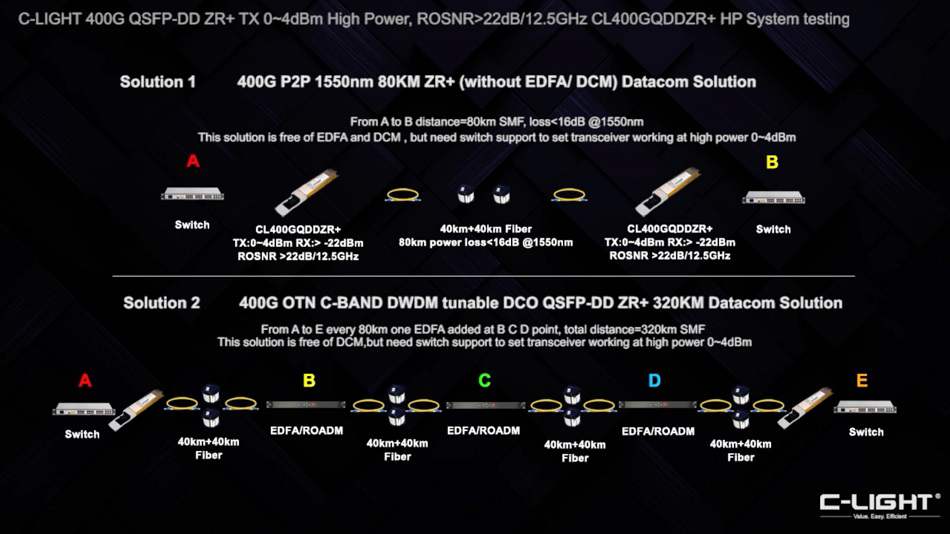
C-LIGHT provides CL400GQDDZR+ 400G QSFPDD ZR+ High Power for 400G 80km P2P data communication without EDFA DCM, and 400G OTN C-BAND DWDM tunable 320KM Datacom Solution.
In this solution. C-LIGHT's 400G QSFP-DD 80km ZR+ transceiver can provide 0 to 4dBm transmitting optical power, and ensure that the sensitivity of each channel is greater than -22dBm, and the transmission distance can exceed 500 kilometers.
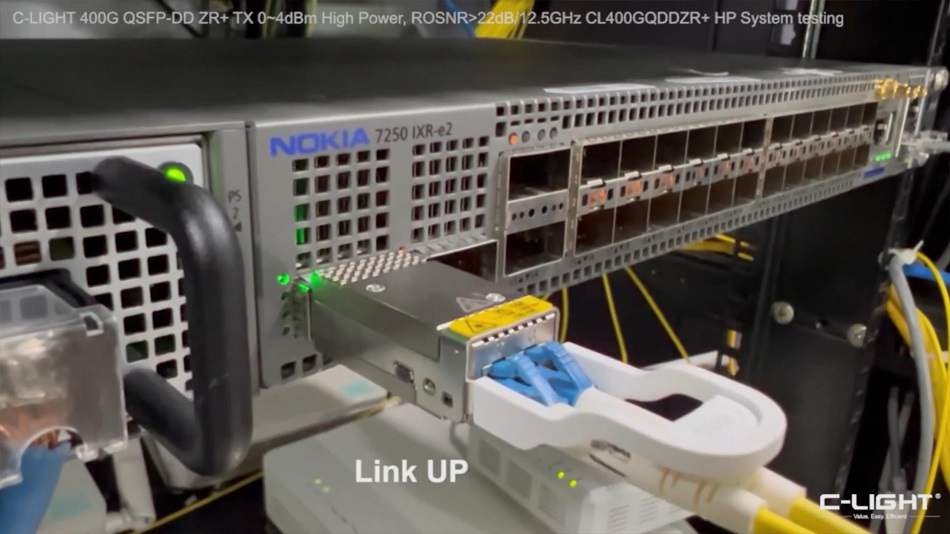
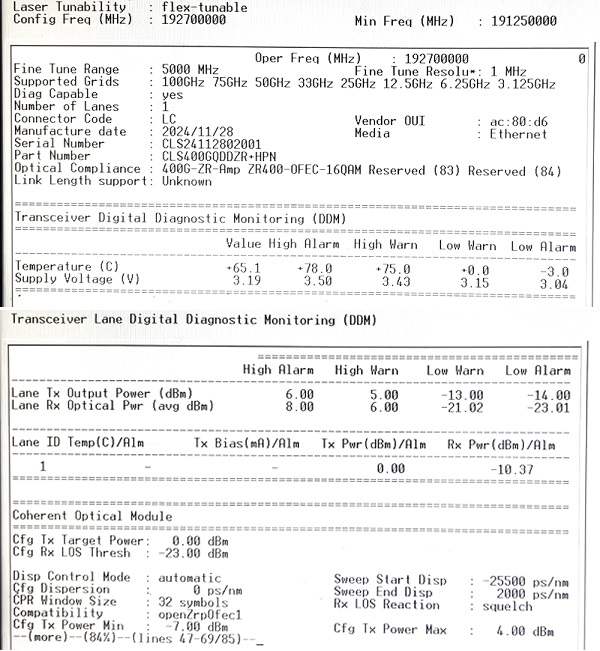
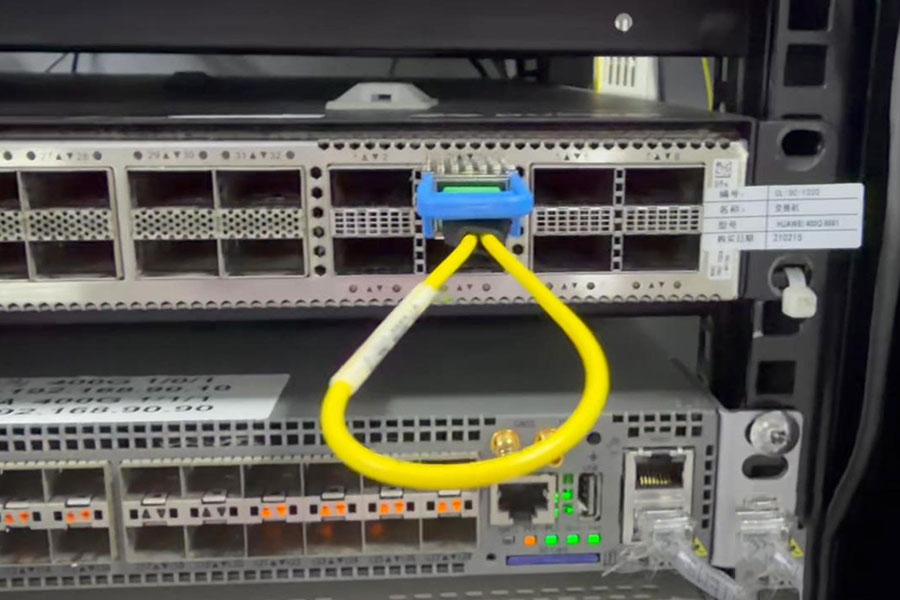
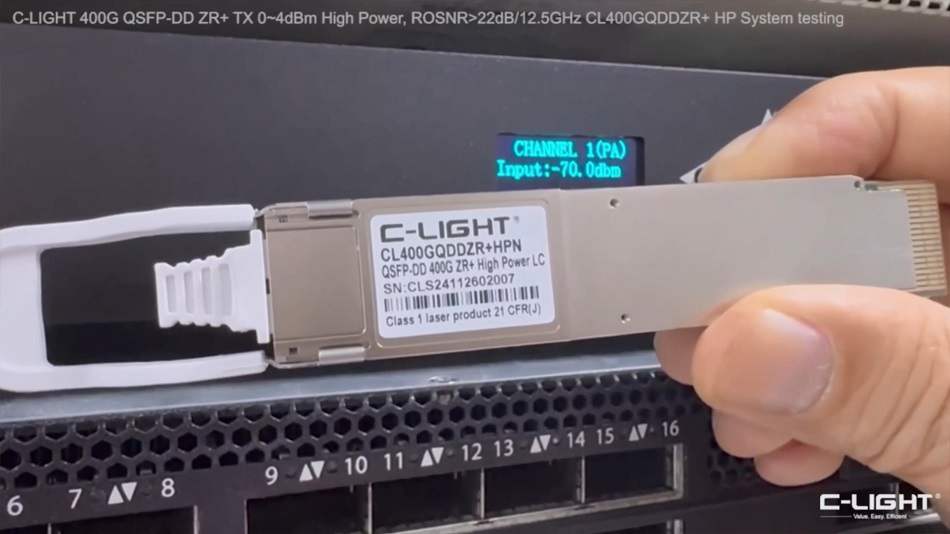
DDM information shows on switch, the transceiver works in normal status.
Why choose C-light 400G QSFP-DD ZR+ optical transceiver?
When it comes to choosing the 400G QSFP-DD ZR+ optical transceiver, there are several compelling reasons to cooperate with C-light.
15 years of invaluable experience
Firstly, C-light has 15 years of invaluable experience in the field. This extensive experience has equipped them with in-depth knowledge and expertise in optical transceiver manufacturing. Over these years, they have likely encountered and overcome various technological challenges, which means they can bring a high level of sophistication and reliability to the 400G QSFP-DD ZR+ optical transceiver. Their long-standing presence in the industry is a strong indication of their ability to produce top-notch products.
Original factory – full quality control
Secondly, being an original factory is a significant advantage. C-light has complete control over the entire production process of the 400G QSFP-DD ZR+ optical transceiver. This includes strict quality control at every stage, from the selection of components to the final assembly and testing. By eliminating intermediaries, the original factory can ensure that the product meets the highest standards of quality and performance. Customers can have confidence that they are getting a genuine, high-quality optical transceiver directly from the source.
Short delivery cycle
The delivery cycle of C-light's 400G QSFP-DD ZR+ optical transceiver is also a key factor. In today's fast-paced technological landscape, timely delivery is crucial. C-light has optimized its production and supply chain systems to ensure a short and reliable delivery cycle. This allows businesses to quickly integrate the optical transceiver into their networks, reducing downtime and enabling them to stay competitive in the market. Whether it's for upgrading an existing network or building a new one, a prompt delivery ensures that projects can progress without unnecessary delays.
Competitive prices
Finally, competitive prices make C-light's 400G QSFP-DD ZR+ optical transceiver an attractive option. Despite the advanced technology and high-performance capabilities of this optical transceiver, C-light offers it at a price point that is competitive in the market. This allows companies to enjoy the benefits of high-speed, long-distance data transmission with 400G capacity without incurring exorbitant costs. It provides a cost-effective solution for businesses of all sizes, whether they are large-scale enterprises or small-to-medium-sized companies looking to upgrade their network infrastructure.
The 400G QSFP-DD ZR+ optical transceiver itself is a powerful component. It is designed to support high-speed data transmission at 400G over long-distance fiber-optic links. It can be used in a variety of applications such as data center interconnects, long-haul telecommunications networks, and high-performance computing environments. It enables the seamless transfer of large amounts of data, which is essential for modern-day applications that require high-bandwidth and low-latency communication.
400G QSFP-DD ZR Optical Transceiver FAQ
A 400G QSFP-DD ZR optical transceiver is a high-speed coherent optical module designed for 400Gbps long-distance data transmission.
Unlike traditional short-reach optical modules, 400G QSFP-DD ZR uses coherent optical technology to achieve longer transmission distances while maintaining a compact pluggable form factor.
Key features include:
400Gbps data rate
QSFP-DD high-density package
Coherent optical technology
Long-distance transmission capability
Support for Data Center Interconnect (DCI) applications
Typical applications include:
Data Center Interconnect (DCI)
Cloud computing networks
Metro optical networks
Telecom infrastructure
The rapid growth of AI computing, cloud services, and large-scale data processing is driving continuous increases in network traffic.
Traditional optical solutions face challenges in:
Bandwidth scalability
Transmission distance
Network expansion cost
400G QSFP-DD ZR addresses these challenges by providing:
Higher bandwidth capacity
Longer transmission distance
Better fiber utilization
Simplified network deployment
It enables operators and cloud providers to upgrade optical networks without relying entirely on traditional transport equipment.
400G QSFP-DD ZR uses coherent optical communication technology to improve long-distance transmission performance.
The transmission process includes:
Electrical signals enter the QSFP-DD module.
A DSP processes high-speed signals.
Coherent modulation converts signals into optical carriers.
Optical signals travel through single-mode fiber.
The receiver performs coherent detection and signal recovery.
Compared with direct detection solutions, coherent technology provides better tolerance against:
Fiber loss
Dispersion
Long-distance transmission challenges
400G QSFP-DD ZR provides several advantages for next-generation optical networks.
High Bandwidth Capacity
Supports 400Gbps transmission
Meets increasing traffic requirements from AI and cloud applications
Long-Distance Connectivity
Supports extended optical transmission distances
Compact Form Factor
QSFP-DD packaging enables higher port density
Lower Network Complexity
Enables direct optical interconnection without large transport systems in some applications
Better Fiber Utilization
Improves existing fiber infrastructure efficiency
The main difference is transmission technology and application distance.
| Feature | 400G QSFP-DD ZR | Traditional 400G Optical Module |
| Technology | Coherent optics | PAM4 direct detection |
| Transmission Distance | Long reach | Short / medium reach |
| Application | DCI, metro networks | Data center interconnect |
| Signal Processing | DSP-based | Simpler optical design |
| Network Type | Wide-area optical links | Data center networks |
400G ZR is designed for applications requiring longer transmission distance and higher optical performance.
400G QSFP-DD ZR modules are mainly used in high-bandwidth optical communication scenarios.
Typical applications include:
Data Center Interconnect (DCI)
Connecting distributed data centers and supporting cloud infrastructure expansionAI Data Center Networks
Supporting large-scale AI workloads and improving high-speed data exchangeTelecom Networks
Metro network upgrades and optical backbone connectionsCloud Computing Infrastructure
Large-scale service provider networks
These applications require high capacity, low latency, and efficient optical transmission.
400G ZR and 400G ZR+ are both based on coherent optical technology, but they target different transmission requirements.
| Feature | 400G ZR | 400G ZR+ |
| Main Application | DCI links | Extended optical networks |
| Distance | Around 120km class | Longer distance with amplification |
| Network Type | Data center interconnect | Metro / backbone networks |
| Optical Margin | Standard | Enhanced |
400G ZR+ provides additional flexibility for networks requiring longer transmission distances and more complex optical environments.
Selecting a suitable 400G ZR solution requires evaluating several factors.
1. Transmission Distance
40km
80km
120km
Longer metro requirements
2. Network Application
Data center interconnect
Metro network
Telecom backbone
3. Optical Infrastructure
Fiber quality
Link loss
Amplification requirements
4. Equipment Compatibility
Switch platforms
Routers
Optical transport systems
A proper selection ensures reliable 400G network performance and future scalability.
 >

 >
 >
 >
 >
 >
 >
 >