TEL:+86 132 6656 7067




Understanding Data Center Infrastructure
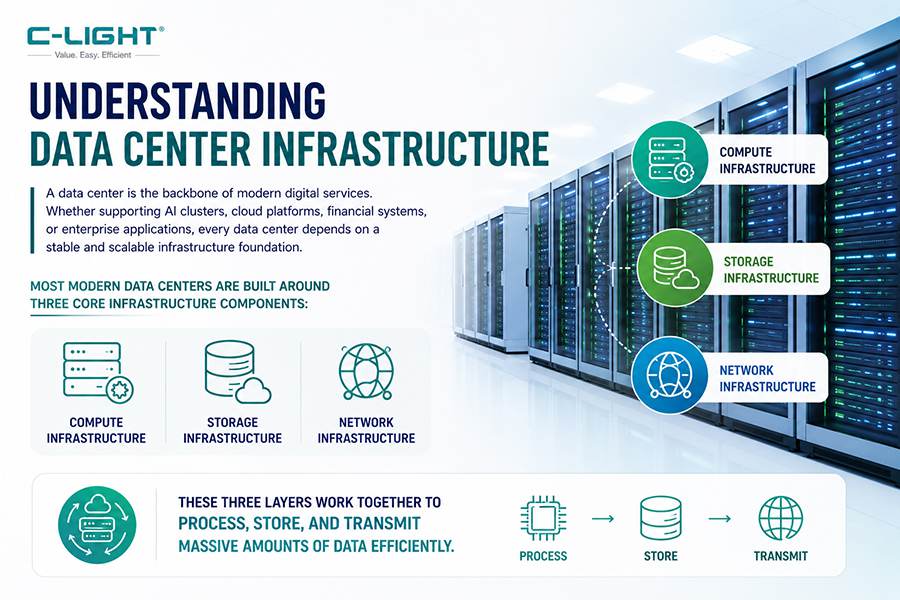
A data center is the backbone of modern digital services. Whether supporting AI clusters, cloud platforms, financial systems, or enterprise applications, every data center depends on a stable and scalable infrastructure foundation.
Although architectures continue to evolve, most modern data centers are built around three core infrastructure components:
Compute Infrastructure
Storage Infrastructure
Network Infrastructure
These three layers work together to process, store, and transmit massive amounts of data efficiently.
1. Compute Infrastructure
The Processing Core of the Data Center
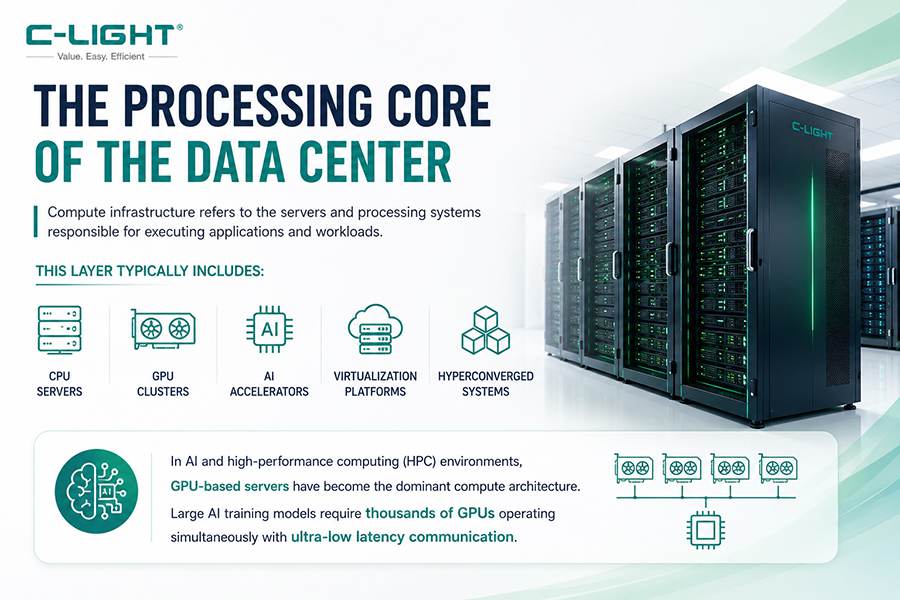
Compute infrastructure refers to the servers and processing systems responsible for executing applications and workloads.
This layer typically includes:
CPU servers
GPU clusters
AI accelerators
Virtualization platforms
Hyperconverged systems
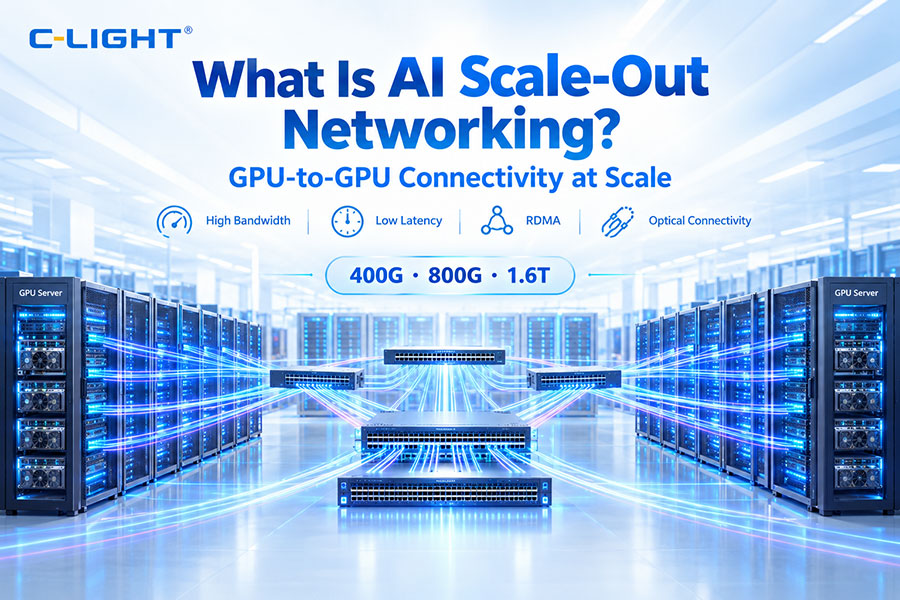
In AI and high-performance computing (HPC) environments, GPU-based servers have become the dominant compute architecture. Large AI training models require thousands of GPUs operating simultaneously with ultra-low latency communication.
Key Challenges
Modern compute infrastructure faces several major challenges:
Increasing power consumption
High-density deployment
Heat dissipation
Ultra-fast interconnect requirements
Scalability for AI workloads
As GPU clusters continue expanding, the importance of high-bandwidth optical interconnects grows significantly.
C-LIGHT Solutions for Compute Connectivity
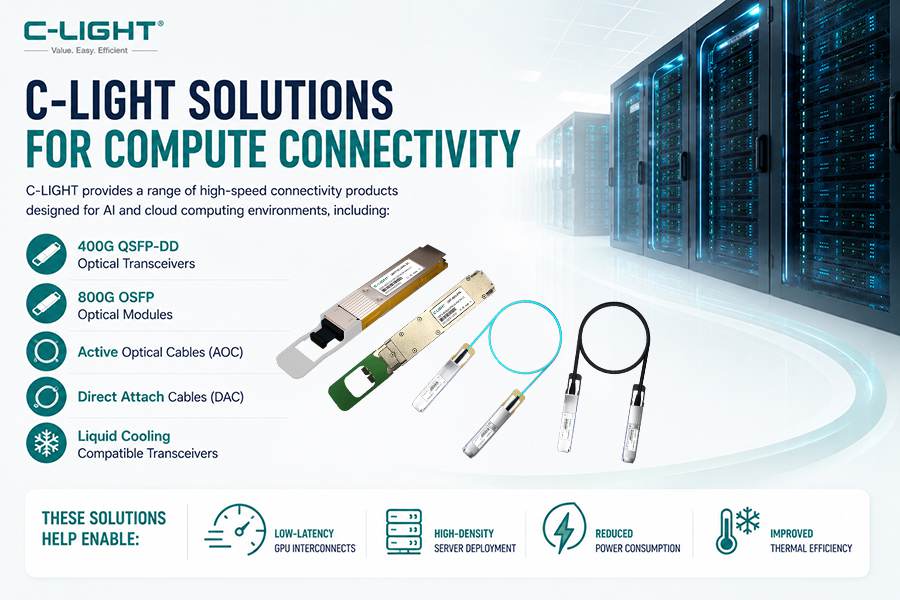
C-LIGHT provides a range of high-speed connectivity products designed for AI and cloud computing environments, including:
Liquid Cooling Compatible Transceivers
These solutions help enable:
Low-latency GPU interconnects
High-density server deployment
Reduced power consumption
Improved thermal efficiency
2. Storage Infrastructure
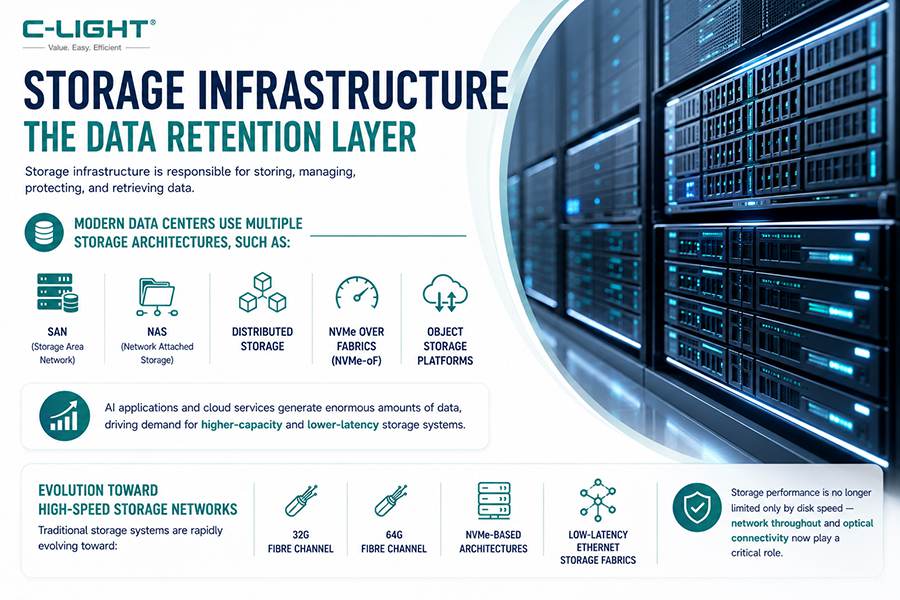
The Data Retention Layer
Storage infrastructure is responsible for storing, managing, protecting, and retrieving data.
Modern data centers use multiple storage architectures, such as:
SAN (Storage Area Network)
NAS (Network Attached Storage)
Distributed Storage
NVMe over Fabrics (NVMe-oF)
Object Storage Platforms
AI applications and cloud services generate enormous amounts of data, driving demand for higher-capacity and lower-latency storage systems.
Evolution Toward High-Speed Storage Networks
Traditional storage systems are rapidly evolving toward:
32G Fibre Channel
64G Fibre Channel
NVMe-based architectures
Low-latency Ethernet storage fabrics
Storage performance is no longer limited only by disk speed — network throughput and optical connectivity now play a critical role.
C-LIGHT Storage Networking Products
C-LIGHT offers enterprise-grade optical solutions for storage networking, including:
Long-distance FC optics
100G/200G Ethernet optics
High-compatibility transceivers for major switch platforms
These products support:
Enterprise SAN connectivity
Disaster recovery (DR)
Long-distance storage replication
High-speed backup systems
3. Network Infrastructure
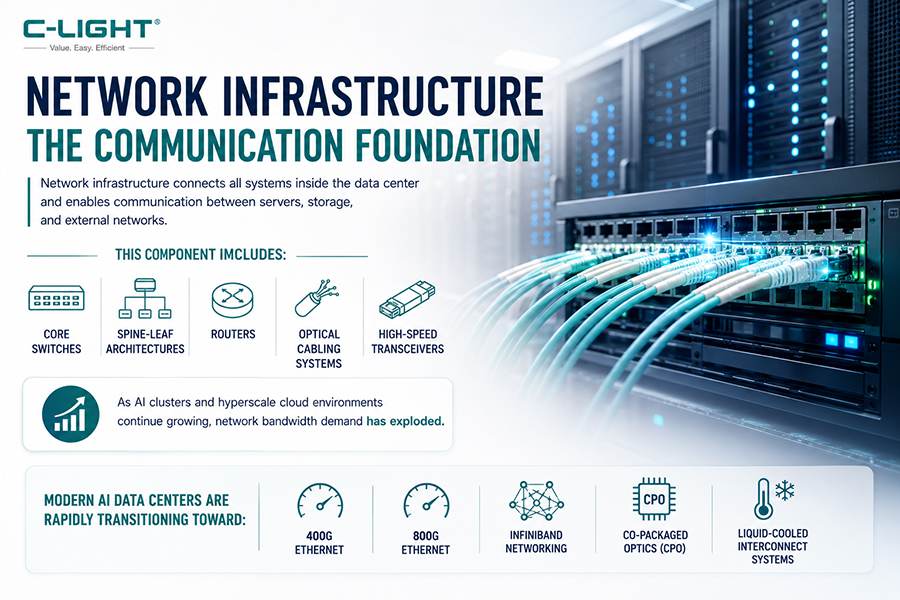 The Communication Foundation
Network infrastructure connects all systems inside the data center and enables communication between servers, storage, and external networks.
This component includes:
Core switches
Spine-leaf architectures
Routers
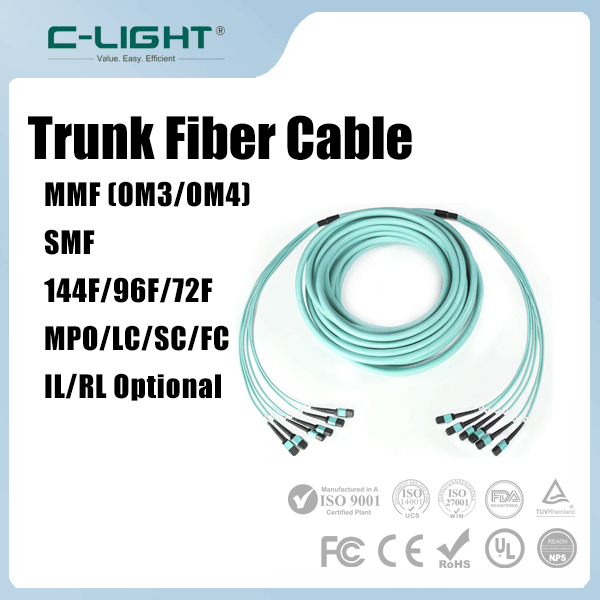
Optical cabling systems
High-speed transceivers
As AI clusters and hyperscale cloud environments continue growing, network bandwidth demand has exploded.
Modern AI data centers are rapidly transitioning toward:
400G Ethernet
800G Ethernet
InfiniBand networking
Co-Packaged Optics (CPO)
Liquid-cooled interconnect systems
Why High-Speed Networking Matters
Network bottlenecks can severely impact:
AI training efficiency
GPU utilization
Application response times
Data synchronization
Overall cluster performance
In many AI environments, network performance directly affects compute efficiency.
C-LIGHT High-Speed Networking Solutions
C-LIGHT provides optical networking products for modern hyperscale and AI data centers, including:
High-Speed Optical Modules
400G QSFP-DD SR8/DR4/FR4
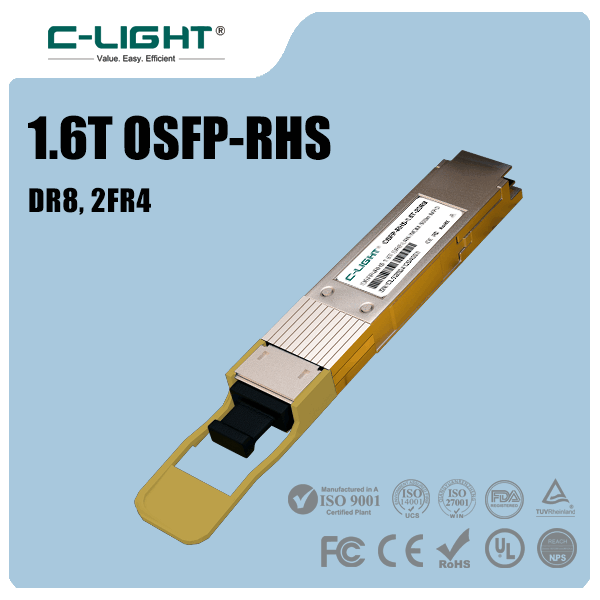
800G OSFP SR8/DR8/2xFR4
1.6T next-generation optical solutions
Interconnect Solutions
DAC cables
AOC cables
Active Electrical Cables (AEC)
Advanced Technologies
Silicon photonics solutions
Liquid immersion cooling transceivers
Low-power optical interconnects
These products help operators build:
Scalable AI fabrics
High-density network architectures
Energy-efficient data centers
Long-distance DCI systems
The Future of Data Center Infrastructure
Modern data center infrastructure is evolving toward:
AI-centric architectures
Higher bandwidth density
Lower power consumption
Advanced cooling technologies
Optical-first interconnect designs
As AI models become larger and cloud services continue expanding, the integration between compute, storage, and networking becomes increasingly critical.
The future data center will depend heavily on:
800G and 1.6T optical networking
Liquid cooling systems
Ultra-low latency fabrics
High-efficiency optical modules
Conclusion
The three main components of a data center infrastructure are:
Compute Infrastructure
Storage Infrastructure
Network Infrastructure
Together, they form the foundation of modern digital services, AI computing, and cloud platforms.
As workloads become more bandwidth-intensive and latency-sensitive, high-speed optical interconnect solutions are becoming essential to maintaining data center performance and scalability.
With advanced optical modules, Fibre Channel solutions, DAC/AOC products, and AI-ready networking technologies, C-LIGHT continues supporting the next generation of high-performance data center infrastructure.
Data Center Infrastructure Components FAQ
Q1: What are the three main components of a data center infrastructure?
The three main components of a data center infrastructure are:
Compute Infrastructure: Including servers, CPUs, GPUs, and processing resources responsible for running applications and workloads.
Storage Infrastructure: Including HDDs, SSDs, NAS, and SAN systems used for storing and managing data.
Network Infrastructure: Including switches, routers, optical modules, and cables that enable communication between servers, storage systems, and external networks.
Together, these three components form the foundation of modern data center operations.
Q2: What role do servers play in a data center?
Servers are the core computing resources of a data center.
They perform tasks such as:
Running applications
Processing data
Supporting cloud services
Handling AI and HPC workloads
Modern data centers increasingly use high-performance servers equipped with CPUs, GPUs, and DPUs to support demanding applications such as artificial intelligence, machine learning, and big data analytics.
Q3: Why is storage infrastructure important in a data center?
Storage infrastructure provides reliable and scalable data management for applications and services.
Common data center storage solutions include:
HDD storage for large-capacity data
SSD storage for high-performance workloads
NAS for file-based access
SAN for high-speed enterprise storage
A well-designed storage system ensures fast data access, high availability, and efficient data management.
Q4: What is the role of network infrastructure in a data center?
Network infrastructure connects computing and storage resources, enabling fast and reliable data communication.
Key network components include:
Ethernet switches
Routers
Firewalls
Optical transceivers
Fiber optic cables
DAC and AOC cables
In modern AI data centers, network infrastructure is especially important because large GPU clusters require extremely high bandwidth and low-latency communication.
Q5: How do optical interconnects support modern data center infrastructure?
Optical interconnects provide high-speed communication links between servers, switches, and storage systems.
They enable:
Higher bandwidth transmission
Longer-distance connectivity
Lower signal loss
Better scalability for future networks
Solutions such as optical transceivers, DAC cables, and AOC cables are widely used in data centers to support 100G, 400G, 800G, and future high-speed networking requirements.
Q6: How are AI data centers different from traditional data centers?
AI data centers require significantly higher computing power and network performance compared with traditional data centers.
Key differences include:
Large-scale GPU clusters
Higher east-west traffic
Advanced networking architectures
Higher bandwidth interconnects
Increased power and cooling requirements
AI workloads such as large language model training require fast communication between thousands of GPUs, making high-speed optical connectivity essential.
Q7: What networking equipment is commonly used in data centers?
Common data center networking equipment includes:
Switches: Connect servers and provide internal data transmission.
Routers: Connect data centers with external networks.
Firewalls: Protect network security.
Optical modules: Convert electrical signals into optical signals.
Cabling systems: Provide physical connectivity between devices.
High-performance networking equipment enables efficient data movement across modern cloud, enterprise, and AI infrastructures.
Q8: How do I design a scalable data center infrastructure?
A scalable data center infrastructure should consider:
Computing requirements
Storage capacity
Network bandwidth
Power efficiency
Cooling capability
Future upgrade paths
For modern deployments, especially AI and HPC environments, selecting scalable networking solutions such as high-speed optical modules, DAC, and AOC interconnects helps support increasing bandwidth demands.
 >
>

 >
>
 >
>
 >
>
 >
>
 >
>
 >
>
 >
>