TEL:+86 132 6656 7067




In the world of modern networking, the ability to move massive amounts of data quickly and reliably over long distances is non-negotiable. Whether it's streaming a 4K movie, making a high-stakes financial transaction, or training a large-scale AI model, all of these operations rely on a robust physical infrastructure. At the heart of this infrastructure lies a critical but often overlooked component: the fiber trunk cable.
Think of a fiber trunk cable as the digital equivalent of a major interstate highway. Just as a highway carries thousands of vehicles between cities, a trunk cable carries vast volumes of optical data signals between major network junctions. This article explains what a fiber trunk cable is, how it's built, where it's used, and why it's indispensable in modern data centers and telecommunication networks, with a special look at high-quality solutions from C-LIGHT.
What is a Fiber Trunk Cable?
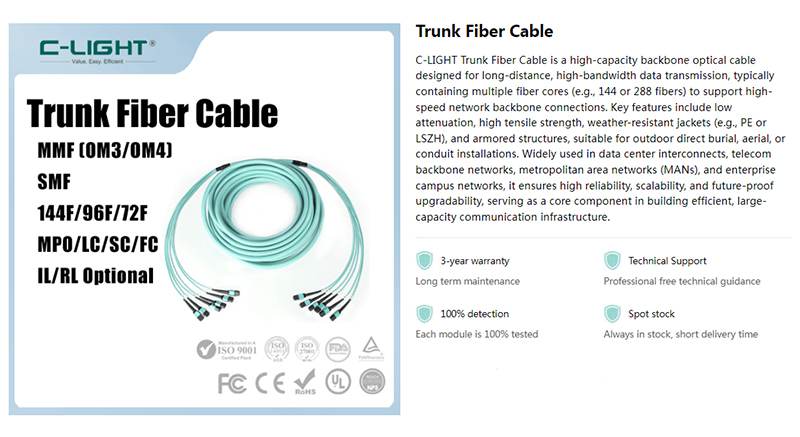
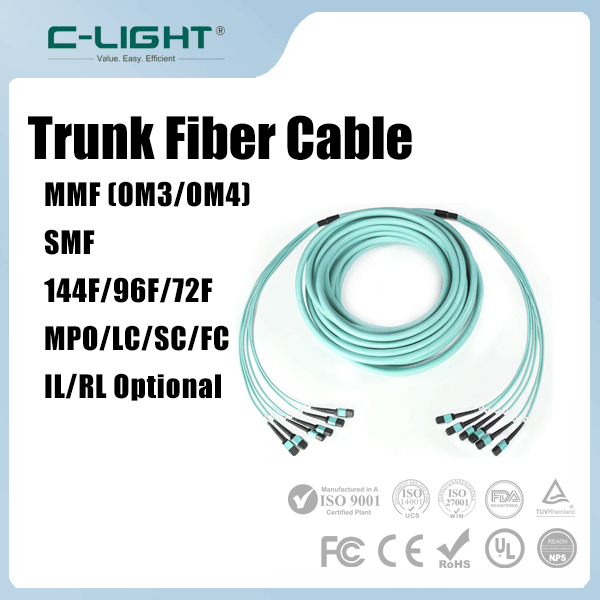
A fiber trunk cable is a high-capacity, pre-terminated fiber optic cable assembly designed to carry multiple data channels simultaneously between key infrastructure points within a network. Acting as the “backbone” or main line of communication, it connects different network areas while preserving signal quality over long distances.
Rather than running dozens of individual patch cords between two cabinets—which creates clutter, restricts airflow, and makes troubleshooting difficult—a single trunk cable consolidates many fibers into one bundled, organized unit. Trunk cables are typically pre-terminated at the factory with high-density multi-fiber connectors like MPO (Multi-fiber Push-On) or MTP connectors. This "plug-and-play" design dramatically speeds up deployment while reducing the risk of human error during field terminations.
Anatomy of a Fiber Trunk Cable: Core Components
A well-designed trunk cable is more than just a bundle of fibers. It is a carefully engineered system built from multiple layers, each serving a specific purpose:
Optical Fibers: The core of the cable, usually multiple glass or plastic strands that carry light signals. Fiber counts can range from 12 up to 144, 288, or even higher in ultra-high-density designs. Common types include single-mode fiber (SMF) for long-distance transmission and multimode fiber (MMF) for shorter distances within data centers.
Sheath and Strength Members: A protective outer layer shields the fibers from moisture, abrasion, and physical damage. Strength members made of aramid yarn (like Kevlar) or fiberglass rods provide tensile strength, preventing the fibers from breaking during pulling and installation.
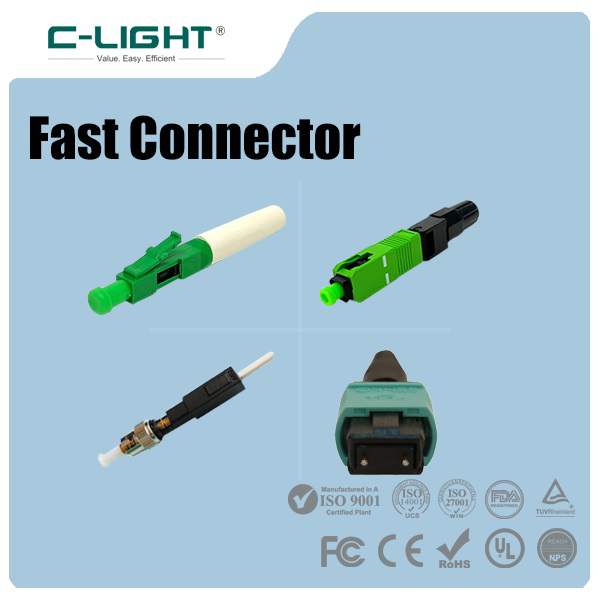
Connectors: The interface points that link the trunk cable to network equipment. Trunk cables commonly use MPO/MTP connectors for high-density multi-fiber connections, as well as LC, SC, or ST connectors for lower-density applications.
Enclosures and Patch Panels: These components provide secure environments for splicing and termination, helping manage and route fibers at distribution points throughout the network.
Fiber Trunk vs. Standard Patch Cable vs. Breakout Cable
Understanding the differences between trunk cables, patch cables, and breakout cables is essential for proper network design.
| Feature | Fiber Trunk Cable | Standard Patch Cable | Breakout Cable |
| Primary Use | Backbone and long-haul connection sbetween distribution areas | Short-distance device-to-device or device-to-panel connections | Splitting a high-density trunk into individuallow-density connectors |
| Fiber Count | High (12–144+ fibers) | Low (typically 1–2 fibers) | Medium (depends on trunk source) |
| Connector Type | MPO/MTP (high-density) | LC, SC, ST (low-density) | MPO on one end; LC/SC on the other |
| Deployment Speed | Fast (pre-terminated, plug-and-play) | Moderate (requires individual patching) | Moderate |
| Ideal Scenario | Connecting Main Distribution Area (MDA) to Horizontal Distribution Area (HDA) in a data center | Connecting a server directly to a top-of-rack switch | Transitioning from a trunk cable to individual equipment ports |
A breakout cable (also known as a fanout or harness cable) is typically used when a high-density trunk needs to be split into multiple individual channels. For example, a 12-fiber MPO trunk can be broken out into six LC duplex pairs for connection to standard SFP/SFP+ ports on servers or switches. Breakout cables are often used at the "last mile" of a structured cabling system, where trunk cables terminate and individual connections fan out to active equipment.
Single-mode vs. Multimode: Choosing the Right Fiber Type
Fiber trunk cables come in two primary optical variants, each suited for different applications.
Single-mode fiber (SMF) features a small core diameter (approximately 8–10 microns) that allows only one mode of light to propagate. This virtually eliminates modal dispersion, enabling signals to travel distances of 10 km, 40 km, 80 km, or more without significant attenuation. SMF is ideal for long-haul backbone networks, data center interconnects (DCI), and metropolitan area networks (MANs).
Multimode fiber (MMF) has a larger core diameter (50 or 62.5 microns), allowing multiple light modes to travel simultaneously. While this reduces reach due to modal dispersion, MMF supports very high bandwidth over short to medium distances—typically up to 300–550 meters at 100G speeds. OM3 (laser-optimized 50/125 µm) and OM4 (enhanced OM3) are the most common multimode types in data center environments.
For most modern data center applications, OM4 multimode fiber offers an excellent balance of cost and performance for intra-building connections, while single-mode fiber is preferred for longer-distance interconnects and future-proofing.
Fiber Trunk Cable FAQ
Q1: What is a Fiber Trunk Cable?
Answer: A Fiber Trunk Cable is a high-density pre-terminated fiber optic cable assembly designed to provide backbone connectivity between major network areas. It typically contains multiple fiber cores and uses high-density connectors such as MPO/MTP to simplify installation and support large-scale data transmission in data centers and telecom networks.
Q2: Why are Fiber Trunk Cables important for modern data centers?
Answer: Fiber Trunk Cables help data centers manage increasing fiber counts caused by higher network speeds such as 100G, 400G, 800G, and future 1.6T connectivity. They reduce cable congestion, improve airflow management, simplify installation, and provide scalable infrastructure for high-density optical networks.
Q3: What are the main components of a Fiber Trunk Cable?
Answer: A typical Fiber Trunk Cable consists of:
Multiple optical fibers
Protective cable jacket
Strength members for mechanical protection
MPO/MTP or LC connectors
Patch panels or fiber cassette systems
The fiber type can include single-mode fiber (OS2) for long-distance transmission or multimode fiber (OM3/OM4/OM5) for short-distance data center applications.
Q4: What are the advantages of Fiber Trunk Cables compared with traditional fiber patch cables?
Answer: Fiber Trunk Cables provide several advantages over traditional patch cables:
Higher fiber density
Faster deployment
Reduced installation complexity
Better cable management
Lower risk of installation errors
Easier future network expansion
Instead of managing many individual fiber patch cords, trunk cables consolidate multiple fiber connections into one organized assembly.
Q5: What is the difference between Fiber Trunk Cable and Breakout Cable?
Answer: The main difference is their application purpose.
Fiber Trunk Cable:
Designed for backbone connections
Contains many fiber cores
Usually uses MPO/MTP connectors
Connects major distribution areas in data centers
Breakout Cable:
Splits high-density fiber connections into individual fibers
Converts MPO connections into LC/SC connections
Used for connecting trunk systems to network equipment ports
Fiber Trunk Cables provide the high-density backbone, while breakout cables provide equipment-level connectivity.
Q6: What types of fiber are used in Fiber Trunk Cables?
Answer: Fiber Trunk Cables are commonly available in two major fiber types:
Single-Mode Fiber (SMF):
OS2 fiber
Suitable for long-distance transmission
Used in telecom networks, DCI, and large-scale backbone connections
Multimode Fiber (MMF):
OM3, OM4, OM5 fiber
Suitable for short-distance data center connections
Commonly used in high-density rack environments
The choice depends on transmission distance, network speed, and application requirements.
Q7: What are the typical applications of Fiber Trunk Cables?
Answer: Fiber Trunk Cables are widely used in:
Data center structured cabling
Server room backbone connections
Switch-to-switch interconnects
Data Center Interconnect (DCI)
Telecom backbone networks
Enterprise network infrastructure
They are especially suitable for environments requiring high bandwidth, high reliability, and scalable fiber management.
Q8: How do I choose the right Fiber Trunk Cable for my network?
Answer: Selecting the right Fiber Trunk Cable depends on several factors:
Required fiber count
Connector type (MPO/MTP, LC, etc.)
Fiber type (OS2, OM3, OM4, OM5)
Transmission distance
Network speed requirements
Data center cabling architecture
For modern AI and cloud data centers, high-density MPO/MTP Fiber Trunk solutions are increasingly preferred because they support efficient deployment of high-speed optical interconnects.
 >
>

 >
>
 >
>
 >
>
 >
>
 >
>
 >
>
 >
>