TEL:+86 132 6656 7067




In modern optical communication networks, fiber resources are both invaluable and limited. As global data traffic continues to explode—driven by 5G, cloud computing, AI workloads, and ultra-high-definition video streaming—network operators face an urgent question: how can we exponentially increase transmission capacity without laying new fiber cables? The answer lies in DWDM (Dense Wavelength Division Multiplexing), a foundational technology that has quietly revolutionized how the world stays connected.
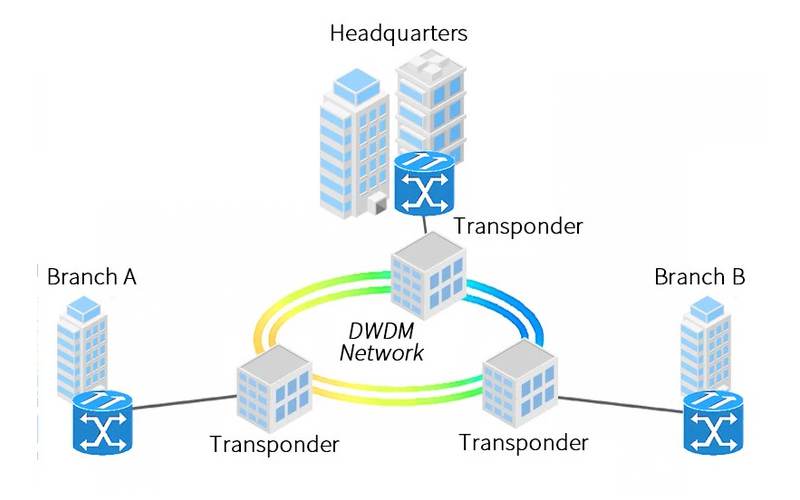
1、What is DWDM?
Imagine a multi-lane highway. A traditional single-wavelength fiber optic link is like a one-lane road—only one vehicle (data stream) can travel at a time. DWDM transforms that single lane into a multi-story elevated expressway. It enables dozens or even hundreds of independent optical signals, each carried on a slightly different wavelength (or "color") of laser light, to travel simultaneously through the very same strand of optical fiber.
At the sending end, an optical multiplexer (MUX) combines all these different wavelength signals together into the fiber. At the receiving end, a demultiplexer (DEMUX) separates them back into their individual streams for delivery to the appropriate destinations.This process effectively converts a single physical fiber into multiple "virtual fibers," multiplying its capacity many times over.
2、DWDM Network Architecture: How Does a DWDM System Work?
A complete DWDM network consists of several key optical components, including DWDM transceivers, DWDM MUX/DEMUX, optical amplifiers, optical add/drop multiplexers (OADM), and monitoring systems.
The basic working process of a DWDM system includes three main steps:
2.1 Optical Signal Multiplexing
At the transmitting side, multiple optical signals with different wavelengths are generated by DWDM optical modules. Each wavelength carries an independent data channel.
The DWDM MUX combines these multiple wavelengths into a single optical fiber, allowing multiple high-speed data streams to share the same fiber infrastructure.
2.2 Long-Distance Optical Transmission
The combined optical signal travels through single-mode fiber. For long-distance transmission, optical amplifiers such as EDFA (Erbium-Doped Fiber Amplifier) can be deployed to compensate for optical loss and extend transmission distance.
2.3 Optical Signal Demultiplexing
At the receiving end, the DWDM DEMUX separates the combined optical signal back into individual wavelengths. Each wavelength is then connected to the corresponding optical receiver or network equipment.
This wavelength-based transmission method enables DWDM networks to significantly increase fiber capacity without installing additional fiber cables.
3、Key Components of a DWDM Network
DWDM MUX/DEMUX
DWDM MUX/DEMUX is the fundamental passive component in a DWDM system.
A DWDM Multiplexer combines multiple wavelength channels into one fiber, while a Demultiplexer separates them at the receiving side.
Typical DWDM systems support:
8-channel DWDM
16-channel DWDM
32-channel DWDM
40-channel DWDM
80-channel DWDM
DWDM technology typically operates in the C-band (around 1525nm–1565nm), where optical transmission performance and amplification capability are optimized.
4、DWDM vs CWDM: What Is the Difference?
DWDM and CWDM are both wavelength division multiplexing technologies, but they target different network requirements.
| Feature | DWDM | CWDM |
|---|---|---|
| Full Name | Dense Wavelength Division Multiplexing | Coarse Wavelength Division Multiplexing |
| Channel Spacing | Narrow spacing | Wider spacing |
| Number of Channels | Higher channel capacity | Fewer channels |
| Operating Band | Mainly C-band | 1270nm-1610nm |
| Transmission Distance | Long distance | Short to medium distance |
| Cost | Higher | Lower |
| Application | Backbone, DCI, Metro Network | Enterprise, Access Network |
CWDM is commonly used for cost-effective short-distance applications, while DWDM is preferred for high-capacity networks requiring maximum fiber utilization and long-distance transmission.
5、DWDM Applications in Modern Optical Networks
5.1 Data Center Interconnect (DCI)
With the rapid growth of cloud computing, AI workloads, and distributed data centers, large-scale data centers require high-capacity optical connections between different locations.
DWDM enables:
High bandwidth transmission
Long-distance connectivity
Efficient fiber utilization
Scalable network expansion
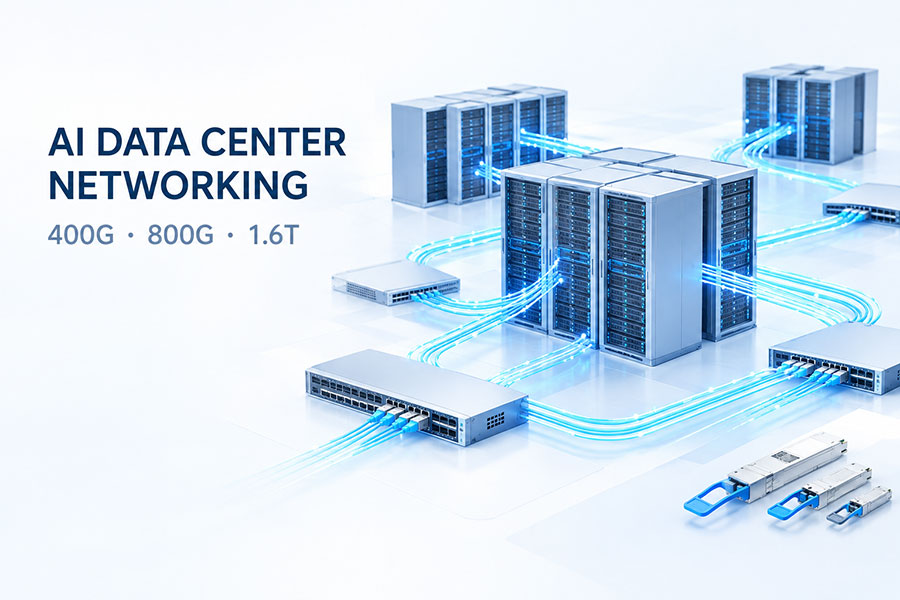
For hyperscale data centers, DWDM works together with 400G, 800G, and future 1.6T optical solutions to build high-capacity interconnection networks.
5.2 Telecom Backbone Networks
Telecom operators use DWDM technology to build national and regional backbone networks.
DWDM provides:
Multi-terabit transmission capacity
Long-haul fiber transmission
Multiple service support
High network reliability
It can transport different services including Ethernet, OTN, Fibre Channel, and other optical networking protocols.
5.3 Enterprise and Campus Networks
Large enterprises, universities, and government organizations use DWDM solutions to connect multiple buildings or campuses through existing fiber infrastructure.
Advantages include:
Reduced fiber leasing cost
Higher bandwidth scalability
Simplified network management
6、Passive DWDM vs Active DWDM
DWDM systems can generally be divided into passive DWDM and active DWDM.
6.1 Passive DWDM
Passive DWDM mainly includes optical components such as:
DWDM MUX
DWDM DEMUX
OADM
Features:
No external power supply
Low maintenance
High reliability
Simple deployment
Passive DWDM is widely used for:
Enterprise networks
Campus networks
Short and medium-distance DCI
6.2 Active DWDM
Active DWDM systems include:
Transponders
Optical amplifiers
Network management systems
Features:
Longer transmission distance
Higher capacity
Network monitoring capability
Carrier-grade deployment
Active DWDM is commonly used in:
Telecom backbone networks
Long-haul transmission
Large-scale optical transport networks
7、Why DWDM Is Important for AI Data Centers?
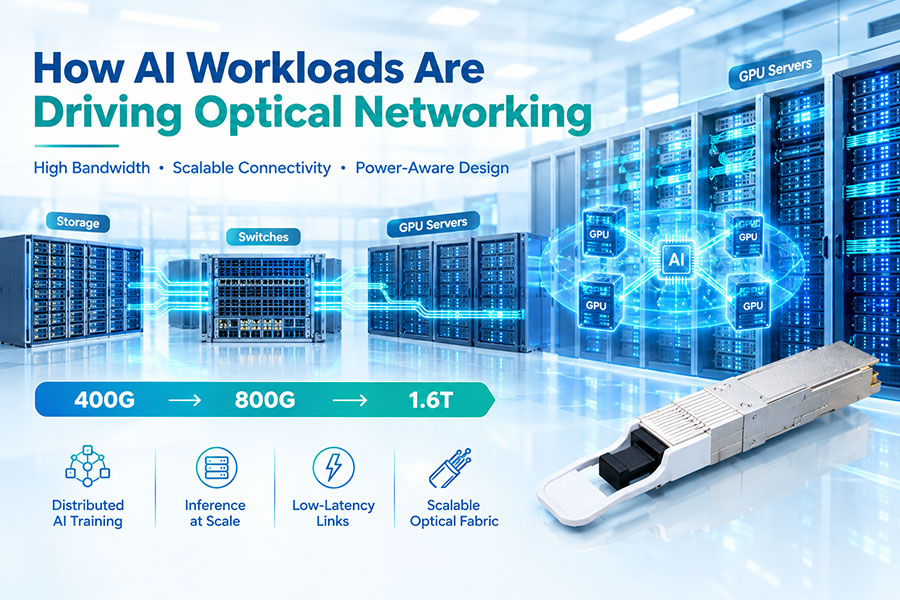
The rapid expansion of AI clusters has created unprecedented demand for optical bandwidth.
Large GPU clusters require high-speed communication between:
GPU servers
Network switches
Data center regions
DWDM provides an efficient solution for:
Inter-data center connectivity
High-capacity optical transport
Fiber resource optimization
Combined with 800G and 1.6T optical modules, DWDM helps build scalable AI infrastructure for next-generation computing workloads.
8、How to Choose the Right DWDM Solution?
When selecting a DWDM system, consider:
8.1 Transmission Distance
Determine whether the application requires:
Metro connectivity
Regional backbone
Long-haul transmission
8.2 Channel Capacity
Select suitable channel numbers:
8CH
16CH
32CH
40CH
80CH
based on future bandwidth requirements.
8.3 Optical Module Compatibility
Ensure compatibility between:
DWDM MUX/DEMUX
DWDM optical transceivers
Fiber type
Network equipment
8.4 Network Expansion Requirements
A scalable DWDM solution should support future upgrades without replacing existing fiber infrastructure.
9、Conclusion
DWDM networking is one of the most important technologies for modern optical communication infrastructure. By transmitting multiple wavelengths over a single fiber, DWDM dramatically improves bandwidth capacity, reduces fiber resource consumption, and enables scalable network expansion.
From telecom backbone networks to AI-driven data center interconnects, DWDM continues to play a critical role in supporting the next generation of high-speed optical networks.
DWDM Networking FAQ
Q1: What is DWDM networking?
Answer: DWDM (Dense Wavelength Division Multiplexing) networking is an optical communication technology that combines multiple optical signals with different wavelengths onto a single fiber. Each wavelength carries an independent data channel, allowing network operators to significantly increase fiber capacity without deploying additional fiber cables.
Q2: How does a DWDM network work?
Answer: A DWDM network works by using DWDM MUX/DEMUX devices to combine and separate multiple wavelength channels.
At the transmitting side, multiple optical signals from different services are assigned different wavelengths and combined by a DWDM multiplexer into one fiber. At the receiving side, the DWDM demultiplexer separates each wavelength and sends the signals to their corresponding receivers.
This allows multiple independent data streams to share the same optical fiber infrastructure.
Q3: What are the main components of a DWDM system?
Answer: A typical DWDM system includes several key components:
DWDM optical transceivers
DWDM MUX/DEMUX modules
Optical amplifiers (such as EDFA)
Optical Add-Drop Multiplexers (OADM)
Single-mode fiber infrastructure
These components work together to provide high-capacity and long-distance optical transmission for telecom and data center networks.
Q4: What are the advantages of DWDM networking?
Answer: DWDM networking provides several important advantages:
Maximizes existing fiber capacity
Supports high-bandwidth transmission
Enables long-distance optical communication
Reduces the need for new fiber deployment
Supports multiple protocols and services on the same infrastructure
DWDM is especially valuable for operators facing increasing bandwidth requirements from cloud computing, 5G, AI workloads, and large-scale data transmission.
Q5: What is the difference between DWDM and CWDM?
Answer: The main difference between DWDM and CWDM is channel spacing, capacity, and application scenarios.
DWDM:
Uses dense wavelength spacing
Supports more wavelength channels
Provides higher transmission capacity
Designed for backbone networks and long-distance transmission
CWDM:
Uses wider wavelength spacing
Offers lower system cost
Suitable for metro networks and shorter-distance applications
DWDM is preferred when higher capacity, scalability, and longer transmission distances are required.
Q6: What are the typical applications of DWDM networks?
Answer: DWDM networks are widely used in:
Telecom backbone networks
Metropolitan Area Networks (MAN)
Data Center Interconnect (DCI)
Cloud infrastructure
5G transport networks
Enterprise backbone networks
For large-scale networks requiring high bandwidth and long-distance transmission, DWDM provides an efficient optical transport solution.
Q7: How does DWDM support data center interconnect (DCI)?
Answer: DWDM plays an important role in Data Center Interconnect (DCI) by enabling multiple high-speed optical channels to be transmitted over existing fiber infrastructure.
With increasing demand from AI clusters, cloud services, and hyperscale data centers, DWDM solutions help support 100G, 200G, 400G, and higher-speed optical connectivity between data centers while reducing fiber resource pressure.
Q8: How do I choose the right DWDM solution for my network?
Answer: Choosing the right DWDM solution depends on several factors:
Required transmission distance
Number of wavelength channels
Network bandwidth requirements
Optical budget
Fiber infrastructure
Compatibility with optical modules and equipment
For high-capacity backbone networks, long-distance transmission, and DCI applications, DWDM provides a scalable solution that can support future network expansion.
 >
>

 >
>
 >
>
 >
>
 >
>
 >
>
 >
>
 >
>