TEL:+86 132 6656 7067




An AOC, or Active Optical Cable, is a pre-terminated high-speed cable assembly that uses optical fiber to transmit data between two devices. Optical transceivers are integrated into the cable ends, allowing electrical signals to be converted into optical signals for transmission through the fiber and converted back at the receiving end.
1. What Does AOC Stand For?
AOC stands for Active Optical Cable. Unlike a passive copper cable, an AOC contains active optical and electrical components in its connector assemblies.
This allows the cable to use optical fiber for high-speed data transmission while maintaining a simple plug-and-play cable structure.
2. How Does an AOC Cable Work?
The basic AOC signal path is:
Electrical Data → Optical Transmitter → Optical Fiber → Optical Receiver → Electrical Data
At one end, the embedded transmitter converts the electrical signal into an optical signal. The optical signal travels through the fiber inside the cable. At the other end, the receiver converts the optical signal back into an electrical signal for the connected device.
3. What Components Are Inside an AOC Cable?
An AOC cable normally includes:
Optical fiber
Optical transmitters
Optical receivers
Driver and receiver electronics
Electrical connector interfaces
Cable jacket and mechanical structure
The components are assembled and terminated as one complete cable solution.
4. Why Is AOC Called an Active Optical Cable?
The cable is called active because electronic and optical components are integrated into the cable ends. These components actively convert electrical and optical signals.
This is different from a passive copper cable, which carries the electrical signal directly through copper conductors without optical conversion.
5. What Is the Main Advantage of AOC?
The main advantage of AOC is the ability to provide high-speed connectivity over longer distances than passive copper cables while keeping the installation simple.
AOCs are especially useful when high bandwidth, lower cable weight, and improved immunity to electromagnetic interference are required.
6. What Fiber Does AOC Use?
Many data center AOCs use multimode optical fiber, particularly for short- and medium-reach applications.
The exact fiber type depends on the cable design, optical technology, data rate, and specified transmission distance.
7. What Is the Transmission Distance of an AOC Cable?
AOC transmission distance depends on the data rate and optical design. AOCs are generally used for short- and medium-reach connections inside data centers and other high-speed networking environments.
For example, a 400G AOC may be available in cable lengths ranging from a few meters to several tens of meters depending on the product design.
8. What Data Rates Are Available for AOC?
AOC technology is available across multiple generations of high-speed networking.
| Data Rate | Typical Application |
|---|---|
| 10G | Enterprise and data center links |
| 25G | Server and switch connectivity |
| 100G | High-speed data center networks |
| 200G | High-density server and switch links |
| 400G | AI, HPC, and high-bandwidth data centers |
| 800G | Next-generation AI and data center networks |
9. What Connector Types Are Used for AOC?
AOC cables can use different connector form factors depending on the application and data rate.
Common interfaces include SFP+, SFP28, QSFP28, QSFP56, QSFP-DD, OSFP, and other high-speed optical connector formats.
10. What Is a 400G AOC?
A 400G AOC is an active optical cable designed to provide an aggregate data rate of 400Gbps.
Depending on the architecture, it can use multiple optical lanes and connector formats such as QSFP-DD or OSFP. 400G AOCs are commonly used for switch-to-server, switch-to-switch, AI cluster, and high-performance computing connections.
11. What Is an 800G AOC?
An 800G AOC is an active optical cable designed for 800Gbps aggregate connectivity. It is intended for high-bandwidth networks where the power, size, and distance limitations of copper cabling become more significant.
800G AOCs can be used in AI data centers, high-performance computing, and high-density Ethernet networks.
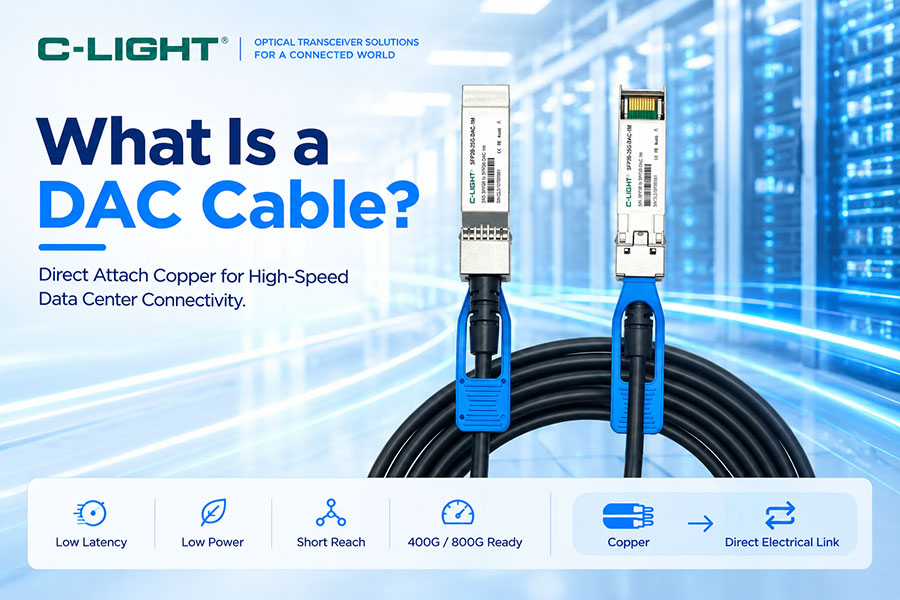
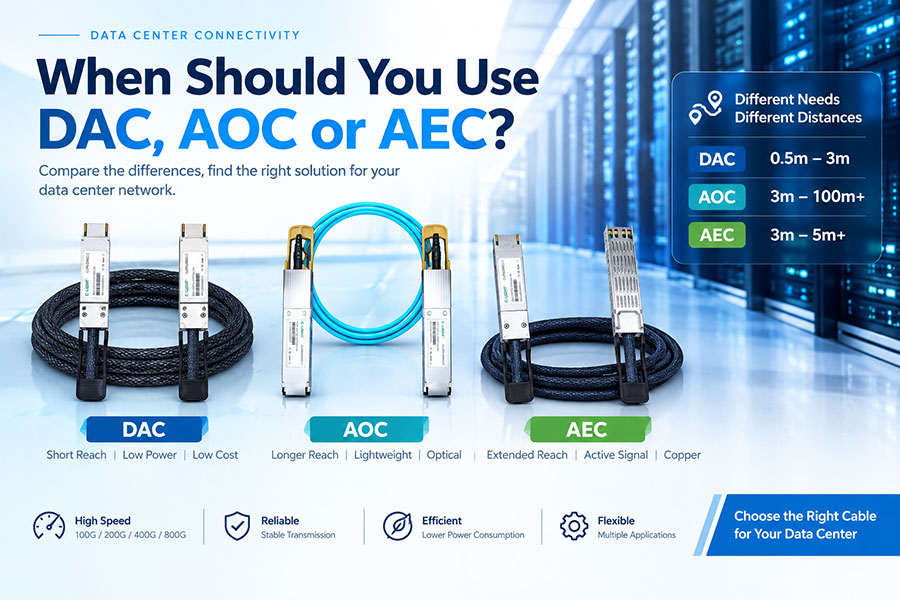
12. What Is the Difference Between AOC and DAC?
| Feature | AOC | DAC |
|---|---|---|
| Transmission medium | Optical fiber | Copper |
| Active components | Yes | Passive or active depending on design |
| Typical reach | Longer | Shorter |
| Cable weight | Lower potential | Higher potential |
| EMI immunity | High | Lower |
| Cost | Generally higher | Generally lower |
13. Why Is AOC Better for Longer Reach Than DAC?
Copper cables experience increasing electrical loss as frequency and transmission distance increase. Optical fiber does not have the same high-frequency electrical attenuation characteristics.
As a result, AOC can provide longer high-speed connections while maintaining manageable signal integrity and cable weight.
14. Why Is AOC Lighter Than DAC?
Optical fiber is generally thinner and lighter than the copper conductors required for high-speed electrical transmission.
This can make AOC cable bundles easier to route and manage in high-density racks, particularly when many cables are installed in the same area.
15. Is AOC Immune to Electromagnetic Interference?
The optical transmission section of an AOC is highly resistant to electromagnetic interference because the data travels as light through optical fiber rather than as an electrical signal through copper conductors.
This can be useful in environments with high levels of electrical noise.
16. What Is the Difference Between AOC and Optical Transceiver Plus Fiber?
An AOC integrates the optical transceivers and fiber into one factory-assembled cable. A conventional optical link uses separate optical transceivers, fiber cables, and connectors.
AOC simplifies installation because the optical interface is already integrated into the cable assembly.
17. What Are the Advantages of AOC Over Separate Optics?
AOC can simplify deployment because the cable is supplied as one tested assembly.
Simple plug-and-play installation
Factory-terminated optical path
Reduced connector count
Lower cable weight
Good high-speed signal integrity
Reduced electromagnetic interference
18. What Are the Limitations of AOC?
AOC also has some limitations compared with separate transceivers and fiber cables.
The complete cable assembly must normally be replaced if one end fails
Cable length is fixed
Less flexible than separate optics and patch cables
Active components consume power
Compatibility must be checked with the host equipment
19. Is AOC Plug and Play?
Yes. AOCs are designed as pre-terminated cable assemblies, so installation is generally as simple as connecting each end to the corresponding host port.
However, the cable's data rate, connector type, coding, and compatibility should be verified before deployment.
20. Does AOC Have Low Latency?
AOC provides a direct optical connection and does not require network switching inside the cable itself. The cable's optical conversion introduces some device-level processing latency, but AOCs are widely used in applications where low-latency connectivity is required.
21. Does AOC Consume Power?
Yes. Because AOCs contain active optical components, each end requires electrical power from the host equipment.
The actual power consumption depends on the data rate, optical technology, connector type, and cable architecture.
22. Why Is AOC Suitable for AI Data Centers?
AI data centers use large numbers of high-speed connections between GPUs, switches, servers, and other computing systems. AOC can provide high bandwidth while reducing cable weight and electromagnetic interference.
400G and 800G AOCs are particularly relevant to high-density AI and HPC network architectures.
23. What Applications Use AOC Cables?
AOC cables are commonly used in:
Data center networks
AI clusters
High-performance computing
Ethernet switching
Server-to-switch connections
Switch-to-switch connections
Storage networks
GPU interconnects
24. Can AOC Be Used for InfiniBand?
Yes. AOCs can be designed for InfiniBand applications when the cable architecture and transceivers are compatible with the required InfiniBand generation and data rate.
High-speed active optical cables are widely relevant to HPC and AI cluster interconnects.
25. What Is the Difference Between AOC and Fiber Patch Cable?
| Feature | AOC | Fiber Patch Cable |
|---|---|---|
| Optical transceiver | Integrated | Separate |
| Fiber | Integrated | Separate cable |
| Installation | Simple | Requires compatible transceivers |
| Flexibility | Lower | Higher |
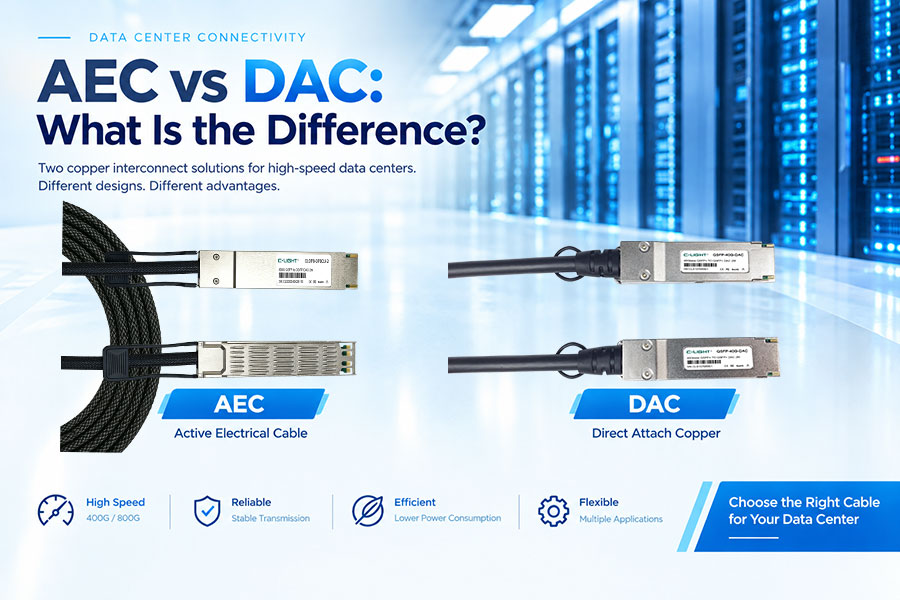
26. What Is the Difference Between AOC and AEC?
AOC uses optical fiber as the transmission medium, while AEC, or Active Electrical Cable, continues to use copper but adds active electronics to improve electrical signal transmission.
AOC is generally preferred when longer reach, lower weight, or electromagnetic immunity is more important, while AEC can provide a cost-effective alternative for certain short-reach applications.
27. What Is the Difference Between AOC and LPO?
AOC describes a complete cable assembly with active optical components integrated at both ends. LPO describes a linear optical module architecture that reduces or removes traditional DSP processing inside the optical module.
An AOC can therefore use different internal optical architectures depending on its implementation.
28. How Should an AOC Cable Be Selected?
Selection should consider:
Required data rate
Transmission distance
Connector form factor
Host equipment compatibility
Fiber architecture
Power consumption
Cable routing requirements
Operating temperature
29. Can AOC Be Used for 400G Breakout?
Yes. 400G AOC assemblies can be designed in breakout configurations such as 400G to 2 × 200G or 4 × 100G, depending on the host interfaces and cable architecture.
Breakout AOCs are useful for connecting a high-speed switch port to multiple lower-rate interfaces.
30. Can AOC Be Used for 800G Breakout?
800G AOC assemblies can also support breakout configurations when the corresponding host ports and optical lane architectures are compatible.
The exact breakout configuration depends on the transceiver form factor, Ethernet standard, lane architecture, and host equipment.
31. What Are the Main Benefits of AOC in High-Density Networks?
The key benefits include high bandwidth, reduced cable weight, low electromagnetic interference, simple installation, and suitability for high-density optical connectivity.
These characteristics make AOC useful when many high-speed connections must be deployed within a limited rack space.
32. What Are the Main Limitations of AOC in High-Density Networks?
The main limitations are fixed cable lengths, integrated active components, power consumption, and lower flexibility compared with systems using separate transceivers and fiber patch cables.
33. What Is the Future of AOC?
AOC technology will continue to evolve with the growth of 400G, 800G, AI networking, and high-performance computing.
Future AOCs are expected to focus on higher bandwidth, lower power consumption, improved thermal performance, higher density, and better compatibility with next-generation switch and accelerator platforms.
34. FAQ
Q1. What is an AOC cable?
Q2. How does an AOC work?
Q3. What is the difference between AOC and DAC?
Q4. What speeds can AOC support?
Q5. Is AOC suitable for AI data centers?
Q6. Does an AOC cable require power?
35. Summary
An AOC cable is an Active Optical Cable that integrates optical transceivers, optical fiber, and active electronics into one high-speed cable assembly. It provides longer reach, lower weight, and strong electromagnetic immunity compared with copper-based solutions, making it widely suitable for data centers, AI clusters, HPC networks, and 400G or 800G connectivity.
 >
>

 >
>
 >
>
 >
>
 >
>
 >
>
 >
>
 >
>