TEL:+86 132 6656 7067





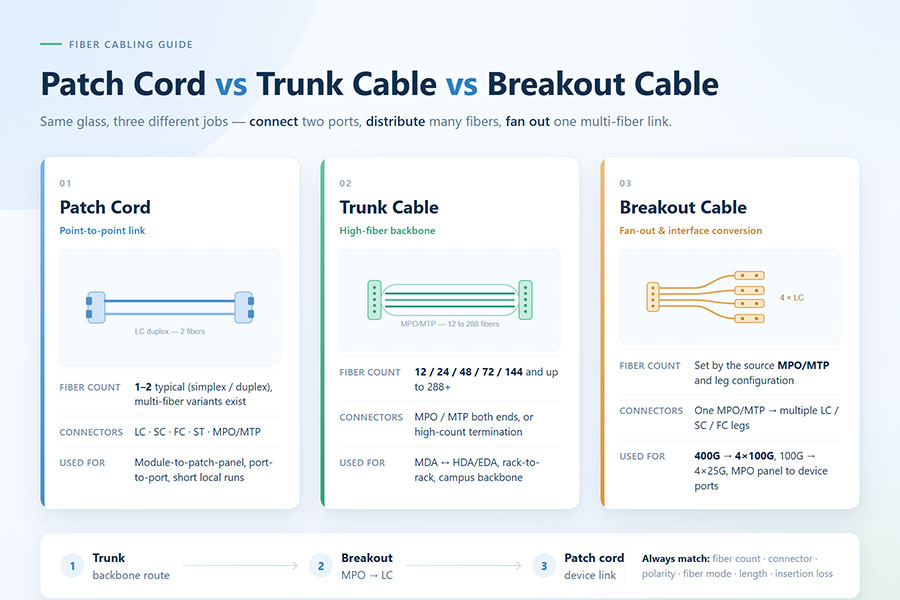
A Breakout AOC (Active Optical Cable) is an integrated optical cable assembly designed to connect one high-speed network port to multiple lower-speed ports. It uses a high-density optical connector at the host end and multiple optical connectors at the branch end, with integrated optical components and fiber channels supporting the connections.
For example, a 400G-to-4x100G Breakout AOC connects one compatible 400G switch port to four independent 100G ports. An 800G-to-2x400G Breakout AOC distributes one 800G connection across two 400G interfaces.
Unlike a Breakout DAC, which transmits electrical signals over copper conductors, a Breakout AOC uses optical fiber to transmit data. It is suitable for high-bandwidth data center connections where longer short-reach distances, lighter cabling, and electromagnetic interference immunity are important.
Breakout AOC cables are commonly used in AI data centers, GPU clusters, high-performance computing (HPC), cloud infrastructure, and high-density Ethernet or InfiniBand networks.
1. How Does a Breakout AOC Cable Work?
A Breakout AOC combines active optical interfaces with multiple fiber channels in one factory-terminated cable assembly. Instead of connecting one high-speed port to a single remote port, it distributes the host connection across multiple lower-speed interfaces.
1.1 Electrical-to-Optical Conversion
At the host end, electrical signals from the switch or server enter the integrated optical engine. The optical components convert the electrical signals into optical signals, which travel through the fiber channels inside the cable.
At the branch end, the integrated optical components convert the received optical signals back into electrical signals for the connected devices. Each branch connector provides a separate network connection when the host equipment supports the corresponding breakout mode.
1.2 Multi-Lane Optical Architecture
High-speed interfaces use multiple electrical and optical lanes operating in parallel. A Breakout AOC is designed to map the available lanes into separate lower-speed connections according to the supported architecture.
For example, a 400G-to-4x100G configuration distributes the aggregate 400G capacity across four 100G connections. An 800G-to-2x400G configuration provides two 400G connections from one 800G host port.
The actual optical lane count, modulation format, and internal mapping depend on the AOC design. Some configurations use direct lane mapping, while others may incorporate signal-processing or gearbox functions. The product datasheet should be checked before deployment.
1.3 Integrated Branch Connectors
Unlike a conventional optical link that requires separate transceivers and fiber patch cords at every connection, a Breakout AOC integrates the optical components and cable assembly. The host connector and branch connectors are factory terminated, reducing the number of individual components required for installation.
1.4 Independent Branch Connections
Each branch is intended to operate as an independent network link. A Breakout AOC is not simply a passive optical splitter that divides one optical signal into several copies. It uses an optical architecture designed to support separate data channels between the host and branch interfaces.
2. Common Breakout AOC Configurations
Breakout AOC cables are available in different aggregate data rates and connector combinations. The appropriate configuration depends on the host port, branch port speeds, and supported optical architecture.
2.1 100G to 4x25G Breakout AOC
A 100G-to-4x25G Breakout AOC connects one compatible 100G port to four 25G interfaces. It can be used when a 100G switch port needs to connect to multiple 25G servers or network devices.
This configuration is useful in networks where 25G server connectivity coexists with 100G switching infrastructure. The exact connector and optical architecture depend on the product design.
2.2 200G to 2x100G Breakout AOC
A 200G-to-2x100G Breakout AOC distributes one 200G host connection into two 100G links. It can connect a compatible 200G switch port to two 100G network interfaces.
This arrangement is useful in mixed-speed data center networks where 100G devices need to connect to higher-capacity switching infrastructure.
2.3 400G to 4x100G Breakout AOC
A 400G-to-4x100G Breakout AOC connects one 400G host port to four independent 100G interfaces. It is commonly used to connect high-speed switches to multiple 100G servers, network adapters, or downstream switches.
C-LIGHT lists a 400G QSFP-DD-to-4x100G QSFP56 configuration. This provides a practical option for deployments that combine 400G switching ports with 100G devices.
2.4 400G to 2x200G Breakout AOC
A 400G-to-2x200G Breakout AOC divides one 400G connection into two 200G links. It is suitable for network architectures where 200G ports are used on servers, switches, or computing systems.
C-LIGHT lists several 400G-to-2x200G interface combinations, including OSFP112-to-2xOSFP112, OSFP112-to-2xQSFP112, and selected QSFP-DD configurations.
2.5 800G to 2x400G Breakout AOC
An 800G-to-2x400G Breakout AOC distributes one 800G host connection into two 400G links. This allows a high-speed switch port to connect to two compatible 400G network interfaces.
C-LIGHT lists OSFP112-to-2xOSFP112, OSFP112-to-2xQSFP112, and QSFP-DD-to-2xQSFP-DD configurations. The supported protocol depends on the specific product model.
2.6 800G to 4x200G Breakout AOC
An 800G-to-4x200G Breakout AOC connects one 800G host port to four 200G interfaces. It is useful in high-density computing and switching environments where multiple 200G links are required.
C-LIGHT lists an OSFP112-to-4xOSFP112 configuration for this application.
| Host Data Rate | Breakout Configuration | Aggregate Bandwidth | Typical Application |
|---|---|---|---|
| 100G | 4 × 25G | 100G | 25G server connectivity |
| 200G | 2 × 100G | 200G | 100G network connections |
| 400G | 4 × 100G | 400G | High-density server connections |
| 400G | 2 × 200G | 400G | 200G switch and server links |
| 800G | 2 × 400G | 800G | 400G high-speed interconnections |
| 800G | 4 × 200G | 800G | 200G computing and switching links |
These are representative breakout ratios. Not every data rate or connector combination is available in every product family. The host device must also support the required breakout mode.
3. Common Connector Types for Breakout AOC Cables
The connector arrangement determines how the AOC connects to the host and branch devices. Different generations of high-speed networking equipment use different form factors.
3.1 QSFP-DD to 4xQSFP56
This configuration is used for selected 400G-to-4x100G applications. One QSFP-DD connector connects to the 400G host port, while four QSFP56 connectors connect to separate 100G ports.
C-LIGHT lists the 400G QSFP-DD-to-4x100G QSFP56 configuration for data center and high-performance network applications.
3.2 QSFP-DD to 2xQSFP56
A QSFP-DD-to-2xQSFP56 configuration supports selected 400G-to-2x200G deployments. It provides two branch connections for compatible 200G interfaces.
3.3 OSFP112 to 2xOSFP112
This connector arrangement can be used for 400G-to-2x200G or 800G-to-2x400G configurations, depending on the specific product architecture and interface generation.
3.4 OSFP112 to 4xOSFP112
An OSFP112-to-4xOSFP112 configuration is used for selected 800G-to-4x200G applications. It allows one 800G host port to connect to four compatible 200G interfaces.
3.5 OSFP112 to 2xQSFP112
This arrangement provides an interface combination between an OSFP112 host port and two QSFP112 branch ports. It is useful when the network uses different physical form factors at the host and branch sides.
Different connector types do not automatically guarantee compatibility. The data rate, electrical interface, optical lane mapping, protocol, and host port configuration must also match.
4. Breakout AOC vs. Breakout DAC
Breakout AOC and Breakout DAC both connect one high-speed port to multiple lower-speed ports, but they use different transmission media and internal architectures.
| Feature | Breakout DAC | Breakout AOC |
|---|---|---|
| Transmission Medium | Copper twinax | Optical fiber |
| Signal Type | Electrical | Optical within the cable |
| Optical Components | No | Integrated at cable ends |
| Typical Reach | Very short | Longer short-reach links |
| Power Consumption | Very low for passive models | Requires power for optical conversion |
| EMI Immunity | More susceptible to electromagnetic interference | Optical fiber is immune to EMI |
| Cable Weight | Can be relatively heavy | Generally lighter for comparable longer runs |
| Installation | Simple copper connection | Integrated optical cable assembly |
| Typical Application | Short rack-level connections | Short-reach optical interconnections |
4.1 Transmission Medium
A Breakout DAC uses copper conductors to carry electrical signals between devices. A Breakout AOC converts electrical signals into optical signals and transmits them through fiber.
This difference affects the practical distance, cable weight, electromagnetic performance, and power requirements of the connection.
4.2 Reach and Cable Routing
Passive Breakout DAC is generally preferred for very short connections within a rack or between closely positioned devices. Breakout AOC is more suitable when copper cable reach or cable routing becomes a limitation.
The actual reach of an AOC depends on its optical design and fiber specification. It should be checked against the manufacturer's product datasheet rather than assumed from the breakout ratio.
4.3 Power Consumption
Passive Breakout DAC does not require active optical conversion, making it a low-power option. Breakout AOC contains active optical components at its ends and therefore requires operating power from the connected equipment.
Although AOC generally consumes more power than passive DAC, it can provide better cable-management flexibility and optical transmission for longer short-reach connections.
5. Breakout AOC vs. Standard AOC vs. Fiber Breakout Cable
These three cable solutions can look similar in a data center, but they serve different connection requirements.
| Feature | Standard AOC | Breakout AOC | Passive Fiber Breakout Cable |
|---|---|---|---|
| Connection Type | One-to-one | One-to-many | One-to-many physical fiber arrangement |
| Optical Components | Integrated at both ends | Integrated at host and branch ends | Not included |
| Transmission Medium | Optical fiber | Optical fiber | Optical fiber |
| Separate Transceivers | Not required | Not required | Required at connected equipment |
| Power Requirement | Active optical components | Active optical components | No active cable electronics |
| Installation | Direct cable connection | Direct multi-port cable connection | Requires compatible transceivers and fiber connections |
| Typical Application | Direct high-speed links | High-speed to multiple lower-speed ports | Flexible optical cabling infrastructure |
5.1 Breakout AOC vs. Standard AOC
A standard AOC connects one port to another port at the same supported link rate. A Breakout AOC connects one high-speed host port to multiple lower-speed interfaces.
For example, a standard 800G AOC connects one 800G port to another 800G port, while an 800G-to-2x400G Breakout AOC connects one 800G port to two 400G ports.
5.2 Breakout AOC vs. MPO/MTP Fiber Breakout Cable
A passive MPO/MTP fiber breakout cable provides a physical fiber connection between optical interfaces. It does not contain integrated optical transmitters or receivers. Separate transceivers must be installed in the connected equipment.
A Breakout AOC integrates the optical components and fiber into one cable assembly. This simplifies installation when the required connector combination is available, while passive fiber breakout cables provide more flexibility for structured cabling systems.
6. Understanding Optical Lane Mapping and Rate Conversion
One of the most important considerations when selecting a Breakout AOC is the difference between optical lane mapping and data-rate conversion.
6.1 Optical Lane Mapping
Optical lane mapping defines how the data channels of a high-speed host interface are distributed across the branch connections. A breakout design must correctly map the transmit and receive lanes so that each branch operates as an independent link.
For example, a 400G-to-4x100G configuration distributes the 400G aggregate capacity across four 100G links. Each branch must receive the correct optical and electrical signals for its intended operating mode.
6.2 Rate Conversion
Rate conversion involves changing the signaling rate, modulation format, or lane arrangement between interfaces. It is different from simply distributing existing lanes across multiple connectors.
Some optical architectures use gearbox or other signal-processing functions to support different electrical and optical lane arrangements. However, not every Breakout AOC performs rate conversion. The capabilities depend on the internal optical engine and the specific product design.
6.3 Why Host Port Support Matters
A compatible cable cannot independently enable a breakout mode that the switch does not support. The host device must provide the required channelization or breakout function.
Before deployment, verify:
Host-side data rate and port configuration.
Number of electrical and optical lanes.
Branch-side data rates and connector types.
Optical lane mapping and signaling format.
Ethernet or InfiniBand protocol support.
Switch firmware and supported breakout modes.
7. Applications of Breakout AOC Cables
7.1 AI Data Center Networks
AI training and inference clusters generate substantial traffic between GPU servers, switches, and storage systems. Breakout AOC cables provide a way to distribute high-speed switch connections across multiple lower-speed links in compatible network architectures.
They can help connect computing nodes while supporting the high port density required by large AI infrastructure deployments.
7.2 GPU Cluster Interconnection
GPU clusters rely on high-speed communication between compute nodes. A Breakout AOC can connect one high-bandwidth switch port to multiple compatible GPU server or network interfaces, depending on the supported topology.
7.3 Leaf-Spine Network Architectures
In leaf-spine networks, high-speed uplinks connect leaf switches to spine switches. Breakout AOC provides an option for distributing selected high-speed ports across multiple lower-speed connections, helping accommodate different network port speeds.
7.4 High-Performance Computing
HPC environments require high-throughput communication between compute nodes and networking infrastructure. Breakout AOC can support short-reach optical connections in these environments when the cable and network equipment support the required protocol.
7.5 Mixed-Speed Network Deployment
Data centers often contain equipment operating at different generations of network speeds. A 400G switch may need to connect to several 100G or 200G devices, while an 800G switch may need to connect to multiple 400G or 200G ports.
Breakout AOC provides a practical interconnection option for these mixed-speed environments without requiring a separate optical module and patch cord for every branch.
7.6 Rack-Level and Adjacent-Rack Connections
Breakout AOCs are suitable for short optical links between switches, servers, and other network devices located within the same rack or nearby racks. Their integrated construction can reduce installation complexity in high-density cabling environments.
8. How to Select the Right Breakout AOC Cable
Selecting a Breakout AOC requires more than matching the aggregate data rate. The host interface, branch connectors, optical lane architecture, protocol, and cable length must all be considered.
8.1 Confirm the Host Interface
Identify the physical interface on the high-speed device. Common form factors include QSFP-DD, QSFP112, and OSFP112. These interfaces have different mechanical designs and are not automatically interchangeable.
8.2 Identify the Branch Interfaces
Determine the number of branch ports and their data rates. For example, a 400G host may require four 100G connections or two 200G connections. These configurations require different cable designs.
8.3 Verify Optical Lane Architecture
Check the number of optical lanes, lane mapping, modulation format, and supported signaling rates. A matching connector and aggregate bandwidth do not guarantee that two interfaces can communicate.
8.4 Confirm Protocol Compatibility
Verify whether the AOC supports Ethernet, InfiniBand, or another required protocol. This is particularly important for AI and HPC networks, where the cable must match the network fabric and host equipment.
8.5 Select the Appropriate Cable Length
Measure the actual routing distance, including rack height, cable trays, and service loops. Select a cable length that supports the installation without creating unnecessary cable congestion.
For reference, C-LIGHT lists its 400G AOC and 800G AOC product families with individual cable lengths from 1m to 30m. Actual length availability depends on the selected configuration.
8.6 Check Optical Fiber Specifications
Review the wavelength, fiber type, and supported reach. C-LIGHT's listed 400G AOC configurations use 850nm multimode transmission over OM3 fiber, while its 800G AOC configurations list 850nm multimode transmission with OM3/OM4 options.
8.7 Verify Switch Breakout Support
Confirm that the switch supports the required breakout mode and port channelization. Check the equipment documentation for supported lane mapping, firmware, and port configuration.
8.8 Check Connector Housing and Cooling Requirements
Some OSFP AOC configurations use finned connector housings, while others use flat housings. The correct mechanical arrangement depends on the thermal design and physical requirements of the host equipment.
9. C-LIGHT Breakout AOC Cable Solutions
C-LIGHT provides 400G and 800G AOC configurations for high-speed data center and computing networks. The product family includes direct optical connections and breakout designs for connecting one high-speed interface to multiple lower-speed ports.
9.1 C-LIGHT 400G Breakout AOC
The 400G AOC product family includes 400G-to-4x100G and 400G-to-2x200G configurations. Listed optical specifications include 850nm multimode transmission over OM3 fiber, with cable lengths from 1m to 30m.
| Configuration | Part Number | Data Rate | Fiber / Wavelength | Listed Length |
|---|---|---|---|---|
| QSFP-DD to 4xQSFP56 | CLQD4-4xQ56AOC-xx | 400G to 4x100G | OM3 / 850nm | 1–30m |
| OSFP56 to 2xQSFP56 | CLOP4-2xQ56AOC-xx | 400G to 2x200G | OM3 / 850nm | 1–30m |
| QSFP-DD to 2xQSFP56 | CLQD4-2xQ56AOC-xx | 400G to 2x200G | OM3 / 850nm | 1–30m |
| QSFP-DD to 2xQSFP-DD | CLQD4-2xQD2AOC-xx | 400G to 2x200G | OM3 / 850nm | 1–30m |
| OSFP112 to 2xOSFP112 | CLOP4-2xOP2AOC-xx | 400G to 2x200G | OM3 / 850nm | 1–30m |
| OSFP112 to 2xQSFP112 | CLOP4-2xQP2AOC-xx | 400G to 2x200G | OM3 / 850nm | 1–30m |
For more specifications, visit the C-LIGHT 400G AOC product page.
9.2 C-LIGHT 800G Breakout AOC
The 800G AOC product family includes OSFP112 and QSFP-DD configurations, with breakout options for 800G-to-2x400G and 800G-to-4x200G connections. Listed optical specifications include 850nm multimode transmission over OM3/OM4 fiber.
| Configuration | Part Number | Data Rate | Fiber / Wavelength | Listed Length |
|---|---|---|---|---|
| OSFP112 to 2xOSFP112 | CLOP8-2xOP4AOC-xx-FIN | 800G to 2x400G | OM3/OM4 / 850nm | 1–30m |
| OSFP112 to 4xOSFP112 | CLOP8-4xOP2AOC-xx-FIN | 800G to 4x200G | OM3/OM4 / 850nm | 1–30m |
| OSFP112 to 2xQSFP112 | CLOP8-2xQP4AOC-xx-FLT | 800G to 2x400G | OM3/OM4 / 850nm | 1–30m |
| QSFP-DD to 2xQSFP-DD | CLQD8-2xQD4AOC-xx-FLT | 800G to 2x400G | OM3/OM4 / 850nm | 1–30m |
The listed OSFP112-to-2xQSFP112 configuration is specified for 800G/400G InfiniBand, while the QSFP-DD-to-2xQSFP-DD configuration is listed for 800G Ethernet. Protocol support should be confirmed for each model rather than assumed across the entire product family.
For detailed specifications and available options, visit the C-LIGHT 800G AOC product page.
10. Frequently Asked Questions About Breakout AOC Cables
Q1: What is a Breakout AOC cable?
A Breakout AOC is an active optical cable that connects one high-speed network port to multiple lower-speed ports through integrated optical components and fiber channels.
Q2: What is the difference between Breakout AOC and Breakout DAC?
Breakout AOC uses optical fiber and integrated optical components, while Breakout DAC uses copper conductors to transmit electrical signals.
Q3: What are common Breakout AOC configurations?
Common examples include 400G to 4x100G, 400G to 2x200G, 800G to 2x400G, and 800G to 4x200G.
Q4: Does a Breakout AOC require separate optical transceivers?
No. The optical components are integrated into the cable assembly, so separate pluggable transceivers and fiber patch cords are not required for the AOC connections.
Q5: Can a 400G AOC connect to four 100G ports?
Yes. A 400G-to-4x100G Breakout AOC can connect one 400G host port to four 100G ports when the equipment supports the required breakout mode.
Q6: Can an 800G AOC connect to two 400G ports?
Yes. An 800G-to-2x400G Breakout AOC provides two 400G branch connections from one compatible 800G host port.
Q7: Is a Breakout AOC an optical splitter?
No. It is an active optical cable assembly designed to support separate data links. It does not simply divide one optical signal into multiple copies through a passive splitter.
Q8: What is the maximum distance of a Breakout AOC?
The supported distance depends on the optical design and fiber specification. C-LIGHT lists 400G and 800G AOC configurations with cable lengths from 1m to 30m.
Q9: Can a Breakout AOC support Ethernet and InfiniBand?
Some configurations are designed for Ethernet and others for InfiniBand. Protocol support depends on the specific cable model and host equipment.
Q10: Does every switch support Breakout AOC?
No. The switch must support the required port channelization, data rates, lane mapping, and cable compatibility. Check the equipment documentation before deployment.
11. Conclusion
A Breakout AOC cable provides an integrated optical solution for distributing one high-speed network connection across multiple lower-speed ports. By combining optical components and fiber channels in one assembly, it supports flexible, high-bandwidth connections in data centers, AI clusters, GPU networks, and high-performance computing environments.
From 400G-to-4x100G and 400G-to-2x200G to 800G-to-2x400G and 800G-to-4x200G, different breakout configurations support different network architectures. The correct selection depends on the host interface, branch connectors, optical lane mapping, protocol support, and cable length.
Compared with Breakout DAC, Breakout AOC is more suitable for applications that require optical transmission, longer short-reach connections, and electromagnetic interference immunity. For very short links where low power consumption and cost are priorities, passive Breakout DAC may remain the more appropriate option.
Explore C-LIGHT 400G AOC, C-LIGHT 800G AOC, and the C-LIGHT AOC product range for high-speed optical interconnection solutions.
 >

 >
 >
 >
 >
 >
 >
 >