TEL:+86 132 6656 7067




Transmitter optical power is the amount of optical power launched from an optical transmitter into the fiber. It is a key specification of an optical transceiver because it directly affects the available optical link budget, transmission distance, receiver input power, and overall link performance.
1. What Does Transmitter Optical Power Mean?
Transmitter optical power, also called transmit optical power or optical output power, describes the optical power emitted by the transmitter into the optical link.
In an optical transceiver, the transmitter converts electrical data into an optical signal and launches that signal into the fiber at a specified optical power level.
2. How Is Transmitter Optical Power Measured?
Transmitter optical power is normally measured in dBm. The value represents optical power relative to 1mW.
For example, 0dBm corresponds to 1mW of optical power, while positive dBm values represent power above 1mW and negative values represent power below 1mW.
3. What Is the Difference Between Average and Peak Optical Power?
Average optical power represents the mean optical power over a defined measurement period. Peak optical power represents the highest instantaneous optical power reached by the signal.
Optical transceiver specifications commonly focus on average launch power because it is useful for link-budget calculations.
4. Why Is Transmitter Optical Power Important?
Transmitter optical power determines how much optical power is available at the beginning of the fiber link.
A higher launch power can provide more optical margin, but optical power cannot simply be increased without limit because excessive power can contribute to receiver overload or nonlinear effects in some optical systems.
5. How Does Transmitter Optical Power Affect Optical Link Budget?
A simplified optical power budget can be expressed as:
Optical Power Budget = Transmitter Optical Power − Receiver Sensitivity
For example, if the transmitter output is 2dBm and receiver sensitivity is -10dBm, the simplified available power budget is 12dB.
The actual link must then account for fiber attenuation, connector loss, splice loss, passive component loss, and engineering margin.
6. How Does Transmitter Optical Power Affect Transmission Distance?
Optical power decreases as the signal travels through fiber. A transmitter with sufficient launch power can provide more margin against fiber and component losses.
However, transmission distance depends on the complete optical link design, not transmitter power alone.
7. What Factors Determine Transmitter Optical Power?
Transmitter optical power depends on several factors:
Laser technology
Optical modulation method
Data rate
Wavelength
Operating temperature
Transmitter bias conditions
Optical coupling efficiency
Applicable transmission standard
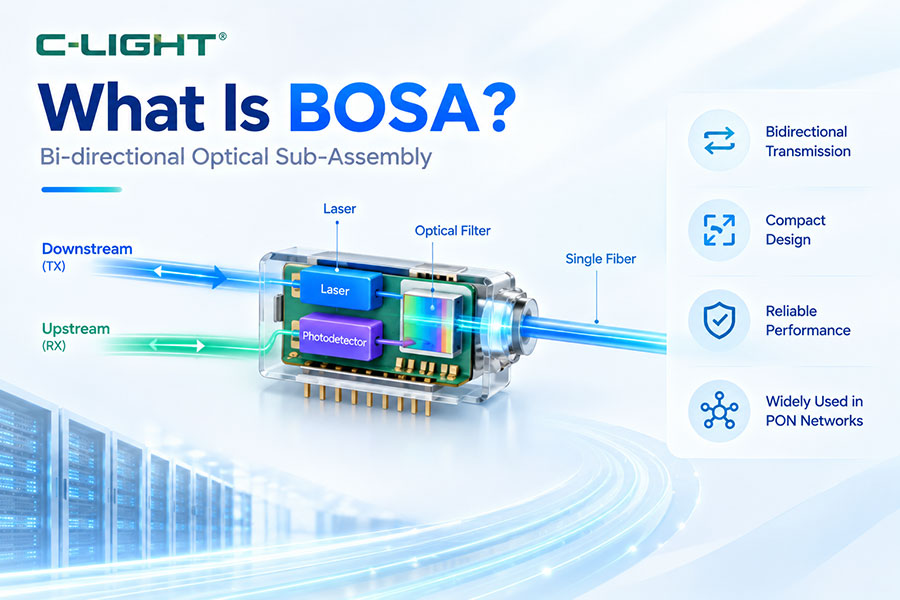
8. What Optical Components Generate Transmitter Power?
The optical source generates the transmitted optical signal. Depending on the transceiver architecture, common sources include:
VCSEL
DFB laser
EML
Silicon photonics laser source
Other semiconductor laser technologies
9. What Is the Role of a Laser?
The laser generates the optical carrier used to transmit data through the fiber.
The transmitter driver controls the laser or optical modulator according to the electrical data signal, while the laser determines an important part of the available optical launch power.
10. What Is the Difference Between Transmitter Power and Receiver Sensitivity?
| Parameter | Transmitter Optical Power | Receiver Sensitivity |
|---|---|---|
| Meaning | Optical power launched into fiber | Minimum optical input required for specified performance |
| Position | Transmitter side | Receiver side |
| Unit | dBm | dBm |
11. Why Is a Higher Transmitter Power Not Always Better?
Increasing optical power can improve power margin under some conditions, but excessive optical power may cause receiver overload or increase nonlinear fiber effects in suitable systems.
Transmitter power must therefore be matched to receiver limits, fiber characteristics, wavelength, and the total link architecture.
12. What Is Receiver Overload Power?
Receiver overload power is the maximum optical input power at which the receiver can maintain its specified performance.
This creates an upper operating boundary for the received signal. A link must provide enough power to stay above receiver sensitivity while also remaining below the receiver overload limit.
13. What Is the Difference Between Minimum and Maximum Transmitter Power?
Optical transceiver specifications may define a minimum, typical, and maximum transmitter output power.
The minimum value ensures that the transmitter provides sufficient launch power, while the maximum value helps prevent excessive power and maintains compatibility with the complete optical system.
14. What Is Optical Power Tolerance?
Optical power tolerance represents the allowed variation in transmitter output power around its nominal operating point.
Manufacturing variation, temperature, aging, bias conditions, and other factors can cause the actual optical output to vary within the specified range.
15. How Does Temperature Affect Transmitter Optical Power?
Temperature can affect laser efficiency, threshold current, wavelength, and optical output power.
As the operating temperature changes, the transmitter may produce different optical power levels. This is why optical modules are normally specified and tested across a defined operating temperature range.
16. How Does Laser Bias Affect Optical Power?
The laser bias current determines the operating point of the laser. Increasing the bias current can increase optical output power within the normal operating range.
Excessive bias can increase power consumption, heat generation, and device stress, so the laser must operate within its designed conditions.
17. What Is the Relationship Between Transmitter Power and Extinction Ratio?
Extinction ratio describes the relationship between the optical power levels associated with logical high and low states.
Transmitter optical power and extinction ratio are different parameters, but both affect the quality and usable margin of an optical transmitter.
18. What Is the Relationship Between Transmitter Power and OMA?
Optical Modulation Amplitude, or OMA, describes the difference between optical power levels associated with the modulation signal.
Average transmitter optical power and OMA are related but not identical. A transmitter can have adequate average power while still requiring sufficient modulation amplitude to meet the system specification.
19. How Does Transmitter Power Affect PAM4?
PAM4 uses four optical or electrical amplitude levels. Maintaining adequate optical power and signal separation is important because the receiver must distinguish multiple closely spaced levels.
Insufficient optical power can reduce signal-to-noise performance and increase the probability of errors.
20. Why Is Transmitter Optical Power Important for 400G?
400G optical transceivers commonly use high-speed PAM4 signaling and multiple optical lanes or wavelengths. Each optical channel must maintain sufficient launch power to achieve the required receiver performance.
Transmitter power is therefore an important specification in 400G optical link design.
21. Why Is Transmitter Optical Power Important for 800G?
800G systems operate with higher aggregate bandwidth and demanding lane-level signal requirements. Maintaining sufficient optical launch power helps ensure that the received signal remains within the required operating range.
At the same time, power levels must remain compatible with receiver overload and optical system constraints.
22. Why Is Transmitter Optical Power Important for 1.6T?
1.6T-class optical systems place tighter requirements on optical and electrical signal quality. Transmitter output power must be carefully optimized together with modulation, receiver sensitivity, optical loss, and thermal performance.
23. How Does Transmitter Optical Power Affect OSNR?
Increasing signal power can improve the optical signal-to-noise relationship under certain conditions. However, in amplified systems, the overall OSNR also depends on optical amplifier noise and the complete optical path.
Excessive launch power can also increase nonlinear effects, so power must be optimized rather than simply maximized.
24. What Is the Relationship Between Transmitter Power and RIN?
RIN, or Relative Intensity Noise, describes fluctuations in the optical output of a laser. Transmitter power and RIN are separate specifications, but laser operating conditions can affect both.
High-speed optical systems must manage optical output power and intensity noise together to maintain signal quality.
25. How Does Transmitter Power Affect Optical Fiber Loss?
Fiber attenuation reduces optical power as the signal propagates. The amount of loss depends on fiber characteristics, wavelength, distance, and operating conditions.
Higher transmitter launch power provides additional margin against this loss, but it does not reduce the physical attenuation of the fiber.
26. What Is the Difference Between Transmitter Power and Link Margin?
Transmitter optical power is a transmitter-side parameter. Link margin describes the remaining performance margin after accounting for the actual optical losses in the complete link.
A strong transmitter does not necessarily guarantee a large link margin because connector loss, fiber attenuation, passive components, and receiver sensitivity must also be considered.
27. How Is Transmitter Optical Power Tested?
Transmitter optical power is commonly measured by connecting the optical transmitter to calibrated optical power measurement equipment.
The measurement is performed under defined wavelength, temperature, data pattern, and operating conditions according to the relevant specification.
28. What Equipment Is Used to Measure Optical Power?
Common measurement equipment includes:
Optical power meter
Optical spectrum analyzer
Optical test system
Calibrated optical receiver
The selected instrument depends on whether average power, wavelength, spectral characteristics, or other transmitter parameters are being evaluated.
29. How Is Transmitter Optical Power Tested in Optical Modules?
Optical modules are tested under controlled operating conditions. The transmitter is connected to suitable fiber and measurement equipment, and the optical output is recorded.
Testing may be performed at different temperatures and wavelengths to verify compliance across the specified operating range.
30. What Causes Low Transmitter Optical Power?
Low optical output power can be caused by:
Laser degradation
Insufficient bias current
High operating temperature
Optical coupling loss
Driver problems
Laser aging
Contaminated optical interfaces
Component failure
31. What Causes Excessive Transmitter Optical Power?
Excessive output power can result from abnormal bias conditions, control-loop problems, component variation, or other transmitter faults.
Excessive optical power should be investigated because it can cause receiver overload or increase nonlinear effects in some optical systems.
32. How Can Transmitter Optical Power Be Optimized?
Transmitter power should be optimized according to the complete link requirements.
Match transmitter power to receiver sensitivity
Account for fiber attenuation
Include connector and splice losses
Consider passive component loss
Maintain sufficient link margin
Stay below receiver overload limits
Control nonlinear effects where applicable
33. Why Is Transmitter Optical Power Important for Data Center Networks?
Data center networks use high-speed optical links across different distances. The transmitter must provide an appropriate optical output level to ensure reliable operation without excessive power or receiver overload.
This becomes increasingly important for high-speed 400G, 800G, and 1.6T systems.
34. What Is the Future of Transmitter Optical Power?
As optical data rates continue to increase, transmitter designs will focus on higher efficiency, improved optical output stability, lower noise, and better thermal performance.
Future optical systems will increasingly optimize transmitter power together with receiver sensitivity, DSP, FEC, optical link budgets, and power consumption at the system level.
35. FAQ
Q1. What is transmitter optical power?
Q2. Why is transmitter optical power important?
Q3. What unit is used for transmitter optical power?
Q4. Is higher transmitter optical power always better?
Q5. How does transmitter optical power affect transmission distance?
Q6. How is transmitter optical power measured?
36. Summary
Transmitter optical power is the optical power launched into the fiber by an optical transmitter. Expressed mainly in dBm, it is a fundamental parameter for optical link-budget calculations and transmission planning. Proper transmitter power must provide sufficient margin for fiber and component losses while remaining within receiver and optical-system limits. For high-speed 100G, 400G, 800G, and 1.6T networks, transmitter optical power must be optimized together with receiver sensitivity, optical noise, modulation, and overall signal integrity.
 >
>

 >
>
 >
>
 >
>
 >
>
 >
>
 >
>
 >
>