TEL:+86 132 6656 7067





Fiber utilization is an important consideration when designing enterprise networks, telecommunications infrastructure, and data center connections. Optical transceivers can establish full-duplex communication using different fiber arrangements, with BiDi and duplex modules representing two common approaches.
A BiDi transceiver sends and receives optical signals over one fiber strand by using different wavelengths. A conventional duplex transceiver uses two separate strands, assigning one to transmission and the other to reception. This difference affects fiber consumption, optical interfaces, module pairing, and network deployment.
1. What Is a BiDi Optical Transceiver?
A BiDi (Bidirectional) optical transceiver is designed to transmit and receive data through a single optical fiber. It uses wavelength division multiplexing (WDM) to separate the two communication directions.
Inside the module, the transmitter generates an optical signal at one wavelength, while the receiver detects an incoming signal at another wavelength. Optical filtering components separate the signals so that both directions can operate simultaneously.
Many BiDi SFP and SFP+ products use a simplex LC connector. The two ends of the connection normally require complementary wavelength variants rather than two identical modules.
2. What Is a Duplex Optical Transceiver?
A duplex optical transceiver uses two separate optical fiber strands to transmit and receive data. One strand carries the signal from the local transmitter to the remote receiver, while the other carries the return signal in the opposite direction.
In a conventional duplex LC connection, the two fibers are commonly arranged as a Tx/Rx pair. The optical module does not need to separate two opposite-direction signals by wavelength on the same fiber because each direction has its own physical path.
Duplex optical interfaces are widely used across Ethernet transceivers, including many LR, ER, and FR optical module designs. The exact connector and wavelength configuration depend on the optical interface.
3. How Do Their Optical Architectures Differ?
The most important difference is how the two technologies allocate fiber strands and optical wavelengths.
BiDi: Single-Fiber Link
Both signals travel through one fiber using different wavelengths. The modules at opposite ends must have complementary TX/RX configurations.
Duplex: Two-Fiber Link
Each direction has a dedicated fiber strand. The two strands must be connected to the correct transmit and receive ports.
The wavelength values in the BiDi example are illustrative. Actual wavelength pairs vary by module family and standard. Duplex modules may also use different wavelengths depending on their optical interface, but they do not rely on a single shared strand for both directions.
4. BiDi vs. Duplex: Key Technical Differences
| Feature | BiDi Optical Transceiver | Duplex Optical Transceiver |
|---|---|---|
| Fiber strands per link | One | Two |
| Transmission method | Different wavelengths on one fiber | Separate fibers for Tx and Rx |
| Optical separation | WDM filters or diplexers separate the directions | Physical fiber separation provides the two paths |
| Common connector | Simplex LC for many SFP-family products | Duplex LC for many Ethernet products |
| Module pairing | Complementary wavelength variants are generally required | Matching optical interface specifications are required |
| Fiber consumption | Lower for a two-way point-to-point link | Uses two strands for a two-way link |
| Fiber polarity | Single strand; no two-fiber polarity reversal | Tx and Rx strands must be correctly crossed between endpoints |
| Typical applications | Fiber-constrained access and enterprise links | Enterprise, data center, and backbone connectivity |
5. Wavelength Selection and Module Compatibility
BiDi and duplex transceivers follow different wavelength-selection requirements. With BiDi, the wavelength relationship between the two endpoints is essential because both directions share one fiber.
For example, a compatible BiDi pair may use the following configuration:
| Module | TX Wavelength | RX Wavelength |
|---|---|---|
| BiDi A-side | 1310nm | 1490nm |
| BiDi B-side | 1490nm | 1310nm |
For duplex modules, the two directions use separate fiber strands. Many duplex Ethernet interfaces use the same nominal wavelength for both directions, although the exact optical specification depends on the module type.
6. Fiber Consumption and Deployment Cost
One of the main advantages of BiDi technology is its ability to reduce fiber consumption. A point-to-point connection that would normally require two strands can operate over one strand when both endpoints support a compatible BiDi interface.
This can be valuable in existing fiber routes where spare strands are limited, or where adding new fiber infrastructure would increase deployment complexity.
However, reduced fiber consumption does not automatically mean lower total system cost in every project. The complete cost should account for:
Transceiver prices and the requirement to purchase complementary BiDi variants.
Availability of spare fiber strands in the existing cable plant.
Patch panels, connectors, and fiber distribution infrastructure.
Installation, testing, and maintenance requirements.
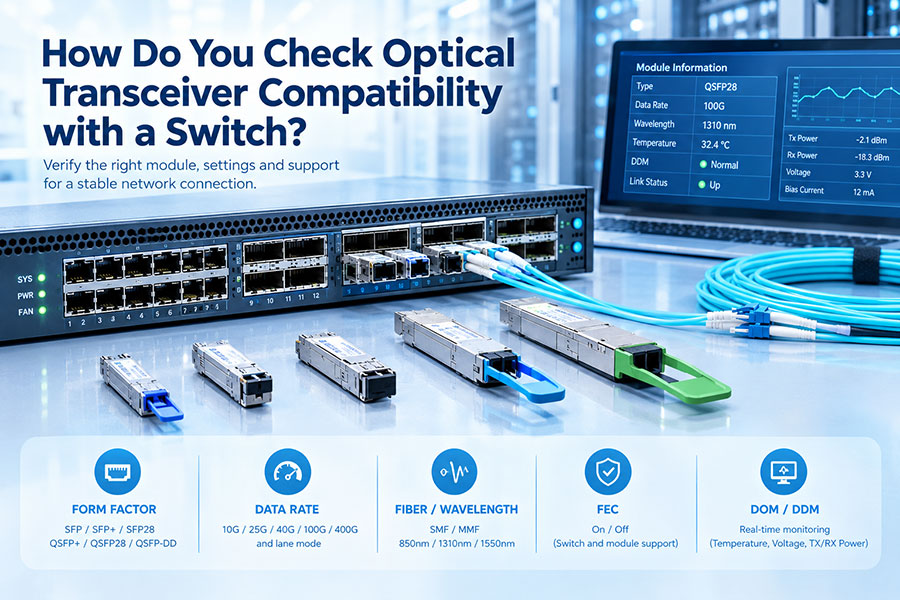
Compatibility with existing switches, routers, and optical systems.
Where fiber is already abundant and duplex cabling is standardized, conventional duplex transceivers may remain the more straightforward option.
7. Transmission Distance and Optical Performance
BiDi and duplex technologies do not have an inherent distance advantage over each other. Their reach depends on the specific transceiver design, transmitter output, receiver sensitivity, fiber attenuation, and optical link budget.
| Performance Factor | BiDi | Duplex |
|---|---|---|
| Optical reach | Defined by the specific BiDi module | Defined by the specific duplex module |
| Fiber attenuation | Depends on the operating wavelength and fiber | Depends on the operating wavelength and fiber |
| Optical budget | Must be checked for both wavelength directions | Must be checked for both fiber directions |
| Receiver sensitivity | Specified for the module's receive wavelength | Specified for the module's optical interface |
| Signal quality | Depends on optical and electrical specifications | Depends on optical and electrical specifications |
For BiDi links, each direction should be evaluated separately because the two wavelengths may experience different attenuation and have different optical power characteristics. Duplex links also require both directions to meet their respective receiver limits.
8. When Should You Choose BiDi or Duplex?
The right architecture depends on the available fiber infrastructure, equipment support, and project requirements.
Choose BiDi When
Only one fiber strand is available for a point-to-point connection.
Existing fiber infrastructure needs to support additional links.
Fiber consumption needs to be reduced.
Both endpoints support a compatible BiDi wavelength pair.
The required data rate and distance are available in a suitable BiDi product.
Choose Duplex When
Two fiber strands are readily available.
The network already uses standard duplex optical interfaces.
Consistent module and fiber arrangements simplify maintenance.
The required optical interface is designed for duplex fiber.
The project uses established duplex link engineering and testing procedures.
9. Common Installation and Troubleshooting Considerations
Although both technologies support full-duplex communication, their installation checks are not identical.
| Issue | BiDi Link | Duplex Link |
|---|---|---|
| Incorrect module pairing | Check complementary TX/RX wavelengths. | Check matching interface, speed, and optical specifications. |
| Fiber connection | Confirm the single strand is connected correctly. | Verify that the two strands connect local Tx to remote Rx and local Rx to remote Tx. |
| Low RX power | Check the relevant wavelength direction, connector, and path loss. | Check the corresponding fiber strand and receiver path. |
| Intermittent link | Inspect the shared fiber and both module connections. | Inspect both fiber strands and their connector pairs. |
| Optical testing | Verify both directions and their optical power levels. | Test both fiber strands independently. |
For both architectures, connector inspection and cleaning are essential. DDM/DOM readings can help identify abnormal TX or RX power, while calibrated optical power meters and insertion-loss test equipment provide more reliable measurements when investigating link performance.
10. BiDi and Duplex Options Across Network Speeds
Both fiber arrangements appear in different network environments, but availability depends on the optical interface and product family.
| Module Family | Common Optical Architecture | Typical Network Use |
|---|---|---|
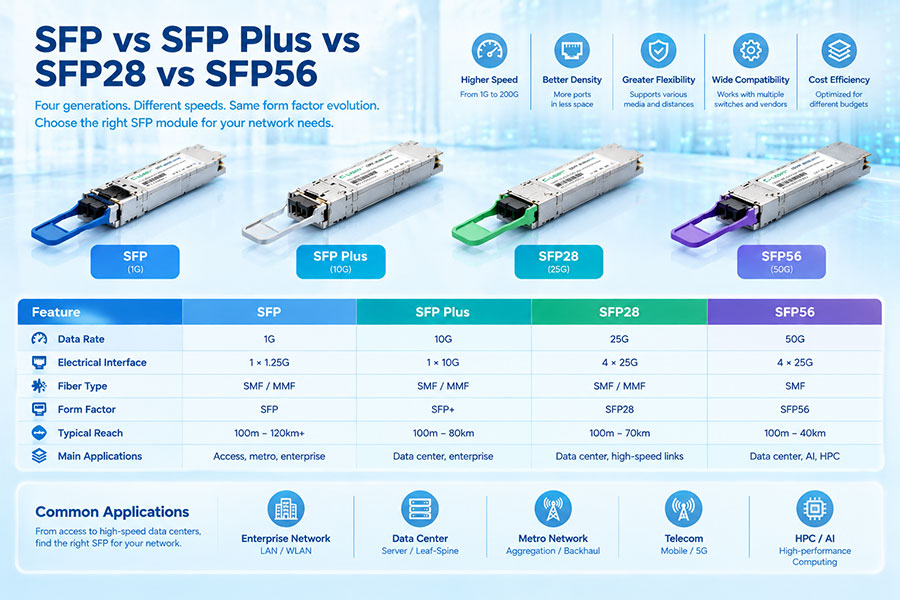
| 1G SFP | BiDi and duplex options | Enterprise access and telecom links |
| 10G SFP+ | BiDi and duplex options | Enterprise aggregation and access networks |
| 25G SFP28 | Product-specific BiDi and duplex options | High-bandwidth access and aggregation |
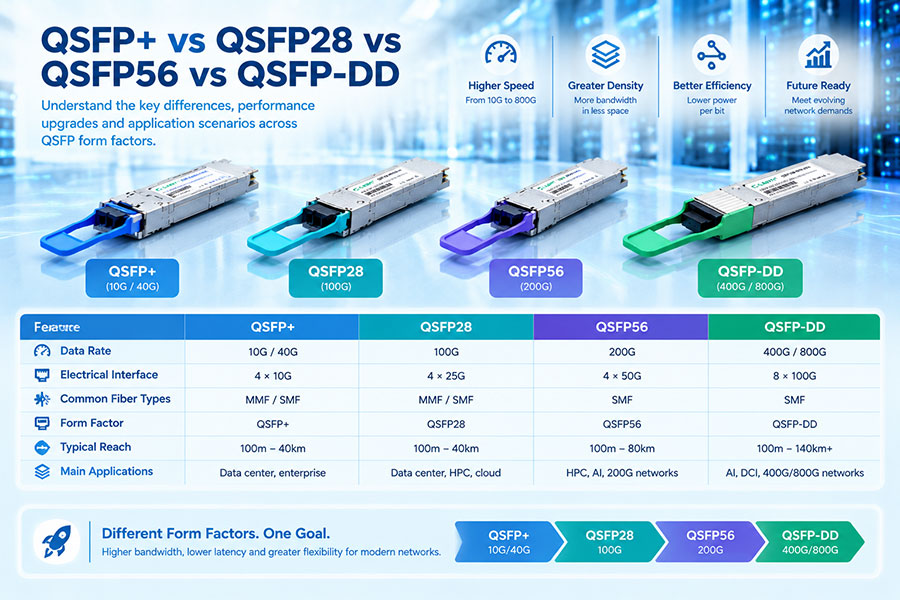
| 100G QSFP28 | Commonly parallel or duplex optical interfaces, depending on the variant | Data center and network aggregation |
| 400G QSFP-DD / OSFP | Parallel or multi-wavelength architectures, depending on the standard | High-performance data center networks |
| 800G QSFP-DD / OSFP | Parallel or multi-wavelength architectures, depending on the interface | AI clusters and high-density data centers |
It is important not to classify every multi-wavelength optical module as a BiDi transceiver. Some high-speed modules use multiple lanes or WDM channels but have different optical architectures and fiber requirements. The exact module datasheet determines how the link must be connected.
11. C-LIGHT Optical Transceiver Solutions
C-LIGHT provides optical connectivity products for enterprise networking, telecommunications, and high-speed data center infrastructure. Depending on the application, suitable product families may include:
SFP and SFP+ Transceivers
Optical connectivity for enterprise access, aggregation, and telecom applications, with interface options selected according to the required link architecture.
25G SFP28 Transceivers
Higher-bandwidth optical connections for supported network equipment. Confirm the exact wavelength, fiber, and connector specifications for each variant.
400G and 800G Modules
High-speed optical solutions for data centers and AI infrastructure, with SR, DR, FR, and other optical interface options according to product specifications.
When selecting between BiDi and duplex solutions, C-LIGHT can evaluate the required data rate, transmission distance, fiber availability, wavelength configuration, and host equipment model to identify a suitable product configuration.
12. Conclusion
BiDi and duplex optical transceivers both support full-duplex fiber communication, but they use different optical architectures. BiDi modules transmit and receive through one fiber using separate wavelengths, while duplex modules use two independent fiber strands for the two directions.
BiDi is useful when fiber resources are limited or existing single-fiber infrastructure needs to support additional connections. Duplex remains a practical choice where two strands are available and standard duplex interfaces are already established.
The final selection should consider fiber availability, module compatibility, wavelength configuration, transmission distance, optical budget, and network equipment support. Choosing the architecture that matches the physical infrastructure and optical requirements helps simplify deployment and long-term maintenance.
Share your network speed, fiber availability, transmission distance, and equipment model to identify a suitable optical transceiver solution.
Contact C-LIGHT >

 >
 >
 >
 >
 >
 >
 >