TEL:+86 132 6656 7067





A 25G SFP28 transceiver can operate at 10Gbps, but only if the module is designed to support both data rates and the connected switch or network device supports the required 10G operating mode.
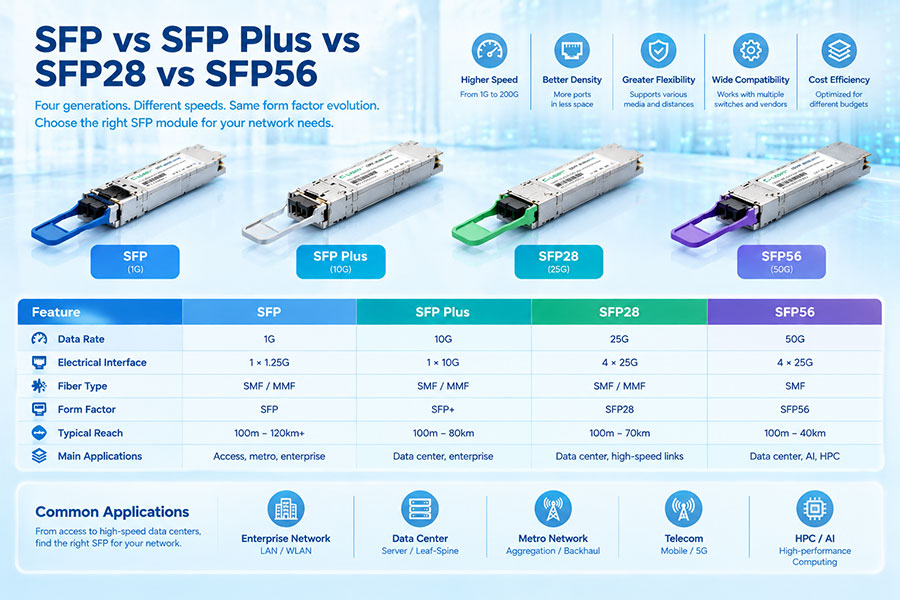
The SFP28 form factor is used for 25G Ethernet connectivity, but physical compatibility does not guarantee multi-rate operation. Some SFP28 modules support both 10G and 25G, while others are designed specifically for 25G. The module's electrical interface, optical specifications, and host-port configuration determine whether 10Gbps operation is available.
1. Can a 25G SFP28 Transceiver Run at 10Gbps?
Yes, certain 25G SFP28 transceivers support 10Gbps operation. These products are commonly described as 10G/25G dual-rate SFP28 transceivers. They are designed to operate at either 10Gbps or 25Gbps, depending on the connected equipment and configured link speed.
However, a standard 25G-only SFP28 module should not be assumed to support 10Gbps. Its transmitter, receiver, electrical interface, and firmware may be designed specifically for 25G operation.
10G support is not guaranteed
10Gbps and 25Gbps
The distinction is important when upgrading a network. A dual-rate SFP28 module can provide flexibility when connecting equipment operating at different generations of Ethernet speeds, provided both endpoints support the selected rate.
2. Difference Between 25G SFP28 and 10G/25G Dual-Rate SFP28
Both module types use the SFP28 physical form factor, but their supported data rates are different. The product datasheet should explicitly identify the supported operating speeds.
| Parameter | 25G-only SFP28 | 10G/25G Dual-Rate SFP28 |
|---|---|---|
| Physical form factor | SFP28 | SFP28 |
| Maximum supported rate | 25Gbps | 25Gbps |
| 10Gbps operation | Not generally supported unless specified | Supported when enabled by the host |
| 25Gbps operation | Supported | Supported |
| Host configuration | 25G-capable port and supported configuration | Compatible 10G or 25G port mode |
| Typical application | 25G Ethernet links | Networks requiring both 10G and 25G connectivity |
| Backward-speed flexibility | Depends on the specific module | Designed for 10G and 25G operation |
For example, some manufacturer specifications identify 10/25G CSR and LR modules with separate optical operating parameters for 10G and 25G. This is a clear indication that the module supports both rates rather than relying on its SFP28 shape alone.
3. Why Can Some SFP28 Modules Support 10Gbps?
Multi-rate operation depends on the electrical and optical design of the transceiver. A dual-rate module is engineered to handle the signaling and data-processing requirements associated with both 10G and 25G operation.
Several design elements determine whether a module can operate at both speeds:
Transmitter and receiver bandwidth: The optical components must support the signal characteristics required at both data rates.
Electrical interface: The module must support the host-side signaling rate used by the selected operating mode.
Clock and data recovery: The internal signal-processing architecture must support the relevant data rates and clock conditions.
Firmware and module identification: The module must correctly communicate its supported capabilities to the host device.
Optical specifications: Transmit power, receiver sensitivity, wavelength, and link performance must meet the relevant requirements at the selected rate.
These design characteristics explain why two SFP28 modules with similar appearance may have different operating capabilities. The supported data rates must be verified from the actual product specification.
4. Can a 25G SFP28 Module Work in a 10G SFP+ Port?
Not automatically. SFP28 and SFP+ share a closely related physical interface, and some SFP28 modules can be used in SFP+ host ports when the module and equipment support the required operating mode. However, physical insertion does not guarantee that the port will recognize or operate the module at 10Gbps.
Three compatibility conditions should be checked:
Module capability: The SFP28 transceiver must explicitly support 10Gbps operation.
Host-port support: The SFP+ switch port must recognize and support the specific module.
Port configuration: The interface must be configured for 10GbE rather than a 25G-only mode.
Important: An SFP28 module that supports 25G only may not establish a link in a 10G SFP+ port, even though the module can physically fit. Always check the manufacturer's compatibility documentation.
5. Can a 25G SFP28 Module Work in a 25G Port at 10Gbps?
Some 25G-capable switch ports support multiple operating speeds, including 10G and 25G. When a dual-rate SFP28 transceiver is installed, the port may be configured to operate at 10Gbps instead of 25Gbps.
However, the switch's supported speed options vary by model. Some ports support only 25G operation, while others support multiple rates. The device may also require a specific configuration command or firmware version to enable the intended speed.
| Host port | Installed module | 10G operation |
|---|---|---|
| 10G SFP+ port | 10G/25G dual-rate SFP28 | Possible if the port and module are compatible |
| 10G SFP+ port | 25G-only SFP28 | Not guaranteed; generally unsupported unless specified |
| Multi-rate SFP28 port | 10G/25G dual-rate SFP28 | Possible with the correct 10G configuration |
| 25G-only SFP28 port | 10G/25G dual-rate SFP28 | Not possible if the host does not support 10G mode |
| 25G SFP28 port | 25G-only SFP28 | Normally operates at 25G, subject to host support |
6. Optical Compatibility at 10G and 25G
Operating at 10Gbps does not mean that a 25G optical module automatically becomes equivalent to every 10G SFP+ transceiver. The optical characteristics of the module must still match the connected device and fiber link.
For dual-rate modules, the datasheet may specify different optical parameters for 10G and 25G operation. These can include:
Transmit optical power.
Receiver sensitivity and overload limits.
Operating wavelength and wavelength tolerance.
Supported fiber type and transmission distance.
Required FEC settings and link performance conditions.
For example, a dual-rate 10G/25G LR module may support 10km over single-mode fiber at both speeds. Nevertheless, its optical specifications can differ between the two operating modes. A 25G-only LR module should not be assumed to provide 10G LR interoperability.
Bidirectional modules require additional attention. The transmitting wavelength of one endpoint must match the receiving wavelength of the other endpoint, and the opposite direction must also be compatible. A matching data rate alone is insufficient.
7. FEC Requirements and Link Configuration
Forward Error Correction (FEC) is another consideration when changing between 10G and 25G operation. Many conventional 10G Ethernet optical links operate without FEC, while certain 25G Ethernet implementations require or recommend a specific FEC mode depending on the standard and module.
For example, some 25G optical modules require RS-FEC on the host port for full specified reach. The same manufacturer's datasheet may state that FEC is not required for the module's 10G operating mode.
| Configuration factor | 10G operation | 25G operation |
|---|---|---|
| Data rate | 10Gbps | 25Gbps |
| FEC | Often not required for conventional 10G Ethernet optics | Depends on the optical standard and module specification |
| Host port mode | 10G Ethernet | 25G Ethernet |
| Optical link | Must meet the 10G operating specification | Must meet the 25G operating specification |
| Validation | Check 10G link status and optical diagnostics | Check 25G link status, FEC counters and optical diagnostics |
FEC settings should match the requirements of the selected link mode at both endpoints. Incorrect FEC configuration can prevent link establishment or affect error performance, even when the transceivers and fiber are otherwise compatible.
8. How to Verify Whether a 25G SFP28 Supports 10Gbps
Before purchasing or deploying a 25G SFP28 transceiver for a 10G connection, verify the following information:
Check the product datasheet: Look for an explicit 10G/25G or dual-rate designation.
Check the module part number: Confirm that the exact SKU supports 10Gbps rather than relying on a general product family description.
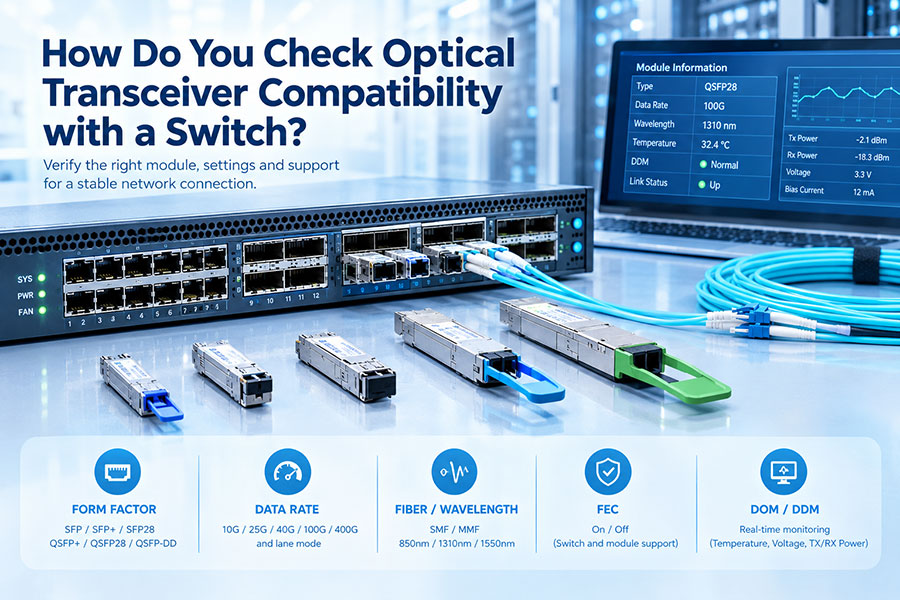
Check the switch compatibility list: Verify that the host recognizes the module and supports the intended operating speed.
Check the port configuration: Confirm that the interface can be configured for 10G operation.
Check the optical link: Match wavelength, fiber type, connector, reach, and optical budget.
Check FEC requirements: Apply the correct settings for the selected data rate and optical standard.
After installation, verify the module identification, configured port speed, interface status, and optical diagnostics. A successful module detection message does not necessarily mean that the optical link has established at the intended speed.
9. Conclusion
A 25G SFP28 transceiver can run at 10Gbps when it is specifically designed for dual-rate operation and the connected host supports 10G mode. However, not every 25G SFP28 module has this capability.
The most important distinction is between a 25G-only SFP28 transceiver and a 10G/25G dual-rate SFP28 transceiver. Both use the same general form factor, but their supported electrical and optical operating modes may differ.
For reliable deployment, confirm the exact module specification, switch compatibility, port configuration, optical parameters, and FEC requirements. These checks are more important than physical compatibility alone.
View the C-LIGHT 25G SFP28 Transceiver product range for 25G optical module options. Confirm the required operating rate and exact product specification when selecting a module for a 10G application.
10. Frequently Asked Questions
No. Only modules explicitly designed to support 10Gbps operation can be used at that rate. A 25G-only SFP28 module should not be assumed to support 10G.
The two form factors have related physical interfaces, but backward compatibility depends on the transceiver and host device. A compatible dual-rate SFP28 module may work in an SFP+ port at 10G, subject to manufacturer support.
No. The module and host must support 10G operation. The switch may also require the interface speed to be configured manually.
Some SFP28 ports support 10G SFP+ modules, but this depends on the switch model, port configuration, and module compatibility list. Physical insertion alone does not guarantee operation.
Not necessarily. Some products specify the same nominal reach at both rates, while their optical power and receiver performance limits differ. Always check the datasheet for each operating mode.
Many conventional 10G Ethernet optical links do not require FEC, but the exact requirement depends on the module and link specification. Follow the manufacturer's operating-mode documentation.
Need help selecting a 10G/25G SFP28 transceiver?
Provide the switch model, required data rate, transmission distance, fiber type, and module part number. For product specifications and compatibility support, Contact C-LIGHT.
 >

 >
 >
 >
 >
 >
 >
 >