TEL:+86 132 6656 7067




PAM4, or Pulse Amplitude Modulation 4, is a four-level signaling technology used in high-speed electrical and optical communication. Unlike NRZ, which uses two signal levels to transmit one bit per symbol, PAM4 uses four amplitude levels and transmits two bits per symbol. This allows higher data rates without requiring the same increase in symbol rate.
1. What Does PAM4 Mean?
PAM4 stands for Pulse Amplitude Modulation with four distinct signal levels. Each symbol can represent one of four amplitude states, allowing two bits of information to be transmitted per symbol.
The four signal levels can represent the bit combinations 00, 01, 10, and 11.
2. How Does PAM4 Work?
PAM4 uses four voltage or optical amplitude levels instead of the two levels used by NRZ.
A simplified representation is:
00 → Level 0
01 → Level 1
10 → Level 2
11 → Level 3
Because each symbol carries two bits, PAM4 can transmit twice as many bits per symbol as NRZ at the same symbol rate.
3. Why Does PAM4 Increase Data Rate?
The main advantage of PAM4 is higher bit density per symbol. NRZ transmits one bit per symbol, while PAM4 transmits two bits per symbol.
| Signaling | Signal Levels | Bits per Symbol |
|---|---|---|
| NRZ | 2 | 1 |
| PAM4 | 4 | 2 |
This allows network interfaces to increase aggregate bandwidth while keeping symbol rates within practical limits.
4. What Is the Difference Between PAM4 and NRZ?
| Feature | NRZ | PAM4 |
|---|---|---|
| Signal levels | 2 | 4 |
| Bits per symbol | 1 | 2 |
| Signal spacing | Larger | Smaller |
| Noise tolerance | Higher | Lower |
| Data rate potential | Lower at the same symbol rate | Higher at the same symbol rate |
5. Why Is PAM4 Used in Optical Communication?
As Ethernet speeds increased from 100G to 400G and 800G, simply increasing the electrical symbol rate became increasingly difficult because of channel loss, bandwidth limitations, and signal-integrity challenges.
PAM4 provides a way to increase the number of transmitted bits per symbol, helping achieve higher interface speeds using commercially practical electrical and optical technologies.
6. Where Is PAM4 Used?
PAM4 is widely associated with modern high-speed networking and data center interconnects, including:
200G Ethernet
400G Ethernet
800G Ethernet
1.6T optical networking
AI data center interconnects
High-performance computing
High-speed electrical SerDes
7. How Is PAM4 Used in 400G?
400G optical interfaces commonly use four or eight high-speed electrical or optical lanes depending on the architecture. A widely used approach is based on 8 × 50G-class PAM4 lanes.
Each lane can carry approximately 50Gbps while using a lower symbol rate than would be required for an equivalent NRZ implementation.
8. How Is PAM4 Used in 800G?
800G interfaces commonly use 8 × 100G-class PAM4 lanes. Each lane carries approximately 100Gbps of data, allowing the aggregate interface to reach 800Gbps.
This architecture is widely relevant to high-density switch, AI networking, and data center applications.
9. How Is PAM4 Used in 1.6T?
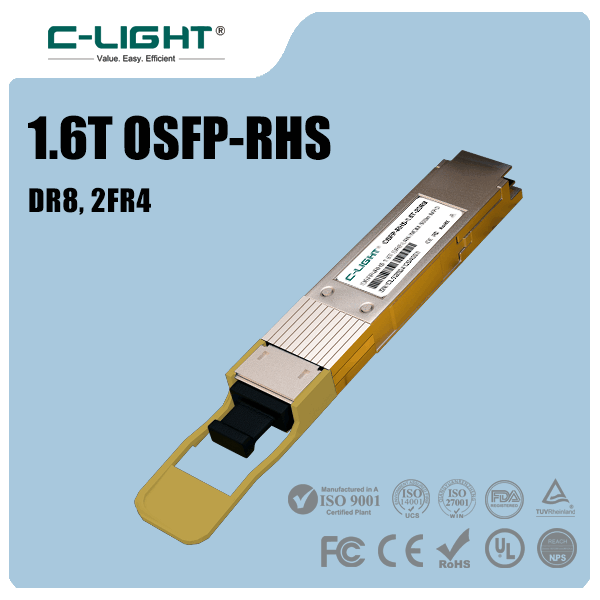
Future and emerging 1.6T interfaces can use multiple 200G-class PAM4 lanes. An 8 × 200G architecture provides a path toward 1.6Tbps aggregate bandwidth.
At these speeds, electrical channel loss, jitter, crosstalk, equalization, and optical signal quality become increasingly important.
10. What Are the Four PAM4 Signal Levels?
PAM4 uses four amplitude levels. The levels are often represented as:
-3, -1, +1, +3
The exact electrical or optical voltage values depend on the implementation. The important principle is that there are four distinct levels used to encode two bits per symbol.
11. Why Is PAM4 More Sensitive to Noise?
Because PAM4 divides the signal range into four levels instead of two, the distance between adjacent levels is smaller for the same overall signal swing.
This reduces the noise margin and makes PAM4 more sensitive to:
Noise
Jitter
Inter-symbol interference
Crosstalk
Nonlinear distortion
Loss in electrical channels
12. What Is PAM4 Symbol Rate?
Symbol rate, also called baud rate, describes the number of symbols transmitted per second. Because each PAM4 symbol represents two bits, the required symbol rate is lower than the bit rate.
For an ideal PAM4 signal:
Bit Rate = Symbol Rate × 2
In practical systems, coding, framing, FEC, and protocol overhead mean the exact line rate is higher than the simple payload calculation.
13. What Is PAM4 Eye Diagram?
A PAM4 eye diagram contains three eye openings because four signal levels create three vertical decision regions.
The eye diagram is commonly used to evaluate signal quality, including amplitude separation, jitter, noise, and inter-symbol interference.
14. Why Are There Three Eyes in a PAM4 Diagram?
Four signal levels create three adjacent decision boundaries. This produces three eye openings in the PAM4 eye diagram.
In contrast, a two-level NRZ signal produces one eye opening.
15. What Is TDECQ in PAM4?
TDECQ, or Transmitter and Dispersion Eye Closure Quaternary, is an optical transmitter performance metric used for PAM4 systems.
It evaluates signal quality by considering the effects of transmitter distortion and channel-related impairments on the PAM4 eye opening.
16. What Is PAM4 BER?
BER, or Bit Error Rate, represents the ratio of incorrectly received bits to the total number of transmitted bits.
Because PAM4 has smaller level spacing and greater sensitivity to impairments than NRZ, maintaining a low BER requires careful transmitter, receiver, and channel design.
17. What Is the Role of FEC in PAM4?
Forward Error Correction can improve the effective error tolerance of high-speed PAM4 links by detecting and correcting certain transmission errors without requiring retransmission.
FEC is particularly important in high-speed Ethernet systems where the raw link BER requirements are difficult to achieve using the physical layer alone.
18. Does PAM4 Require a DSP?
PAM4 does not inherently require a DSP, but modern high-speed PAM4 optical systems commonly use DSPs for signal processing, equalization, clock recovery, and other functions.
Some architectures, such as LPO, reduce or remove DSP functionality from the optical module and rely more heavily on host-side signal processing.
19. What Is the Role of DSP in PAM4 Optical Modules?
In a conventional PAM4 optical module, the DSP can perform functions such as:
Transmit equalization
Receive equalization
Clock and data recovery
Signal conditioning
FEC-related processing in some architectures
The exact functions depend on the module design and system architecture.
20. How Does PAM4 Affect Optical Transceiver Design?
PAM4 places tighter requirements on optical transmitters, receivers, electrical channels, and signal processing.
The transceiver must maintain adequate linearity, bandwidth, signal-to-noise ratio, and optical performance while minimizing distortion and inter-symbol interference.
21. What Optical Components Support PAM4?
Different optical technologies can support PAM4 depending on the data rate, wavelength, reach, and module architecture.
Common technologies include EML, directly modulated laser solutions for suitable applications, silicon photonics, and PIN or APD receivers.
22. Is PAM4 Analog or Digital?
PAM4 is a multilevel amplitude modulation format. It uses discrete amplitude levels to represent digital information, while the transmitted waveform itself is an analog electrical or optical signal.
For this reason, PAM4 is often described as a multilevel signaling format for digital communication systems.
23. What Is the Main Advantage of PAM4?
The main advantage of PAM4 is the ability to transmit two bits per symbol, increasing bandwidth efficiency without requiring a proportional increase in symbol rate.
This makes PAM4 particularly useful for high-speed Ethernet and optical interconnects.
24. What Are the Main Disadvantages of PAM4?
The main disadvantage is reduced signal margin compared with NRZ. Four signal levels are closer together, making the system more sensitive to noise, jitter, distortion, and channel loss.
As a result, PAM4 systems often require stronger equalization, tighter component specifications, and error-correction techniques.
25. Why Is PAM4 Important for AI Data Centers?
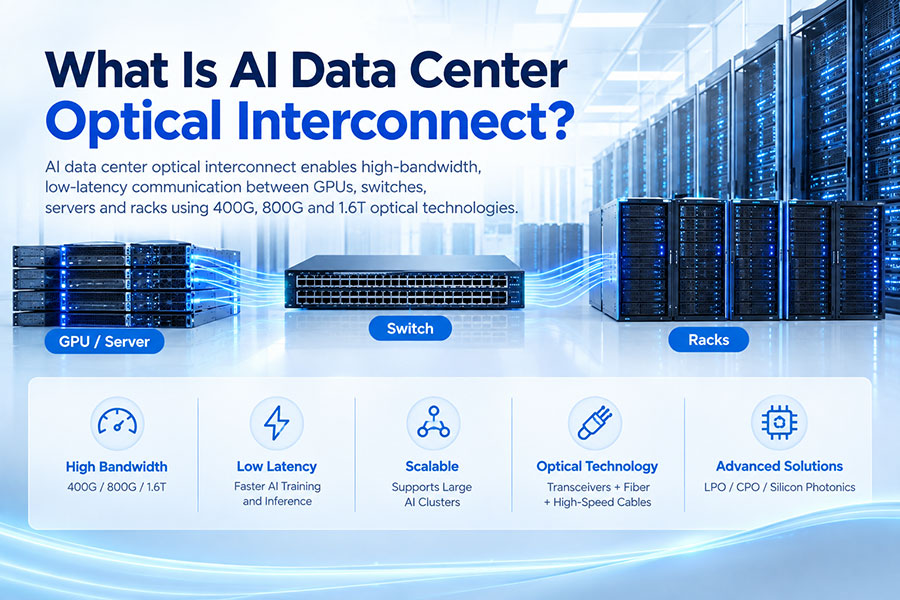
AI data centers require very high bandwidth between GPUs, switches, servers, and other network devices. PAM4 enables higher-speed electrical and optical interfaces while helping keep symbol rates within practical ranges.
This makes PAM4 a key signaling technology for 400G, 800G, and emerging 1.6T optical interconnects.
26. PAM4 vs NRZ in Optical Networking
| Parameter | NRZ | PAM4 |
|---|---|---|
| Levels | 2 | 4 |
| Bits per symbol | 1 | 2 |
| Noise margin | Higher | Lower |
| Signal processing requirements | Lower | Higher |
| High-speed applications | Legacy and selected lower-speed links | 400G and above |
27. What Is PAM4 LPO?
PAM4 LPO combines PAM4 signaling with Linear Pluggable Optics. The optical module uses a linear driver and TIA rather than a conventional high-speed DSP architecture.
This can reduce module power consumption and latency, but it also places greater responsibility on the host ASIC and electrical channel for signal conditioning.
28. What Is PAM4 Used for in Ethernet?
PAM4 is widely used in high-speed Ethernet physical-layer architectures. It enables higher line rates while keeping symbol rates lower than an equivalent NRZ implementation.
It is especially important for 400G and 800G Ethernet systems and is becoming increasingly relevant to 1.6T-class interfaces.
29. How Is PAM4 Tested?
PAM4 systems can be evaluated using a combination of electrical and optical measurements.
Eye diagram
BER
TDECQ
Jitter
Optical modulation amplitude
Receiver sensitivity
Extinction ratio and related transmitter parameters
These measurements help verify that the transmitter, receiver, and complete communication channel meet the required performance targets.
30. What Is the Future of PAM4?
PAM4 has become a key signaling technology for modern high-speed networking and is expected to remain important as data center interfaces move toward higher bandwidths.
Future systems will continue to improve PAM4 transmitters, receivers, DSPs, equalization, FEC, and optical technologies to support higher data rates and more power-efficient interconnects.
31. FAQ
Q1. What does PAM4 stand for?
Q2. Why is PAM4 used in 400G and 800G?
Q3. What is the difference between PAM4 and NRZ?
Q4. Does PAM4 require FEC?
Q5. Why is PAM4 more sensitive to noise?
Q6. Is PAM4 used in optical transceivers?
32. Summary
PAM4 is a four-level signaling technology that transmits two bits per symbol, making it an important foundation for high-speed 400G, 800G, and 1.6T networking. Compared with NRZ, PAM4 provides greater bandwidth efficiency but introduces tighter requirements for signal integrity, optical performance, equalization, and error correction.
 >
>

 >
>
 >
>
 >
>
 >
>
 >
>
 >
>
 >
>