TEL:+86 132 6656 7067




Optical modulation is the process of encoding electrical data onto an optical carrier by changing one or more properties of light. Depending on the transmitter architecture, the optical signal can be modulated by changing its intensity, phase, frequency, or polarization. Optical modulation is a fundamental technology used in fiber optic communication and high-speed optical networks.
1. What Does Optical Modulation Mean?
Optical modulation means changing a property of an optical carrier according to the information being transmitted.
The optical carrier is generated by a laser, and the transmitter uses a modulator or directly modulates the laser to encode the electrical data onto the light.
2. How Does Optical Modulation Work?
A simplified transmission path is:
Electrical Data → Driver → Optical Modulator or Laser → Modulated Optical Signal → Fiber
At the receiver, the optical signal is detected and converted back into an electrical signal.
3. What Properties of Light Can Be Modulated?
Optical communication systems can encode information by controlling different optical properties, including:
Optical intensity
Optical phase
Optical frequency
Polarization
Different modulation formats use different combinations of these properties.
4. What Is Intensity Modulation?
Intensity modulation changes the optical power of the transmitted signal according to the electrical data.
It is widely used in direct-detection optical communication systems because the receiver can recover the information by detecting changes in optical power.
5. What Is Direct Intensity Modulation?
Direct intensity modulation changes the output power of the laser itself by varying its drive current.
This is the basic operating principle of a Directly Modulated Laser, or DML.
6. What Is External Optical Modulation?
External modulation uses a continuous-wave laser as the optical source and a separate optical modulator to encode the data onto the light.
This approach provides greater control over the optical waveform and can support higher-speed or longer-reach applications.
7. What Is the Difference Between Direct and External Modulation?
| Feature | Direct Modulation | External Modulation |
|---|---|---|
| Modulation method | Laser drive current is varied | Separate optical modulator |
| Architecture | Simpler | More complex |
| Component count | Lower | Higher |
| High-speed capability | Application-dependent | High potential |
| Typical technologies | DML, VCSEL | EML, silicon photonics modulators |
8. What Is DML?
DML, or Directly Modulated Laser, directly changes the laser drive current to modulate the optical output.
DML provides a relatively simple transmitter architecture and is commonly considered for suitable short- and medium-reach optical communication applications.
9. What Is EML?
EML, or Electro-Absorption Modulated Laser, combines a laser with an electro-absorption modulator.
The laser generates the optical carrier while the modulator changes the optical signal according to the electrical input.
10. What Is a Mach-Zehnder Modulator?
A Mach-Zehnder Modulator, or MZM, changes the phase of light in two optical paths and uses interference to control the output optical signal.
MZM technology is widely used for external optical modulation and can support advanced high-speed communication systems.
11. What Is an Electro-Absorption Modulator?
An electro-absorption modulator, or EAM, changes the absorption characteristics of a semiconductor material according to an applied electrical field.
By controlling how much light passes through the device, the EAM can modulate the optical signal.
12. What Is PAM4 Optical Modulation?
PAM4, or Pulse Amplitude Modulation 4, uses four amplitude levels to transmit two bits per symbol.
It enables higher data rates at a given symbol rate compared with two-level NRZ signaling and is widely associated with modern 400G and 800G optical communication.
13. What Is the Difference Between PAM4 and NRZ?
| Feature | NRZ | PAM4 |
|---|---|---|
| Signal levels | 2 | 4 |
| Bits per symbol | 1 | 2 |
| Noise margin | Higher | Lower |
| Signal processing | Simpler | More demanding |
14. How Does Optical Modulation Support Higher Data Rates?
Increasing optical data rates can be achieved by increasing symbol rate, increasing the number of bits represented by each symbol, using multiple optical lanes, or combining these techniques.
Advanced modulation formats such as PAM4 help increase the number of transmitted bits per symbol without requiring the same proportional increase in symbol rate.
15. What Is Phase Modulation?
Phase modulation changes the phase of the optical carrier according to the transmitted data.
Phase-based modulation is particularly important in coherent optical communication, where both amplitude and phase information can be detected and processed.
16. What Is Frequency Modulation?
Frequency modulation changes the instantaneous optical frequency of the carrier according to the transmitted information.
Frequency-related effects are important in coherent communication systems, although practical optical communication typically combines multiple modulation dimensions.
17. What Is Polarization Modulation?
Polarization modulation encodes information by changing the polarization state of the optical carrier.
Polarization is especially important in coherent systems that use polarization multiplexing to increase transmission capacity.
18. What Is Coherent Optical Modulation?
Coherent optical modulation uses multiple properties of the optical carrier, particularly amplitude and phase, to encode information efficiently.
Combined with coherent detection and DSP, it enables high-capacity long-distance optical transmission.
19. What Is QPSK?
QPSK, or Quadrature Phase Shift Keying, uses four phase states to represent two bits per symbol.
It is a robust coherent modulation format that has been widely used in long-distance optical transport systems.
20. What Is QAM in Optical Communication?
Quadrature Amplitude Modulation, or QAM, combines amplitude and phase changes to encode multiple bits per symbol.
Higher-order formats such as 16QAM and 64QAM provide greater spectral efficiency but require better optical signal quality and generally provide less reach than more robust lower-order formats.
21. What Is the Role of the Optical Modulator?
The optical modulator converts an electrical control signal into changes in the optical carrier.
Depending on the technology, the modulator can control optical intensity, phase, or another optical property to encode the transmitted data.
22. What Is the Role of the Laser?
The laser generates the optical carrier used by the communication system.
In direct modulation, the laser itself is modulated. In external modulation, the laser normally produces a continuous optical carrier that is subsequently modulated by a separate device.
23. How Does Optical Modulation Affect Signal Quality?
The modulation process directly affects the quality of the transmitted optical waveform. Nonlinearity, insufficient bandwidth, noise, distortion, and imperfect bias control can degrade the modulated signal.
Signal quality is especially important for high-speed PAM4 and coherent optical systems.
24. What Is Modulation Bandwidth?
Modulation bandwidth describes how quickly an optical transmitter or modulator can respond to changes in the electrical input signal.
Higher data rates require optical devices and drivers with sufficient bandwidth to reproduce the required waveform without excessive distortion.
25. What Is Chirp in Optical Modulation?
Chirp is a change in the instantaneous optical frequency that occurs as the optical signal is modulated.
Directly modulated lasers can exhibit significant chirp because changes in carrier density affect both optical intensity and optical frequency.
26. How Does Chirp Affect Fiber Transmission?
Chirp can interact with chromatic dispersion in optical fiber. Depending on the laser, modulation format, wavelength, and transmission distance, this interaction can cause additional signal distortion.
Chirp management is therefore important for some higher-speed and longer-reach optical links.
27. What Is Optical Modulation Amplitude?
Optical Modulation Amplitude, or OMA, describes the difference between specified optical power levels of a modulated signal.
OMA is an important transmitter parameter for high-speed optical interfaces, especially PAM4 systems.
28. What Is Extinction Ratio?
Extinction ratio describes the relationship between the optical power of the high and low states of a two-level optical signal.
It is commonly expressed in dB and is widely used for conventional two-level optical transmitter characterization.
29. What Is the Relationship Between Optical Modulation and Extinction Ratio?
Optical modulation determines how the optical carrier changes with the transmitted data, while extinction ratio measures the relative separation between high and low optical states in a two-level signal.
They are related transmitter characteristics but represent different measurements.
30. What Is the Role of DSP in Optical Modulation?
DSP can process electrical signals before optical transmission and after optical reception. In high-speed systems, it can provide equalization, filtering, clock recovery, and other signal-processing functions.
DSP is particularly important in PAM4 and coherent optical systems where signal impairments must be carefully managed.
31. How Does Optical Modulation Work in 400G?
400G optical systems commonly use multiple high-speed lanes and PAM4 signaling. The transmitter modulates optical signals according to the architecture, and the optical lanes are combined or connected to provide the required aggregate bandwidth.
The exact number of lanes and modulation structure depends on the specific standard and optical module.
32. How Does Optical Modulation Work in 800G?
800G optical systems commonly use multiple 100G-class PAM4 lanes or other high-speed architectures.
The transmitter must maintain sufficient bandwidth, linearity, optical modulation amplitude, and overall signal quality across all optical lanes.
33. How Does Optical Modulation Work in 1.6T?
1.6T-class optical systems require even higher electrical and optical bandwidth. Candidate architectures can use 200G-class lanes and advanced modulation and photonic technologies.
At these speeds, modulator bandwidth, linearity, driver performance, packaging, thermal management, and signal integrity become increasingly important.
34. How Does Optical Modulation Work in Silicon Photonics?
Silicon photonics can integrate optical modulators directly into a silicon photonic circuit. Electrical signals control the modulator, which changes the optical carrier as it propagates through the photonic waveguide.
This integrated approach can support compact and high-density optical engines.
35. What Is the Difference Between DML, EML, and Silicon Photonics?
| Technology | Modulation Method | Main Characteristic |
|---|---|---|
| DML | Direct laser modulation | Simple architecture |
| EML | Electro-absorption modulation | Laser and modulator integrated together |
| Silicon Photonics | Integrated photonic modulation | High optical integration |
36. What Are the Main Advantages of Optical Modulation?
The main advantages include:
Efficient transmission of digital data over fiber
Support for high optical data rates
Compatibility with multiple modulation formats
Scalability to multi-lane optical architectures
Support for long-distance coherent communication
Integration with advanced photonic technologies
37. What Are the Main Challenges of Optical Modulation?
Optical modulation also introduces several technical challenges:
Limited modulator bandwidth
Nonlinear distortion
Laser chirp
Noise and jitter
Temperature sensitivity
Optical power requirements
Signal integrity at high data rates
38. Why Is Optical Modulation Important for AI Data Centers?
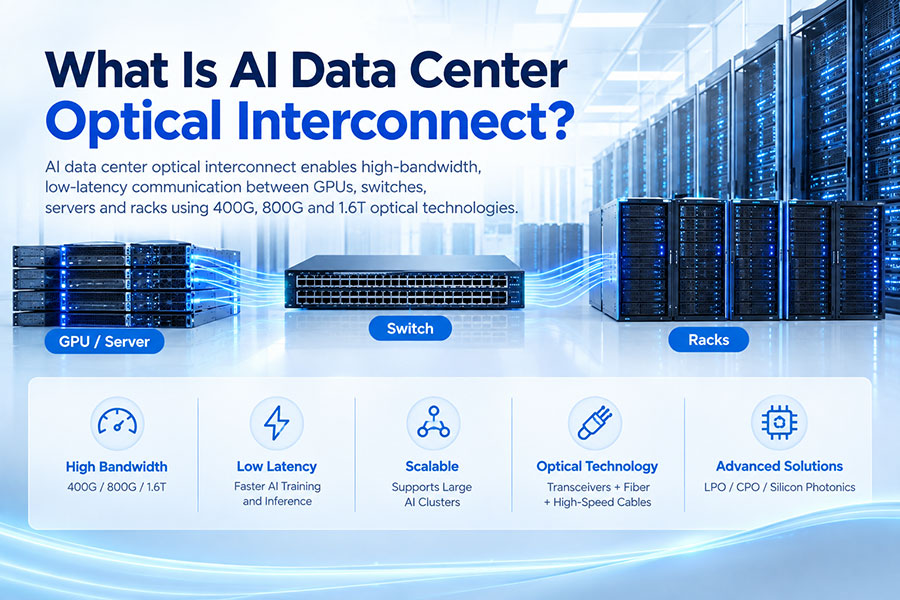
AI data centers require high bandwidth between GPUs, switches, servers, and accelerators. Optical modulation provides a practical way to encode high-speed electrical data onto optical carriers for low-loss, high-bandwidth fiber transmission.
As networks move toward 400G, 800G, and 1.6T, advanced modulation and optical transmitter technologies become increasingly important.
39. How Is Optical Modulation Tested?
Optical transmitters and modulators can be evaluated using a range of optical and electrical measurements.
Optical output power
OMA
Extinction ratio where applicable
Eye diagram
TDECQ for applicable PAM4 systems
RIN
Wavelength
BER
Jitter
40. What Is the Future of Optical Modulation?
Optical modulation technology is evolving toward higher bandwidth, improved linearity, lower power consumption, and greater integration.
Developments in silicon photonics, EML, advanced lasers, coherent modulation, PAM4, and integrated optical engines will support the continued growth of high-speed data center and optical transport networks.
41. FAQ
Q1. What is optical modulation?
Q2. What are the main types of optical modulation?
Q3. What is the difference between DML and EML?
Q4. Why is PAM4 important in optical modulation?
Q5. What is the role of optical modulation in 400G and 800G?
Q6. What is the difference between optical modulation and optical modulation format?
42. Summary
Optical modulation encodes electrical data onto light by changing one or more properties of an optical carrier. Direct modulation uses the laser itself, while external modulation uses a separate modulator. Technologies such as DML, EML, silicon photonics, PAM4, and coherent modulation provide different approaches for meeting bandwidth, reach, power, and signal-quality requirements. Optical modulation is therefore a fundamental technology behind modern 100G, 400G, 800G, and 1.6T optical communication systems.
 >
>

 >
>
 >
>
 >
>
 >
>
 >
>
 >
>
 >
>