TEL:+86 132 6656 7067




NPO, or Near-Packaged Optics, is an optical interconnect architecture that places optical engines close to a host ASIC on the same PCB or in a nearby package-level location. By shortening the high-speed electrical path between the ASIC and optical engine, NPO can reduce electrical loss and help support higher bandwidth, lower power, and improved signal integrity.
1. What Does NPO Mean?
NPO stands for Near-Packaged Optics. It describes an architecture in which optical components are positioned very close to the host silicon, such as a high-speed switch ASIC, while remaining separate from the ASIC package.
Compared with conventional front-panel pluggable optics, NPO significantly reduces the length of the high-speed electrical connection between the ASIC and optical engine.
2. How Does NPO Work?
A simplified NPO signal path is:
Switch ASIC → Short PCB Electrical Path → Optical Engine → Optical Fiber
For received signals, the direction is reversed:
Optical Fiber → Optical Engine → Short PCB Electrical Path → Switch ASIC
The main concept is to move optical conversion closer to the ASIC without integrating the optical engine directly into the same package substrate as the ASIC.
3. Why Is NPO Needed?
As switch ASIC and SerDes speeds increase, electrical signals become more sensitive to PCB trace loss, connector discontinuities, crosstalk, reflections, and other channel impairments.
NPO reduces the distance that high-speed electrical signals travel before optical conversion, helping address these challenges at higher data rates.
4. Where Is the Optical Engine Located in NPO?
In an NPO architecture, the optical engine is mounted on the host PCB near the ASIC rather than being placed at the front panel like a conventional pluggable optical module.
The exact placement and mechanical implementation can vary according to the switch platform and packaging design.
5. What Is an Optical Engine?
An optical engine is the portion of an optical interconnect system responsible for electrical-to-optical and optical-to-electrical conversion.
It can include optical transmitters, receivers, drivers, TIAs, photonic components, and related circuitry required to transfer high-speed electrical signals through optical fiber.
6. How Does NPO Reduce Electrical Loss?
In a conventional switch, high-speed electrical signals may travel from the ASIC across PCB traces, through connectors, and into a front-panel optical module.
NPO places the optical engine much closer to the ASIC. The shorter electrical path reduces PCB channel loss and other electrical impairments that become increasingly difficult to manage at higher SerDes speeds.
7. How Does NPO Improve Signal Integrity?
Signal integrity generally becomes more challenging as lane speeds increase. Long electrical paths can introduce insertion loss, reflections, crosstalk, and inter-symbol interference.
By shortening the electrical connection, NPO can reduce these channel impairments and provide a more favorable environment for high-speed signaling.
8. How Does NPO Compare With Front-Panel Pluggable Optics?
| Feature | Pluggable Optics | NPO |
|---|---|---|
| Optical location | Front panel | Near the ASIC on PCB |
| Electrical path | Longer | Shorter |
| Signal loss | Higher potential | Lower potential |
| Serviceability | High | Higher than tightly integrated CPO in some implementations |
| Integration | Module-level | Near-package level |
9. What Is the Difference Between NPO and CPO?
NPO and CPO both move optical conversion closer to the host ASIC, but they use different levels of integration.
NPO places the optical engine near the ASIC on the host PCB, while CPO integrates optical engines with the ASIC at the package level.
10. NPO vs CPO
| Feature | NPO | CPO |
|---|---|---|
| Optical position | Near ASIC on PCB | Integrated at package level |
| ASIC integration | Separate | Co-packaged |
| Electrical path | Very short | Extremely short |
| Integration complexity | Lower | Higher |
| Serviceability | Potentially higher | More challenging |
11. What Is the Difference Between NPO and LPO?
NPO describes the physical placement of the optical engine close to the ASIC. LPO, or Linear Pluggable Optics, describes a pluggable optical architecture that removes or reduces traditional DSP processing inside the optical module.
Therefore, NPO and LPO address different aspects of optical interconnect design: NPO focuses on proximity, while LPO focuses primarily on the optical module signal-processing architecture.
12. Can NPO Use Linear Optics?
Yes. NPO can use linear optical architectures where appropriate. Combining near-package placement with linear optical components can further reduce electrical path losses and module-side processing requirements.
The exact architecture depends on the target data rate, host SerDes, optical technology, and system design.
13. How Does NPO Work With PAM4?
PAM4 is widely used in high-speed networking because it carries two bits per symbol using four amplitude levels.
However, PAM4 has tighter signal margins than NRZ. NPO can help by shortening the electrical path between the host SerDes and optical engine, reducing some of the channel impairments that affect PAM4 signals.
14. Why Is NPO Important for High-Speed SerDes?
Higher-speed SerDes interfaces place increasingly strict requirements on electrical channels. As lane rates increase, PCB traces and connectors can consume a larger portion of the available signal budget.
NPO reduces the electrical distance between the ASIC and optical conversion point, helping the system manage these high-speed channel requirements.
15. How Does NPO Reduce Power Consumption?
NPO can reduce power consumption by shortening the electrical path and reducing the signal-conditioning effort required to drive a long high-speed PCB channel.
The actual system-level power savings depend on the ASIC, SerDes, optical engine, channel design, and implementation.
16. How Does NPO Affect Latency?
A shorter electrical path can reduce signal propagation distance and may also reduce the need for additional electrical signal-conditioning components.
The overall latency benefit depends on the complete system architecture, including SerDes, optical components, FEC, switching, and other processing stages.
17. What Is the Role of the Host ASIC in NPO?
The host ASIC remains the main switching or processing device. It generates and receives high-speed electrical signals that connect to nearby optical engines.
Because the electrical path is shorter than in a conventional pluggable architecture, the ASIC and optical engine can operate across a more tightly controlled high-speed channel.
18. What Is the Role of the PCB in NPO?
The PCB provides the electrical connection between the ASIC and the nearby optical engine. Compared with front-panel optics, this connection is much shorter.
Even though the electrical path is shorter, PCB material, routing, vias, connectors, impedance control, and signal integrity remain important considerations.
19. What Optical Technologies Can Be Used in NPO?
NPO can be implemented using different optical technologies depending on the target application.
Silicon photonics
EML-based optical transmitters
VCSEL-based solutions for suitable short-reach applications
PIN photodetectors
APD receivers where appropriate
Integrated optical engines
20. What Role Does Silicon Photonics Play in NPO?
Silicon photonics is well suited to high-density optical integration and can combine multiple photonic functions within a compact optical engine.
In NPO systems, silicon photonics can provide an efficient platform for placing high-speed optical conversion close to the host ASIC.
21. What Are the Main Advantages of NPO?
The main advantages of NPO include:
Short electrical interconnects
Reduced PCB channel loss
Improved high-speed signal integrity
Potentially lower power consumption
High optical density
Support for higher-speed SerDes
A less tightly integrated approach than CPO
22. What Are the Main Challenges of NPO?
NPO also introduces several design challenges:
PCB routing complexity
Thermal management
Optical fiber routing
Optical engine packaging
Testing and manufacturing
Service and replacement considerations
Mechanical integration
23. Why Is Thermal Management Important for NPO?
High-speed ASICs and optical engines both generate heat. Although NPO can reduce some electrical interconnect power, the optical engine remains physically close to the ASIC.
The board and system therefore need an appropriate thermal architecture to maintain the operating temperature of all components.
24. How Does NPO Compare With CPO in Thermal Design?
CPO places the optical engine extremely close to the switching ASIC, creating high integration but also making thermal isolation and heat removal more difficult.
NPO provides some physical separation because the optical engine is near the ASIC rather than integrated directly into the same package. This can provide more design flexibility for thermal management.
25. Is NPO Easier to Service Than CPO?
In general, NPO can provide more physical separation between the optical engine and ASIC than CPO. This can offer greater flexibility for assembly, testing, or replacement depending on the specific mechanical implementation.
However, NPO serviceability depends on how the optical engine is mounted and connected to the host PCB.
26. Does NPO Use a Pluggable Optical Module?
NPO is not defined simply by whether a module is pluggable. The key characteristic is that the optical engine is positioned close to the host ASIC.
An NPO implementation may use a separable optical engine or another nearby optical assembly depending on the system design.
27. How Does NPO Support 800G?
800G interfaces typically require multiple high-speed electrical lanes. At these speeds, reducing the electrical path between the switching ASIC and optical conversion point becomes increasingly valuable.
NPO can provide a short electrical connection between the 800G-class ASIC interface and optical engines, helping manage signal loss and power requirements.
28. How Does NPO Support 1.6T?
1.6T-class networking increases the challenge of electrical signal transmission between ASICs and optical interfaces. NPO can reduce this challenge by moving optical conversion closer to the host silicon.
Successful 1.6T NPO systems will require high-performance SerDes, advanced optical engines, low-loss PCB technologies, efficient thermal management, and careful system validation.
29. Why Is NPO Relevant to AI Data Centers?
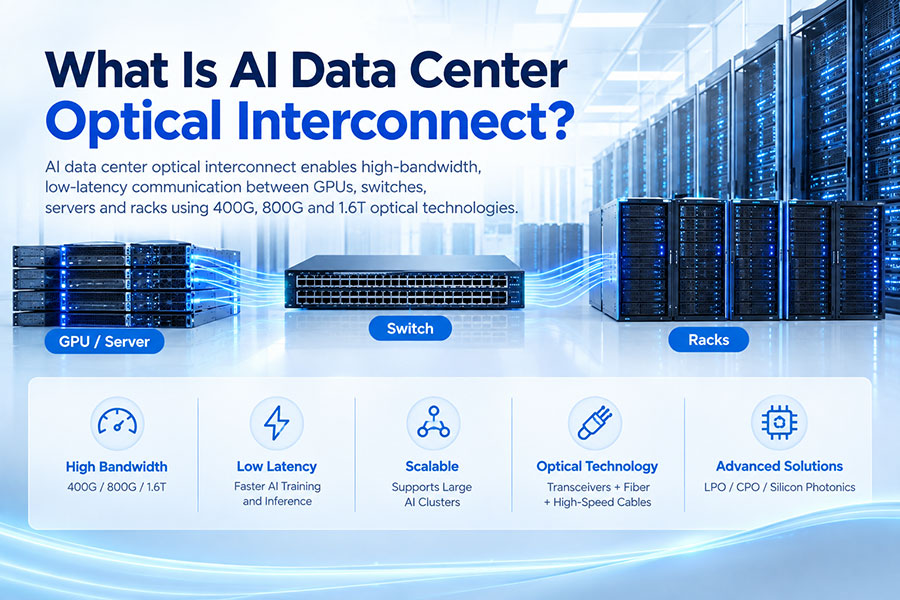
AI data centers require extremely high bandwidth between switches, GPUs, XPUs, and other computing resources. As switch bandwidth increases, electrical interconnect power and signal loss become increasingly important.
NPO provides an intermediate architecture between conventional pluggable optics and highly integrated CPO, helping bring optical conversion closer to the switching silicon.
30. What Applications Can Use NPO?
NPO can be considered for applications such as:
AI data center networks
High-performance computing
High-radix Ethernet switches
800G optical interconnects
1.6T-class network platforms
High-density optical switching systems
Advanced accelerator networking
31. How Does NPO Affect Network Scalability?
NPO can support higher optical density by locating optical engines close to the switching silicon. This can help reduce the electrical routing burden associated with large numbers of high-speed front-panel optical connections.
However, overall scalability also depends on optical fiber management, thermal design, PCB layout, manufacturing, and system architecture.
32. How Is NPO Tested?
NPO should be evaluated as a complete electrical, optical, and thermal system.
Electrical insertion loss
Return loss
Signal integrity
BER
Eye diagram
TDECQ where applicable
Optical power
Temperature
Power consumption
Long-term reliability
33. What Are the Main Design Considerations for NPO?
NPO design requires coordinated consideration of:
ASIC SerDes capability
PCB material and routing
Electrical channel loss
Optical engine performance
Thermal management
Fiber routing
Mechanical structure
Manufacturing and testing
Serviceability
34. NPO vs LPO vs CPO
| Feature | LPO | NPO | CPO |
|---|---|---|---|
| Primary concept | Linear optical module | Optics near ASIC | Optics co-packaged with ASIC |
| Optical location | Front panel | Near ASIC on PCB | ASIC package |
| Electrical path | Shortened through linear architecture | Very short | Extremely short |
| Module integration | Pluggable | Near-package | Co-packaged |
| Serviceability | High | Potentially moderate | More challenging |
35. What Is the Future of NPO?
NPO is an important near-package optical architecture for addressing the electrical and power challenges of increasingly high-speed network interfaces.
As switch ASICs move toward higher SerDes rates, placing optical conversion closer to the host silicon can become increasingly attractive. NPO may therefore serve as an intermediate or complementary architecture alongside LPO, CPO, and other advanced optical interconnect technologies.
36. FAQ
Q1. What does NPO stand for?
Q2. How does NPO work?
Q3. What is the difference between NPO and CPO?
Q4. What is the difference between NPO and LPO?
Q5. Why is NPO important for 800G and 1.6T?
Q6. Is NPO suitable for AI data centers?
37. Summary
NPO, or Near-Packaged Optics, places optical engines close to the host ASIC rather than at the front panel or directly inside the ASIC package. This shortens high-speed electrical paths, helping reduce channel loss and improve signal integrity for 800G, 1.6T, and future AI data center networks. Compared with CPO, NPO offers a less tightly integrated architecture, while its concept is different from LPO, which primarily addresses signal processing inside pluggable optical modules.
 >
>

 >
>
 >
>
 >
>
 >
>
 >
>
 >
>
 >
>