TEL:+86 132 6656 7067




LRO, commonly used to describe Linear-drive Receive Optics, is a high-speed optical module architecture that uses linear receiver components and relies more heavily on the host system for signal processing. LRO is designed to reduce optical module power and latency while supporting high-speed 400G and 800G data center connectivity.
1. What Does LRO Mean?
LRO generally refers to Linear-drive Receive Optics. The term describes an optical architecture in which the receive path uses a linear TIA and does not rely on a full traditional DSP inside the optical module.
The exact meaning and implementation of LRO can vary between vendors, so the detailed module architecture should always be checked against the specific product.
2. How Does LRO Work?
A simplified LRO receive path is:
Optical Fiber → Photodetector → Linear TIA → Host SerDes/DSP → Switch ASIC
Instead of performing full digital signal recovery inside the optical module, LRO keeps the receive path more linear and shifts more signal-processing responsibility to the host equipment.
3. What Is the Main Idea Behind LRO?
The main idea is to simplify the optical module and reduce the amount of high-speed digital processing performed inside it.
By using a linear receive path, LRO can potentially reduce module power consumption, heat generation, and processing latency while maintaining compatibility with suitable high-speed host systems.
4. What Components Are Used in LRO?
An LRO optical module can include:
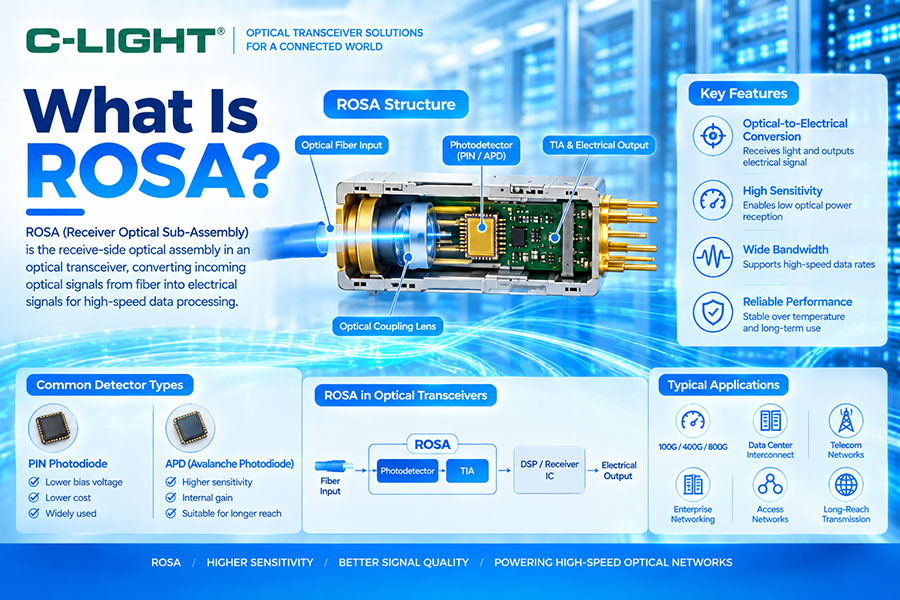
Optical receiver
Photodetector
Linear TIA
Optical coupling components
Monitoring circuitry
Host-facing electrical interface
The exact transmit architecture can vary. Some implementations may use conventional DSP-based or linear transmit functions while applying the LRO concept specifically to the receive side.
5. What Is a Linear TIA?
A linear TIA, or transimpedance amplifier, converts the current produced by the photodetector into a high-speed electrical signal while preserving the waveform characteristics required by the host system.
In an LRO architecture, the linear TIA is a key component of the receive path.
6. Why Does LRO Remove DSP From the Receive Path?
A traditional optical DSP performs digital signal processing to compensate for channel impairments and recover high-speed data. This processing consumes power and adds complexity.
LRO removes the full DSP function from the receive module path and relies more heavily on the host SerDes and signal-processing capabilities.
7. How Does LRO Reduce Optical Module Power?
The main power saving comes from reducing or eliminating high-speed DSP processing inside the optical module.
Because the receiver uses a linear architecture, the module can have lower processing power requirements than a conventional DSP-based receiver.
8. How Does LRO Reduce Latency?
Removing digital processing stages from the optical module can reduce module-side signal-processing latency.
The actual end-to-end latency depends on the host ASIC, SerDes, FEC, electrical channel, and complete system architecture.
9. What Is the Difference Between LRO and LPO?
| Feature | LPO | LRO |
|---|---|---|
| Architecture | Linear pluggable optics | Linear receive optics |
| Receive DSP | Generally removed | Generally removed from receive path |
| Transmit architecture | Linear approach | May vary |
| Host dependency | High | High |
| Primary goal | Lower module power and latency | Simplify and lower-power the receive path |
10. What Is the Difference Between LRO and Traditional DSP Optics?
Traditional DSP-based optical modules perform substantial digital signal processing inside the module. LRO reduces this processing on the receive side and relies more heavily on the host system.
This can lower module power but also places stricter requirements on the host electrical channel and SerDes.
11. How Does LRO Work With PAM4?
LRO is particularly relevant to high-speed PAM4 communication. PAM4 uses four amplitude levels to transmit two bits per symbol, enabling higher data rates at practical symbol rates.
Because PAM4 has tighter signal margins than NRZ, the host SerDes must provide sufficient equalization and signal recovery capability for a linear receive architecture.
12. Why Is Signal Integrity Important for LRO?
Without a full receive DSP inside the optical module, the host system must handle more of the signal-conditioning workload.
Important factors include:
Electrical channel loss
Insertion loss
Return loss
Jitter
Crosstalk
Inter-symbol interference
Receiver linearity
Host SerDes equalization
13. What Role Does the Host ASIC Play in LRO?
The host ASIC and its SerDes become especially important in LRO systems. The host-side electrical interface must be capable of receiving and processing the relatively unprocessed linear signal from the optical module.
This makes host compatibility a major consideration when deploying LRO.
14. What Is the Role of Host SerDes?
The host SerDes provides high-speed electrical transmission and reception between the switch ASIC and optical module. In LRO systems, it may also provide equalization and other signal-conditioning functions that would traditionally be performed by the module DSP.
15. Does LRO Need FEC?
LRO can operate in systems that use Forward Error Correction. FEC is separate from the optical module DSP and may be implemented in the host networking system.
The exact FEC architecture depends on the Ethernet standard and overall system design.
16. What Is the Relationship Between LRO and DSP?
LRO does not eliminate signal processing from the complete network system. Instead, it reduces the amount of processing performed inside the optical module.
More of the equalization and recovery work is shifted toward the host ASIC, SerDes, or other system components.
17. Does LRO Support 400G?
Yes. LRO is relevant to 400G optical modules where reducing optical module power and latency is a major design objective.
400G LRO implementations can use PAM4 signaling and depend on compatible host SerDes performance.
18. Does LRO Support 800G?
Yes. 800G is an important application area for linear receive architectures because the power consumption of high-speed DSP-based optical modules becomes increasingly significant at higher data rates.
800G LRO implementations typically use multiple high-speed PAM4 lanes.
19. Can LRO Support 1.6T?
LRO concepts can be extended to 1.6T-class optical connectivity, but the required signal integrity and host processing capabilities become more demanding as lane speeds increase.
Future 1.6T architectures will depend on advances in SerDes, linear TIAs, optical receivers, packaging, and system-level equalization.
20. How Does LRO Affect Optical Module Thermal Design?
Reducing DSP processing can lower the heat generated inside the optical module.
This can simplify thermal management and provide additional power headroom for high-density 400G and 800G deployments. The actual thermal benefit depends on the complete module and system design.
21. What Are the Main Advantages of LRO?
The main advantages of LRO include:
Lower receive-side module power
Reduced module-side processing
Lower potential latency
Simpler receive architecture
Reduced thermal load
Potentially higher efficiency for high-density data centers
22. What Are the Main Challenges of LRO?
The main challenges are related to signal integrity and host compatibility.
Greater dependence on host SerDes
Higher sensitivity to electrical channel quality
More demanding system validation
Potential interoperability limitations
Reduced ability to compensate for impairments inside the module
23. Why Is LRO Attractive for AI Data Centers?
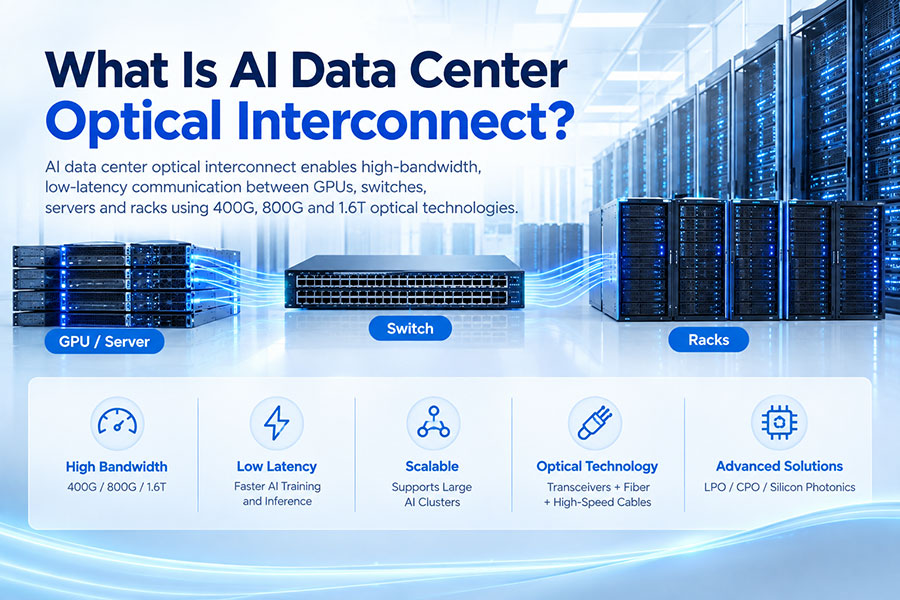
AI data centers use large numbers of high-speed optical links between GPUs, switches, and other networking equipment. Reducing the power consumption of each module can produce significant system-level benefits at large scale.
LRO provides a way to reduce optical module processing power while maintaining the pluggable architecture used by many data center platforms.
24. LRO vs DSP-Based Optics
| Parameter | DSP-Based Optics | LRO |
|---|---|---|
| Receive DSP | Included | Reduced or removed |
| Module power | Higher | Lower potential |
| Signal processing | More processing inside module | More processing in host |
| Host dependency | Lower | Higher |
| Thermal load | Higher | Lower potential |
25. How Does LRO Affect Transmission Distance?
LRO does not directly determine the optical transmission distance. Reach depends on the optical transmitter, receiver, fiber, wavelength, optical power budget, dispersion, and applicable transmission standard.
LRO mainly changes where signal processing is performed rather than the fundamental optical reach of the system.
26. Can LRO Be Used for Long-Distance Optics?
LRO is generally more attractive for short- and medium-reach high-speed links where the host electrical channel can be tightly controlled.
Longer-distance optical systems may require stronger signal-processing capability, so the suitability of LRO depends on the specific optical technology and system architecture.
27. How Is LRO Tested?
LRO modules should be validated together with the target host system. Important measurements include:
BER
Pre-FEC and post-FEC performance
Eye diagram
TDECQ where applicable
Jitter
Receiver sensitivity
Electrical channel loss
Power consumption
Temperature
28. What Host Compatibility Is Required for LRO?
The host platform must provide adequate SerDes performance, equalization capability, electrical channel quality, and interoperability with the selected LRO module.
For this reason, LRO modules generally require more careful system-level validation than conventional DSP-based optical modules.
29. What Is the Future of LRO?
LRO is part of the broader industry move toward lower-power optical interconnects. As 400G, 800G, and 1.6T interfaces increase in scale, reducing DSP power inside optical modules becomes increasingly important.
Future adoption will depend on host SerDes improvements, linear receiver performance, interoperability, system validation, and standardized architectures.
30. FAQ
Q1. What does LRO mean?
Q2. How does LRO work?
Q3. What is the difference between LRO and LPO?
Q4. Does LRO use a DSP?
Q5. Is LRO suitable for 800G?
Q6. What is the main challenge of LRO?
31. Summary
LRO, or Linear-drive Receive Optics, simplifies the optical module receive path by using linear receiver components and shifting more signal processing to the host system. This architecture can reduce module power, heat, and latency, making it attractive for 400G and 800G AI data center networks. Its main trade-off is greater dependence on host SerDes performance and overall electrical signal integrity.
 >
>

 >
>
 >
>
 >
>
 >
>
 >
>
 >
>
 >
>