TEL:+86 132 6656 7067





Fiber availability and infrastructure costs are important considerations in access networks, enterprise connectivity, and distributed data transmission. A conventional duplex optical link uses two fiber strands for transmitting and receiving data. A BiDi (Bidirectional) optical transceiver combines transmission and reception over a single fiber by assigning a different optical wavelength to each direction.
This approach allows network operators to establish full-duplex communication while using fewer fiber strands, making BiDi technology particularly useful where fiber resources are limited or existing cable infrastructure needs to be utilized efficiently.
1. What Is a BiDi Optical Transceiver?
A BiDi optical transceiver is an optical module designed to transmit and receive data through one optical fiber. Unlike conventional duplex transceivers, which use separate fibers for the two directions, a BiDi module uses wavelength division multiplexing (WDM) to separate outgoing and incoming optical signals.
Inside the module, a transmitter generates an optical signal at one wavelength, while the receiver detects a signal arriving at another wavelength. Optical filtering components separate the two signals so that transmission and reception can take place simultaneously.
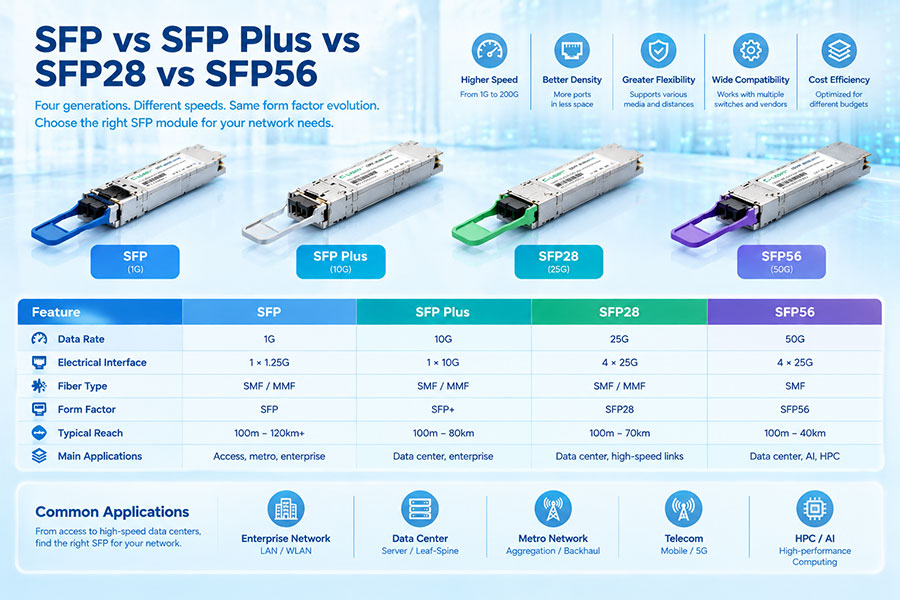
BiDi transceivers are commonly available in SFP, SFP+, and SFP28 form factors, with other configurations available for different network applications. The supported data rate, reach, wavelength pair, connector type, and optical budget depend on the specific module.
2. How Does BiDi Technology Work?
BiDi communication relies on two different wavelengths traveling through the same fiber in opposite directions. This is achieved through wavelength division multiplexing, together with optical components that separate the transmitted and received signals.
Direction A to B
Module A sends an optical signal at its assigned transmit wavelength. The signal travels through the single fiber and is received by Module B at its corresponding receive wavelength.
Direction B to A
Module B simultaneously sends a signal at a different wavelength. Module A receives this signal through the same fiber using its designated receiver channel.
The two optical signals travel in opposite directions, but their wavelengths are different. WDM filters or diplexers inside the transceivers separate the signals and direct them to the appropriate transmitter and receiver components.
For example, a BiDi pair may use 1310nm in one direction and 1550nm in the other. These are illustrative wavelength assignments; actual wavelengths vary by product and transmission standard.
3. Why Do BiDi Transceivers Require a Matched Pair?
BiDi modules are generally designed as complementary pairs. The transmit wavelength of one module must match the receive wavelength of the module at the opposite end, and vice versa.
| Module | Transmit Wavelength | Receive Wavelength | Connection Role |
|---|---|---|---|
| BiDi Module A | 1310nm | 1550nm | Transmits at 1310nm and receives at 1550nm |
| BiDi Module B | 1550nm | 1310nm | Transmits at 1550nm and receives at 1310nm |
In this example, Module A and Module B form a compatible pair because their transmit and receive wavelengths complement each other.
Installing two identical modules with the same wavelength configuration at both ends may prevent the link from operating correctly. The modules must be selected according to their specified A/B wavelength relationship.
4. BiDi vs. Duplex Optical Transceivers
The main difference between BiDi and conventional duplex optical transceivers is how they allocate fiber strands to the transmit and receive directions.
| Feature | BiDi Transceiver | Duplex Transceiver |
|---|---|---|
| Fiber strands | One strand | Two strands |
| Transmission method | Different wavelengths on one fiber | Separate fibers for Tx and Rx |
| Optical interface | Commonly simplex LC | Commonly duplex LC |
| Module pairing | Complementary wavelength pair required | Matching interface and optical specifications required |
| Fiber consumption | Lower for a two-way link | Higher for a two-way link |
| Typical use | Fiber-constrained access and enterprise links | Data centers, enterprise and backbone networks |
BiDi technology can reduce the number of fiber strands needed for a link, but it does not automatically provide a longer transmission distance or higher data rate than a duplex module. Reach and performance depend on the optical design, transmitter output, receiver sensitivity, fiber characteristics, and applicable interface specifications.
5. Common BiDi Optical Transceiver Types
BiDi transceivers are available across several data rates and module form factors. The correct choice depends on the network equipment, required bandwidth, fiber type, and transmission distance.
| Module Type | Common Application | Key Selection Considerations |
|---|---|---|
| 1G BiDi SFP | Enterprise access, switches, and legacy Ethernet links | 1G interface support, wavelength pair, fiber type and reach |
| 10G BiDi SFP+ | Enterprise aggregation and 10G access networks | 10G host compatibility, complementary wavelengths and optical budget |
| 25G BiDi SFP28 | 25G access and selected high-bandwidth enterprise connections | Host port support, signaling requirements and module-specific specifications |
| Higher-rate BiDi solutions | Specialized high-capacity optical networks | Exact optical architecture, lane configuration, wavelength plan and standard |
Not every data rate or form factor has the same BiDi implementation. Higher-speed optical modules may use multiple wavelengths, parallel optical lanes, or other architectures. A module should only be identified as BiDi when its datasheet specifies bidirectional operation over a single fiber.
6. Where Are BiDi Optical Transceivers Used?
BiDi technology is particularly useful when fiber resources are limited, when existing single-fiber infrastructure must be reused, or when reducing fiber consumption can simplify network deployment.
FTTx and access networks: Supports bidirectional connectivity in fiber access environments where efficient use of installed fiber is important.
Enterprise networks: Connects switches, aggregation devices, and remote network equipment over single-fiber links.
Telecommunications infrastructure: Helps operators use existing fiber routes more efficiently for selected point-to-point connections.
Campus networks: Provides connectivity between buildings or network distribution points where fiber availability is constrained.
Industrial networks: Can support fiber links between control rooms, remote cabinets, and industrial Ethernet equipment when the optical specifications are suitable.
BiDi is not necessarily the best choice for every optical network. Duplex links may be more appropriate where fiber is readily available, standardized duplex interfaces are required, or the network design uses optical architectures that do not support single-fiber bidirectional transmission.
7. How to Select the Right BiDi Optical Module
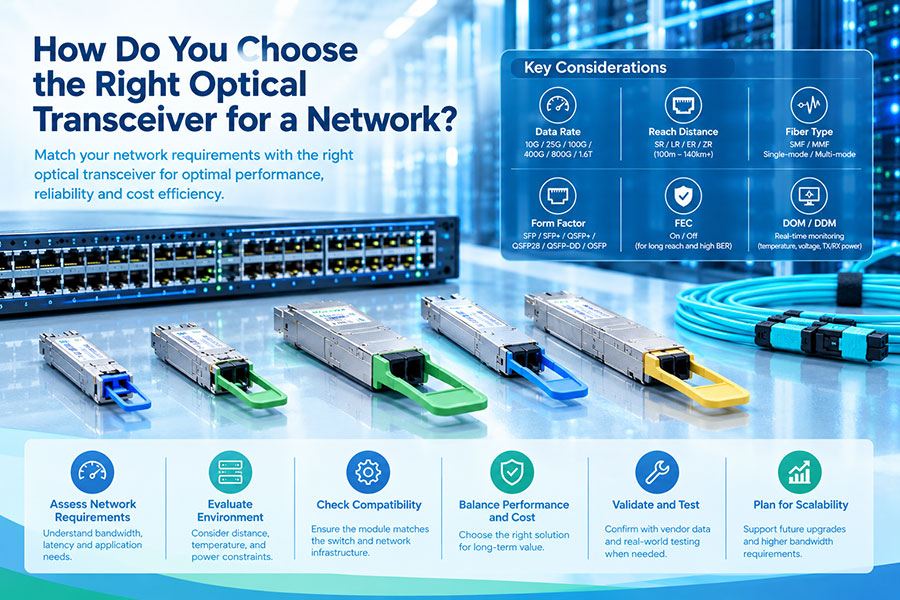
Choosing a BiDi transceiver requires more than matching the nominal data rate. The modules at both ends must form a compatible optical pair and meet the requirements of the host equipment and fiber link.
| Selection Factor | What to Verify |
|---|---|
| Data rate | Confirm that the module speed matches the switch or router port. |
| Wavelength pair | Check that the A/B modules have complementary Tx and Rx wavelengths. |
| Transmission distance | Confirm the specified reach and ensure the link loss remains within the optical budget. |
| Fiber type | Verify single-mode or multimode fiber requirements against the module datasheet. |
| Connector | Check the optical connector type, commonly simplex LC for many BiDi SFP-family products. |
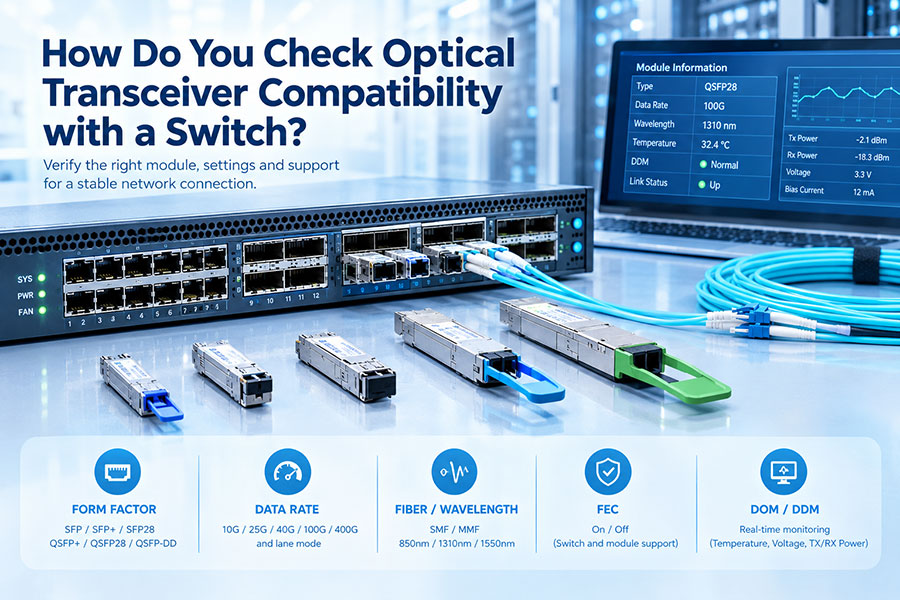
| Host compatibility | Verify form factor, supported port speed, coding and equipment compatibility. |
| Optical budget | Check minimum transmit power, receiver sensitivity, maximum input power and total link loss. |
| Operating environment | Confirm temperature range, power consumption and other deployment requirements. |
For a point-to-point BiDi connection, the two modules should be specified together as a compatible pair. Procurement teams should record both module variants and their wavelength assignments to avoid mixing incompatible units during installation or replacement.
8. Common BiDi Link Problems and Troubleshooting
A BiDi link may fail even when the fiber cable is physically intact. Because both directions share one strand, wavelength pairing, optical condition, and module compatibility all need to be checked.
| Symptom | Possible Cause | Recommended Check |
|---|---|---|
| Link does not come up | Incorrect A/B module pairing | Verify the Tx and Rx wavelength assignments at both ends. |
| Low received optical power | Dirty connectors, excessive loss or damaged fiber | Inspect and clean connectors, then measure optical power and link loss. |
| Intermittent connection | Unstable connector contact, bending or module issues | Check the fiber route, connector condition and module diagnostics. |
| One direction fails | Fault in one transmitter or receiver path | Check the corresponding transmit output and remote receive power. |
| Module is not recognized | Host compatibility, coding or port configuration | Verify the equipment support list and port configuration. |
Digital diagnostics monitoring (DDM/DOM), where supported, can provide useful Tx and Rx power readings, temperature, and supply voltage information. These readings help narrow down possible faults, but calibrated optical test equipment should be used when accurate link-loss measurements are required.
For a more systematic diagnosis, inspect and clean the connector, confirm the complementary wavelength pair, check module recognition, read optical power at both ends, and measure the fiber link loss where necessary. Never look directly into an active optical connector.
9. BiDi Transceivers in Modern Optical Networks
Although high-density data centers increasingly use parallel optics and multi-lane optical interfaces for 400G and 800G connectivity, single-fiber BiDi remains useful in network environments where fiber conservation is a major design consideration.
Different optical technologies serve different deployment requirements:
BiDi transceivers: Use wavelength separation to carry two-way communication over one fiber.
Duplex optical transceivers: Use separate fiber strands for transmit and receive signals.
Parallel optical transceivers: Use multiple optical lanes and fiber paths to achieve higher aggregate bandwidth.
WDM systems: Combine multiple wavelength channels on a fiber infrastructure, with the channel plan and optical components determined by the system design.
For network upgrades, the choice should be based on fiber availability, capacity requirements, equipment support, optical loss, and the planned network architecture rather than fiber count alone.
10. C-LIGHT Optical Transceiver Solutions
C-LIGHT provides optical connectivity products for enterprise networks, telecom infrastructure, and high-speed data center applications. Depending on the deployment architecture, the product portfolio includes SFP-family, QSFP-family, OSFP-family, and other optical transceiver solutions.
SFP and SFP+ Transceivers
Compact optical connectivity options for Ethernet access, enterprise switching, and telecommunications links. BiDi configurations should be specified with the required complementary wavelength pair.
SFP28 Transceivers
25G optical connectivity for supported network equipment and higher-bandwidth access or aggregation applications. Confirm the exact optical interface and wavelength configuration.
400G and 800G Transceivers
High-speed optical connectivity for data center and AI infrastructure, with different SR, DR, FR, and other interface options depending on the required link architecture.
For a BiDi deployment, the key requirement is a correctly matched pair with complementary transmit and receive wavelengths. C-LIGHT can support product selection based on data rate, fiber type, transmission distance, connector interface, and host equipment requirements.
11. Conclusion
A BiDi optical transceiver enables full-duplex communication over a single optical fiber by using different wavelengths for transmission and reception. This reduces fiber consumption and makes better use of existing infrastructure in access, enterprise, and telecommunications networks.
Successful deployment depends on selecting complementary A/B modules, matching the optical specifications to the fiber link, and confirming host equipment compatibility. With the correct wavelength pairing and link budget, BiDi technology provides a practical option for two-way optical connectivity where fiber resources are limited.
Share your required data rate, transmission distance, fiber type, wavelength pair, and equipment model to identify an appropriate optical solution.
Contact C-LIGHT >

 >
 >
 >
 >
 >
 >
 >