TEL:+86 132 6656 7067





As global data traffic continues its exponential growth—fueled by cloud computing, 5G network expansion, artificial intelligence workloads, and the proliferation of data centers—optical networking infrastructure has become more critical than ever. At the heart of this infrastructure lies Wavelength Division Multiplexing (WDM) technology, a fundamental approach that multiplies fiber capacity by enabling multiple optical signals at different wavelengths to be transmitted simultaneously over a single fiber. This article provides a comprehensive overview of the global WDM equipment market, examining its current size, growth trajectory, key drivers, competitive landscape, and emerging trends, with a focused look at C-LIGHT, a manufacturer of optical transceivers and WDM solutions.
Market Overview and Size
The global Wavelength Division Multiplexing equipment market is experiencing robust growth across multiple market analyses. According to research from 360iResearch, the market was valued at approximately USD 5.26 billion in 2025 and is projected to reach USD 5.71 billion in 2026, growing at a compound annual growth rate (CAGR) of 9.24% to reach USD 9.77 billion by 2032. A separate analysis by LP Information estimates the broader global WDM equipment market will grow from USD 24.87 billion in 2025 to USD 44.03 billion by 2031, reflecting a CAGR of 10.0%. Market Signals Report similarly projects the global WDM equipment market at approximately USD 44.13 billion in 2025, with an anticipated CAGR of 9.6% through 2033.
Within the WDM ecosystem, Dense Wavelength Division Multiplexing (DWDM)—the higher-capacity variant of the technology—represents a substantial and fast-growing segment. The global DWDM equipment market grew from USD 9.85 billion in 2025 to USD 10.84 billion in 2026 and is expected to reach USD 20.85 billion by 2032 at a CAGR of 11.30%. Meanwhile, Fortune Business Insights reports that the broader DWDM market was valued at USD 13.87 billion in 2025 and is projected to grow to USD 28.24 billion by 2034, with a CAGR of 8.30%, and notes that the Asia-Pacific region dominated the market with a 39.50% share in 2025.
The optical transport equipment market as a whole—of which WDM equipment is a key component—grew 10% in 2025, reaching approximately USD 16 billion, driven largely by demand for data center interconnect (DCI).
Key Market Drivers
●Data Center Interconnect (DCI) and Cloud Expansion
The most powerful growth engine for the WDM equipment market is the surging demand for data center interconnect solutions. According to Dell‘Oro Group, revenue from direct purchases of WDM equipment for DCI grew nearly 40% in 2025. Cloud provider direct purchases increased around 50% in the same year as hyperscalers and neo-clouds aggressively expanded their optical infrastructure.
This trend is intimately tied to the rise of generative AI, which demands massive data transfer between AI training clusters and inference nodes. As cloud providers build scale-out DCI networks to support distributed AI data centers, demand for high-capacity WDM solutions continues to intensify. The global data center capacity is projected to double over the next five years, according to Moody’s ratings, further accelerating WDM equipment adoption.
●5G Network Deployment
The ongoing global rollout of 5G networks represents another major demand driver. 5G architectures—particularly Centralized Radio Access Networks (C-RAN)—require dense fiber connectivity between distributed units (DUs) and active antenna units (AAUs). WDM technology enables multiple optical signals to share a single fiber, significantly reducing fiber consumption while maintaining the high capacity and low latency demanded by 5G fronthaul applications. The integration of 5G networks with DWDM systems enables service providers to efficiently scale transport capacity while minimizing fiber deployment costs.
●Technological Innovations
Several technological trends are reshaping the WDM equipment landscape. The migration toward disaggregated WDM architectures—where transponder units, optical line systems, and control layers are decoupled—has been particularly noteworthy. The disaggregated WDM market grew approximately 40% in 2025, exceeding expectations across all technology segments. This approach gives network operators greater vendor choice and more flexible upgrade paths.
Additionally, the adoption of IP over DWDM (IPoDWDM) and ZR/ZR+ pluggable optics is accelerating, with the global IP-over-DWDM pluggable market expected to grow at a CAGR of 15.8% from 2025 to 2031. Coherent optical technology, once confined to long-haul chassis applications, is now common across metro and regional routes, enabling operators to unify design principles while tailoring reach and spectral efficiency to each network segment.
The transition from fixed-grid DWDM to Flexible Grid (FlexGrid) technology further multiplies channel density and supports dynamic allocation of spectral bandwidth, addressing capacity bottlenecks while aligning with broader trends toward network automation and programmability.
Regional Dynamics
The WDM equipment market exhibits distinct regional characteristics. Asia-Pacific leads the global market with a 39.50% share as of 2025, driven by massive 5G deployments in China, South Korea, and Japan, as well as rapid data center construction across the region. North America follows closely, benefiting from concentrated hyperscaler investments in DCI infrastructure and early adoption of AI-driven networking. Europe maintains steady growth as service providers upgrade legacy networks and deploy fiber-to-the-home initiatives.
The implementation of U.S. tariff measures in 2025 targeting imported optical components has injected policy-driven complexity into the supply chain, compelling market participants to reevaluate manufacturing footprints and supplier risk management strategies. These trade dynamics are reshaping sourcing decisions and could influence regional market share distributions over the forecast period.
Competitive Landscape
The WDM equipment market is characterized by a mix of established telecommunications equipment giants and specialized optical networking vendors. According to Dell‘Oro Group, the top five system vendors by revenue share in 2025 were Huawei, Ciena, Nokia, ZTE, and Cisco. For DCI specifically, the top three suppliers were Ciena, Nokia, and Cisco, with a high concentration of revenue coming from North America.
Other significant players in the global WDM equipment landscape include ADVA Optical Networking, Infinera, Fujitsu, and FiberHome. The market has seen notable vendor gains in specific quarters; for example, Ciena and Nokia each gained more than one percentage point of market share in Q3 2025.
The competitive dynamics are increasingly shaped by the shift toward open, interoperable ecosystems, with cloud providers and communication service providers alike demanding vendor-neutral platforms that support automation and rapid capacity expansion.
Focus on C-LIGHT: Product Portfolio and Market Positioning
Amidst the market leaders, specialized optical component manufacturers play a vital role in the WDM ecosystem. C-LIGHT founded in 2011, is a professional high-end optical transmission module supplier with over 15 years of industry experience, focusing on the development and production of active optical modules, optical passive devices, and data exchange equipment.
DWDM DCO Coherent Transceivers
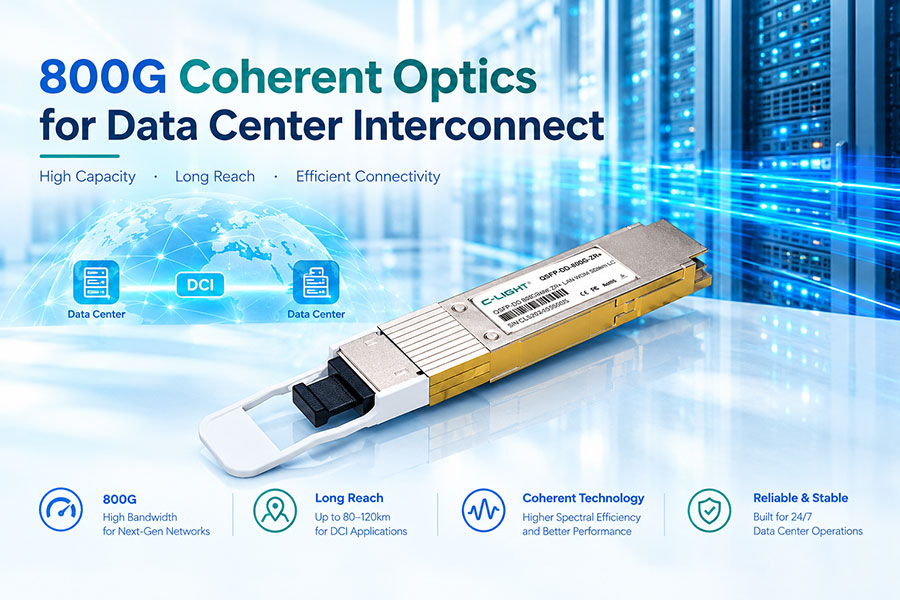
C-LIGHT offers a comprehensive portfolio of DWDM DCO (Digital Coherent Optics) coherent transceiver products, covering data rates from 100G to 800G. This integrated wavelength division solution combines high-capacity transmission with intelligent control, enabling dynamic software-based adjustment of optical signals and allowing multiple high-speed channels to be transmitted simultaneously over a single fiber for ultra-long-haul data transport.
Key products in this lineup include the 800G DCO QSFP-DD and 800G DCO CFP2 transceivers supporting transmission distances up to 500km; 400G DCO QSFP-DD modules with reach options from 120km to 450km; 200G DCO solutions capable of 2,000km transmission; and 100G DCO QSFP28 modules supporting 120km Open ZR applications. These modules operate in the C-Band DWDM tunable range and utilize advanced modulation formats including 16QAM and QPSK.
Notably, C-LIGHT‘s 400G ZR DWDM optical transceivers are specifically designed for DCI applications, offering 120km transmission distance with low power consumption (≤18W), providing cost-saving IP-over-DWDM solutions for AI, cloud, and 5G networks.
DWDM MUX/DeMUX Passive Components
Complementing its active transceiver portfolio, C-LIGHT produces DWDM multiplexers and demultiplexers (MUX/DeMUX)—core capacity-expanding components in optical fiber networks. These devices multiplex dozens to hundreds of optical signals with different wavelengths onto a single fiber, overcoming the capacity limits of traditional fiber infrastructure.
C-LIGHT’s DWDM MUX/DeMUX products support C/L bands, flexible grid (Flex Grid) technology, and high channel density (96+ wavelengths), delivering terabit-level, low-latency transmission for DCI, 5G transport networks, and backbone networks. The product lineup spans configurations from 4-channel to 64-channel systems in both single-fiber and dual-fiber variants, with various form factors including 1U rack-mount, LGX, and ABS enclosures.
5G Fronthaul WDM Solutions
C-LIGHT has also developed specialized WDM equipment for 5G fronthaul applications. The company‘s 5G fronthaul semi-active wavelength division equipment addresses the challenges of limited optical cable resources, long construction periods, and high costs associated with direct fiber connections between DUs and AAUs in 5G C-RAN architectures.
The solution employs active WDM equipment on the DU side and a passive wavelength division multiplexer plus colored optical modules on the AAU side, forming a unified, manageable fronthaul network. It supports IP-based Web management and Netconf/Yang-based unified management for operators, facilitating cost reduction, high reliability, and rapid 5G network deployment.
Market Positioning and Differentiators
C-LIGHT positions itself as a reliable supplier of optical transmission products with competitive advantages including a 3-year warranty, professional technical support, 100% product testing, and readily available spot stock with short delivery times. The company’s product breadth—spanning 800G, 2×400G, 400G, 200G, 100G, 50G, 40G, 25G, 10G, and legacy rates—positions it to serve diverse customer requirements across telecom, data center, and enterprise networking segments.
While C-LIGHT operates in the optical components and modules space rather than the full WDM systems market dominated by Huawei, Ciena, and Nokia, its coherent transceiver portfolio and passive WDM devices address critical needs in the disaggregated WDM ecosystem, particularly as network operators increasingly embrace open, multi-vendor architectures.
Future Outlook
The WDM equipment market is poised for sustained growth through 2032 and beyond, underpinned by several enduring trends:
AI-driven data center expansion: As generative AI workloads proliferate, demand for high-bandwidth, low-latency optical interconnects between distributed data centers will continue to accelerate, driving adoption of DWDM and coherent optical technologies.
5G-Advanced and 6G preparation: Next-generation mobile networks will demand even greater fiber densification and transport capacity, sustaining demand for WDM fronthaul and backhaul solutions.
Network automation and programmability: The shift toward software-defined optical networking and intent-driven operations will favor flexible, programmable WDM equipment that supports dynamic wavelength provisioning and multi-layer optimization.
Sustainability and energy efficiency: Operators are increasingly prioritizing power-efficient optical solutions to meet sustainability targets, favoring coherent pluggables and integrated WDM systems with lower per-bit energy consumption.
The market is forecast to grow at approximately 10% in 2026, with DCI-related revenue continuing to outpace the broader market. As optical networking technology evolves from fixed-grid DWDM to flexible, software-defined architectures, the WDM equipment market will remain a cornerstone of global telecommunications and data infrastructure.
Conclusion
The global Wavelength Division Multiplexing equipment market is entering a period of accelerated growth, driven by the convergence of cloud computing, AI workloads, 5G expansion, and the insatiable demand for data center interconnect capacity. With market valuations ranging from USD 5.26 billion to over USD 44 billion depending on scope and methodology, and projected CAGRs between 8% and 11%, the sector presents substantial opportunities for established systems vendors and specialized component suppliers alike.
Companies like C-LIGHT, with focused expertise in DWDM coherent transceivers, passive MUX/DeMUX components, and 5G fronthaul WDM solutions, are well-positioned to capitalize on the disaggregated WDM trend and the growing demand for interoperable, high-performance optical modules. As the industry continues its transformation toward open, automated, and energy-efficient optical networks, WDM technology will remain indispensable to the global connectivity fabric.
 >
>

 >
>
 >
>
 >
>
 >
>
 >
>
 >
>
 >
>