TEL:+86 132 6656 7067





Twinax and fiber optic cables are two widely used transmission media in data center networks. Twinax cables carry electrical signals through shielded copper conductors, while fiber optic cables transmit data as light through optical fibers. Both support high-speed connectivity, but their transmission distance, physical structure, power requirements, and deployment costs are different.
Twinax is commonly used in Direct Attach Copper (DAC) assemblies for short connections between switches, servers, and storage systems. Fiber optic cables support a much wider range of distances and are widely deployed in connections between racks, network rooms, and data center facilities.
The choice between them depends on link distance, port speed, cable density, installation requirements, and the overall cost of the network.
1. What Is a Twinax Cable?
Twinax, short for twinaxial cable, is a type of shielded copper cable containing two central conductors within a common shielding structure. The conductors carry differential electrical signals, while the shielding helps reduce electromagnetic interference and unwanted signal coupling.
In data center networking, Twinax is widely used in Direct Attach Copper (DAC) cable assemblies. A DAC typically has factory-terminated pluggable connectors at both ends, allowing it to connect directly to compatible switch, server, or storage ports without separate optical transceivers.
Twinax DAC assemblies are available in passive and active versions:
Passive DAC: Carries electrical signals directly through the copper cable without active signal-conditioning circuitry in the assembly.
Active DAC: Uses electronic components to condition or improve the electrical signal, allowing certain designs to support greater distances than passive DAC.
Twinax is particularly suitable for short, high-speed connections where low power consumption, low latency, and cost efficiency are important.
2. What Is a Fiber Optic Cable?
A fiber optic cable transmits information through light rather than electrical current. Its optical fibers consist of a glass or plastic core surrounded by cladding, with protective coatings and cable structures designed to protect the fibers during installation and operation.
Fiber optic connectivity is commonly divided into two categories:
2.1 Multimode Fiber (MMF)
Multimode fiber has a relatively large core and is commonly used for short-reach optical connections inside data centers. It supports optical technologies such as SR and SR4/SR8 interfaces, depending on the transceiver design.
2.2 Single-Mode Fiber (SMF)
Single-mode fiber has a smaller core and is designed to support optical transmission over longer distances. It is widely used in DR, FR, LR, and coherent optical applications, depending on the transceiver and network architecture.
Fiber connectivity can use separate optical transceivers and fiber patch cords, or an integrated Active Optical Cable (AOC). An AOC combines optical fibers and permanently attached active optical components into one cable assembly.
3. Twinax vs. Fiber Optic Cables: Key Differences
The main difference is the transmission medium: Twinax uses electrical signals over copper, while fiber optic cables use light. This fundamental distinction affects the distance, power, weight, electromagnetic characteristics, and installation requirements of each solution.
| Comparison | Twinax Cable | Fiber Optic Cable |
|---|---|---|
| Transmission medium | Electrical signals | Optical signals |
| Core material | Copper conductors | Glass or plastic optical fibers |
| Typical application | Short-reach direct connections | Short-, medium-, and long-reach links |
| Distance capability | Generally limited by copper signal loss | Depends on fiber type and optical interface |
| Power consumption | Very low for passive DAC | Optical transceivers or AOC ends require power |
| Electromagnetic interference | Shielding reduces interference | Immune to electromagnetic interference in the fiber medium |
| Cable size and weight | Generally thicker and heavier | Generally thinner and lighter at comparable link capacities |
| Latency | Very low | Very low; depends on the complete link architecture |
| Initial link cost | Generally lower for short links | Varies with optics, fiber, and reach |
| Installation | Simple direct connection | Requires suitable optical connectors and fiber handling |
These are general characteristics rather than fixed performance limits. Actual reach, power, and cost depend on the data rate, cable construction, transceiver type, and equipment platform.
4. Transmission Distance: Twinax vs. Fiber
Transmission distance is one of the most important factors when choosing between Twinax and fiber optic cables.
4.1 Twinax Transmission Distance
Twinax DAC is designed primarily for short connections. Passive copper assemblies commonly support distances of a few meters, with the exact maximum depending on the data rate, cable gauge, connector design, and host platform.
At higher data rates, electrical insertion loss and signal integrity limitations become more significant. Consequently, some high-speed DAC products have shorter supported lengths than earlier-generation products.
Active copper designs can extend the usable distance by incorporating signal-conditioning electronics, but their supported reach remains product-specific.
4.2 Fiber Optic Transmission Distance
Fiber optic links support a broader range of distances. Multimode solutions are commonly used for short-reach data center connections, while single-mode solutions support applications ranging from hundreds of meters to several kilometers or more, depending on the optical interface.
| Connection Type | Transmission Medium | Typical Application |
|---|---|---|
| Passive DAC | Twinax copper | Short in-rack connections |
| Active DAC | Twinax copper | Short-to-intermediate copper connections |
| SR optical transceiver | Multimode fiber | Short-reach optical links |
| DR optical transceiver | Single-mode fiber | Data center links around 500m, depending on specification |
| FR optical transceiver | Single-mode fiber | Links around 2km, depending on specification |
| LR optical transceiver | Single-mode fiber | Links around 10km, depending on specification |
The distances above are common application categories, not universal guarantees. The exact reach must be confirmed from the selected transceiver's specifications and the complete optical channel design.
5. Power Consumption and Latency
Power consumption and latency are important considerations in high-density data center environments, particularly when large numbers of high-speed connections operate simultaneously.
5.1 Power Consumption
Passive Twinax DAC does not require active signal conversion within the cable assembly, making its power consumption extremely low. This is one reason passive DAC is attractive for short server-to-switch connections.
Active DAC requires power for its signal-conditioning components. Fiber-based connections also require powered optical components. An AOC integrates optical conversion electronics into its connector ends, while a conventional optical link uses separate pluggable transceivers.
The actual power difference depends on the specific cable and optical module. It is important to compare the complete link rather than treating all copper or fiber solutions as having identical power requirements.
5.2 Latency
Passive Twinax DAC provides a direct electrical connection with very low propagation delay and no optical-electrical conversion inside the cable assembly.
Fiber optic transmission also has very low propagation delay. AOC and separate optical transceiver links introduce additional electronic and optical conversion stages, although the overall latency remains very low in typical data center applications.
For latency-sensitive connections, the complete system architecture and equipment specifications matter more than the transmission medium alone.
6. Electromagnetic Interference and Signal Integrity
Twinax and fiber optic cables behave differently in environments with electromagnetic interference.
6.1 Twinax Shielding
Twinax cables use shielding to reduce external electromagnetic interference and limit signal coupling. Proper cable construction and grounding are important for maintaining signal integrity.
However, copper remains an electrical transmission medium. Its performance can be affected by insertion loss, crosstalk, impedance discontinuities, and installation conditions.
6.2 Fiber's Immunity to Electromagnetic Interference
Optical fiber carries information through light and does not conduct electrical signals along the fiber itself. This makes the transmission medium immune to electromagnetic interference.
Fiber is particularly useful in electrically noisy environments, between equipment areas, and in installations where electrical isolation is required.
7. Cable Size, Weight, and Installation
Physical characteristics become increasingly important as data center port density grows and cable pathways become more crowded.
7.1 Twinax Cable Construction
Twinax DAC cables generally use thicker copper conductors and shielding. At high data rates, the cable may become relatively stiff and heavy, particularly when multiple connections are bundled together.
This can make cable routing and airflow management more challenging in densely populated racks.
7.2 Fiber Optic Cable Construction
Fiber optic cables are generally lighter and more flexible than comparable high-speed copper assemblies. They can help reduce cable congestion and simplify routing across larger installations.
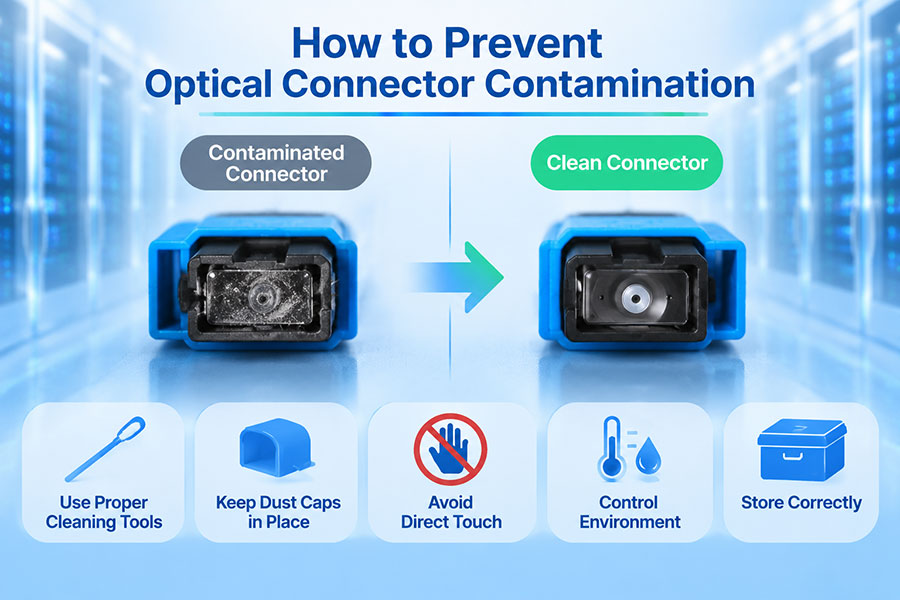
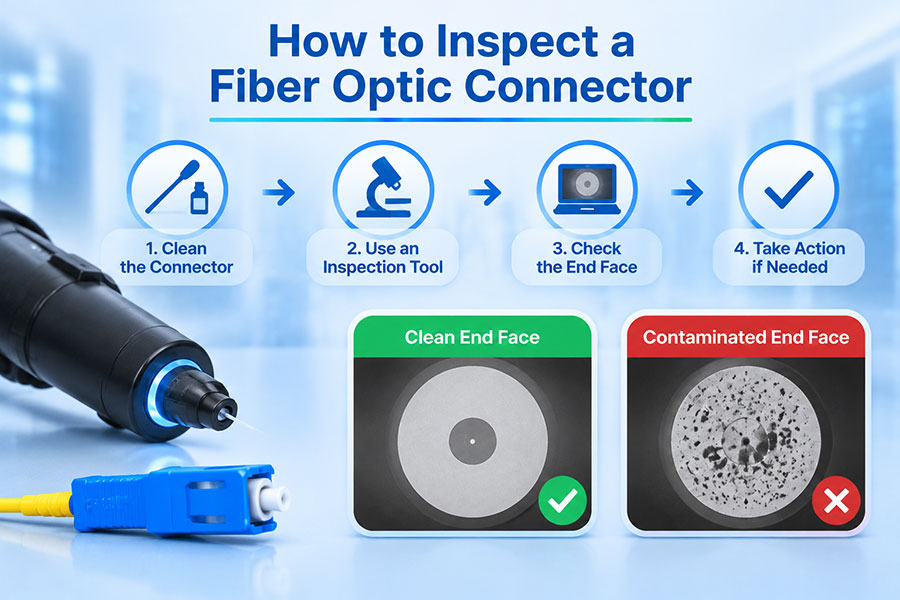
However, fiber requires proper handling. Excessive bending, connector contamination, and physical damage can affect optical performance. Appropriate bend radius and connector cleaning procedures should be followed.
8. Cost Comparison: Twinax vs. Fiber Optic Cables
Twinax DAC is generally the more economical option for short-distance high-speed connections. It combines the cable and connectors into one factory-terminated assembly and does not require separate optical transceivers.
Fiber optic connectivity has a more varied cost structure. A conventional fiber link may require two compatible optical transceivers and a fiber patch cord. An AOC combines the optical components and fiber into one assembly, which can simplify installation and reduce component handling.
| Cost Factor | Twinax DAC | AOC | Separate Optics + Fiber |
|---|---|---|---|
| Cable assembly | Generally low | Moderate | Separate fiber cable |
| Optical transceivers | Not required separately | Integrated into cable ends | Required at both ends |
| Power requirements | Lowest for passive DAC | Active components require power | Depends on optical modules |
| Long-distance suitability | Limited | Product-dependent | Broad range of options |
| Maintenance flexibility | Replace the complete assembly | Replace the complete assembly | Fiber and transceivers can be replaced separately |
For very short links, DAC often offers the lowest total cost. For longer links or structured fiber installations, optical connectivity may provide better flexibility and overall network economics.
9. DAC vs. AOC: Understanding the Difference
DAC and AOC are two common integrated cable solutions used in data center networks. Although they may have similar connector form factors, their internal transmission technologies are different.
9.1 Direct Attach Copper (DAC)
DAC uses Twinax copper conductors to transmit electrical signals between two compatible ports. The pluggable connector assemblies are attached to both ends of the copper cable.
Passive DAC is particularly suitable for short connections between switches and servers within the same rack. Active DAC can support additional reach where the platform and cable specification allow it.
9.2 Active Optical Cable (AOC)
AOC uses optical fiber to transmit data between integrated active optical components at both ends. Electrical signals are converted into optical signals at the transmitting end and converted back at the receiving end.
AOC is suitable for connections that exceed the practical reach of DAC or require thinner, lighter cabling. It is commonly used for cross-rack connections and high-density network installations.
C-LIGHT offers both DAC cable solutions and AOC cable solutions for different data center interconnect requirements.
10. When Should You Choose Twinax or Fiber Optic Cables?
The appropriate choice depends on the physical layout, supported transmission distance, data rate, and equipment requirements.
10.1 Choose Twinax DAC When:
The connection is between devices in the same rack or within a supported short distance.
Low power consumption is a priority.
Low cable cost is important.
The switch and server support the selected DAC type and length.
The installation can accommodate the cable's thickness and weight.
10.2 Choose Fiber Optic Connectivity When:
The connection distance exceeds the supported reach of copper.
Devices are located in different racks or network areas.
Electromagnetic interference immunity is required.
Lower cable weight and improved routing flexibility are important.
The network requires single-mode or multimode optical transmission.
The installation needs a structured fiber infrastructure with separately replaceable transceivers and patch cords.
11. Twinax and Fiber Optic Solutions from C-LIGHT
C-LIGHT provides high-speed connectivity solutions for data centers, enterprise networks, AI infrastructure, and high-performance computing environments.
The C-LIGHT DAC product range includes copper interconnect options for short-reach connections between compatible switches, servers, and storage systems. These solutions are suitable for applications where low power consumption and cost-efficient connectivity are important.
For installations requiring optical transmission, the C-LIGHT AOC product range provides integrated active optical cable solutions for high-speed data center connections.
C-LIGHT also offers high-speed optical transceivers and fiber connectivity products for different transmission distances and network architectures. The appropriate solution should be selected according to port compatibility, data rate, cable length, fiber type, and application requirements.
12. Conclusion
Twinax and fiber optic cables serve different roles in modern data center networks. Twinax carries electrical signals through shielded copper conductors and is particularly effective for short-distance connections where low power consumption, low latency, and low cost are priorities.
Fiber optic cables transmit data through light and support a wider range of distances. They also provide immunity to electromagnetic interference, lower cable weight, and greater flexibility for structured network installations.
For short in-rack connections, Twinax DAC is often a practical choice. For longer links, cross-rack connectivity, and higher-density fiber infrastructure, optical solutions such as AOC or separate transceivers with fiber patch cords are generally more suitable.
 >

 >
 >
 >
 >
 >
 >
 >