TEL:+86 132 6656 7067




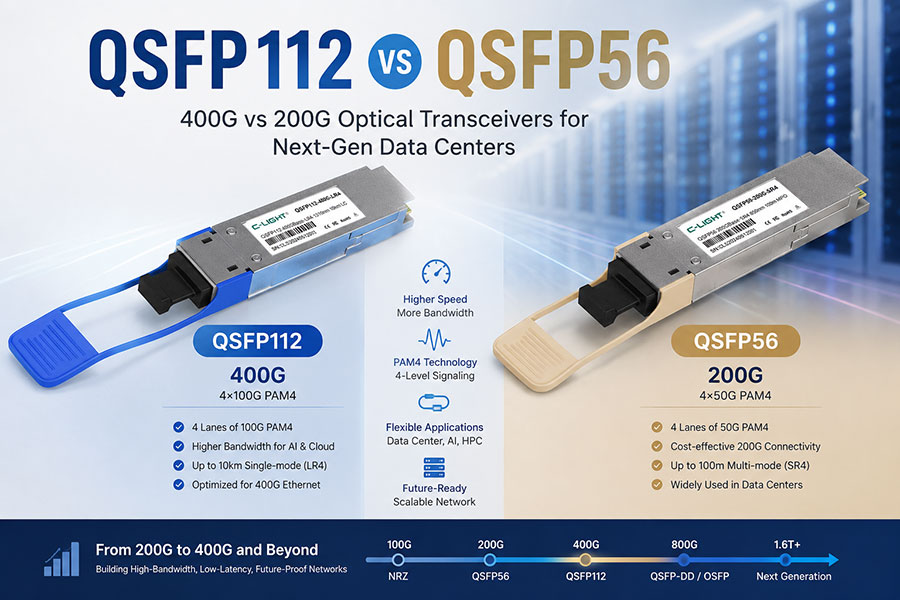
QSFP112 and QSFP56 are high-speed optical transceiver form factors used in data center and Ethernet networking. Both are based on the compact QSFP family and commonly use PAM4 signaling, but they target different bandwidth generations.
QSFP56 is primarily associated with 200G connectivity, while QSFP112 is designed for 400G connectivity. The main difference is the electrical lane rate: QSFP56 commonly uses four 50G-class PAM4 lanes, while QSFP112 uses four 100G-class PAM4 lanes. This allows QSFP112 to provide approximately twice the aggregate bandwidth in the same general QSFP-style module category.
1. What Is QSFP56?
200G QSFP56 Optical Transceiver | 200G SR4 PAM4 Module
QSFP56 is a high-speed QSFP form factor commonly used for 200G optical transceivers and active or passive interconnects. A typical 200G QSFP56 implementation uses four PAM4 lanes, with each lane operating at approximately 50Gbps at the data rate level.
Compared with earlier NRZ-based 100G solutions, PAM4 allows more bits to be transmitted per symbol, making higher bandwidth possible without simply doubling the number of electrical lanes.
QSFP56 is widely used in data center networks, high-performance computing, InfiniBand environments, and 200G Ethernet connectivity.
2. What Is QSFP112?
400G QSFP112 LR4/FR4/DR4/SR4 Optical Transceiver丨AI Data Center Networks丨C-LIGHT
QSFP112 is a higher-speed QSFP form factor designed for 400G-class connectivity. A common QSFP112 optical architecture uses four 100G-class PAM4 lanes to reach an aggregate 400G data rate.
For example, a 400G QSFP112 FR4 transceiver can use four 106.25Gbps PAM4 channels and operate over single-mode fiber for distances of up to 2km, depending on the specific product design and optical standard.
QSFP112 is therefore an important technology for 400G Ethernet, AI data center networking, high-performance computing, and high-density switch connections.
3. QSFP112 vs QSFP56: Main Differences
| Feature | QSFP56 | QSFP112 |
|---|---|---|
| Typical Aggregate Rate | 200G | 400G |
| Typical Lane Configuration | 4 × 50G-class PAM4 | 4 × 100G-class PAM4 |
| Signaling | PAM4 | PAM4 |
| Bandwidth Generation | 200G | 400G |
| Typical Applications | 200G Ethernet, HPC, AI and InfiniBand | 400G Ethernet, AI data centers, HPC and high-density networking |
| Fiber Options | Multimode and single-mode solutions | Multimode and single-mode solutions |
4. QSFP56 and QSFP112 PAM4 Technology
PAM4 is an important common technology between QSFP56 and QSFP112. PAM4 uses four signal levels and carries two bits per symbol, allowing a higher data rate per lane than traditional two-level NRZ signaling.
In a typical 200G QSFP56 architecture, four 50G-class PAM4 lanes are combined to provide approximately 200G aggregate bandwidth. In a typical 400G QSFP112 architecture, four 100G-class PAM4 lanes provide approximately 400G aggregate bandwidth.
The transition from QSFP56 to QSFP112 therefore represents not only an increase in total bandwidth but also a significant increase in the electrical and optical performance requirements of each lane.
5. QSFP56 vs QSFP112: Lane Rate
The lane rate is one of the most important differences between the two technologies.
QSFP56 commonly uses four 50G PAM4 lanes:
4 × 50G = 200G
QSFP112 commonly uses four 100G-class PAM4 lanes:
4 × 100G = 400G
Actual line rates can be higher than the nominal payload rate because Ethernet systems may include coding and FEC overhead. For example, many 400G QSFP112 implementations specify 106.25Gbps per lane.
6. Optical Applications of QSFP56
6.1 200G Data Center Networking
QSFP56 is commonly used for 200G server-to-switch and switch-to-switch connectivity. It can provide a practical bandwidth upgrade for networks moving beyond 100G.
6.2 High-Performance Computing
HPC environments require high-bandwidth connections between compute nodes, storage systems, and network switches. 200G QSFP56 solutions can be used where 200G-class connectivity is sufficient for the required network architecture.
6.3 AI and Accelerator Networks
QSFP56 can also be found in accelerator and AI networking environments, particularly in systems using 200G links or breakout architectures. Its relatively mature ecosystem makes it useful for existing 200G infrastructure.
7. Optical Applications of QSFP112
7.1 400G Ethernet
400G QSFP112 transceivers are designed for high-bandwidth Ethernet connections in modern data centers. Common optical variants include SR4, DR4, FR4 and LR4, with different fiber types and transmission distances.
7.2 AI Data Centers
AI clusters generate significant east-west traffic between GPUs, switches, storage systems, and other computing resources. 400G QSFP112 solutions provide higher bandwidth per port and can help increase network capacity in these environments.
7.3 High-Density Switches
QSFP112 allows switch designers to provide 400G connectivity using a compact QSFP-family form factor. This can help increase aggregate switch capacity while maintaining a high port density.
8. QSFP112 vs QSFP56 Optical Reach
Neither QSFP56 nor QSFP112 defines a single transmission distance. The actual reach depends on the optical variant, wavelength, fiber type, connector, optical components, and link budget.
For example, QSFP56 products can include short-reach multimode solutions as well as longer-reach single-mode solutions. QSFP112 products similarly include short- and medium-reach options such as SR4, DR4 and FR4, as well as longer-reach configurations.
Therefore, QSFP112 should not automatically be considered a longer-distance technology than QSFP56. The primary difference is the bandwidth generation and per-lane signaling rate.
9. QSFP112 vs QSFP56 Compatibility
QSFP112 and QSFP56 should not be considered automatically interchangeable simply because they belong to the QSFP family.
The host electrical interface, lane rate, module management, switch ASIC capabilities, firmware, and optical configuration all need to be considered. Some QSFP112 platforms can support lower-speed QSFP-family modules, but compatibility depends on the specific switch and module implementation.
For a network upgrade, the safest approach is to verify the switch port specification, supported module types, electrical lane configuration, firmware requirements, and optical link budget before deployment.
10. QSFP56 to QSFP112 Network Evolution
The move from QSFP56 to QSFP112 represents a straightforward bandwidth-generation progression from 200G toward 400G.
A simplified evolution can be represented as:
100G → 200G QSFP56 → 400G QSFP112 → 800G QSFP-DD / OSFP → 1.6T
This progression is driven by increasing bandwidth requirements from cloud computing, AI clusters, high-performance computing, and high-density Ethernet networks.
QSFP112 is particularly important because it increases the bandwidth per optical module while retaining the compact QSFP-style form factor, making it suitable for high-density 400G network deployments.
11. QSFP112 vs QSFP56: Which One Should You Choose?
The choice depends primarily on the required network bandwidth and host platform.
Choose QSFP56 when a 200G link is sufficient and the existing switch or network architecture is designed for 200G connectivity.
Choose QSFP112 when 400G bandwidth is required and the switch platform supports 400G QSFP112 modules.
For AI data centers, QSFP112 can provide higher bandwidth per port for 400G network architectures.
For network upgrades, check host compatibility, optical reach, fiber type, connector configuration, power consumption, and link budget before selecting the module.
12. QSFP112 and QSFP56 in AI Data Centers
AI networking is increasing the demand for higher-speed optical connectivity. 200G QSFP56 remains relevant for existing infrastructure and specific accelerator networking architectures, while 400G QSFP112 provides greater bandwidth for newer high-density deployments.
The two technologies can therefore coexist during network upgrades. QSFP56 can continue serving 200G links, while QSFP112 can be introduced where 400G connectivity is required.
13. C-LIGHT High-Speed Optical Transceiver Solutions
C-LIGHT provides optical transceiver solutions covering multiple data rates and form factors for data center and high-speed networking applications.
The product portfolio includes 200G-class and 400G-class optical connectivity solutions, allowing network designers to select modules according to bandwidth, transmission distance, fiber type, connector, host platform, and application requirements.
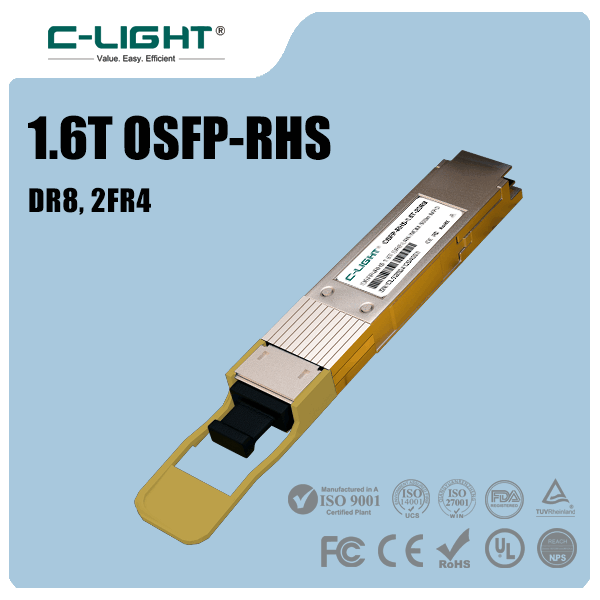
For higher-speed network architectures, C-LIGHT also develops 800G and 1.6T optical transceiver solutions to support the continued evolution of AI and data center optical connectivity.
14. Frequently Asked Questions
Q1: What is the main difference between QSFP112 and QSFP56?
Answer: QSFP56 is commonly used for 200G connectivity with four 50G-class PAM4 lanes, while QSFP112 is commonly used for 400G connectivity with four 100G-class PAM4 lanes.
Q2: Are QSFP112 and QSFP56 both PAM4?
Answer: Yes. Many common QSFP56 and QSFP112 optical transceivers use PAM4 signaling. Their main difference is the signaling rate per lane and the resulting aggregate bandwidth.
Q3: Is QSFP112 twice as fast as QSFP56?
Answer: In common implementations, yes. QSFP56 is associated with 200G aggregate bandwidth, while QSFP112 is associated with 400G aggregate bandwidth.
Q4: Is QSFP112 compatible with QSFP56?
Answer: Compatibility depends on the host platform and module implementation. The fact that both use the QSFP family form factor does not guarantee electrical or operational interoperability.
Q5: What comes after QSFP112?
Answer: Higher-speed technologies such as 800G QSFP-DD and OSFP, followed by 1.6T solutions, are part of the industry's continuing bandwidth evolution.
15. Summary
QSFP56 and QSFP112 represent two important generations of high-speed optical connectivity. QSFP56 is mainly associated with 200G networking and four 50G-class PAM4 lanes, while QSFP112 is designed for 400G networking using four 100G-class PAM4 lanes.
The upgrade from QSFP56 to QSFP112 increases bandwidth per port and supports the requirements of modern data center, AI, HPC, and high-density Ethernet networks. When selecting between them, network designers should evaluate bandwidth, host compatibility, optical reach, fiber type, connector, power consumption, and link requirements rather than relying only on the module form factor.
 >
>

 >
>
 >
>
 >
>
 >
>
 >
>
 >
>
 >
>